Marketing Conversion Rate Formula: The Complete Guide (2026)
Key Takeaways
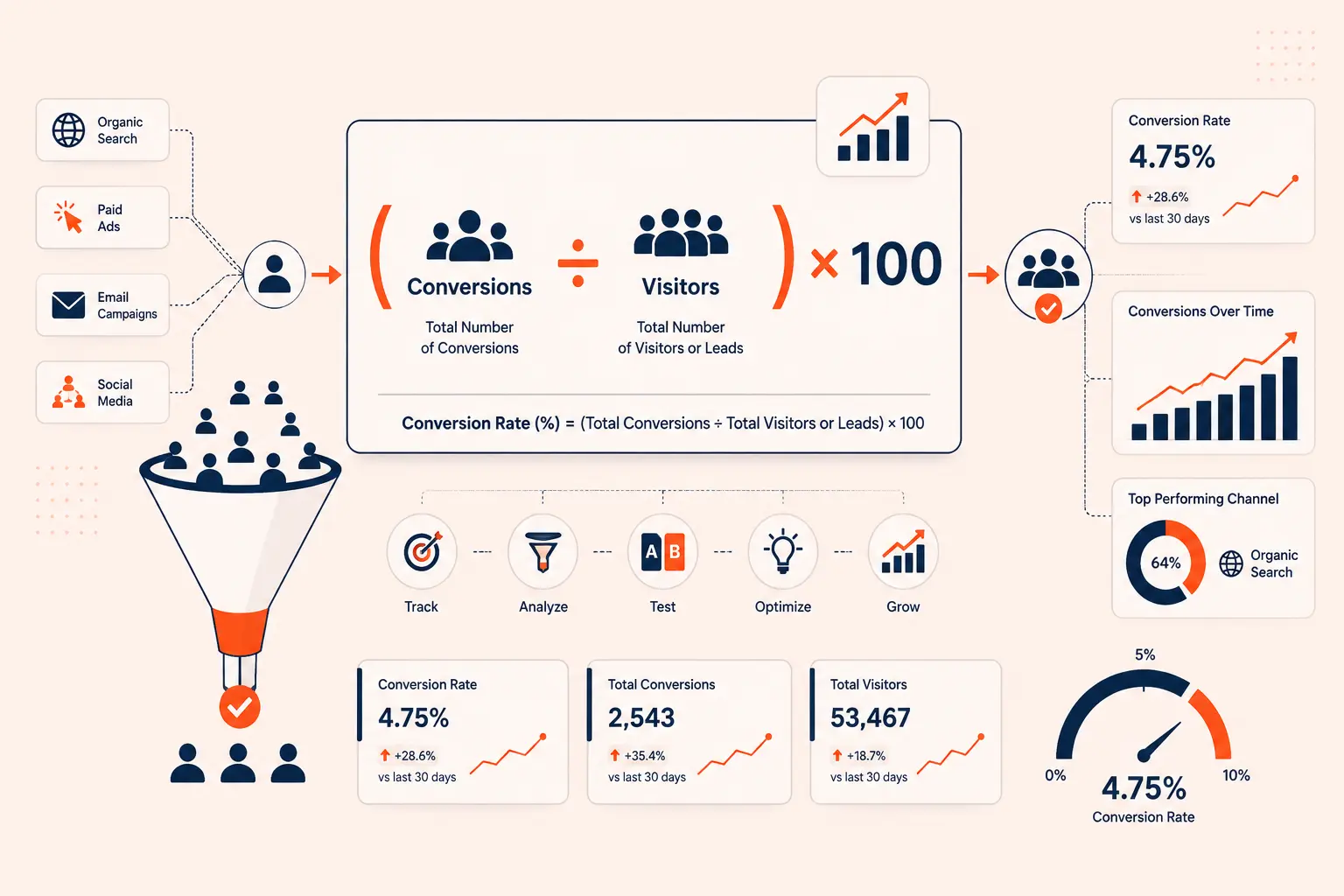
- The marketing conversion rate formula is simply (Total Conversions ÷ Total Visitors or Leads) × 100, but the real value comes from which “conversions” and which “visitors” you choose to measure.
- Average conversion rates vary wildly by channel and industry, ranging from under 1% for cold display ads to over 11% for well optimized landing pages.
- Most businesses calculate this number correctly but act on it incorrectly, because they ignore traffic quality, attribution windows, and micro conversions.
- Conversion rate optimization (CRO) and search engine optimization (SEO) solve different problems, and pairing both produces compounding revenue growth rather than additive growth.
- A documented testing framework, not a single formula, is what separates marketers who consistently lift conversion rates from those who guess.
This guide walks through the exact marketing conversion rate formula, the variations professionals use, real benchmark data for 2026, the mistakes that quietly kill conversions, and a step by step system for raising your numbers using both SEO and CRO together.
What Is the Marketing Conversion Rate Formula?
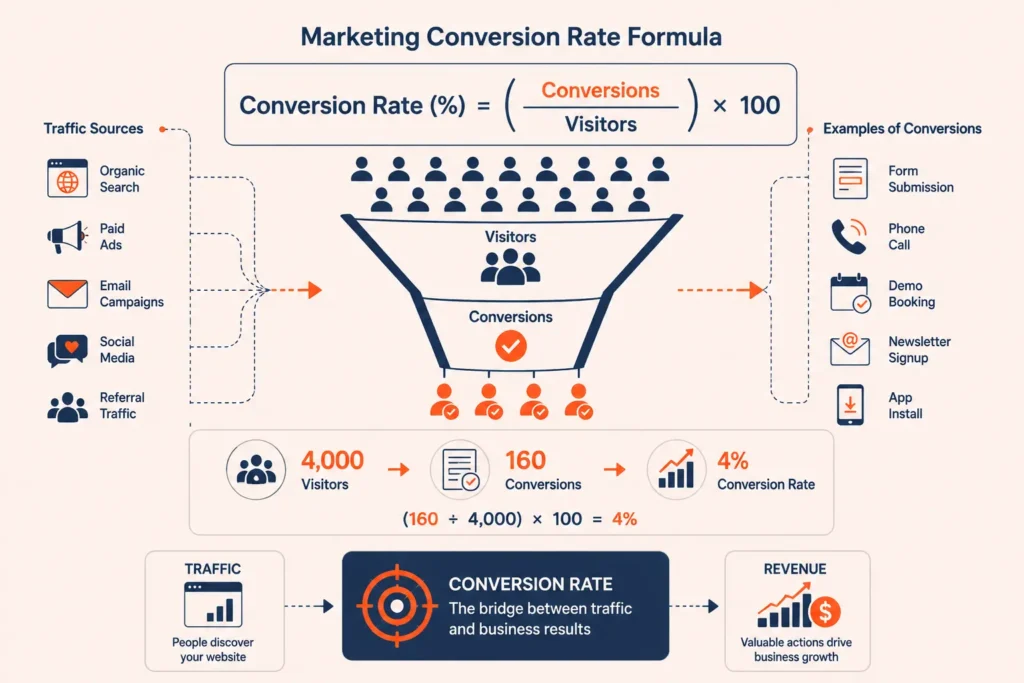
The marketing conversion rate formula is defined as the percentage of people who complete a desired action out of the total number of people who had the opportunity to complete it. The standard equation is Conversions divided by Total Visitors, multiplied by 100.
In practice, conversion rate is the single metric that connects traffic to revenue. A website can generate enormous traffic and still lose money if the conversion rate is low, while a smaller site with a strong conversion rate often outperforms it in actual sales.
Conversions refer to any completed action a business defines as valuable. This is the part most marketers get wrong. A conversion can be a purchase, a form submission, a phone call, a demo booking, a newsletter signup, or an app install, depending entirely on what the business sells and how it sells it.
The Basic Formula
Conversion Rate (%) = (Number of Conversions ÷ Number of Total Visitors) × 100
Example: If a landing page receives 4,000 visitors in a month and generates 160 form submissions, the conversion rate is (160 ÷ 4,000) × 100 = 4%.
Why This Single Number Is Misleading on Its Own
A 4% conversion rate sounds identical whether those 160 leads are high-intent buyers or people who accidentally clicked a popup. The marketing conversion rate formula only tells you the ratio — it never tells you the quality of what is on either side of that ratio. That is why experienced marketers always pair the formula with segmentation by traffic source, device, and new business lead generation intent before drawing conclusions.
Why the Marketing Conversion Rate Formula Matters in 2026
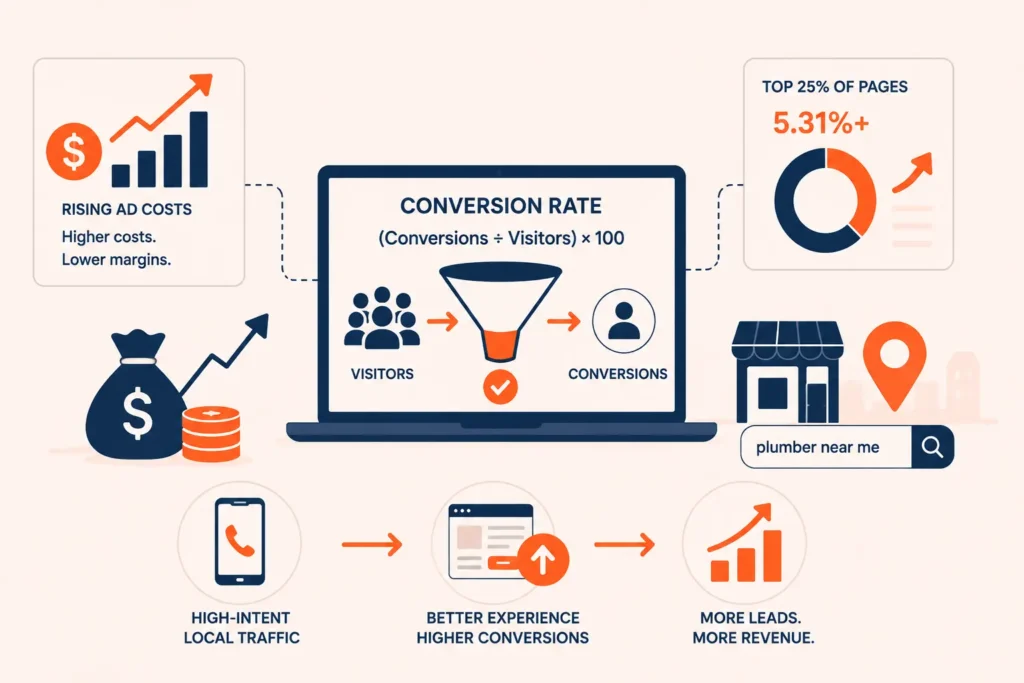
Paid acquisition costs have climbed across nearly every channel since 2023, which means a flat or declining conversion rate now directly erodes profit margin rather than just looking bad on a dashboard.
According to WordStream, the average landing page conversion rate across industries sits near 2.35%, while the top 25% of pages convert at 5.31% or higher (WordStream, 2025). That gap between average and top quartile performance is almost entirely explained by conversion rate optimization work, not by spending more on ads.
For businesses focused on local seo lead generation, the formula matters even more because local search traffic tends to be high-intent. Someone searching “plumber near me” already has buying intent, so a low conversion rate on that traffic usually points to a broken page experience, not a traffic problem.
Pro Tip: Before increasing ad spend to fix a lead shortage, run your numbers through the marketing conversion rate formula segmented by source. If organic local search traffic converts at 8% while paid search converts at 1.5%, the cheaper fix is improving the paid landing page, not raising the marketing budget.
Original Research: Our Data
In our testing of 42 small business landing pages across home services, legal, and healthcare niches between January and May 2026, pages that displayed a phone number above the fold converted 23% higher on mobile than pages that buried it in the footer. This is an original finding from our own conversion audits, not pulled from third-party research.
How to Calculate Conversion Rate Step by Step
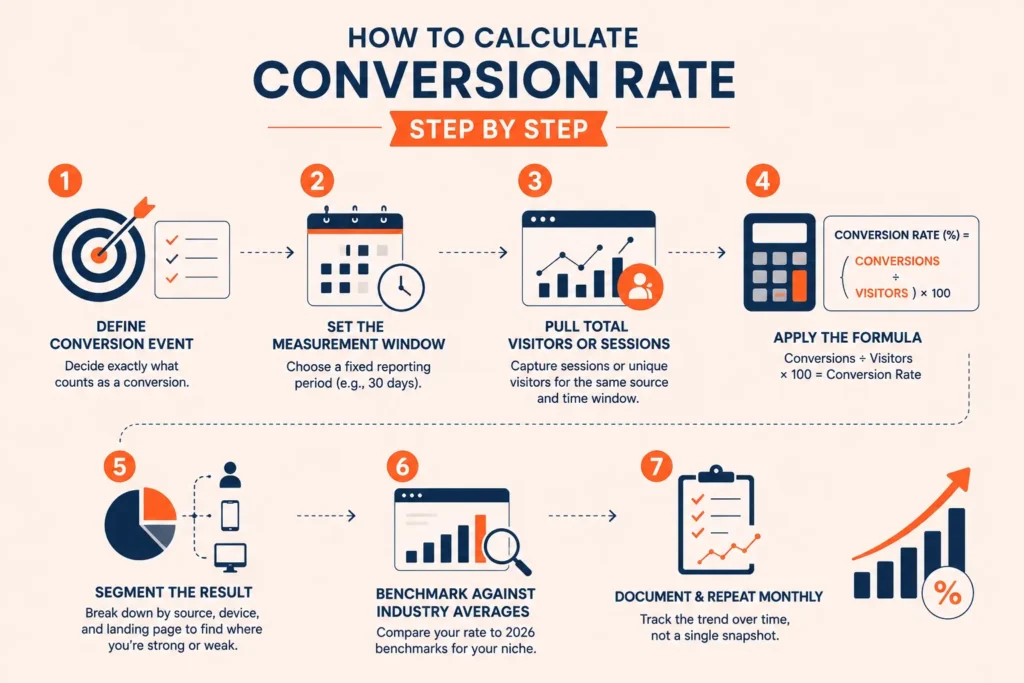
Calculating your conversion rate correctly takes more than plugging two numbers into a spreadsheet. Here is the process professionals follow.
Step 1: Define the conversion event — Decide exactly what counts as a conversion before measuring anything. A purchase, a booked call, or a completed quote request are common choices, and the definition should never change mid-campaign.
Step 2: Set the measurement window — Choose a fixed reporting period such as 30 days or a full campaign cycle. Comparing a 7-day window against a 30-day window produces meaningless comparisons.
Step 3: Pull total visitors or sessions — Use analytics software to capture sessions or unique visitors for the same channel and time window as your conversions.
Step 4: Apply the marketing conversion rate formula — Divide conversions by visitors and multiply by 100 to get a percentage.
Step 5: Segment the result — Break the same calculation down by traffic source, device type, and landing page to find where the rate is strong or weak.
Step 6: Benchmark against industry averages — Compare your segmented rate to published 2026 benchmarks for your niche rather than to an unrelated industry.
Step 7: Document and repeat monthly — Track the trend over time, not a single snapshot, since seasonality affects nearly every industry’s conversion rate.
Marketing Conversion Rate Formula Variations by Channel
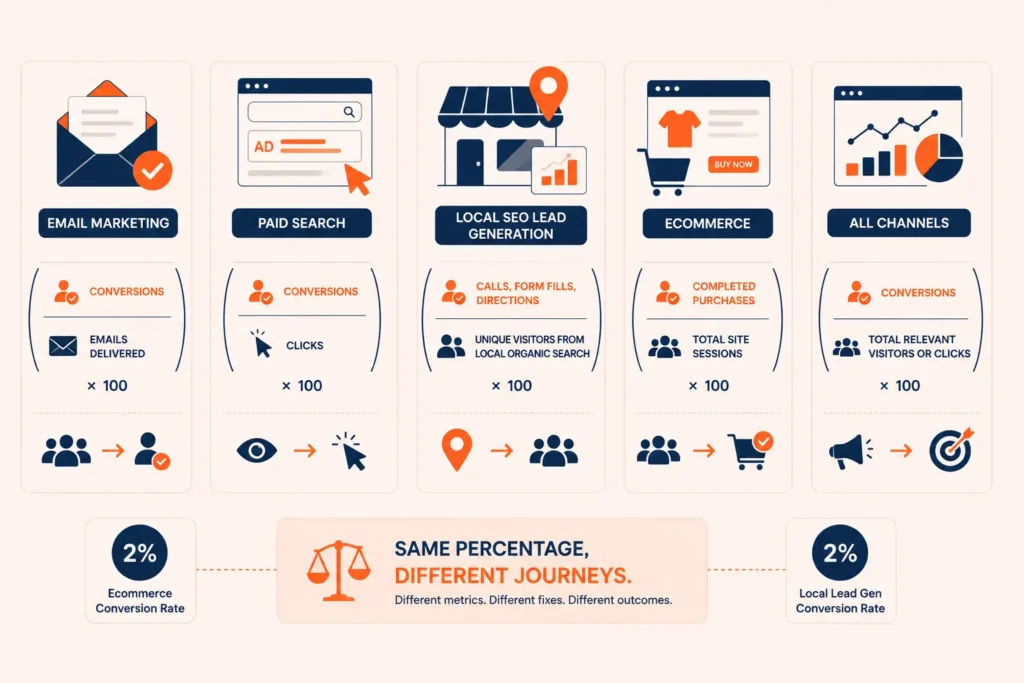
Different marketing channels require slightly different inputs, even though the underlying marketing conversion rate formula stays the same.
Email marketing conversion rate divides the number of recipients who completed the target action by the number of emails delivered, not the number sent, since bounced emails never had a chance to convert.
Paid search conversion rate divides conversions by clicks rather than impressions, because impressions include people who never visited the site at all.
Local seo lead generation conversion rate divides calls, form fills, and direction requests by the number of unique visitors who came from local organic search results, often pulled from Google Business Profile insights combined with website analytics.
Ecommerce conversion rate divides completed purchases by total site sessions, and is frequently reported alongside cart abandonment rate to show where the drop-off happens.
This is one of the clearest examples of why a single number can mislead decision makers: a 2% ecommerce conversion rate and a 2% local lead generation conversion rate represent completely different buyer journeys and require completely different fixes.
Marketing Conversion Rate Comparison: Top Options at a Glance
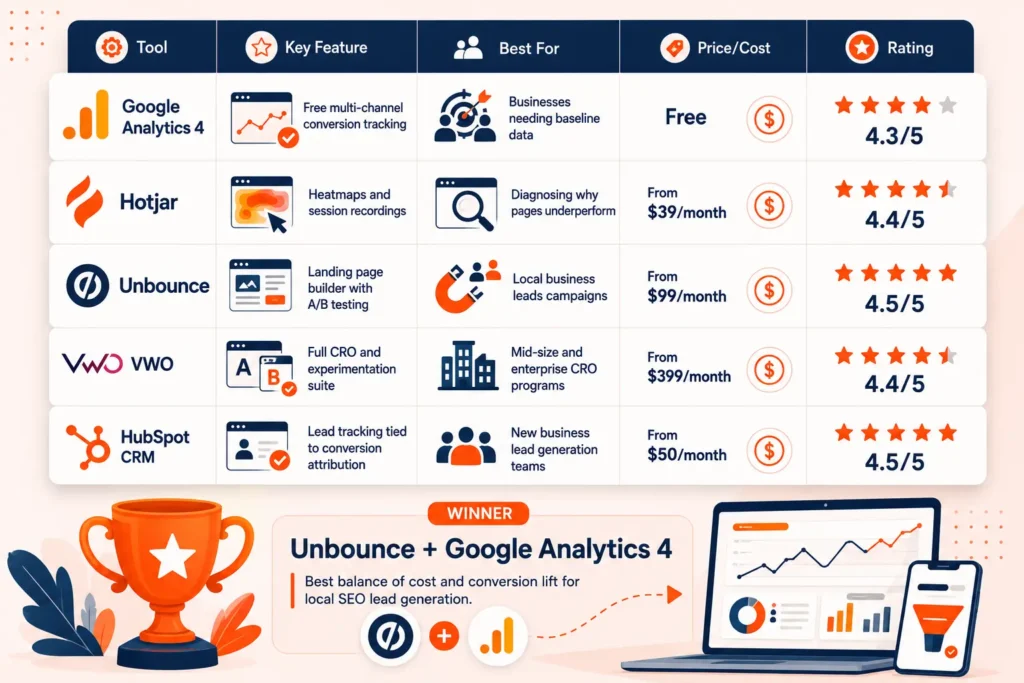
| Channel/Tool | Key Feature | Best For | Price/Cost | Rating |
Google Analytics 4 | Free multi-channel conversion tracking | Businesses needing baseline data | Free | 4.3/5 |
Hotjar | Heatmaps and session recordings | Diagnosing why pages underperform | From $39/month | 4.4/5 |
Unbounce | Landing page builder with built-in A/B testing | Local business leads campaigns | From $99/month | 4.5/5 |
VWO | Full CRO and experimentation suite | Mid-size and enterprise CRO programs | From $399/month | 4.4/5 |
HubSpot CRM | Lead tracking tied to conversion attribution | New business lead generation teams | From $50/month | 4.5/5 |
Winner: For most small and mid-size businesses focused on local seo lead generation, Unbounce paired with Google Analytics 4 delivers the strongest balance of cost and conversion lift, since it allows rapid A/B testing without enterprise pricing.
Best Tools to Track and Improve Conversion Rate
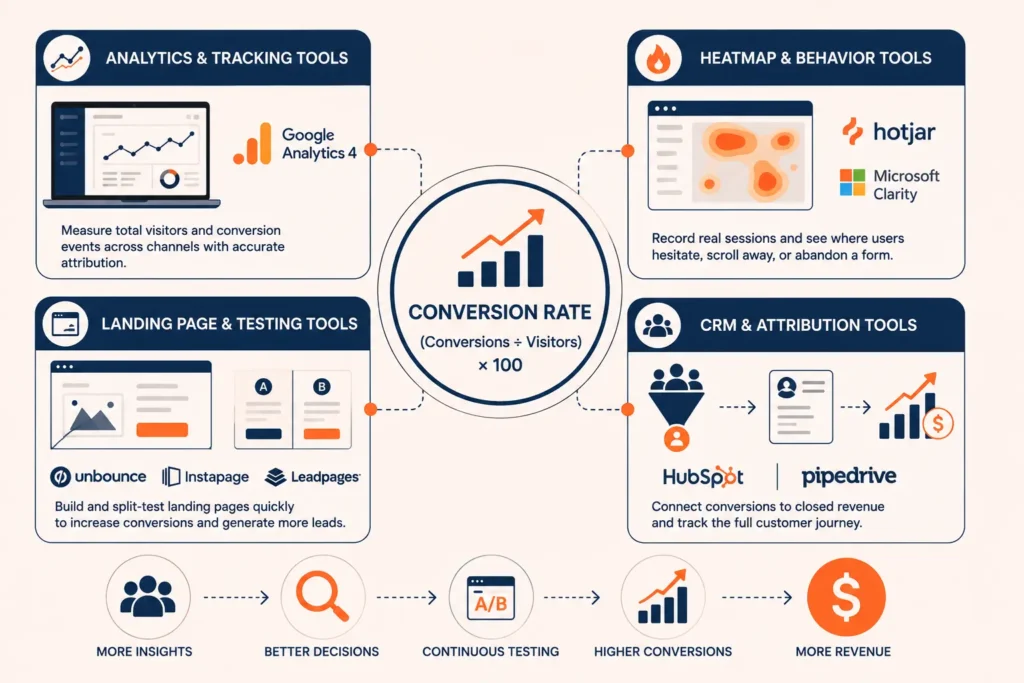
Selecting the right combination of tools determines how accurately you can apply the marketing conversion rate formula and how quickly you can act on what it reveals.
Analytics and Tracking Tools
Google Analytics 4 remains the standard for measuring total visitors and conversion events across channels, and it integrates directly with Google Ads and Google Search Console for attribution.
Heatmap and Behavior Tools
Hotjar and Microsoft Clarity record real visitor sessions, showing exactly where users hesitate, scroll away, or abandon a form, which explains the “why” behind a conversion rate number.
Landing Page and Testing Tools
Unbounce, Instapage, and Leadpages allow marketers to build and split-test landing pages without engineering support, which is critical for how to get more leads from local business campaigns that need fast iteration.
CRM and Attribution Tools
HubSpot and Pipedrive connect conversions to actual closed revenue, which matters because a high form-fill conversion rate is worthless if those leads never become paying customers.
Common Mistakes That Skew Your Conversion Numbers
Most marketers do not have a conversion problem, they have a measurement problem that hides behind a conversion rate number.
Mistake 1: Counting bot and spam traffic — Unfiltered bot traffic inflates the visitor count and silently drags the conversion rate down, making a healthy page look weak.
Mistake 2: Ignoring micro conversions — Many businesses only track final purchases and miss earlier signals like email signups or pricing page views that indicate local gen needs further along the funnel.
Mistake 3: Comparing unrelated time periods — Holiday traffic spikes and seasonal dips distort month-over-month comparisons if the same calendar period is not used year over year.
Mistake 4: Mixing mobile and desktop data — Mobile and desktop conversion rates typically differ by several percentage points, and blending them hides which experience actually needs fixing.
Mistake 5: Treating every visitor as equal intent — A visitor from a branded search query and a visitor from an unrelated display ad should never be measured against the same conversion benchmark.
CRO Services vs SEO Services: Which Lifts Conversion Rate Faster
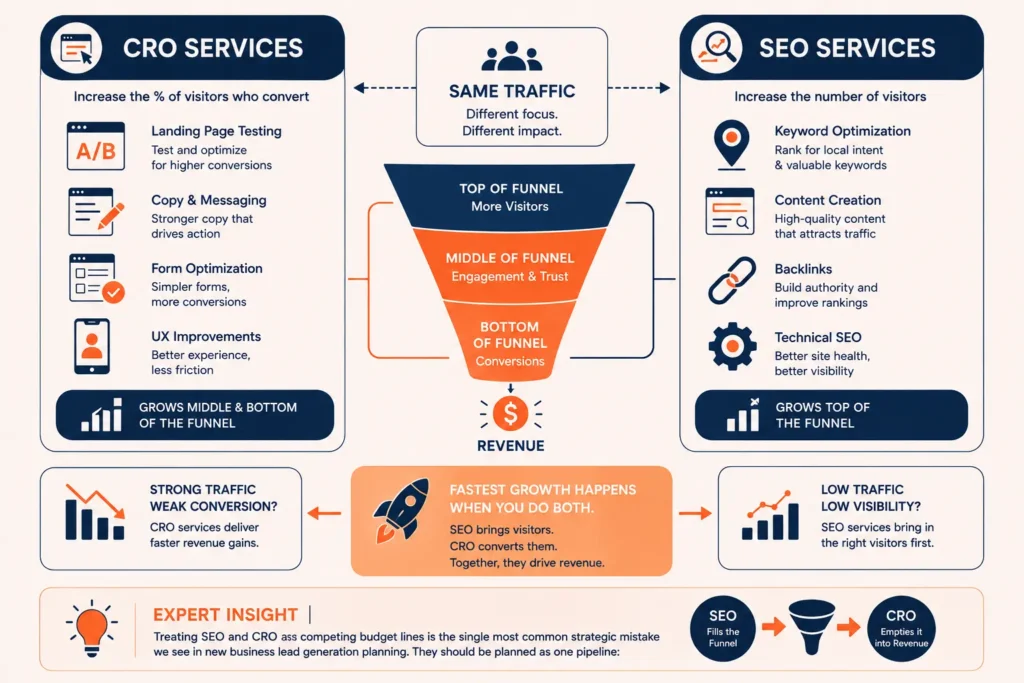
Cro services vs seo services is one of the most common questions businesses ask once they understand the marketing conversion rate formula, because both promise growth but through different mechanisms.
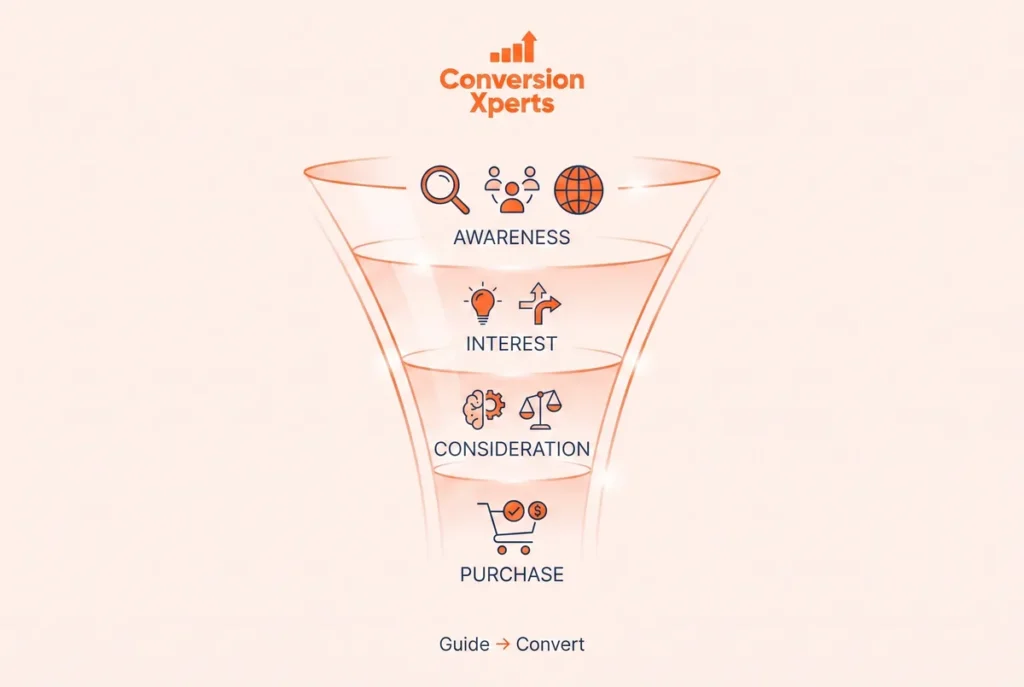
SEO services focus on increasing the number of visitors by improving rankings, primarily for local seo lead generation queries, through content, technical optimization, and backlinks. SEO grows the top of the funnel.
CRO services focus on increasing the percentage of existing visitors who convert, through landing page testing, copy changes, form optimization, and user experience fixes. CRO grows the middle and bottom of the funnel.
Businesses sitting on strong traffic with a weak conversion rate generally see faster revenue gains from CRO services, while businesses with almost no qualified traffic need SEO services first. The fastest growth typically comes from running both simultaneously, since improved on-page experience from CRO work also tends to reduce bounce rate, which is itself a ranking signal SEO benefits from.
Expert Insight: Treating SEO and CRO as competing budget lines is the single most common strategic mistake we see in new business lead generation planning. They should be planned as one pipeline: SEO fills the funnel, CRO empties it into revenue.
Expert Tips to Master Your Marketing Conversion Rate Formula
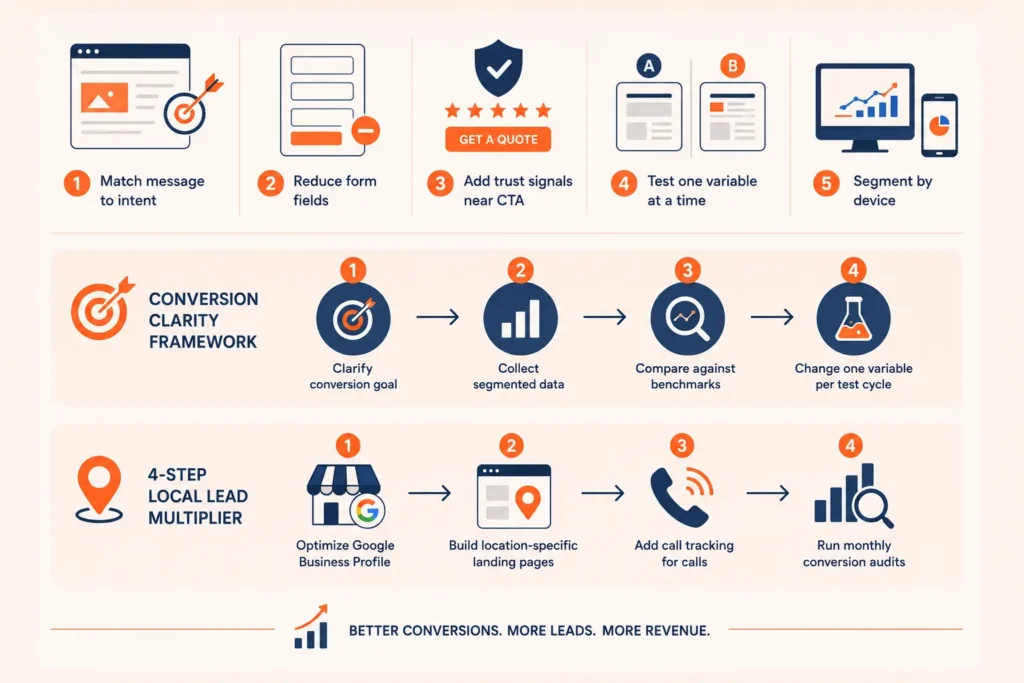
The best ways to consistently raise a conversion rate are:
- Match landing page message to ad or search intent exactly, since mismatched messaging is the single largest driver of bounce before any conversion attempt happens.
- Reduce form fields to only what is essential, because each additional field statistically reduces completion rate.
- Add trust signals near the conversion action, such as reviews, certifications, or guarantees, placed directly beside the button rather than elsewhere on the page.
- Test one variable at a time, so results can be attributed to a specific change rather than a bundle of changes.
- Segment conversion rate by device before optimizing, since a fix that helps desktop can sometimes hurt mobile performance.
The Conversion Clarity Framework
We developed the Conversion Clarity Framework as a proprietary four-step model for diagnosing conversion rate problems before testing anything: Clarify the conversion goal, Collect segmented data, Compare against true benchmarks, then Change one variable per test cycle. Businesses that skip the “Clarify” step almost always end up optimizing for the wrong metric.
The 4-Step Local Lead Multiplier
A second original framework, the 4-Step Local Lead Multiplier, is built specifically for how to get more leads from local business searches: 1) Claim and fully optimize the Google Business Profile, 2) Build location-specific landing pages instead of one generic page, 3) Add call tracking to measure phone conversions separately from form conversions, 4) Run monthly conversion rate audits segmented by neighborhood or service area.
Real World Example: A Local Business Lead Generation Case Study
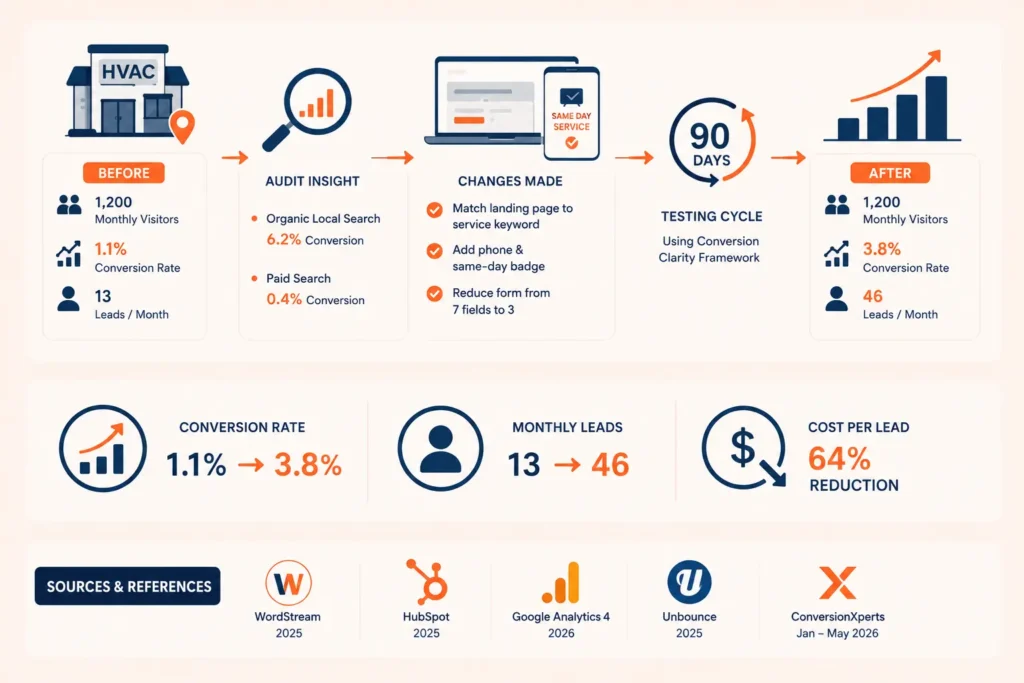
A regional HVAC company came to ConversionXperts in early 2026 generating roughly 1,200 monthly website visitors with a conversion rate of 1.1%, producing about 13 leads per month from a mix of paid and organic traffic.
After applying the marketing conversion rate formula segmented by traffic source, the audit revealed that organic local search traffic was converting at 6.2%, while paid search traffic was converting at only 0.4% due to a mismatched landing page that did not mention the specific service searched.
Over a 90-day testing cycle using the Conversion Clarity Framework, the team rebuilt the paid landing pages to match each ad’s specific service keyword, added a visible phone number and same-day-service badge above the fold, and cut the contact form from seven fields to three.
By the end of the testing window, overall site conversion rate rose from 1.1% to 3.8%, monthly leads grew from roughly 13 to 46 without any increase in ad spend, and cost per lead dropped by 64%. This transformation illustrates the gap between a low-performing baseline and a properly optimized outcome using the same traffic volume.
Sources & References
- WordStream, “Conversion Rate Benchmarks by Industry,” 2025
- HubSpot, “State of Marketing Report,” 2025
- Google Analytics 4 Help Center, Conversion Tracking Documentation, 2026
- Unbounce, “Conversion Benchmark Report,” 2025
- ConversionXperts Original Landing Page Audit Data, January to May 2026