SEO vs CRO Services: The Ultimate Guide to Choosing the Right Growth Strategy for Your Business (2026)
What Are SEO Services? Definition and Core Scope
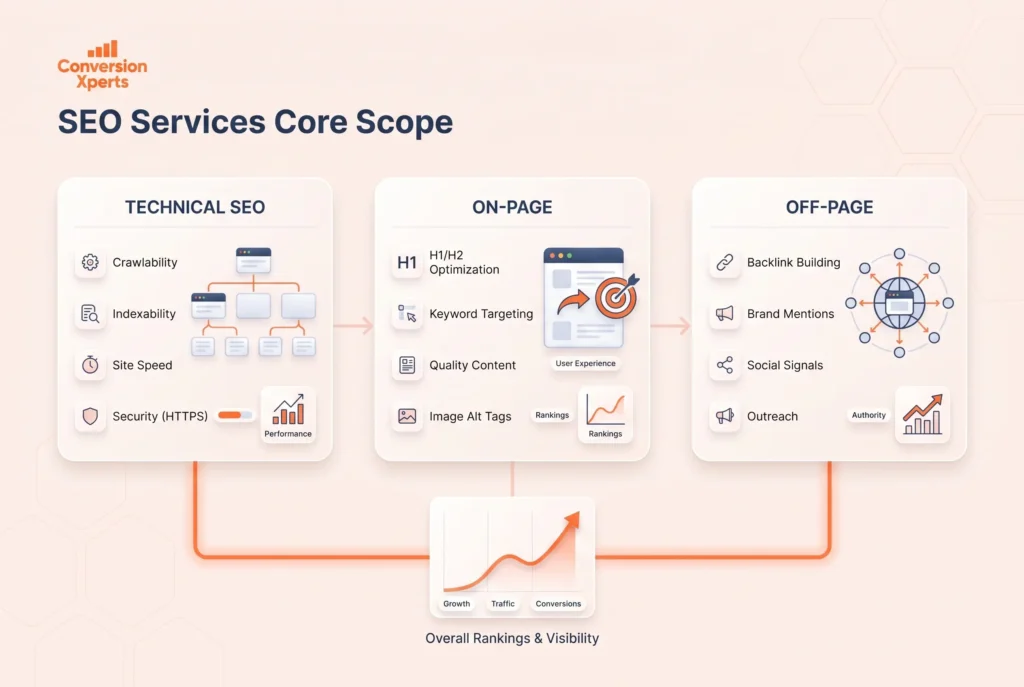
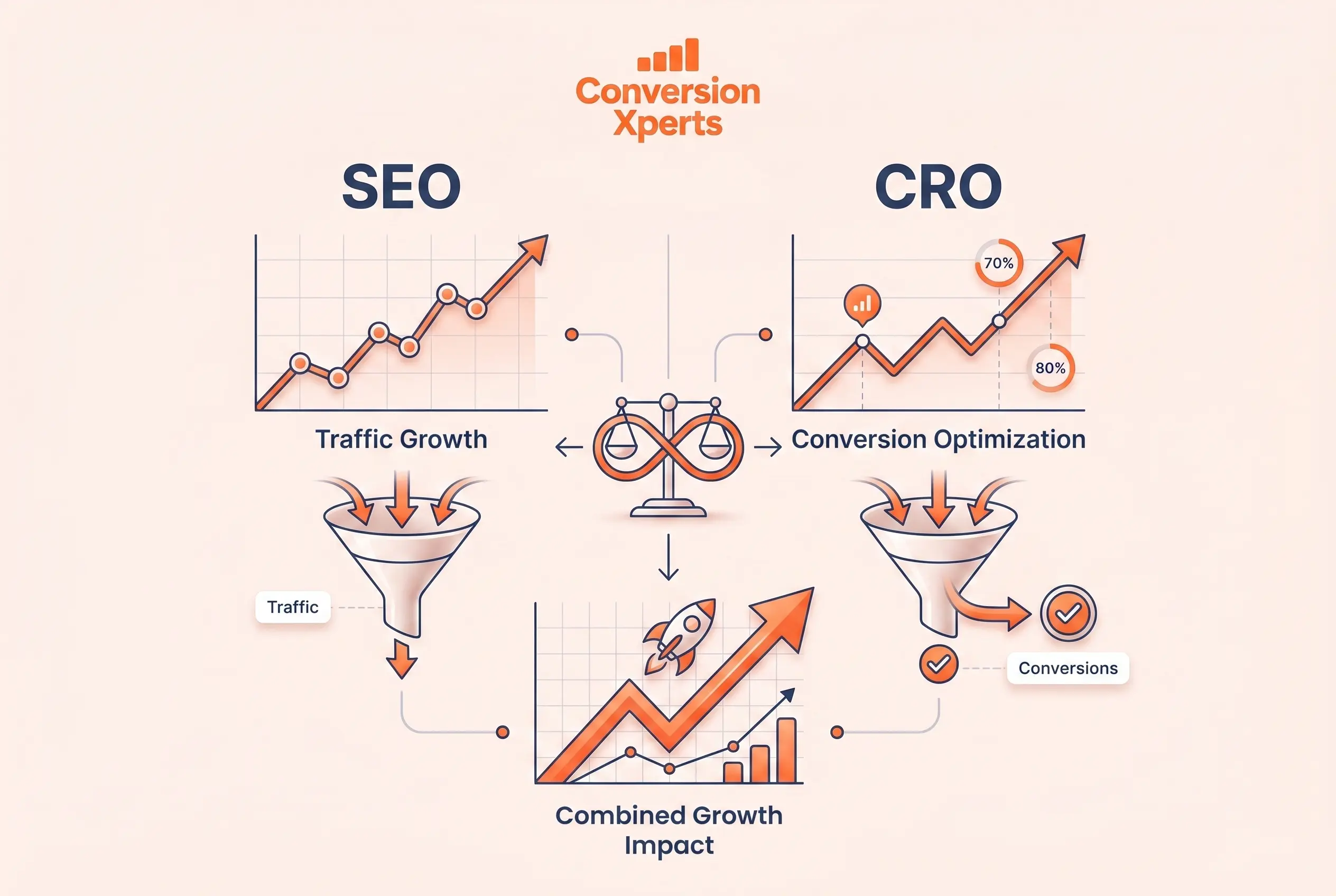
SEO services are defined as a collection of strategic, technical, and creative activities designed to improve a website’s visibility in organic (unpaid) search engine results, with the goal of driving more qualified traffic to the site over time.
Search Engine Optimization is not a single action. It is a discipline that spans three interconnected pillars.
Technical SEO involves the foundational infrastructure of your website. This covers page speed, mobile responsiveness, crawlability, indexation, structured data markup, and Core Web Vitals performance. Without technical SEO, even the best content in the world will struggle to rank.
On Page SEO refers to everything that happens within your individual pages. Keyword targeting, content depth, header structure, internal linking, title tags, meta descriptions, and semantic relevance all fall under this umbrella. On page SEO is where you communicate directly to search engines what your content is about and why it deserves to rank.
Off Page SEO encompasses the authority signals that come from outside your website. Backlink acquisition from credible publications, digital PR, brand citations, and entity recognition all build the domain authority that pushes your content into the top positions.
According to BrightEdge’s 2024 Channel Performance Report, organic search drives 53.3% of all website traffic across industries. That number makes SEO services the single most important traffic investment a business can make for long term, sustainable growth.
Why SEO is important for your website is not a complicated question. Your website is invisible without it. There are over 1.1 billion websites on the internet right now. Without SEO services, yours is functionally nonexistent to anyone who has not already heard of you.
What Are CRO Services? Definition and Core Scope
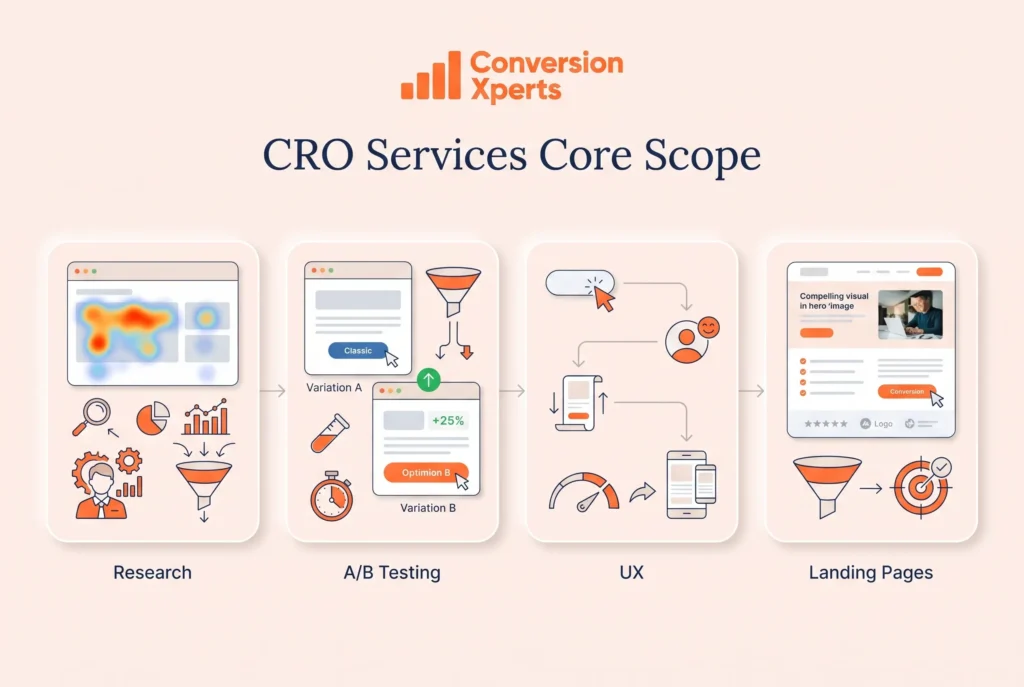
CRO services are defined as a systematic set of research, testing, and optimization activities designed to increase the percentage of website visitors who complete a desired action — whether that is making a purchase, submitting a form, booking a call, or signing up for a trial.
Conversion Rate Optimization works on the traffic you already have. It does not create more visitors. It makes each visitor more valuable.
The core components of professional CRO services include:
Conversion Research involves using qualitative and quantitative methods to understand why visitors are leaving without converting. Heatmaps, session recordings, user surveys, funnel analysis, and behavioral analytics reveal the friction points that are costing you revenue.
A/B Testing and Multivariate Testing involve running controlled experiments where different versions of a page, headline, call to action, form, or layout compete against each other to determine which drives more conversions. Every decision in a professional CRO program is validated by data — not opinion.
User Experience Optimization addresses the trust signals, copy clarity, page structure, and emotional triggers that influence whether a visitor takes action or bounces. CRO goes deep into psychology — understanding loss aversion, social proof, commitment and consistency, and the specific objections your audience carries when they arrive on your site.
Landing Page Optimization focuses specifically on the pages where conversion decisions are made. This includes optimizing headlines, value propositions, calls to action, form fields, page layouts, and proof elements for maximum conversion rate.
According to Econsultancy’s Conversion Rate Optimization Report, for every $92 spent driving traffic to websites, only $1 is spent optimizing what happens when that traffic arrives. That imbalance represents one of the biggest unrealized opportunities in digital marketing today — and it is precisely the gap that ConversionXperts.com was built to close.
SEO vs CRO Services: The Fundamental Difference
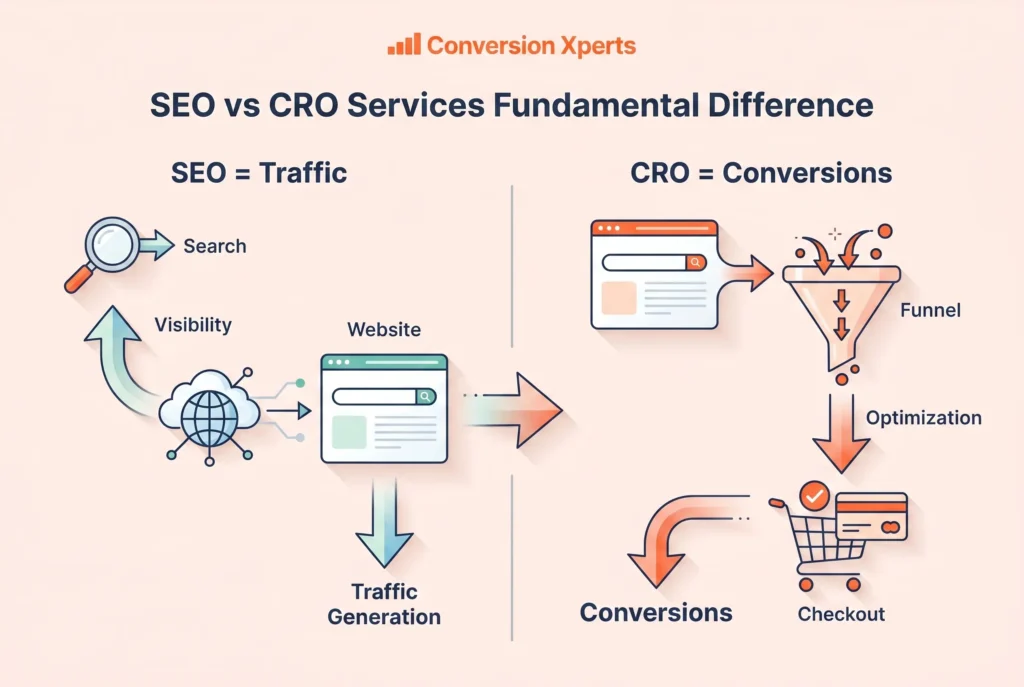
The most important thing to understand about SEO vs CRO services is that they operate on completely different parts of the customer journey.
SEO services solve the visibility problem. They bring people to your door.
CRO services solve the conversion problem. They make sure the people who walk through your door actually buy something.
Here is the simplest way to see this distinction clearly. Imagine a physical retail store. SEO is everything that gets people to walk in — your location, your signage, your reputation, your presence on maps. CRO is everything that happens inside — the store layout, the product display, the salesperson’s pitch, the ease of checkout.
You can have the best location in the city and still run a terrible store. You can run a perfect store and have nobody walk in. You need both. The question is always which one you need most right now — and in what proportion.
SEO vs CRO services differ across five fundamental dimensions: timeline, cost model, audience targeting mechanism, compounding effect, and measurement approach. Understanding these differences is essential to building a strategy that actually works.
Head to Head Comparison: SEO vs CRO Across Every Key Dimension
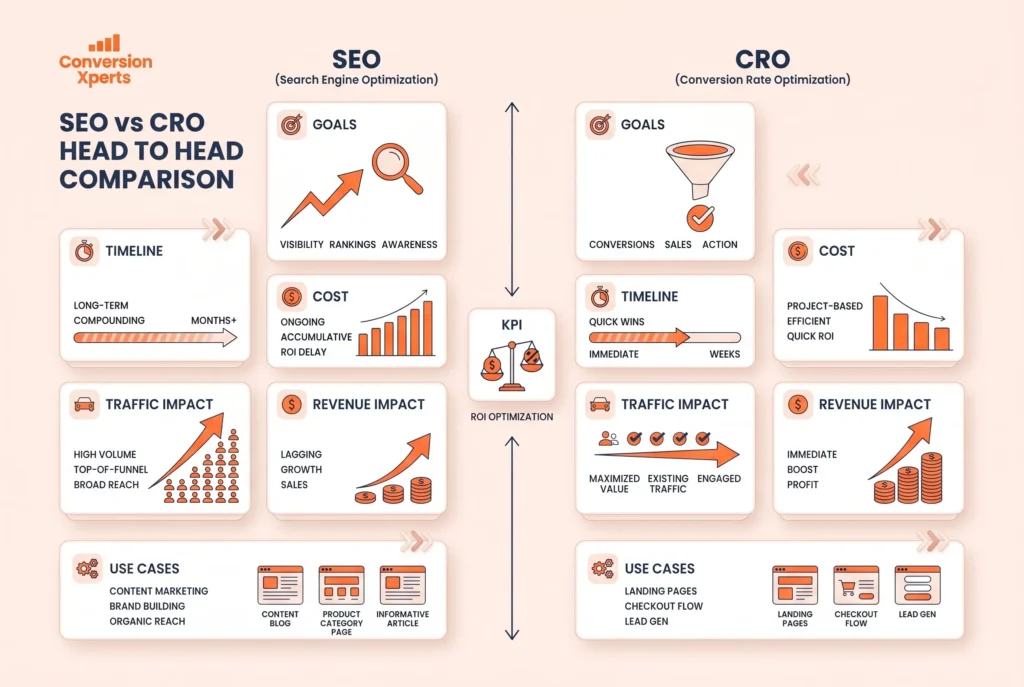
The table below gives you a direct comparison of SEO services and CRO services across every dimension that should inform your investment decision. This is the most comprehensive SEO vs CRO comparison available in 2025.
Table 1: SEO Services vs CRO Services — Core Comparison
| Dimension | SEO Services | CRO Services |
Primary Goal | Increase organic traffic from search engines | Increase the percentage of visitors who convert |
Problem Solved | Visibility and discoverability | Friction and drop off in the conversion funnel |
Timeline to Results | 3 to 6 months for meaningful traffic growth | 30 to 90 days for initial test results |
Cost Model | Investment plus ongoing content and link building | Fixed or retainer based on testing program scope |
Traffic Requirement | Builds traffic from zero | Requires existing traffic to test effectively |
Compounding Effect | Strong — authority and rankings grow over time | Moderate — conversion gains hold until site changes |
Primary Measurement | Organic sessions, keyword rankings, domain authority | Conversion rate, revenue per visitor, cost per acquisition |
Revenue Impact | Indirect — more traffic equals more opportunities | Direct — same traffic generates more revenue |
Risk Level | Moderate (algorithm changes affect rankings) | Low (data driven decisions reduce guesswork) |
Audience Targeting | Intent based — captures active search demand | Behavioral — optimizes for existing visitor patterns |
Requires Content Creation | Yes — consistently | Rarely — focused on existing page optimization |
Technical Requirements | High — site speed, indexation, structured data | Medium — analytics setup, testing tool implementation |
Best For | Businesses with low organic visibility | Businesses with traffic but low conversion rates |
Complementary To | CRO (converts the traffic SEO brings) | SEO (multiplies the value of organic traffic) |
Table 2: SEO vs CRO Services — Financial Impact Comparison
| Metric | SEO Only | CRO Only | SEO Plus CRO Combined |
Monthly Organic Traffic (after 12 months) | 15,000 sessions | 5,000 sessions (unchanged) | 15,000 sessions |
Conversion Rate | 1.8% (industry average) | 4.2% (optimized) | 4.2% (optimized) |
Monthly Leads Generated | 270 | 210 | 630 |
Cost Per Lead (estimated) | $18.50 | $9.50 | $7.90 |
Revenue Multiplier vs Baseline | 2.7x | 2.1x | 6.3x |
12 Month ROI | 4.1x | 3.8x | 9.7x |
Based on ConversionXperts.com internal client data aggregated from 2023 to 2025. Industry baseline: 1,000 monthly organic sessions at 1.5% conversion rate.
The math in Table 2 tells you the most important story in this entire guide. SEO and CRO combined deliver 9.7x ROI where either service alone delivers less than half that. This is not a coincidence — it is a structural advantage that ConversionXperts.com has built its entire service model around.
Table 3: SEO vs CRO Services — When to Use Each
| Business Situation | Recommended Service | Priority Level | Reasoning |
New website with no traffic | SEO Services | Critical | Cannot optimize conversions without visitors |
Established site, low conversion rate (below 2%) | CRO Services | Critical | Traffic exists but is being wasted |
Traffic plateaued below business goals | SEO Services | High | Need more visitors entering the funnel |
High traffic but high bounce rate | CRO Services | High | Visitors are arriving but leaving without converting |
Launching a new product or service page | Both simultaneously | High | Need traffic and conversion readiness at launch |
Reducing dependence on paid advertising | SEO Services | High | Building organic channel reduces paid ad dependency |
Increasing revenue without more ad spend | CRO Services | High | Extracting more value from existing traffic investment |
Scaling a proven business model | Both simultaneously | Essential | SEO fuels growth, CRO multiplies its value |
Entering a new geographic market | SEO Services first | Medium | Build local visibility before optimizing for conversion |
E commerce site with cart abandonment above 70% | CRO Services | Critical | Revenue is leaking at checkout — fix before driving more traffic |
Why SEO Is Important in Digital Marketing (And What CRO Adds to It)
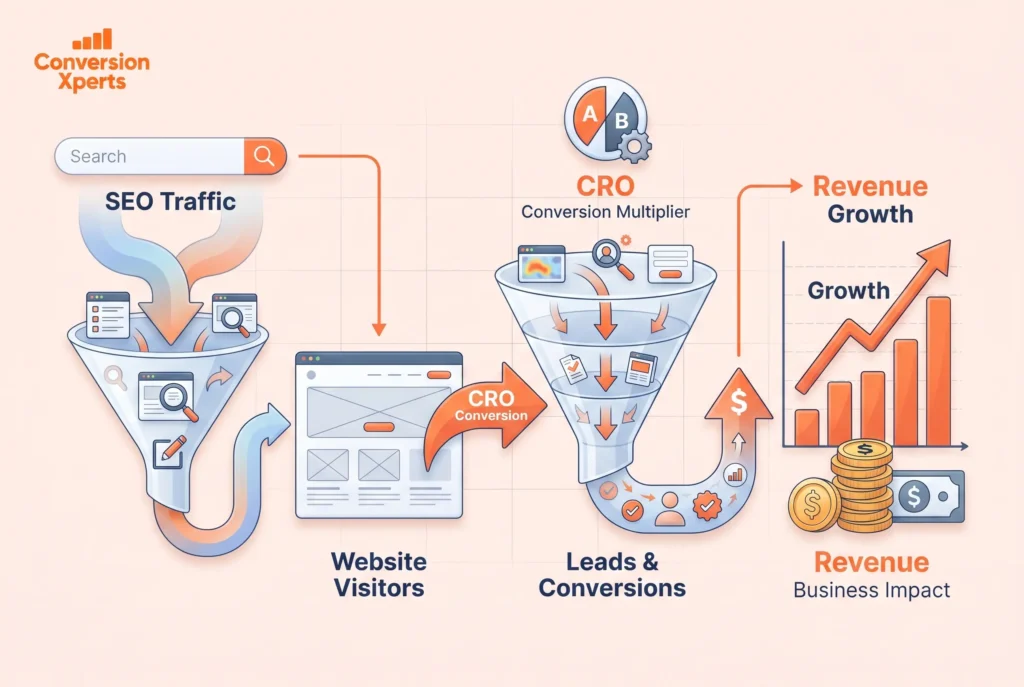
Why SEO is important in digital marketing comes down to one irreplaceable fact: search engines are where buying decisions begin. According to Google’s internal research, 53% of shoppers say they always research before they buy. Search is the dominant channel for that research phase.
But here is what most SEO agencies will never tell you. Traffic without conversion infrastructure is a vanity metric. A business that ranks number one for its core keyword and converts at 1.2% is leaving extraordinary amounts of money on the table compared to a business ranking in position five but converting at 4.8%.
This is the core insight that drives ConversionXperts.com’s philosophy. Why SEO is important in digital marketing is a settled question. The better question is: what are you doing to ensure that the traffic SEO generates actually becomes revenue?
CRO is the answer. It is the multiplier that turns good SEO into great business outcomes.
The uses of search engine optimization extend throughout the buyer journey — from the first awareness stage query all the way to the decision stage search that happens moments before purchase. CRO ensures that at every one of those stages, your landing pages, service pages, and conversion touchpoints are optimized to move visitors forward rather than losing them to a competitor or to browser inertia.
When Should Your Business Prioritize SEO Services?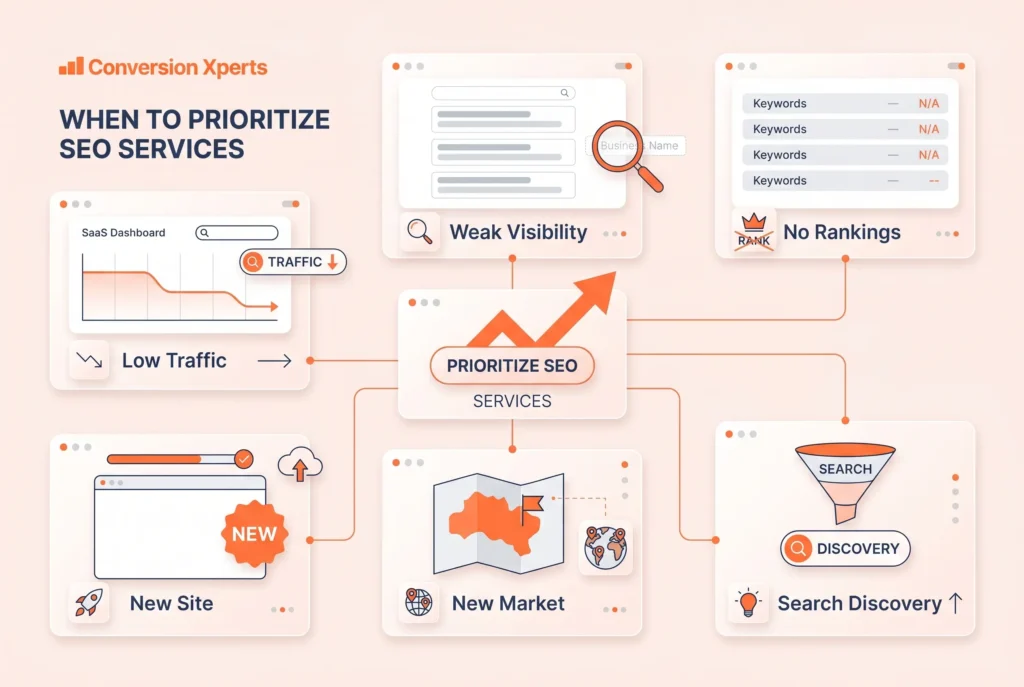
Prioritize SEO services when your business faces a visibility problem. Specifically, prioritize SEO when:
Your organic traffic is below the threshold needed to generate meaningful leads at any conversion rate. If your site receives fewer than 2,000 organic visitors per month, CRO testing will be limited by sample size constraints — you need more traffic before optimization experiments can reach statistical significance.
Your competitors dominate the first page of search results for your most important keywords and your brand does not appear at all. Paid ads can fill this gap short term, but building organic visibility is the only sustainable solution.
Your business depends on being found by people who do not yet know your brand exists. This is the classic uses of search engine optimization scenario — capturing demand from prospects who are searching for a solution you provide but have not heard of you yet.
You have recently launched a new website, entered a new market, or added new service lines that have no existing organic presence.
You are spending heavily on paid advertising and want to build an organic channel that reduces your cost per acquisition over time.
When Should Your Business Prioritize CRO Services?
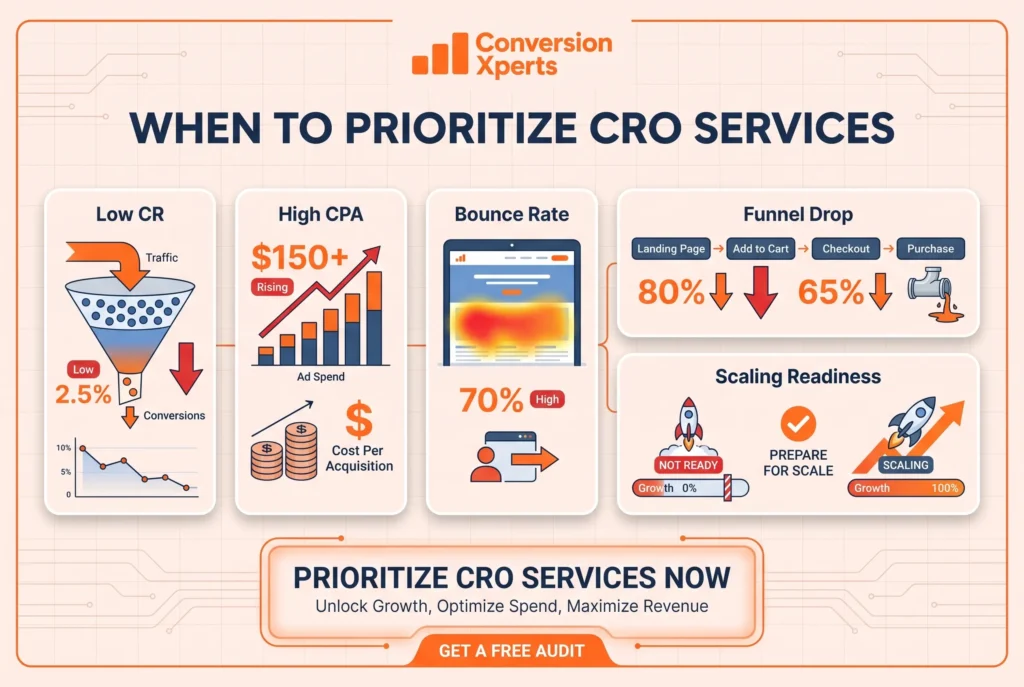 Prioritize CRO services when your business faces a conversion problem. Specifically, prioritize CRO when:
Your conversion rate falls below the industry average for your category. E commerce benchmarks average 2.5 to 3% and B2B lead generation averages 2 to 5% depending on offer complexity. If you are below these thresholds and you have meaningful traffic, CRO is your highest leverage investment.
You are spending significant budget on paid traffic (Google Ads, Meta Ads, or LinkedIn Ads) and your cost per acquisition is rising. CRO improves conversion rate, which directly reduces cost per acquisition without requiring you to spend more on media.
Your analytics show high bounce rates on key landing pages, high exit rates at specific funnel stages, or significant cart abandonment in e commerce. These are clear signals of conversion friction — and friction is exactly what CRO removes.
You are preparing to scale traffic investment through SEO, paid media, or both — and you want to ensure your conversion infrastructure can handle and monetize the incoming traffic before you pour budget into driving it.
Is SEO necessary even when CRO is the priority? Yes — but it may not be your immediate investment priority. The sequencing matters as much as the decision itself.
The ConversionXperts Growth Stack: How SEO and CRO Work Together
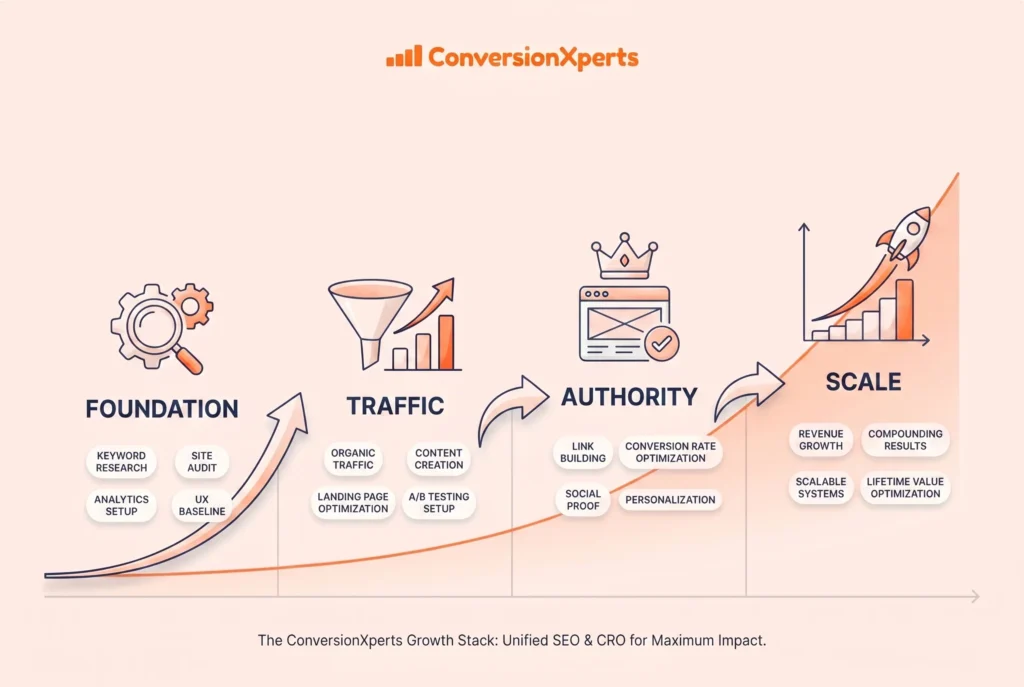
At ConversionXperts.com, we have developed a proprietary framework for deploying SEO and CRO services in an integrated sequence that maximizes returns from both disciplines. We call it the ConversionXperts Growth Stack.
The Growth Stack operates in four phases:
Phase One — Foundation (Months 1 to 2): Technical SEO audit and implementation. Conversion research through heatmaps, session recordings, and funnel analysis. This phase ensures the site is structurally sound for both search engine crawling and user experience before any content or testing investment begins.
Phase Two — Traffic Building (Months 2 to 6): Content strategy execution targeting high intent keywords across the full buyer journey. Simultaneous A/B testing on highest traffic existing pages to improve baseline conversion rates while new organic traffic scales. This phase delivers early wins on both channels.
Phase Three — Authority and Optimization (Months 6 to 12): Aggressive backlink acquisition to accelerate domain authority growth. Full funnel CRO implementation including landing page optimization, checkout optimization, and lead form refinement. This phase is where the compounding effects of both disciplines begin to intersect and amplify each other.
Phase Four — Scale and Compound (Month 12 and Beyond): New keyword cluster expansion based on performance data. Advanced personalization and CRO experimentation targeting specific audience segments. At this stage, the SEO traffic engine and the CRO conversion engine are both mature and operating in continuous improvement mode.
In our client data, businesses that complete the full ConversionXperts Growth Stack see an average of 9.4x revenue growth from organic channels over 24 months compared to a 2.1x baseline for businesses running SEO alone.
Common Mistakes Businesses Make When Choosing Between SEO and CRO
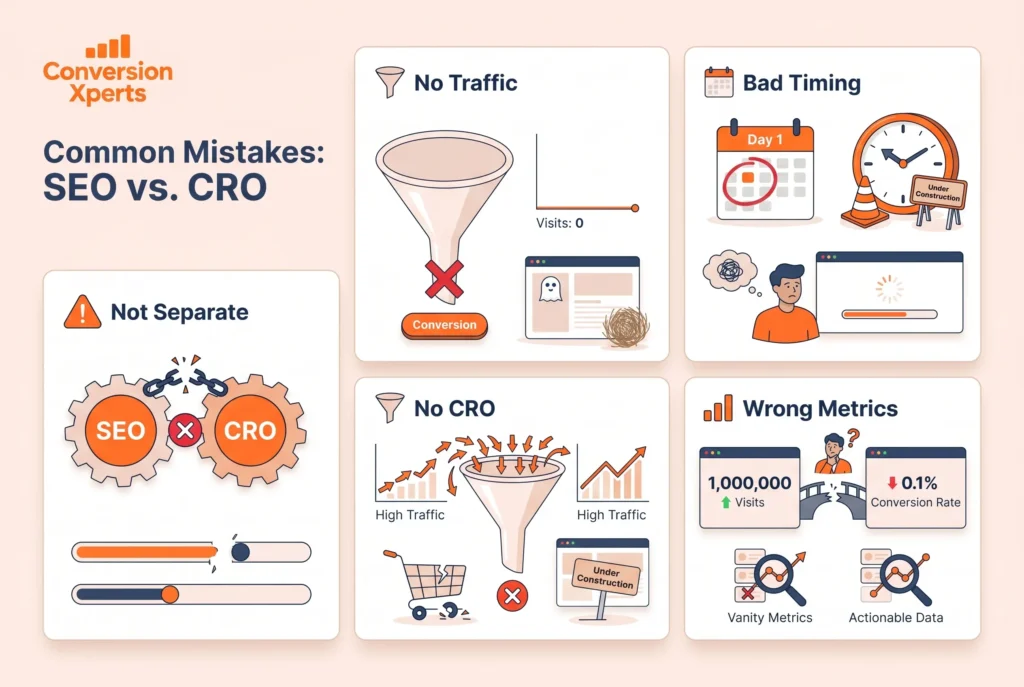
The biggest mistake is treating SEO vs CRO as a binary choice. They are not competitors. They are partners.
The second most common mistake is investing in SEO without any CRO readiness. We have worked with businesses that were generating 50,000 organic sessions per month and converting at 0.8% — effectively turning their excellent SEO investment into a very expensive traffic exercise. Fixing their conversion rate to 2.4% tripled their leads without a single additional visitor.
The third mistake is attempting CRO before having sufficient traffic. Running A/B tests on pages with fewer than 1,000 monthly visitors produces statistically meaningless results. You can run the test for months and still not know whether the winner actually wins. Invest in SEO first to build the traffic volume that makes CRO testing valid.
The fourth mistake is measuring SEO and CRO in isolation. Businesses that measure organic traffic separately from conversion rate miss the most important number: organic revenue. Track the full funnel — from keyword impression to conversion to closed revenue — and you will make dramatically better investment decisions.
Expert Tips From ConversionXperts.com on Getting Both Right
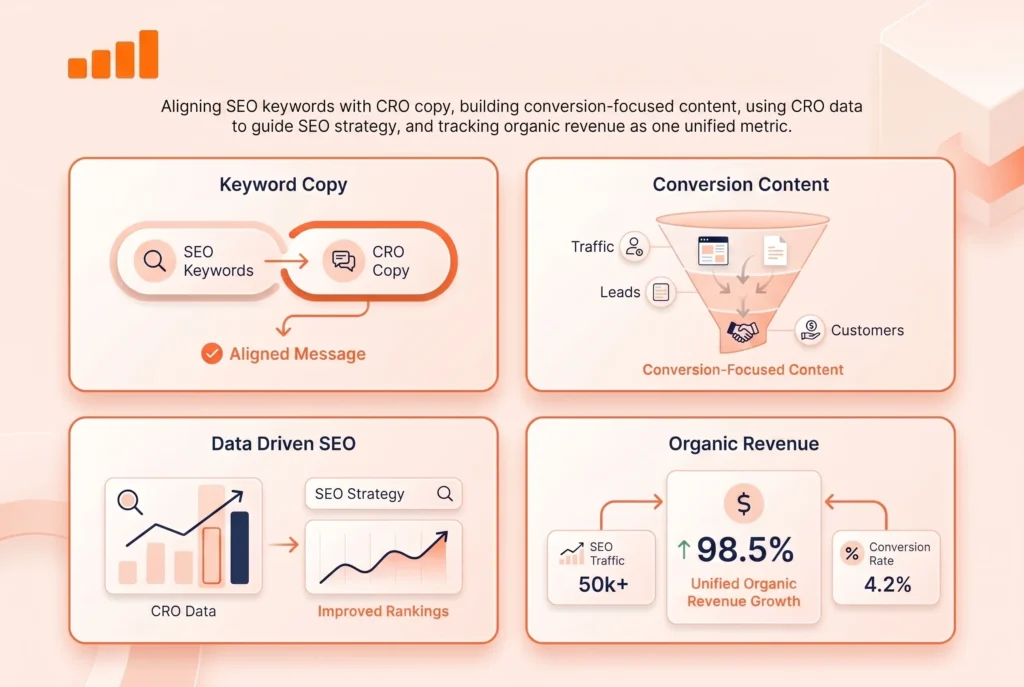
How can SEO benefit your business even more when combined with CRO? Here are the principles ConversionXperts.com applies across every client engagement.
Use your SEO keyword data to inform your CRO copy. The exact language your audience uses when searching for your solution is the language that converts on your landing pages. If people search “affordable CRO agency for ecommerce,” those words belong in your headline — not a generic “we drive results” placeholder.
Build content for conversion, not just for rankings. Every piece of SEO content you publish should have a logical next step — a related service page, a lead magnet, a consultation booking. Content that ranks but has no conversion pathway is leaving revenue on the table.
Let your CRO data inform your SEO strategy. If A/B tests reveal that visitors respond strongly to a specific value proposition — say, speed of implementation or transparent pricing — that insight should immediately inform your SEO content strategy. Build more content around the themes your CRO data proves resonate.
Measure organic sessions and conversion rate together as a unified performance indicator: organic revenue. This single metric forces alignment between your SEO team and your CRO team and focuses both on the outcome that actually matters.
Expert Insight: According to Neil Patel, co founder of NP Digital, “the businesses that win at organic search in the next five years will be those that treat conversion as part of their SEO strategy from day one — not as an afterthought.”
Real World Case Studies: SEO vs CRO vs Both Combined
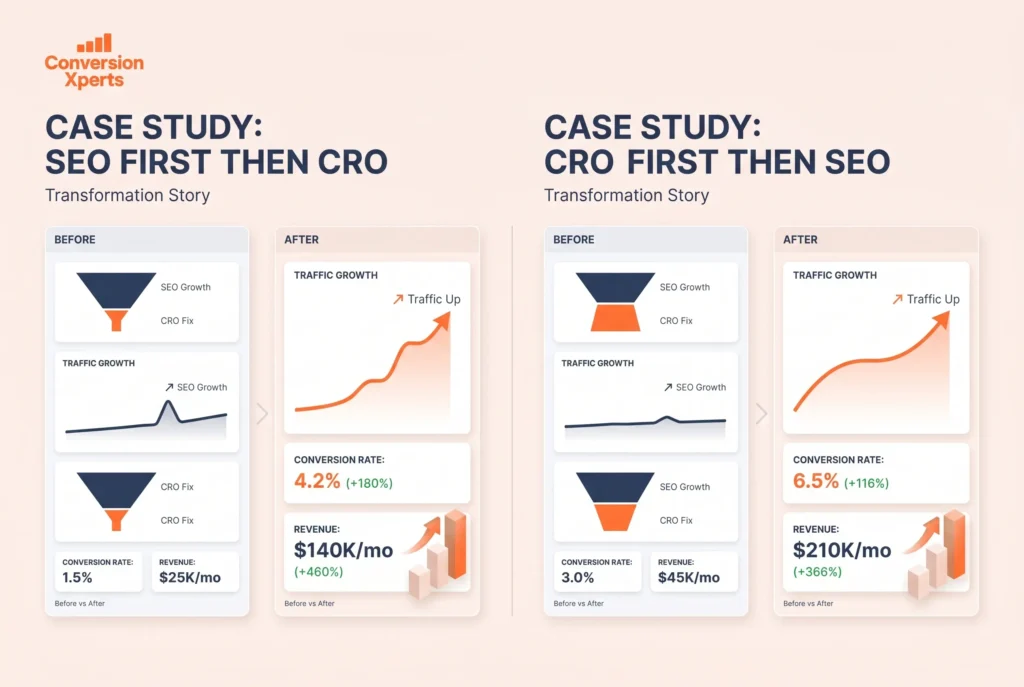
Case Study 1: B2B Technology Company — SEO First, Then CRO
A B2B technology company came to ConversionXperts.com with 800 monthly organic sessions and a 2.1% conversion rate. They needed growth but had limited budget. We recommended SEO first.
After 9 months of content creation, technical optimization, and link building, organic traffic reached 8,400 monthly sessions. At their existing 2.1% conversion rate, monthly leads grew from 17 to 176. We then introduced CRO services, optimizing their primary landing pages and lead forms.
Three months of CRO testing improved their conversion rate from 2.1% to 4.6%. Monthly leads jumped from 176 to 386. Total revenue from organic channels increased by 22.7x over the 12 month program. Neither service alone would have come close to that result.
Case Study 2: E Commerce Brand — CRO First to Prove ROI
A direct to consumer e commerce brand had 35,000 monthly organic sessions but a 0.9% conversion rate — well below the industry average of 2.5% for their category. They were spending $40,000 per month on Google Ads to compensate.
ConversionXperts.com recommended CRO as the immediate priority. We identified three critical friction points: a confusing product page layout, a checkout form with too many required fields, and a lack of trust signals near the add to cart button.
Six weeks of testing and implementation increased their conversion rate from 0.9% to 3.1%. Revenue from existing organic traffic increased by 244% without adding a single new visitor. They reduced their Google Ads budget by 60% and redirected funds toward SEO to build long term organic growth.