












Your website is getting traffic right now. But if most of those visitors are leaving without taking action, the problem is not your traffic. The problem is that you do not yet know what your visitors actually respond to.
A/B testing is how you find out. It is the most direct, most reliable way to improve your conversion rate without spending more on ads or SEO. At ConversionXperts, we run structured, data-driven A/B testing programs that tell you exactly what works on your website and why, then help you implement it.
According to HubSpot's 2024 research, structured A/B testing programs produce an average 18% conversion lift within six months. That is not a small number. For a business doing $500,000 a year in revenue, an 18% lift means $90,000 in additional revenue without a single extra dollar spent on traffic.
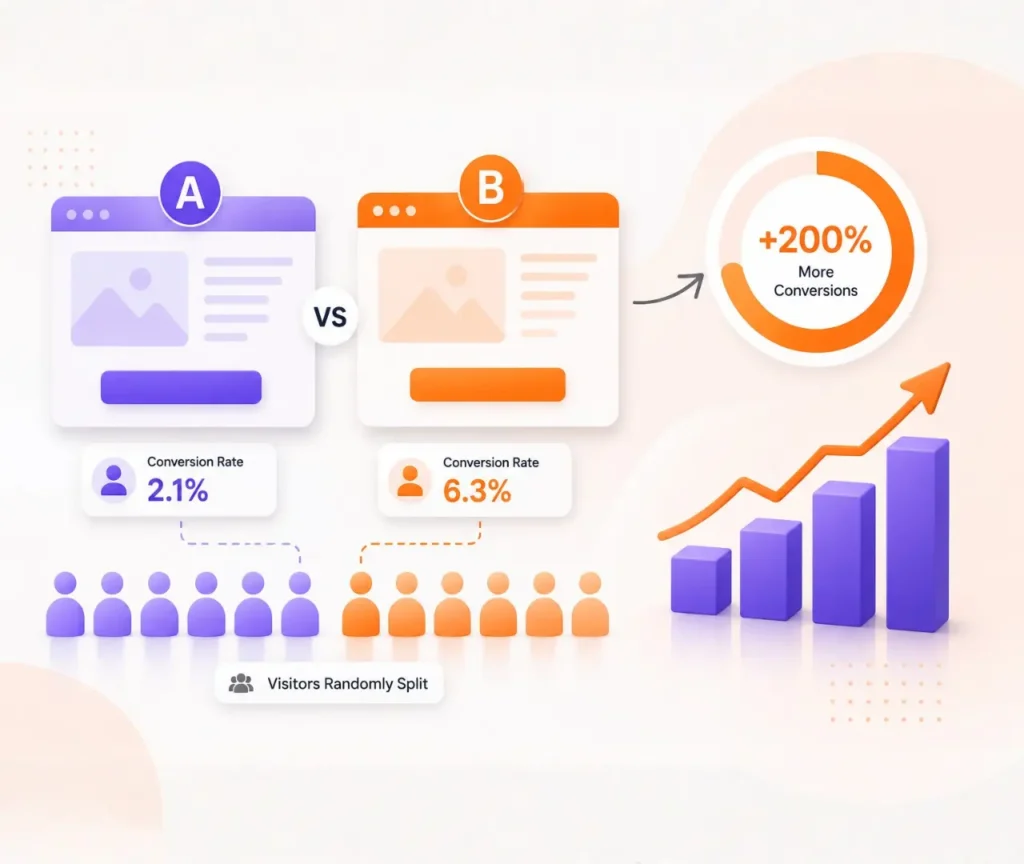






This is the foundation of every CRO program. You take one element of your page, create an alternative version, and measure which converts better. This could be your headline, your hero image, your call to action button, your pricing display, your form layout, or dozens of other elements.
Standard A/B tests are focused, clean, and produce clear results that are easy to act on. When you want to understand whether a specific change makes a measurable difference, this is the approach.
When you want to test multiple changes on a page at the same time and understand how those changes interact with each other, multivariate testing is the right tool.
For example, you might test three different headlines alongside two different images and two different button colors simultaneously. Multivariate testing tells you which combination of all those variables produces the best result.
This approach requires more traffic to reach statistical significance, but it produces richer insights and can identify winning combinations that no single-variable test would uncover. We offer dedicated multivariate testing as part of our service suite.
Sometimes the change you want to test is too significant for a single-element test. A completely redesigned landing page, a new checkout flow, or an entirely different page layout requires split URL testing, where you send traffic to two completely different page URLs and measure which one converts better.
Split URL testing is particularly useful for testing major redesigns before you commit to replacing your existing page. It gives you a safe way to validate big changes before going all in.
Not every visitor to your website is the same. A first-time visitor arriving from a Google ad has different expectations than a returning customer who came back from an email. Testing personalized experiences for different visitor segments consistently outperforms one-size-fits-all approaches.
We use personalization testing to validate hypotheses about specific audience segments, then build winning experiences that show each type of visitor the version of your page most likely to convert them.
You need at least 1,000 unique visitors and 100 conversions per variant before drawing conclusions from an A/B test. Checkout is where the highest-value conversions happen, so even small improvements here have an outsized revenue impact.
We test the number of form fields, field labels and placeholder text, progress indicators, trust signals near payment fields, guest checkout options, and the order of steps in your checkout process.
We work with the best experimentation platforms available. The right tool depends on your tech stack, your team's technical capabilities, and the complexity of your testing program.
| Platform | Best For | Key Strength | Complexity Level |
| VWO | Mid-market ecommerce and SaaS | All-in-one CRO suite with heatmaps | Low to medium |
| Optimizely | Enterprise, complex stacks | Full stack and feature experimentation | High |
| AB Tasty | Brands needing AI personalization | EmotionsAI and advanced segmentation | Medium |
| Convert | Privacy-focused, high volume testing | GDPR compliance, fast performance | Medium |
| Varify.io | Shopify and ecommerce stores | Lightweight, fast implementation | Low |
| Visually.io | Shopify merchants | Visual personalization without code | Low |
| Intelligems | Shopify price testing | Profit-focused price experiments | Low to medium |
We are platform-agnostic. We recommend the tool that fits your business, not the one we are most comfortable with. If you are already using a platform, we can work within it. If you are starting fresh, we help you choose and set up the right tool from day one.
One of the biggest mistakes businesses make with A/B testing is testing elements that do not matter much. Changing a background color by one shade or testing a font size rarely produces meaningful results. We focus our testing on the elements that have the greatest leverage on your conversion rate.
Your headline is the first thing a visitor reads. If it does not immediately communicate why your product or service is worth their attention, many visitors will leave before they ever reach your offer.
We test different headline approaches including benefit-focused copy, question formats, specificity versus broad statements, and social proof-led openings. A strong headline test can produce conversion lifts of 10% to 40% on its own.
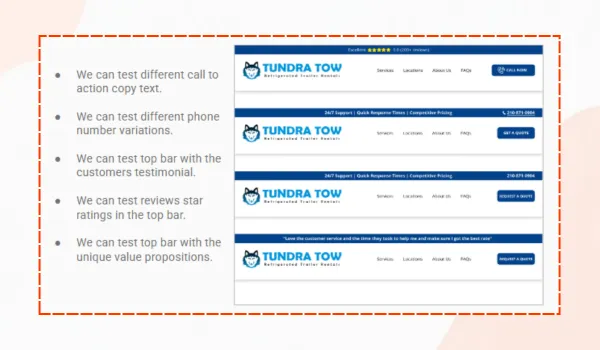
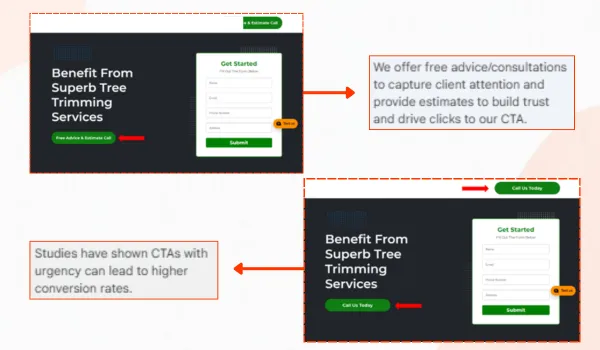
The words on your button, its color, its size, and its placement all affect how many people click it. "Get Started" converts differently than "Start My Free Trial." "Buy Now" converts differently than "Add to Cart."
We test every dimension of your primary CTA including text, color, size, position on the page, and whether it appears above the fold or requires scrolling to find.
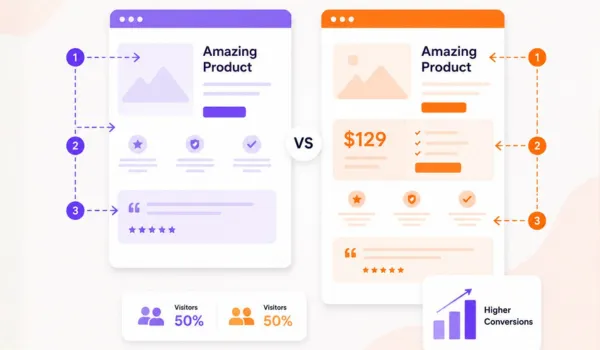
How your page is structured determines what visitors pay attention to and in what order. A layout that leads with price might work differently from one that leads with social proof. A long-form page might convert better than a short one for complex products, or the reverse might be true for impulse purchases.
We test full page layouts to find the structure that moves the most visitors toward your conversion goal.
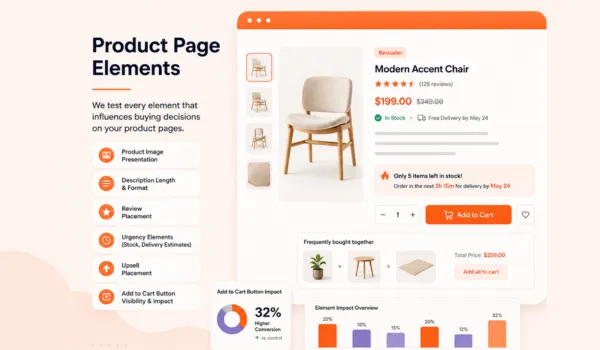
For ecommerce stores, the product page is where buying decisions are made. We test product image presentation, description length and format, review placement, urgency elements like stock indicators and delivery estimates, upsell placement, and the visual weight of the add to cart button.
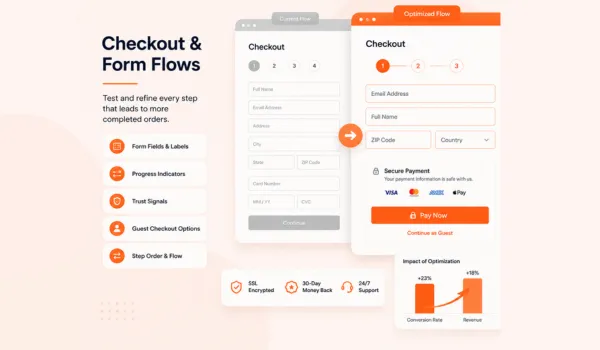
You need at least 1,000 unique visitors and 100 conversions per variant before drawing conclusions from an A/B test. Checkout is where the highest-value conversions happen, so even small improvements here have an outsized revenue impact.
We test the number of form fields, field labels and placeholder text, progress indicators, trust signals near payment fields, guest checkout options, and the order of steps in your checkout process.
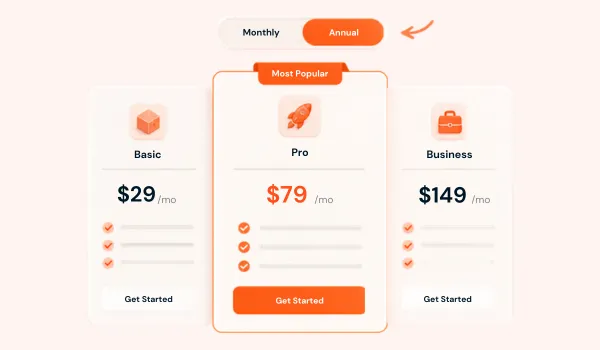
How you display pricing affects perceived value, not just sticker shock. We test annual versus monthly pricing toggles, how savings are communicated, whether to lead with your highest tier or your most popular one, and how competitor comparisons affect conversion on pricing pages.
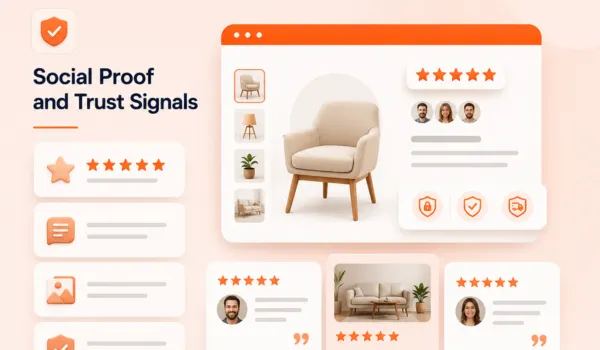
The type, placement, and format of reviews and trust signals all affect how much they reassure hesitant visitors. We test star ratings near headlines versus at the bottom of the page, photo reviews versus text-only reviews, specific review quotes versus aggregate scores, and third-party trust badges in different positions.
We follow a structured, repeatable process that produces consistent results across every client engagement. Here is exactly what working with ConversionXperts on A/B testing looks like.
Before we write a single test hypothesis, we study your website the way a real visitor would. We review your Google Analytics data to understand where visitors are coming from, where they are dropping off in your funnel, and which pages are underperforming relative to the traffic they receive.
We layer in heatmap data to see where visitors click, how far they scroll, and which elements get ignored. We watch session recordings to observe real visitor behavior. We review your existing customer feedback and any survey data you have.
This research phase is not a formality. It is where we identify the real friction points in your conversion funnel, and it is what separates tests that produce meaningful results from tests that produce noise.

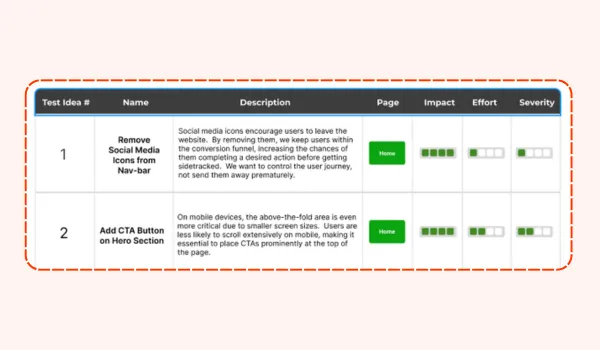
Every test we run starts with a clear, documented hypothesis. A hypothesis is not just a change you want to make. It is a specific prediction about how a change will affect a specific metric, based on evidence from your research.
For example: "We believe that replacing the generic product description on the homepage hero with a specific outcome-focused headline will increase hero click-through rate because our heatmap data shows 73% of visitors are scrolling past the current hero without engaging."
That kind of hypothesis gives the test a clear purpose and makes the results interpretable regardless of which variation wins.
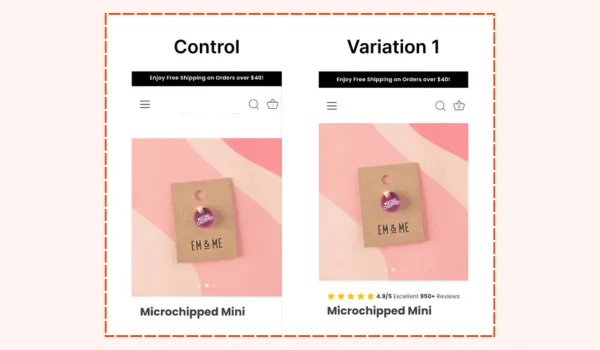
We design the test variations to isolate the change we are measuring. We build the variations using your testing platform, either through a visual editor or with front-end development support when the test requires more complex changes.
Before any test goes live, we run a full quality assurance check. We verify that the test renders correctly across all major browsers and devices. We confirm that conversion tracking is firing correctly for all variations. We check that the traffic split is configured properly. 52% of businesses do not have a specific process to QA experiments before launching them. This explains a lot about why so many programs struggle to prove ROI. We do not skip this step.
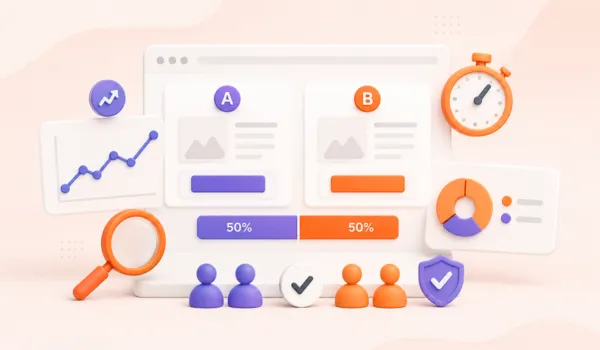
Once the test is live, we monitor it daily for technical issues, unexpected anomalies, and early directional signals. We do not call winners early. We let tests run until they reach statistical significance, meaning the results are reliable enough to act on with confidence.
To reach statistical significance at a 95% reliability rate, you need an A/B testing sample size of 5,000 unique visitors per variation and 100 conversions on each objective per variation. We calculate the required sample size before every test so you know how long it will take to get a clear result.
When a test concludes, we do not just tell you which variation won. We document what we learned, why we think the winner performed better, and what that insight tells us about your visitors' behavior and preferences.
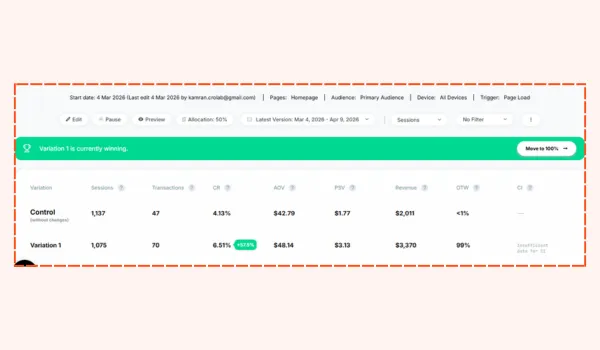
We implement the winning variation and move to the next test on your roadmap. The insights from each test inform the hypotheses for future tests, creating a compounding cycle of improvement.
Businesses that run 10 or more tests per month grow revenue 2.1x faster than those running fewer than 2 tests per month. The pace of your testing program directly affects the pace of your growth.

A/B testing is valuable for almost any business with a website. But professional A/B testing services make the most sense for certain types of businesses.
If you are running an online store, your conversion rate is directly tied to your revenue. Companies with formal CRO programs see a median ROI of 223% according to Econsultancy's 2024 research. Even a 0.5% improvement in conversion rate across thousands of monthly visitors adds up to significant additional revenue every month. We work with ecommerce businesses on Shopify, WooCommerce, Magento, and custom platforms to optimize product pages, collection pages, cart experiences, and checkout flows.
For SaaS companies, the most important conversions happen at specific moments: a free trial sign-up, an upgrade from a free plan, a renewal decision. Each of these moments can be optimized through testing.
We help SaaS businesses reduce trial-to-paid friction, improve onboarding completion rates, and increase plan upgrade rates through targeted experimentation.
If your website exists to generate leads for a service business, professional firm, or B2B company, A/B testing helps you increase the percentage of visitors who fill out your contact form, call your number, or request a consultation.
We test form length, page layout, headline messaging, social proof elements, and offer framing to find the combination that generates the most qualified leads at the lowest cost.
If you are spending money on Google Ads, Meta Ads, or any other paid traffic source, the conversion rate of your landing pages directly affects your cost per acquisition. A 25% conversion lift from testing, as achieved by Esri using targeted content testing, means every dollar of ad spend goes significantly further.
Testing your landing pages is one of the highest-return investments you can make as a paid traffic advertiser.
If you look at your analytics and feel like your website should be performing better than it is, that feeling is usually correct. A proper testing program will tell you exactly what needs to change and exactly how much those changes are worth.
There are agencies that will install a testing tool on your website and run a few tests. That is not what we do.
We build a structured, strategy-led experimentation program around your specific business goals. Every test we run is rooted in data from your actual visitors. Every hypothesis we form is tied to a specific revenue opportunity. Every result we share is explained in plain language with a clear recommendation for what to do next.
We bring expertise across user psychology, analytics, front-end development, and conversion optimization. That combination matters because effective A/B testing requires all of these disciplines working together. A good hypothesis needs analytics expertise and psychological insight. A properly implemented test needs technical precision. A correctly interpreted result needs statistical understanding.
We also believe in building your internal capability, not just running tests for you. Over time, we help your team develop a deeper understanding of your customers and a more sophisticated approach to optimization. The goal is for your business to keep improving even as our engagement evolves.
Marketers who prioritize CRO are 3.5 times more likely to report year over year revenue growth according to HubSpot's 2024 Marketing Report. We want your business to be one of those businesses.
Depending on your specific needs, we offer specialized testing services under our main A/B testing practice.
VWO stands for Visual Website Optimizer. It is a comprehensive, enterprise grade experimentation and conversion optimization platform trusted by thousands of businesses around the world, from fast growing startups to global enterprises.
Optimizely Experimentation is an enterprise-grade platform that allows businesses to run controlled experiments across their websites, mobile apps, and backend systems. It is built for teams that need reliable data before they make changes that affect thousands or millions of users.
AB Tasty is a digital experience optimization platform used by over 1,000 brands worldwide. It enables businesses to test, personalize, and optimize digital experiences with AI-powered experimentation and personalization.
Convert Experiences is a professional-grade A/B testing and web personalization platform. It offers flicker-free test delivery, privacy-compliant tracking, and robust integrations for serious experimentation programs.
Visually.io is a Shopify-native A/B and multivariate testing platform built specifically for e-commerce. It lets Shopify merchants test product pages, collections, and checkout flows without needing code.
Varify.io is an A/B testing and website experimentation platform that allows businesses to test different variations. It is privacy-first and GDPR-compliant, with support for cookieless experimentation.
Intelligems is a Shopify-native experimentation platform purpose-built for e-commerce brands. It specializes in price testing, offer optimization, and profit-focused experimentation to lift revenue.
A/B testing in digital marketing is the process of comparing two versions of a webpage, email, or ad to see which one produces more of your desired outcome, such as purchases, sign-ups, or leads. One version is shown to one group of visitors, the other version to a second group, and the results are measured until there is enough data to declare a statistically significant winner.
The time needed depends on your traffic volume and conversion rate. A page receiving 10,000 visitors a month with a 2% conversion rate will reach statistical significance faster than a page with 2,000 monthly visitors and a 0.5% conversion rate. Most tests need between two and six weeks to produce reliable results. We calculate the required run time before every test so there are no surprises.
To reach statistical significance at a 95% reliability rate, you need an A/B testing sample size of at least 5,000 unique visitors per variation and 100 conversions on each objective per variation. If your current traffic is lower than this, we can still run tests but will adjust the timeline expectations and may focus on higher-traffic pages first.
A/B testing compares two versions of a page with one variable changed at a time. Multivariate testing changes multiple elements simultaneously and measures which combination performs best. Multivariate testing produces richer insights but requires significantly more traffic to reach statistical significance. For most businesses, starting with focused A/B tests and graduating to multivariate testing as traffic grows is the right approach.
Start with the pages and elements that have the biggest impact on your conversion funnel and the most traffic. Your homepage headline, your main product page layout, your primary call to action, and your checkout flow are almost always the highest-priority starting points. A proper CRO audit will tell you exactly which pages have the most room for improvement based on your actual data.
A result is reliable when it reaches statistical significance, typically set at 95% confidence. This means there is only a 5% chance the result occurred by random chance. Running tests too short, calling winners too early, or testing with insufficient traffic are the most common causes of unreliable results. We monitor all of these factors for every test we run.
No, when done correctly. Search engines including Google explicitly support A/B testing. The key is using proper techniques like canonical tags, not cloaking content from search engine crawlers, and ending tests promptly once a winner is identified. We follow all best practices to make sure your testing program has no negative impact on your organic rankings.
Companies with formal CRO programs see a median ROI of 223% according to Econsultancy’s 2024 analysis. The ROI of your specific program depends on your current conversion rate, your traffic volume, and the impact of individual test wins. We discuss realistic expectations with every client at the start of an engagement based on your specific numbers.