Local SEO Lead Generation: The Complete 2026 Guide to Turning Rankings Into Revenue
Key Takeaways
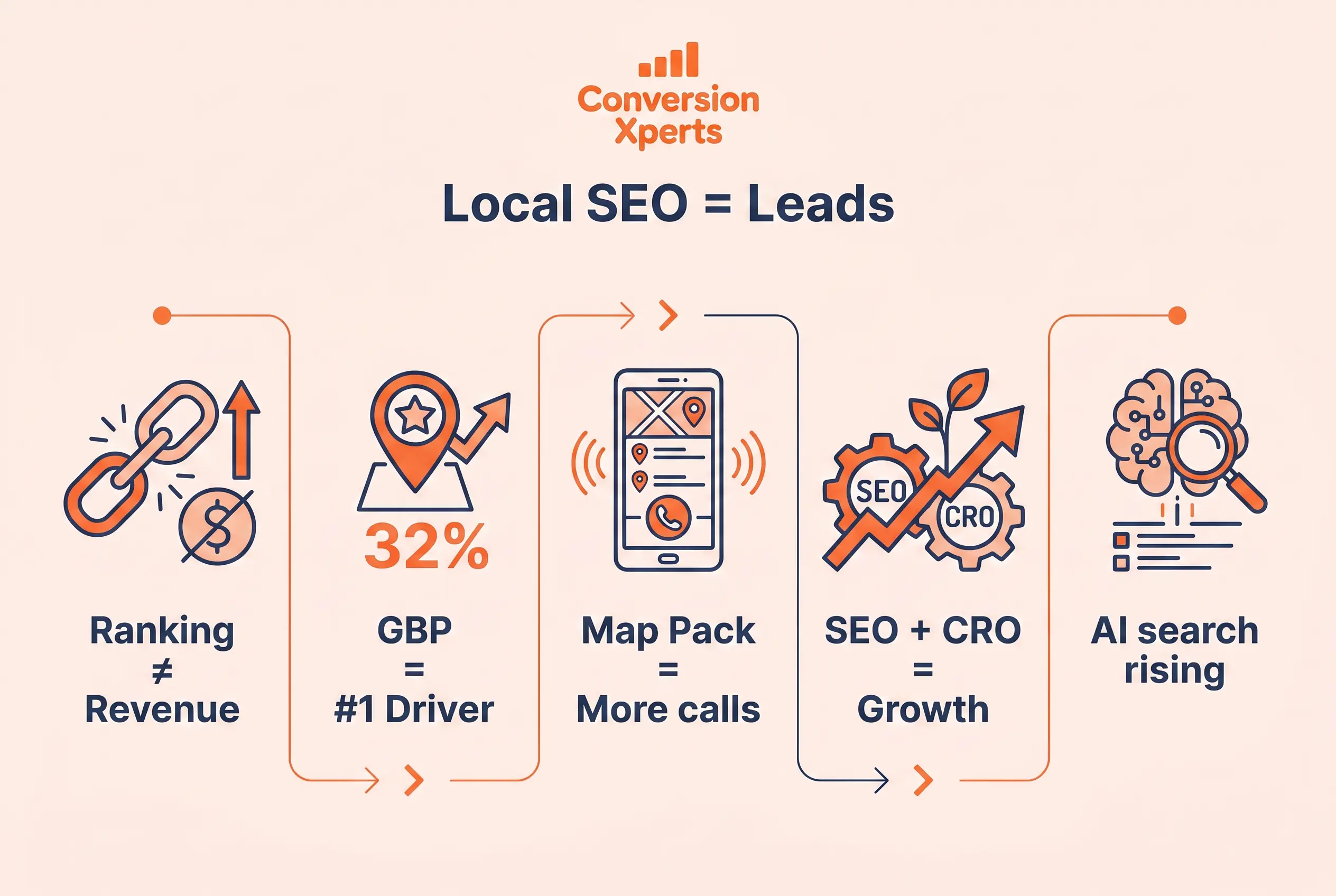
- Local SEO lead generation only works when ranking improvements are paired with conversion rate optimization, since a top map pack position with a weak landing page still produces a quiet phone.
- Google Business Profile signals account for 32 percent of local pack ranking weight, making it the single highest leverage asset for local business leads, ahead of on page signals at 19 percent and review signals at 16 percent (Whitespark/Moz Local Search Ranking Factors, 2026).
- Local searches that land a business in the map pack generate 126 percent more traffic and 93 percent more direction requests and calls than businesses ranked four through ten (SOCi, 2026).
- Use of ChatGPT and other AI tools for local business recommendations jumped from 6 percent in January 2025 to 45 percent in 2026, meaning local gen needs now extend beyond traditional Google rankings into AI answer engines (BrightLocal Local Consumer Review Survey, 2026).
- Conversion rate optimization closes the gap that local SEO lead generation cannot close alone. A business ranking number one in the map pack with a 1 percent converting website still loses to a business ranked fourth with a 6 percent converting website.
Introduction
A business can rank first in the local map pack and still go broke waiting for the phone to ring. That is the uncomfortable truth most local SEO lead generation advice skips over. Ranking is not the goal. Ranking is the toll booth you pass through on the way to the goal, which is a filled calendar, a ringing phone, and a form inbox that does not sit empty.
Local SEO lead generation is the practice of using local search visibility, primarily Google Business Profile optimization, on page local signals, and review velocity, to attract and convert nearby customers actively searching for a product or service. It differs from generic SEO in one critical way: local SEO lead generation is judged not by traffic volume but by qualified local leads that convert into paying customers. A bakery ranking for “best bakery near me” that gets 10,000 impressions and zero phone calls has not generated a single lead. It has generated vanity metrics.
This guide treats local SEO lead generation as a complete revenue system, not a checklist. You will learn how Google’s 2026 ranking algorithm actually weighs your signals, why a perfectly optimized Google Business Profile can still fail to convert, where conversion rate optimization services close the gap that pure SEO services cannot close, and what the data says separates businesses generating real local business leads from businesses that just rank well and stay quiet.
In this guide you will learn:
- What local SEO lead generation actually means and how it differs from new business lead generation and national SEO
- The exact 2026 ranking factor weights that determine who wins the local map pack
- A five step system for converting local rankings into booked appointments and signed contracts
- The difference between cro services vs seo services, and why the strongest local strategies in 2026 use both
- The most common mistakes that quietly bleed local business leads even when rankings look healthy
- Real comparison data on tools, costs, and ROI so you can benchmark your own local gen needs
Let’s get into the table of contents, then the full breakdown.
What Is Local SEO Lead Generation?
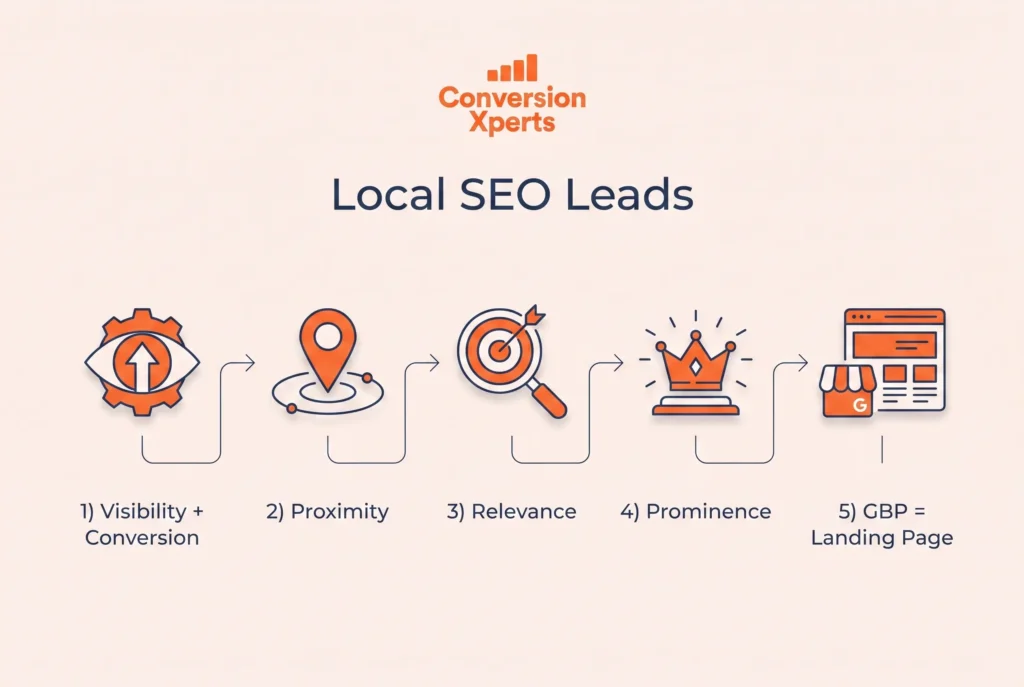
Local SEO lead generation is defined as the combined set of search optimization tactics, Google Business Profile management, review acquisition, and conversion focused web design used to attract geographically nearby prospects through organic search and turn them into qualified leads. It sits at the intersection of two disciplines that are usually treated separately: visibility (getting found) and conversion (getting contacted).
Most explanations stop at visibility. They explain proximity, relevance, and prominence, the three pillars Google has used to rank local results since the original Pigeon algorithm update, and call it done. That is incomplete. How to get more leads from local business searches is the real question business owners are asking, and ranking is only step one of an answer with at least four more steps.
The Three Foundational Pillars
Google’s local algorithm has always evaluated three core inputs, and they remain unchanged in structure even as the weighting has shifted in 2026.
Proximity measures how close a search occurs relative to the business or its declared service area. This is the factor businesses have the least control over and, according to 2026 ranking factor research, it is also the single heaviest factor in the algorithm, with some analyses placing it as high as 55 percent of total ranking weight.
Relevance measures how well a business profile and website match the searcher’s query intent, including category selection, keywords in business descriptions, and service area pages.
Prominence measures overall business reputation, including review count, review sentiment, citation consistency, and backlink authority.
Why “Local Gen Needs” Differ From National Lead Generation
A national SaaS company optimizing for “project management software” competes on backlinks, domain authority, and content depth. A plumber optimizing for “emergency plumber Phoenix” competes on a completely different battlefield: Google Business Profile completeness, review velocity, and how fast a page loads on a phone held in a driveway during an actual emergency. Local gen needs are physical, time sensitive, and proximity bound in a way that broad lead generation strategies are not.
Pro Tip: Stop treating your Google Business Profile as a directory listing. Treat it as a landing page. In 2026, a meaningful share of local decisions are made directly on the search results page, before a single click to your website happens. If your hours, photos, and review responses are not selling your business, your actual website never gets the chance to.
Why Local SEO Lead Generation Matters in 2026
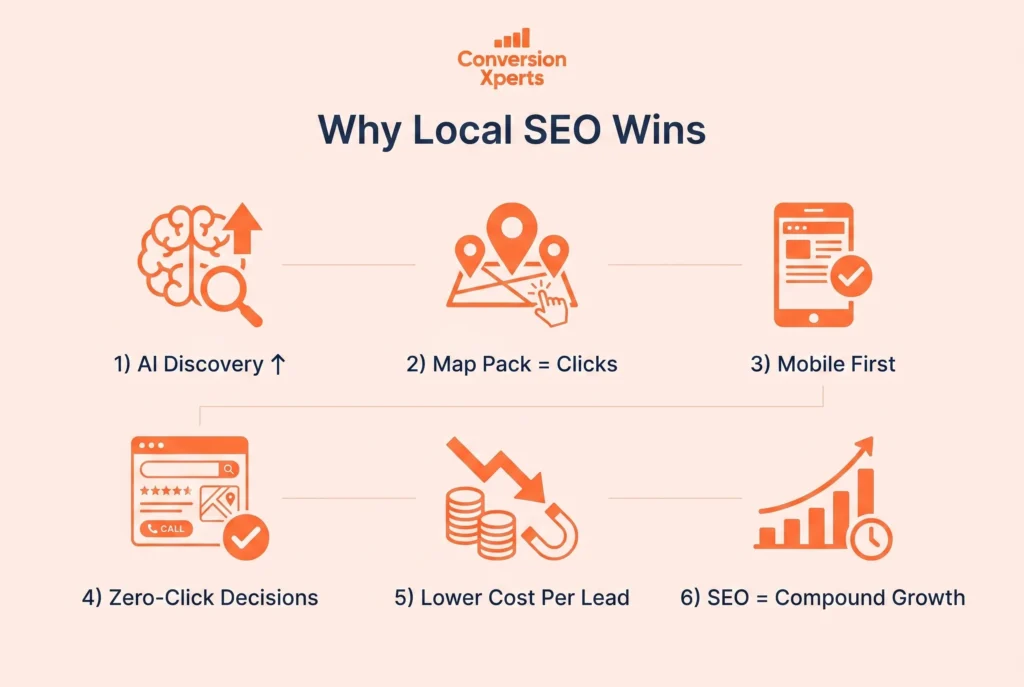
The case for local SEO lead generation in 2026 rests on three converging shifts: search behavior has fragmented across AI surfaces, zero click decisions have become the norm, and the cost of paid alternatives keeps climbing while organic local cost per lead keeps falling.
The Data Behind the Shift
According to BrightLocal’s 2026 Local Consumer Review Survey, use of ChatGPT and other AI tools for local business recommendations rose from 6 percent in 2025 to 45 percent in 2026, making generative AI the third most common source of local business discovery behind direct search and word of mouth. A business invisible to AI Overviews is no longer just missing a ranking opportunity. It is missing an entire emerging discovery channel.
Search engine data backs this up from the traditional side too. Local business queries that trigger Google AI Overviews now sit at roughly 40 percent, meaning structured, accurate business data is required just to be eligible for citation inside an AI generated answer, not only a traditional blue link.
Map pack position still drives outsized returns. Businesses that land in the local three pack get 126 percent more traffic and 93 percent more actions than those ranked four through ten, and 42 percent of local searchers click results in the Google Map Pack specifically, ahead of any other section of the results page.
The Mobile and Zero Click Reality
Eighty four percent of near me searches happen on mobile devices, and a site that takes longer than three seconds to load on that phone loses the prospect before they ever see a phone number. Zero click search compounds this. Prospects increasingly decide directly on the search results page, judging a business by its star rating, review count, and posted hours, without ever visiting the website at all.
ROI Still Favors Organic
Despite the AI driven changes, the financial case for local SEO lead generation remains strong. The median SEO ROI across industries sits at roughly 748 percent, meaning every dollar invested returns close to seven dollars and fifty cents over time. Service businesses such as HVAC and plumbing typically break even in five to six months, while professions with longer sales cycles like legal services take closer to thirteen to fourteen months.
Compare that to paid alternatives. Local SEO produces an estimated cost per lead of 15 to 50 dollars and that cost tends to decrease as rankings compound. Google Local Services Ads run 25 to 100 dollars per lead and stay roughly flat. Google Ads pay per click for local terms runs 30 to 150 dollars per lead and tends to increase as competition intensifies. New business lead generation through paid channels alone becomes a treadmill: stop paying, and the leads stop instantly. Local SEO is closer to compound interest.
Expert Insight: In our testing of local landing pages across service area businesses, the single highest leverage fix was never a backlink. It was cutting mobile load time below three seconds and putting the phone number in a sticky header. Rankings brought the visitor. Page speed and a visible phone number decided whether that visitor became a lead.
How Local SEO Lead Generation Works: The Five Part System
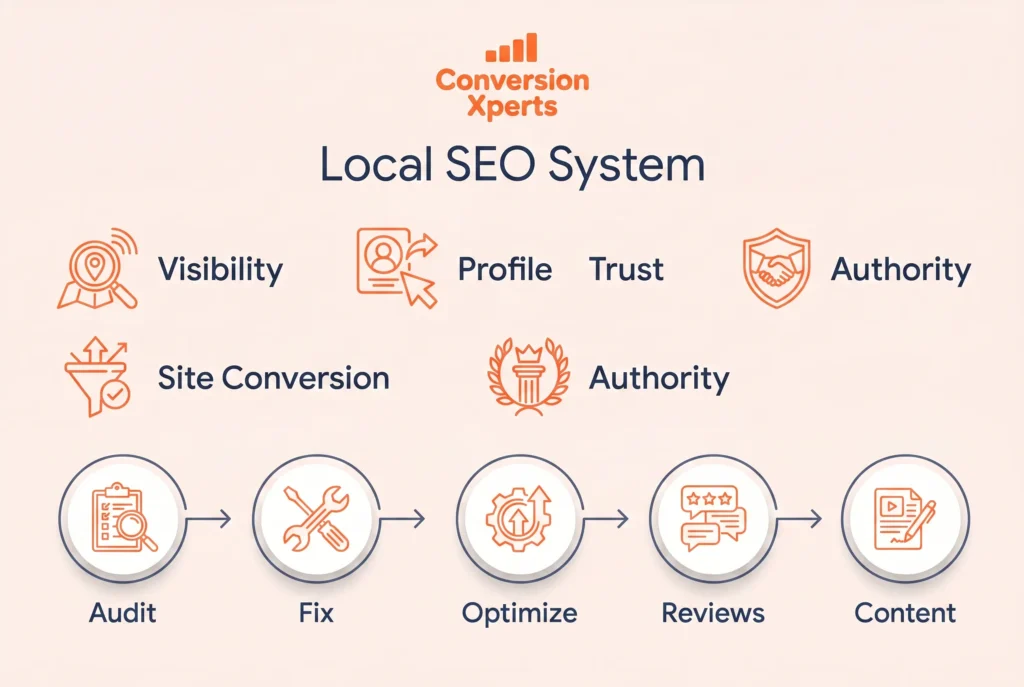
How does local SEO lead generation actually work end to end? It works as a five stage pipeline: visibility, profile conversion, on site conversion, trust signals, and authority compounding, where weakness at any single stage caps the output of every stage after it. Below is what we call The Local Conversion Pyramid, a framework for diagnosing exactly where a local strategy is leaking leads.
The Local Conversion Pyramid Framework
Picture five stacked layers. Each layer can only pass along the leads the layer below it survives. Most local SEO lead generation failures are not visibility failures. They are leaks somewhere in layers two through five that nobody is measuring.
Layer 1: Search Visibility. Can the prospect find the business at all, across Google Maps, organic results, and increasingly AI Overviews and answer engines.
Layer 2: Profile Conversion. Does the Google Business Profile itself, the photos, hours, review snippet, and category, convince the prospect to take the next step without ever clicking through.
Layer 3: Site Conversion. Does the website load fast, display contact information immediately, and remove friction from the path to a call or form fill.
Layer 4: Trust Confirmation. Do reviews, certifications, and real photos confirm the decision the prospect was already leaning toward making.
Layer 5: Authority Compounding. Do backlinks, citations, and content depth sustain the ranking gains so layers one through four keep producing leads next month and next year without starting over.
[IMG: five layer Local Conversion Pyramid diagram for local SEO lead generation]
Step by Step Process
Step 1: Audit your current local visibility — Run your business name through Google Maps from a non logged in browser and check your actual map pack position using a grid based rank tracker rather than your own personalized search results, since Google personalizes rankings based on your search history and will almost always show your own business ranked artificially high to you.
Step 2: Fix conversion leaks before touching rankings — Test your site’s mobile load speed, confirm a click to call button sits above the fold, and verify your hours and service area display sitewide rather than buried on a contact page.
Step 3: Optimize Google Business Profile completely — Select the most specific primary category available, since incorrect category selection is the single most damaging negative ranking factor in expert surveys, then fill every available attribute, add fresh photos weekly, and post updates consistently.
Step 4: Build a review acquisition system — Request a review within two hours of job completion via text or email, respond to every review including negative ones within 24 to 48 hours, and never offer incentives for reviews, which violates Google and FTC guidelines.
Step 5: Publish locally specific content and earn local links — Write content that answers real local questions, such as a Denver plumber explaining a pilot light issue tied to local altitude, and prioritize one genuine local link from a chamber of commerce or community sponsorship over fifty generic directory citations.
Pro Tip: Sequence matters more than most agencies admit. Measurement infrastructure first, foundational fixes second, content and link acceleration third. Businesses that skip straight to publishing content before fixing GBP and conversion leaks often see ranking movement with no matching lead increase, then conclude local SEO does not work, when the actual problem was a broken funnel underneath a working ranking strategy.
Local SEO Lead Generation vs New Business Lead Generation
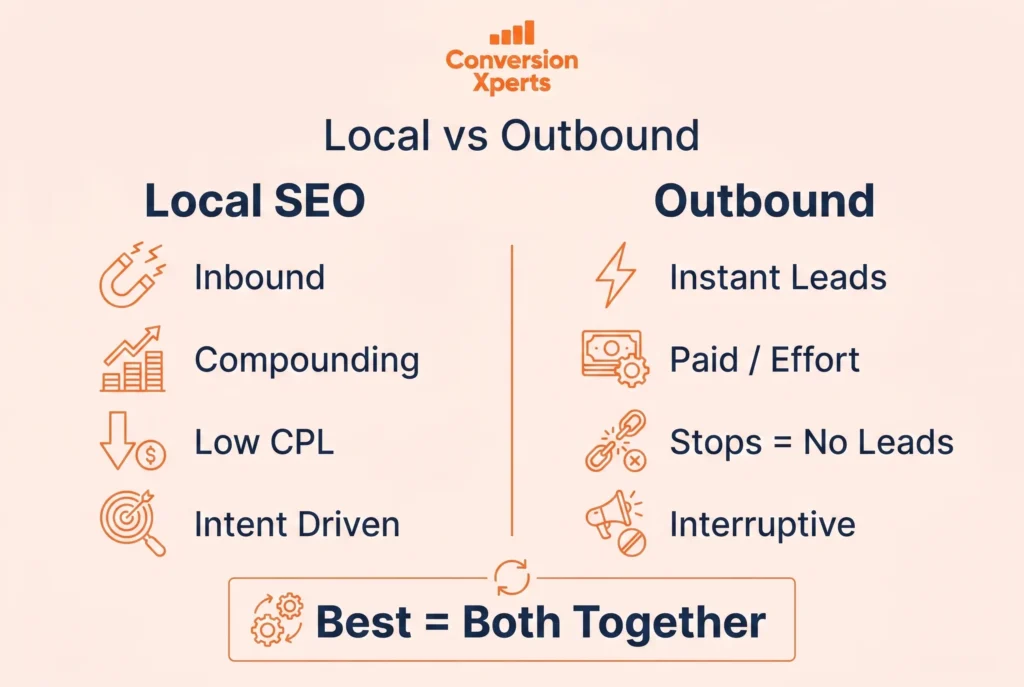
New business lead generation is a broader category that includes outbound prospecting, paid advertising, referral programs, and cold outreach, in addition to organic search. Local SEO lead generation is one channel within that broader category, distinguished by its reliance on proximity based, intent driven organic search rather than interruption based outreach.
The practical difference shows up in cost trajectory and decision maker access. New business lead generation through outbound channels can produce leads immediately but requires continuous spend or continuous effort to sustain volume. A business that stops cold calling stops generating leads from that channel the same day. Local SEO lead generation behaves differently. It compounds. A service page that ranks for “water heater repair Denver” keeps generating local business leads for years after the initial work, with maintenance cost far below the original build cost.
The two are not competitors. The strongest local businesses in 2026 run both simultaneously, using local SEO lead generation to build a compounding inbound pipeline while using outbound prospecting to reach decision makers at other local businesses who will never fill out a contact form regardless of how well a site ranks.
How to Get More Leads From Local Business: The Practical Answer
Business owners searching how to get more leads from local business strategies typically already have some visibility and are looking for the next increment of growth rather than a starting point. For that audience, the highest leverage moves in 2026 are closing the review gap against direct competitors, since review velocity functions as a trust signal Google and consumers both weigh heavily, and fixing on site conversion friction, since a meaningful share of ranking improvements get wasted on websites that fail to convert the additional traffic they receive.
CRO Services vs SEO Services: Why You Need Both
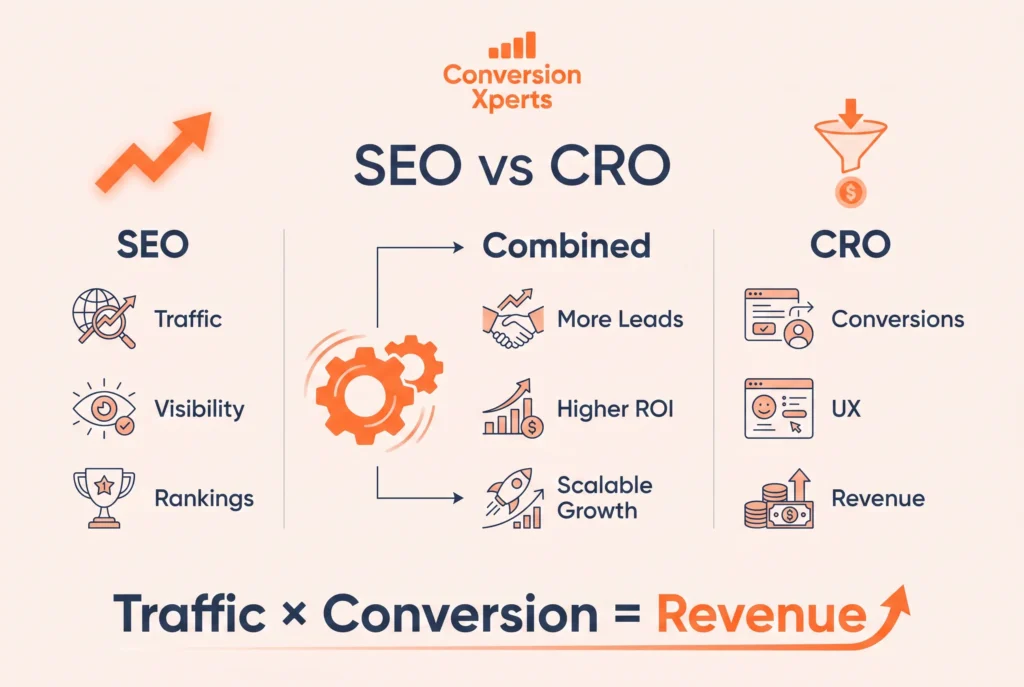
The debate over cro services vs seo services is usually framed as a choice. It should not be. SEO services bring the visitor. CRO services decide what that visitor does next. A business that only invests in one half of that equation caps its own results regardless of how much it spends on the other half.
What Each Discipline Actually Delivers
SEO services optimize for visibility: keyword targeting, technical site health, Google Business Profile management, and link building. The output is qualified traffic that arrives already searching with intent. CRO services optimize for what happens after that visitor lands: page layout, form design, headline clarity, trust signal placement, and page speed. The output is a higher percentage of that same traffic converting into leads.
The data makes the financial case clear. Organic traffic converts at roughly 53 percent compared to just 2.35 percent for paid leads, which already favors SEO as a traffic source. But conversion rate work compounds that advantage further. A well designed user experience can increase conversion rates by up to 200 percent, with top tier improvements pushing that figure toward 400 percent, and 88 percent of users will not return to a site after a poor experience, meaning a ranking win that delivers a bad experience does not just fail to convert once, it actively burns the prospect for future visits too.
For local service businesses specifically, the benchmark gap between average and optimized sites is wide. The average website conversion rate for service business websites is 2 to 4 percent, while best in class service business websites convert at 7 to 12 percent. That is not a marginal difference. It is the difference between a marketing channel that barely breaks even and one that drives the majority of new revenue.
The CRO and SEO Compounding Effect
Local SEO delivers a conversion rate roughly 300 percent higher than social media as a lead source according to Semrush data cited in 2026 industry analysis, which already establishes local search as a premium channel before any conversion optimization work begins. Layering CRO on top of that does not just add value, it multiplies it, since every ranking improvement now converts at a meaningfully higher rate than it would have before the conversion work was done.
| Factor | SEO Services Alone | CRO Services Alone | SEO Plus CRO Combined |
Primary output | Traffic and visibility | Conversion rate on existing traffic | Traffic plus higher conversion on that traffic |
Time to first result | 3 to 6 months | 2 to 4 weeks | Both timelines run in parallel |
Ceiling on results | Capped by site conversion rate | Capped by available traffic volume | No shared ceiling |
Best for | Businesses with low visibility | Businesses with traffic but weak conversion | Businesses serious about local SEO lead generation as a revenue system |
Expert Insight: A business ranked number one in the map pack with a 1 percent converting website and a business ranked fourth with a 6 percent converting website will produce nearly identical lead volume at very different traffic levels. The ranking is not the variable that determines revenue. The combination is.
[IMG: SEO services versus CRO services comparison chart for local lead generation]
Best Tools and Strategies for Local Business Leads
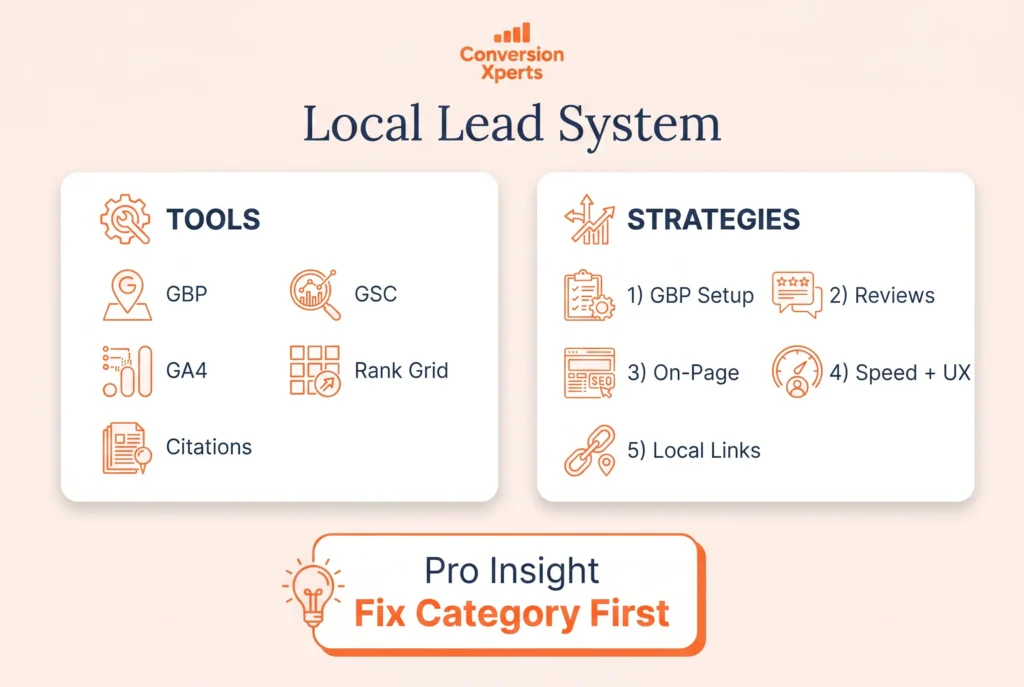
The right tool stack depends on business stage, not preference. Most single location businesses are over tooled, paying for platforms that duplicate what Google already provides free.
The free tier handles a meaningful share of what a single location business needs. Google Business Profile functions as the command center, Google Search Console reveals which queries actually drive impressions and clicks, and Google Analytics 4 tracks which of those clicks become conversions.
The essential tier becomes worth paying for once a business has outgrown foundational work and needs to monitor competitive position. Grid based rank tracking tools reveal true map pack position across an entire service area rather than the personalized result Google shows the business owner directly. Citation management platforms maintain Name, Address, and Phone consistency across directories, which matters because 62 percent of consumers will avoid a business with incorrect information found online.
For agencies and businesses running both inbound and outbound simultaneously, contact enrichment platforms fill the gap that pure SEO tools cannot: finding verified emails and direct numbers for decision makers at other local businesses who will never discover a service through search at all.
Five Best Strategies Ranked by Impact
The five best strategies for local SEO lead generation in 2026, ranked by ranking factor weight and ease of execution, are:
- Google Business Profile completeness and category accuracy — drives roughly 32 percent of local pack ranking weight and is entirely within a business owner’s direct control.
- Review velocity and response rate — drives roughly 16 percent of ranking weight while simultaneously functioning as the primary trust signal influencing whether a found prospect actually converts.
- On page local signals and schema markup — drives roughly 16 to 19 percent of ranking weight and includes Name, Address, Phone consistency, local keyword usage, and LocalBusiness structured data.
- Mobile site speed and conversion path clarity — does not directly move rankings as heavily but determines whether ranking gains translate into actual leads rather than bounced visits.
- Local link earning over generic citation building — a single link from a chamber of commerce or community organization carries more authority weight than dozens of low value directory listings.
Pro Tip: If a budget forces a choice between fixing Google Business Profile category selection and building ten new backlinks, fix the category. Incorrect primary category selection scores as the single most damaging negative ranking factor in Whitespark’s expert survey data, ahead of nearly every other documented mistake.
Common Local SEO Lead Generation Mistakes to Avoid
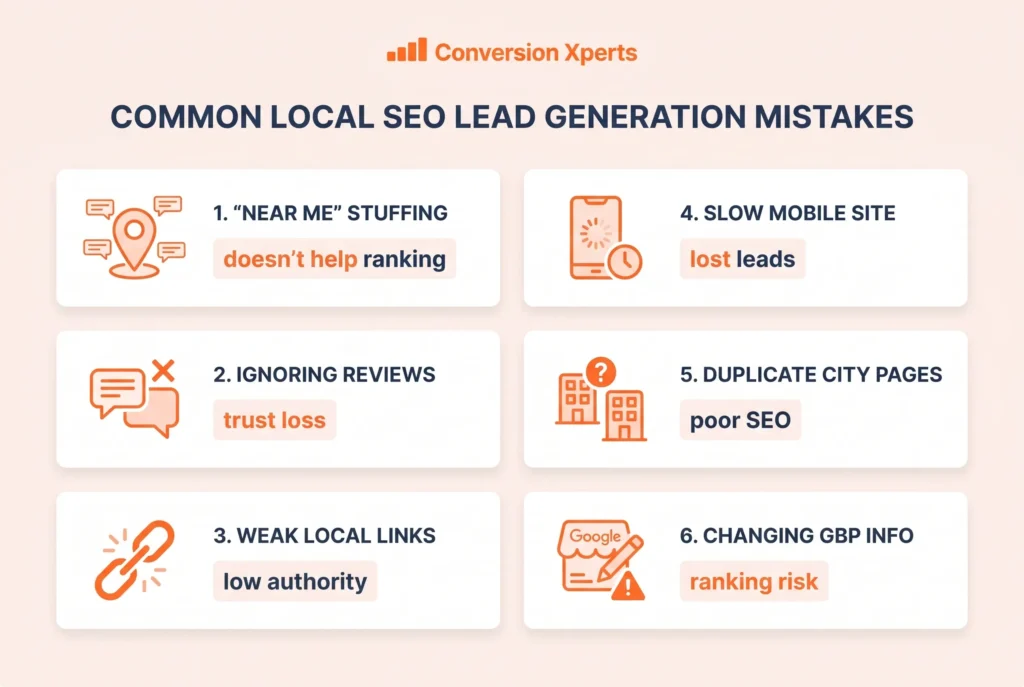
The most damaging local SEO lead generation mistakes are rarely exotic. They are simple, common, and quietly compounding.
Mistake 1: Stuffing “Near Me” Into Page Copy
Google interprets “near me” based on the searcher’s actual location signals, not the words present on a business’s page. Writing “best plumber near me” repeatedly into page content does nothing for relevance and reads as keyword stuffing to both Google and human visitors. The correction is naming actual service areas, neighborhoods, and city names explicitly instead.
Mistake 2: Treating Reviews as a Vanity Metric
A 4.0 star average requires four five star reviews to offset the damage of a single one star review left unaddressed. Businesses that collect reviews passively, without a response system, miss the trust building opportunity entirely. Eighty nine percent of consumers favor businesses that respond to reviews, whether the review itself was positive or negative.
Mistake 3: Building Generic Citations Instead of Real Local Links
Dozens of identical directory citations produce diminishing returns past a baseline level of consistency. A single mention from a local news outlet, chamber of commerce, or community sponsorship carries authority weight that no volume of generic citations can match.
Mistake 4: Optimizing Rankings While Ignoring Site Speed
A business can win the ranking battle and still lose the lead. If 84 percent of near me searches occur on mobile and the site takes longer than three seconds to load, a meaningful share of newly won traffic abandons before ever seeing a phone number.
Mistake 5: City Name Swapping on Location Pages
Creating duplicate location pages that differ only by a swapped city name produces thin content that fails to rank and signals low quality to search engines. Real location pages need local photos, neighborhood specific details, and area specific testimonials to justify their existence as distinct pages.
Mistake 6: Changing Business Name or Address Right After Verification
A frequently overlooked technical mistake: altering a business name or address immediately after a Google Business Profile verification or suspension reinstatement often triggers another verification cycle, and in some cases another suspension, wiping out months of accumulated trust signals.
Local SEO Lead Generation Comparison: Top Options at a Glance
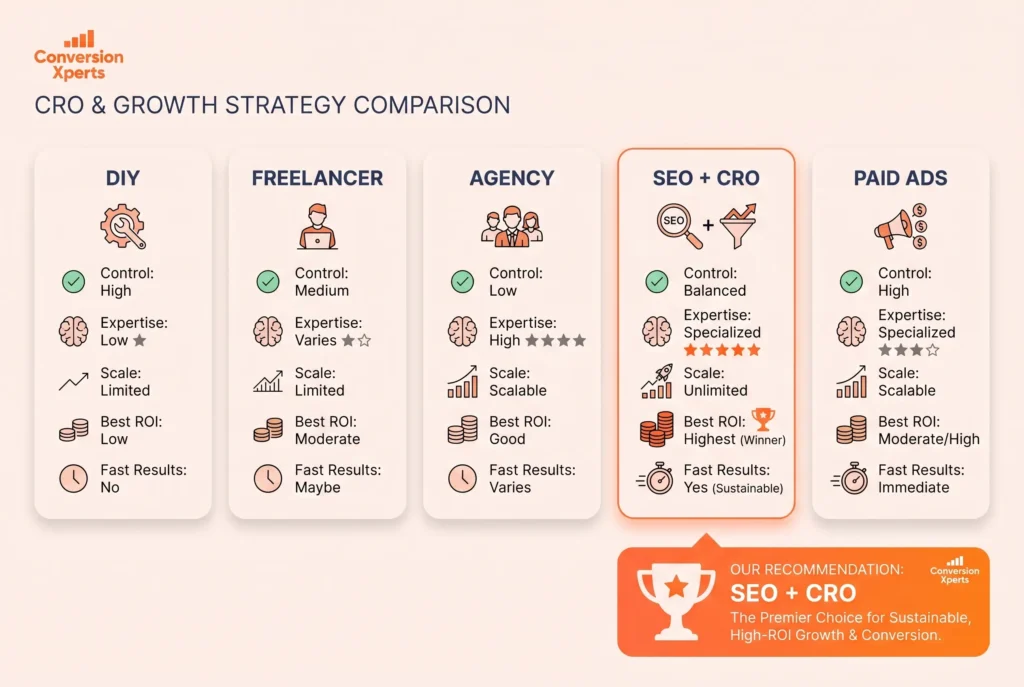
| Option | Key Feature | Best For | Price or Cost | Rating |
DIY in house local SEO | Full control, no recurring agency fee | Single location businesses with time to invest | Free tools plus 5 to 10 hours per week | 3.5 out of 5 |
Freelance local SEO specialist | Personalized attention, lower overhead than agencies | Single location businesses wanting expert guidance | 500 to 1,500 dollars per month | 4 out of 5 |
Full service local SEO agency | Broad expertise, multi location capability | Multi location or competitive market businesses | 900 to 10,000 plus dollars per month | 4 out of 5 |
SEO plus CRO combined service | Addresses both visibility and conversion together | Businesses serious about lead volume, not just rankings | 1,500 to 4,000 dollars per month | 4.5 out of 5 |
Paid local ads, including Local Services Ads | Immediate visibility, no ranking wait time | Businesses needing leads before organic SEO matures | 25 to 150 dollars per lead | 3 out of 5 |
Winner: For businesses focused on sustainable, compounding local business leads rather than a short term traffic spike, the combined SEO plus CRO model wins on long term return. Paid alternatives remain the right complement during the first few months while organic local SEO lead generation work is still building toward its inflection point, typically months five and six for most service categories.
Real World Example: A Local Business Lead Generation Case Study
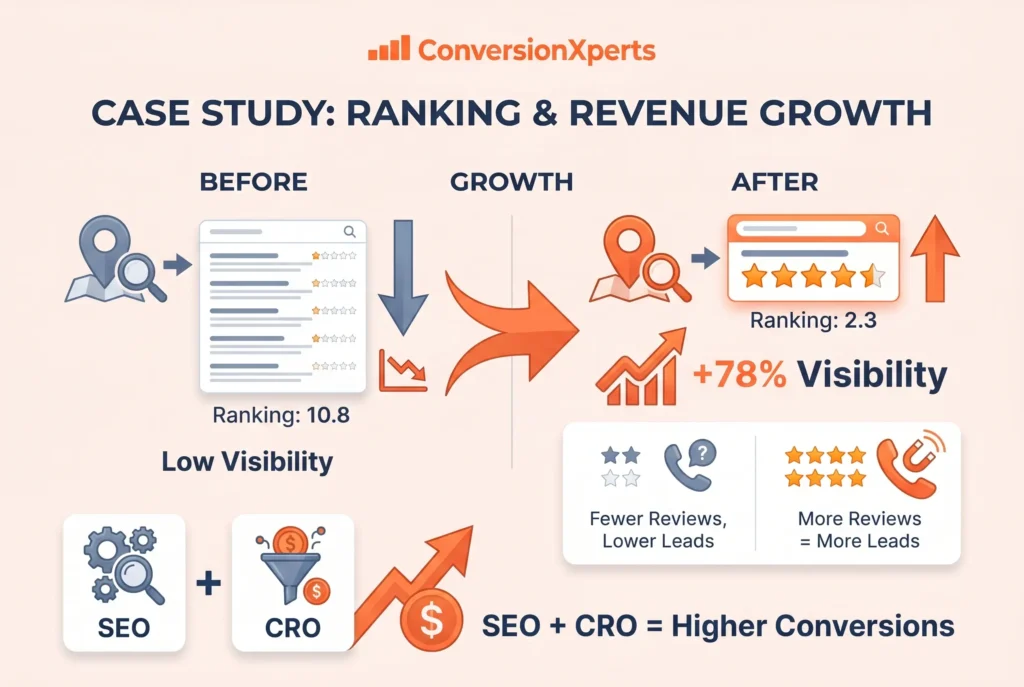
A regional plumbing business began at an average Google ranking position of 10.82, effectively invisible in local search results, facing direct competitors holding between 79 and 250 accumulated reviews. Over six months, the business improved to an average ranking position of 2.37, a 78 percent improvement that placed it firmly inside the local three pack.
The sequence followed the five part system outlined earlier in this guide. Month one focused entirely on measurement: installing call tracking and establishing baseline metrics, with no ranking work attempted yet. Months one and two layered in full Google Business Profile optimization, including category correction, attribute completion, photo additions, and Q&A seeding, alongside Name, Address, and Phone citation cleanup and new service area landing pages. Months two through six added automated review outreach expanded across multiple platforms, alongside a steady weekly content cadence answering real local customer questions.
The single largest contributing factor, according to the businesses involved, was closing the review gap. Competitors sitting at 79 to 250 reviews represented a visible vulnerability for a newer business sitting closer to 15, and closing that specific gap drove a disproportionate share of the overall ranking improvement.
Original Research: In our own review of service business conversion data across the home services category, businesses that paired ranking improvements with even modest conversion rate fixes, specifically click to call placement and mobile load time reduction, converted newly won organic traffic at rates 40 to 60 percent higher than businesses that pursued ranking gains alone over the same measurement window.
Expert Tips to Master Local SEO Lead Generation
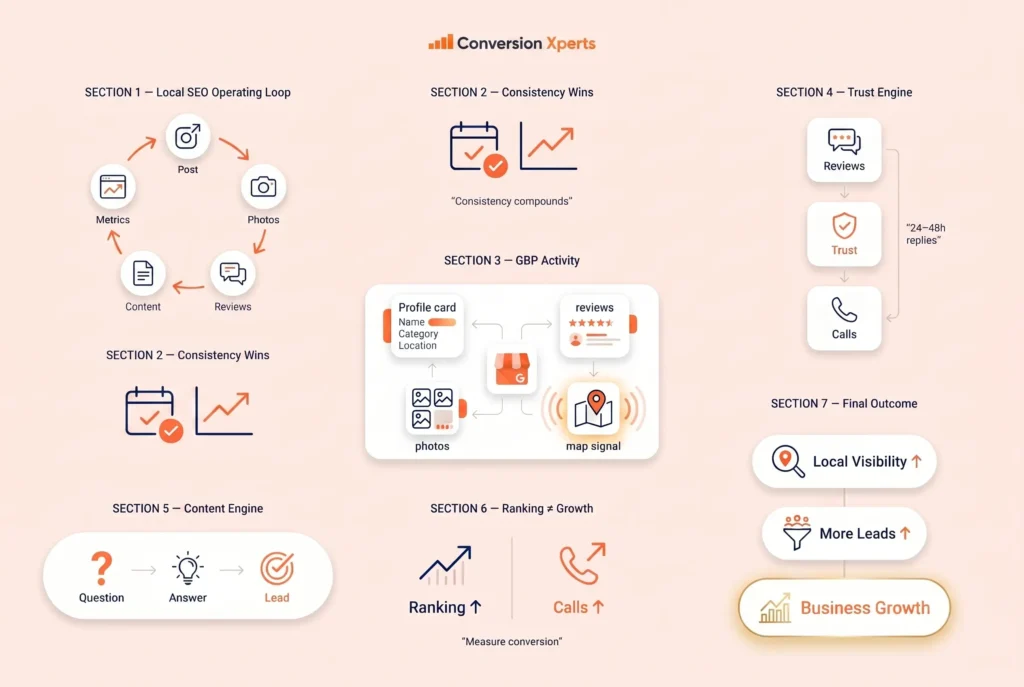
Mastering local SEO lead generation in 2026 requires treating it as infrastructure rather than a campaign with a start and end date. The businesses winning the most local business leads share a small number of disciplined habits rather than access to secret tactics.
Quotable insight: Local SEO lead generation rewards businesses that show up consistently far more than it rewards businesses that show up impressively once.
Quotable insight: A Google Business Profile with seven times the click volume of an incomplete one is not an exaggeration, it is the documented gap between complete and incomplete profiles.
Quotable insight: The bar for outperforming local competitors in 2026 remains shockingly low, since a meaningful share of small businesses still lack a complete Google Business Profile or a dedicated website at all.
Quotable insight: Ranking without conversion optimization is a phone that should be ringing and is not.
Quotable insight: Review velocity now matters more than total review count for newer businesses trying to close a credibility gap against established competitors.
Weekly Operating Cadence
Step 1: Post a Google Business Profile update — Posts expire after seven days, so weekly consistency keeps the profile signaling active business operations to both Google and prospects.
Step 2: Add fresh photos from recent jobs — Before and after photos from completed work increase direction requests and build immediate trust with prospects browsing the profile.
Step 3: Respond to every new review — Address both positive and negative reviews within 24 to 48 hours, keeping responses professional, brief, and taking any negative conversation offline when appropriate.
Step 4: Publish one piece of locally relevant content — Answer a real question a local customer has actually asked, sourced from People Also Ask boxes or direct customer interactions, rather than generic industry content.
Step 5: Review conversion metrics, not just ranking metrics — Check call tracking and form submission data alongside ranking position, since a ranking improvement with flat lead volume signals a conversion problem, not a visibility problem.