Learn Conversion Rate Optimization: The Ultimate Guide (2026)
What Is Conversion Rate Optimization and Why Does It Matter
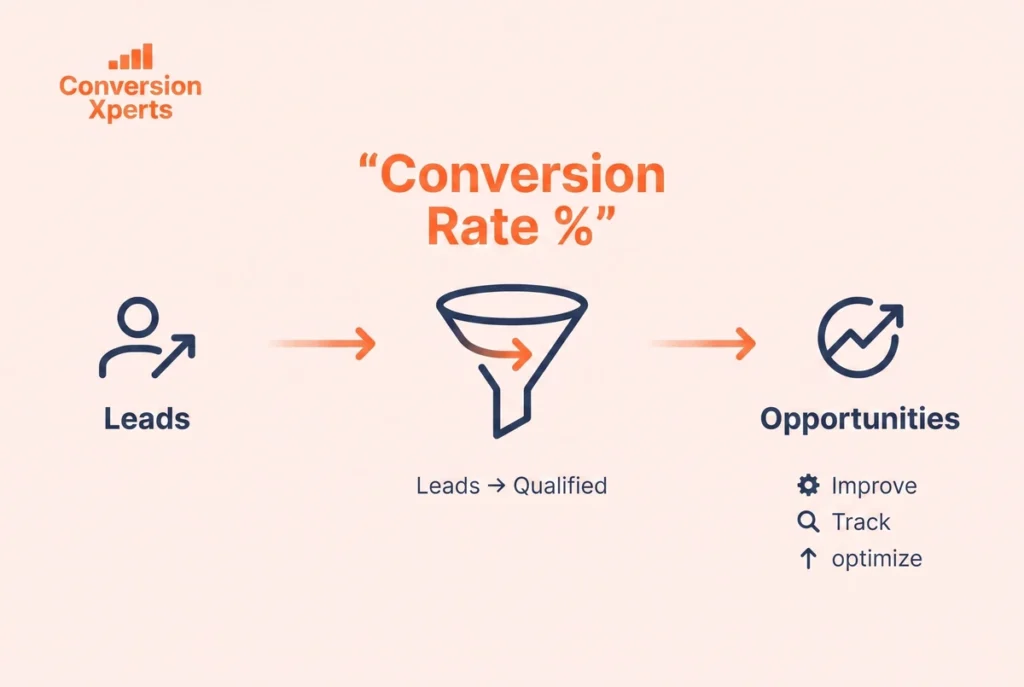
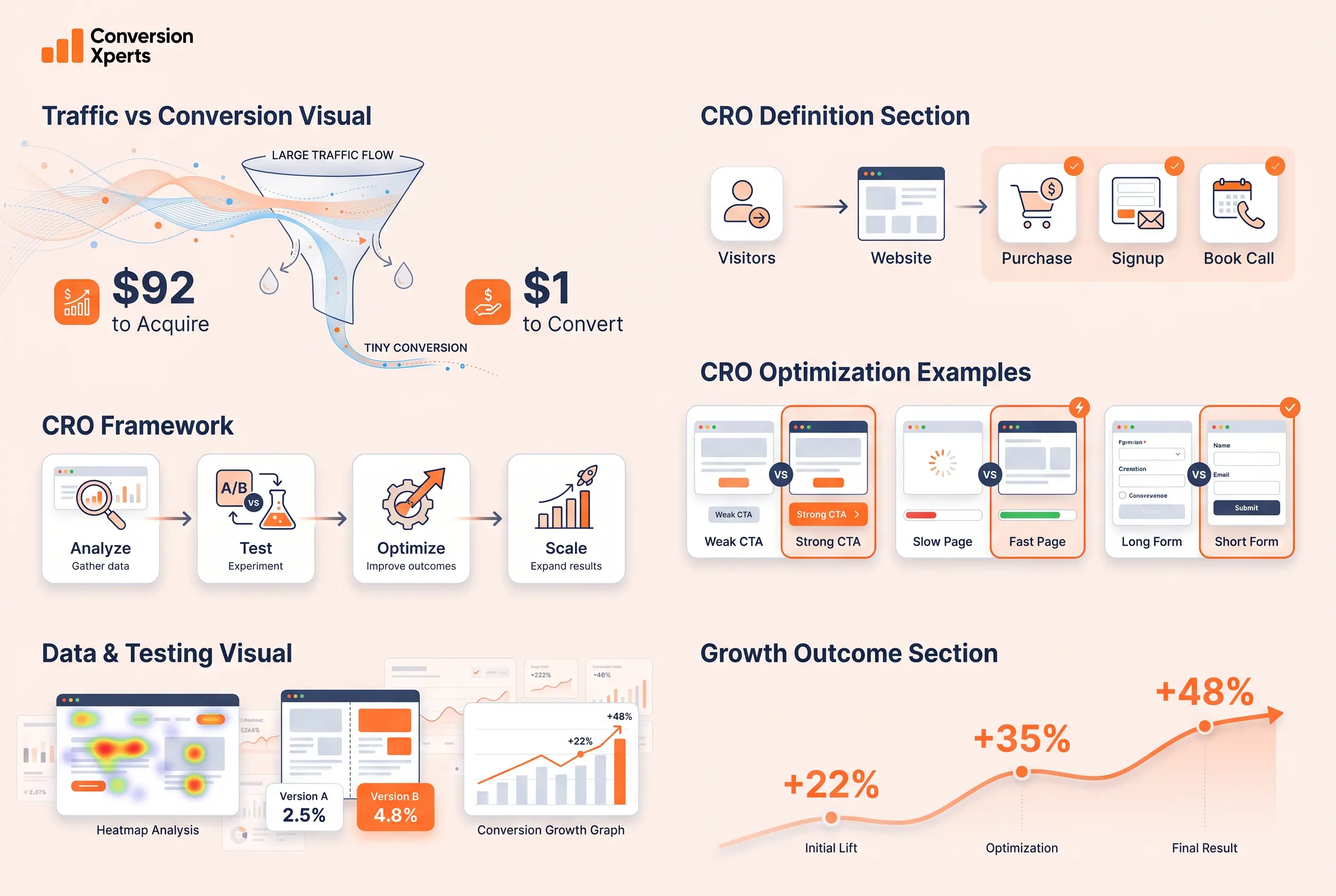
Conversion rate optimization is the discipline of systematically improving your website so that more visitors complete a goal you care about. That goal could be a purchase, a signup, a phone call, or any other action tied to your business growth.
Your conversion rate is calculated with a simple formula:
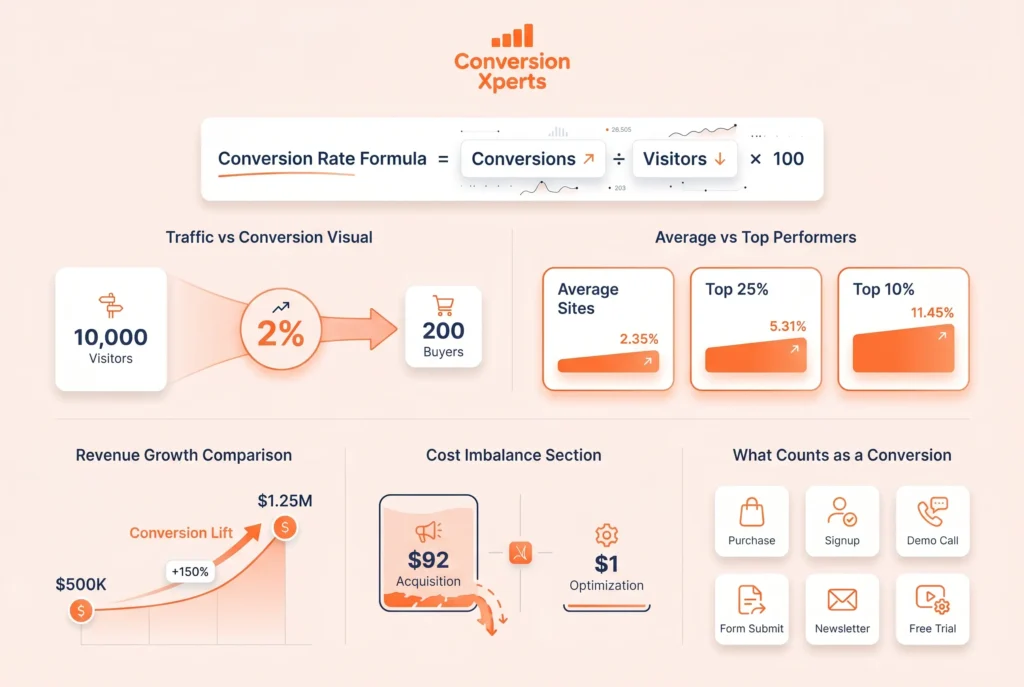
Conversion Rate = (Conversions / Total Visitors) x 100
If 10,000 people visit your site and 200 of them buy something, your conversion rate is 2%.
Why the Average Conversion Rate Is Not Good Enough
According to a 2024 study by Invesp, the average website conversion rate across all industries sits at 2.35%. The top 25% of websites convert at 5.31% or higher. The top 10% convert at 11.45% or above.
That gap between average and excellent is not magic. It is methodology.
A business doing $500,000 in monthly revenue at a 2% conversion rate with 50,000 visitors a month would generate $1,250,000 at a 5% rate from the exact same traffic. No extra ad spend. No SEO campaign. Just optimization.
The Real Cost of Ignoring CRO
Most businesses invest heavily in paid traffic and SEO but neglect what happens after the click. According to a 2025 report by Cropink, most businesses spend $92 to acquire a customer but only $1 to convert them. This imbalance means that for every dollar spent on optimization, the return is dramatically higher than a dollar spent on acquisition.
Conversion optimization fixes the leaky bucket before you keep filling it with expensive water.
What Counts as a Conversion
A conversion is not always a sale. Depending on your business model, conversions can include:
- A completed purchase on an ecommerce store
- A form submission for a service inquiry
- A free trial signup for a SaaS product
- A phone call from a local business landing page
- An email newsletter subscription
- A booked discovery call or demo
Each of these represents a visitor moving closer to becoming a paying customer, which is why conversion optimization matters across every industry.
How to Build a Conversion Rate Optimization Plan That Works
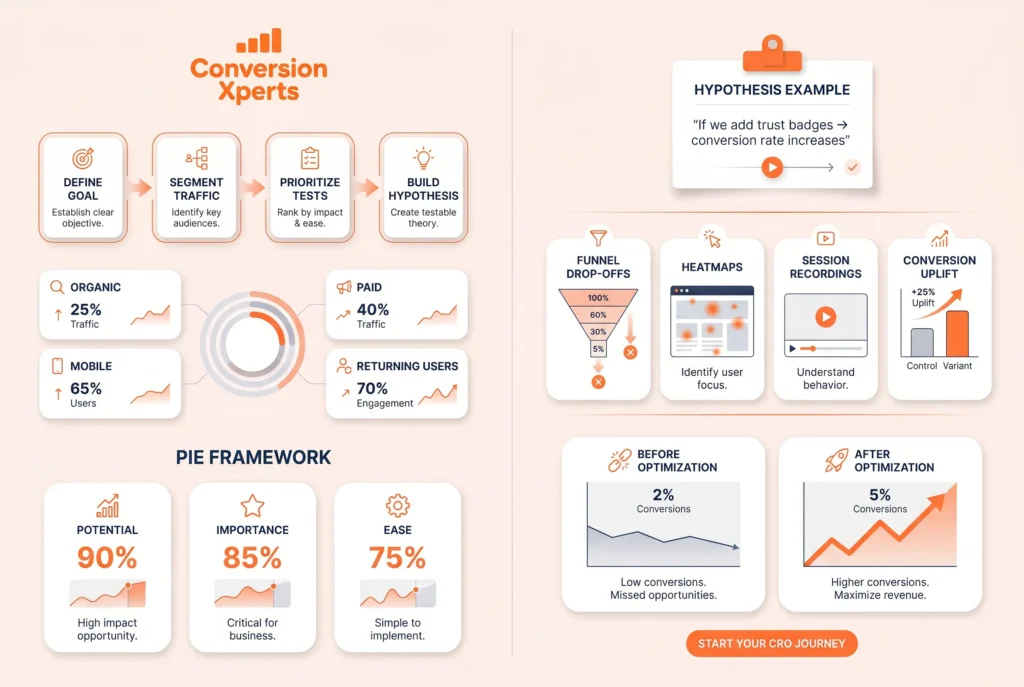
A conversion rate optimization plan is a documented, repeatable system for finding where visitors drop off, forming hypotheses about why, running structured tests, and implementing improvements based on evidence.
Without a plan, CRO becomes guesswork. With a plan, it becomes a growth engine.
Step 1: Define What You Are Optimizing
Before you touch a single element on your site, you must know which metric you are trying to improve and why. This sounds obvious but most teams skip it.
Start by answering three questions:
What is the primary conversion goal for this page or funnel? Be specific. Not “more sales” but “more completed purchases on the product detail page for our bestselling item.”
What is the current baseline conversion rate? You cannot improve what you do not measure. Connect Google Analytics 4 or a similar tool and establish your current numbers.
What would a meaningful improvement look like? A 0.1% lift on a low traffic page is not worth testing. A 0.5% lift on a page that generates 100,000 monthly visits is worth a great deal.
Step 2: Segment Your Traffic and Funnel
Not all visitors behave the same way, and treating them as one group is one of the most common CRO mistakes.
Segment your visitors by:
- Traffic source: Organic, paid, social, email, and direct visitors behave very differently.
- Device type: Mobile users convert at lower rates than desktop users in most industries. According to 2025 data from Linear Design, nearly 68% of ecommerce sales now happen on mobile devices, but mobile conversion rates are still lower than desktop in most categories.
- New vs returning visitors: First time visitors need trust signals. Returning visitors may need urgency or a different offer.
- Funnel stage: A visitor on your homepage is at a different intent level than someone on your checkout page.
When you segment, you stop applying universal fixes and start making targeted improvements where they actually matter.
Step 3: Set Up a Prioritization Framework
You will always have more test ideas than time and traffic to run them. A prioritization framework keeps your conversion rate optimization plan focused on high impact work.
The most widely used framework is PIE, developed by Chris Goward at WiderFunnel:
| Criterion | What It Measures |
P: Potential | How much room does this page have to improve? High bounce and exit rates signal high potential. |
I: Importance | How much traffic and revenue does this page handle? High volume pages have more impact. |
E: Ease | How difficult is this test to design and implement? Complex backend changes score lower. |
Score each potential test from 1 to 10 on all three criteria, average the scores, and work through your list from highest to lowest. This keeps your team aligned and prevents HiPPO decisions (where the Highest Paid Person’s Opinion replaces data).
Step 4: Document Your Hypotheses Properly
A well written CRO hypothesis follows this structure:
“If we [change X], then [metric Y] will improve because [reason Z based on data].”
For example: “If we add a visible 30 day money back guarantee badge near the add to cart button, then our product page conversion rate will increase because our exit survey data shows that 38% of non converting visitors cited uncertainty about returns as their main concern.”
A hypothesis without data behind it is just a guess. A hypothesis backed by behavioral data, heatmaps, session recordings, or survey responses is a testable prediction.
Conversion Rate Optimization Tutorial: Step by Step Process
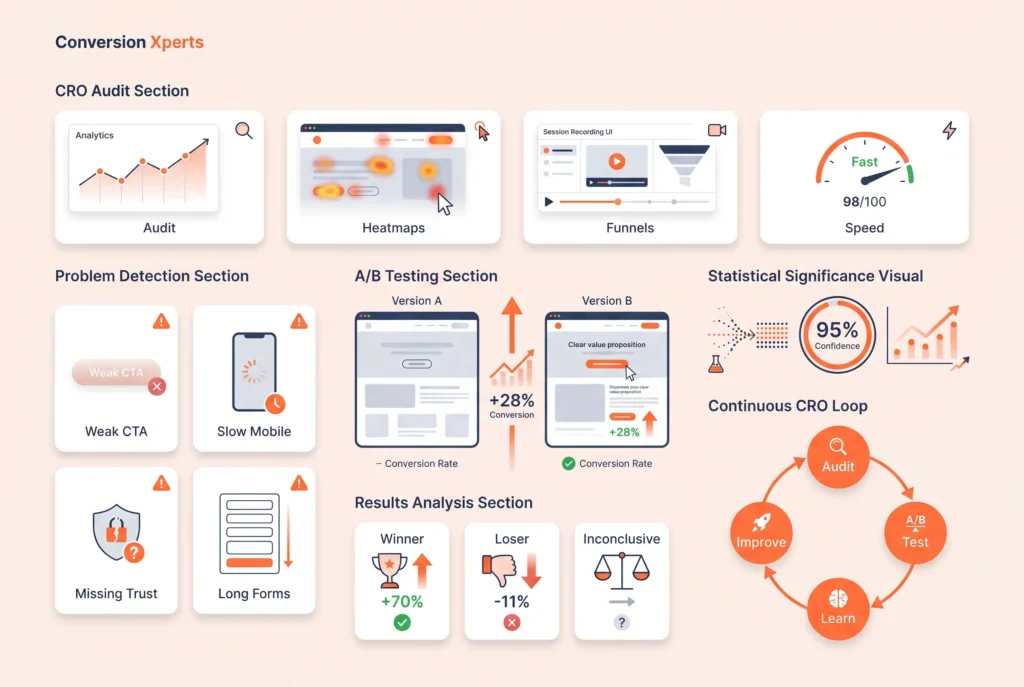
This conversion rate optimization tutorial walks you through the exact process that professional CRO agencies use with their clients. Follow these steps in order and you will have a working optimization program running within 30 days.
Step 1: Run a Full CRO Audit
A CRO audit is a structured review of your website from the visitor’s perspective. You are looking for friction, confusion, and broken trust signals.
During your audit, review the following:
Quantitative data (the what): Use Google Analytics 4 to find pages with high exit rates, funnel drop off points, and poor engagement metrics. Identify the exact pages where visitors are most likely to leave without converting.
Qualitative data (the why): Install a heatmap tool such as Hotjar or Microsoft Clarity. Watch session recordings to see how real users scroll, click, and navigate. Read your existing customer reviews to understand what language buyers use to describe their fears and motivations.
Technical issues: Run your site through Google PageSpeed Insights. A one second delay in page load time can reduce conversions by 7%, according to a 2024 benchmark study by Portent. Check for broken forms, confusing navigation, and unclear calls to action.
Step 2: Identify and Prioritize Problems
After your audit, you will have a list of problems. Common findings include:
- The value proposition is unclear in the first five seconds
- The call to action button is below the fold on mobile devices
- Trust badges are missing from the checkout page
- Product descriptions answer no real buyer questions
- The form has too many required fields
- Page load time on mobile is over three seconds
Rank these issues using the PIE framework from your conversion rate optimization plan. Start with high traffic, high impact, easy to fix problems.
Step 3: Design Your Tests
For each hypothesis, design a test variation. A/B testing (also called split testing) is the most common method. You show 50% of visitors the original version (the control) and 50% the new version (the variant). After enough visitors see both versions, statistical analysis tells you which performs better.
Important rules for good A/B testing:
Test one variable at a time. If you change the headline, button color, and image in one test, you cannot know which change drove the result.
Run tests to statistical significance. Most CRO practitioners use a 95% confidence threshold. This means you are 95% confident the result is real and not random chance. Tools like VWO, Optimizely, and Google Optimize calculate this automatically.
Run tests for at least two full business cycles. Weekly behavior patterns can distort results if you stop a test on a Monday versus a Friday. Run tests for at least 14 days even if you reach significance faster.
Step 4: Analyze Results and Decide What to Do
When a test concludes, you have three possible outcomes:
Winner: The variant outperforms the control. Implement it and document what you learned.
Loser: The control outperforms the variant. Do not discard this. A losing test is still information. Why did the change hurt performance? The answer may lead to a better hypothesis.
Inconclusive: Neither version is significantly better. This usually means you need a bigger sample size, or the change you tested was not meaningful enough to move the needle.
Step 5: Implement, Learn, and Repeat
CRO is not a one time project. The best conversion optimization programs run continuously. According to a 2024 HubSpot survey, companies that run consistent, ongoing CRO programs see 223% better ROI from their efforts compared to companies that do CRO sporadically.
After each test cycle, update your hypothesis backlog with new learnings, prioritize the next round of tests, and repeat the process.
Conversion Rate Optimization Examples From Real Businesses
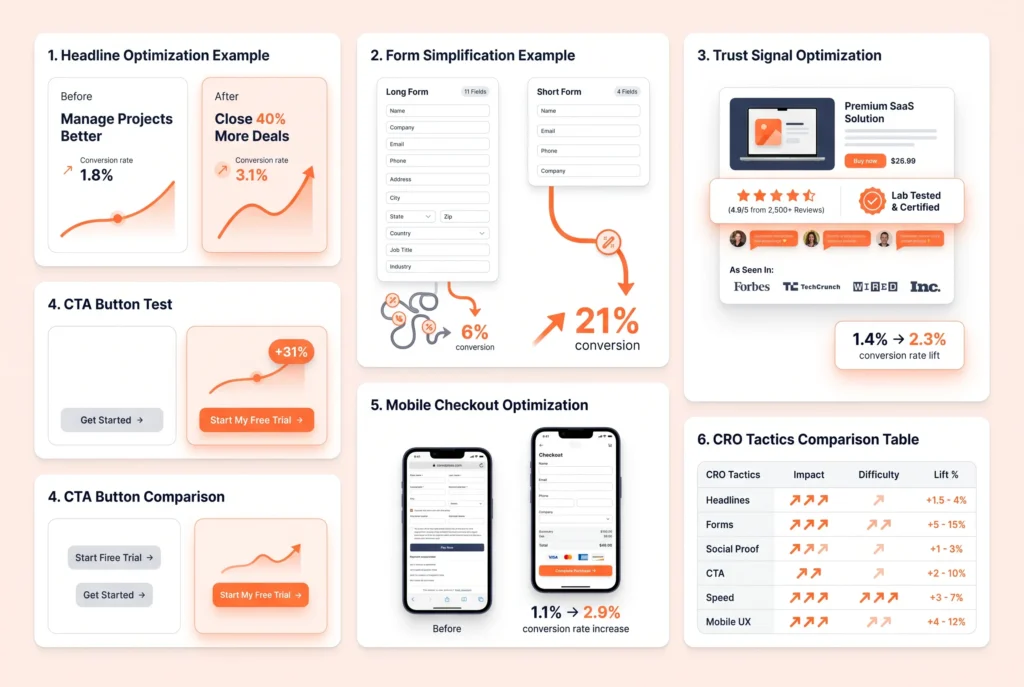
The best way to understand conversion optimization is to see what it looks like in the real world. Here are five categories of conversion rate optimization examples with specific, actionable illustrations.
Example 1: Headline and Value Proposition Testing
A SaaS company offering project management software was converting at 1.8% on their homepage. Their original headline read “Manage Your Projects More Effectively.”
A CRO team rewrote it to: “Close 40% More Deals Without Increasing Your Team Size.” The new headline was specific, outcome focused, and addressed the business result buyers actually wanted.
Result: Conversion rate increased to 3.1%, a 72% improvement. The only change was the headline.
This is one of the most common conversion rate optimization examples because the value proposition is the single most important element on any landing page. If visitors do not understand in five seconds why your product is for them and what outcome they get, they leave.
Example 2: Form Simplification
A B2B lead generation company had a contact form with 11 required fields including company revenue, number of employees, and current software stack. Their form completion rate was 6%.
After removing the seven lowest value fields and keeping only name, email, company, and phone, form completions jumped to 21%.
Less friction equals more conversions. This is a consistent finding across conversion optimization research. According to a 2024 QuickSprout study, reducing form fields from 11 to 4 can increase conversions by as much as 160%.
Example 3: Social Proof and Trust Signal Optimization
An ecommerce brand selling premium supplements was converting at 1.4% on their product pages. Exit surveys revealed that 44% of non buyers said they were uncertain about the product’s quality and safety.
The CRO team added three elements to the product page: a third party lab testing badge, a grid of real customer photos with their reviews, and a “As Seen In” press bar with media logos.
Conversion rate increased to 2.3%, a 64% improvement. Social proof removes the most common psychological barrier to buying: uncertainty.
Example 4: CTA Button Optimization
A software company ran an A/B test on their call to action button copy. The control read “Get Started.” The variant read “Start My Free Trial.”
The variant outperformed the control by 31%. The reason is simple. “Get Started” is vague and asks visitors to take an action. “Start My Free Trial” reminds them of what they get and reduces the fear of commitment by emphasizing that it is free.
Example 5: Mobile Checkout Optimization
An ecommerce fashion brand found that their desktop checkout conversion rate was 3.8% but their mobile rate was only 1.1%. Session recordings showed mobile visitors abandoning the checkout because the form fields were tiny, the keyboard covered the input field, and the credit card section felt confusing on a small screen.
After redesigning the mobile checkout with larger inputs, a progress bar, and an Apple Pay option as the first payment method, the mobile conversion rate climbed to 2.9%.
This is one of the most important conversion rate optimization examples for any business with significant mobile traffic. Mobile experience gaps are still among the most common and highest value conversion opportunities available today.
CRO Improvement Comparison by Tactic
| Tactic | Typical Conversion Lift | Difficulty | Best For |
Headline rewrite | 20% to 80% | Low | All website types |
Form simplification | 30% to 160% | Low | Lead gen, SaaS |
Social proof addition | 15% to 65% | Low to Medium | Ecommerce, SaaS |
CTA button optimization | 10% to 50% | Low | All website types |
Page speed improvement | 7% to 30% | Medium to High | All website types |
Mobile checkout redesign | 40% to 150% | High | Ecommerce |
Personalization | 20% to 200% | High | High traffic sites |
The Most Powerful Conversion Optimization Techniques
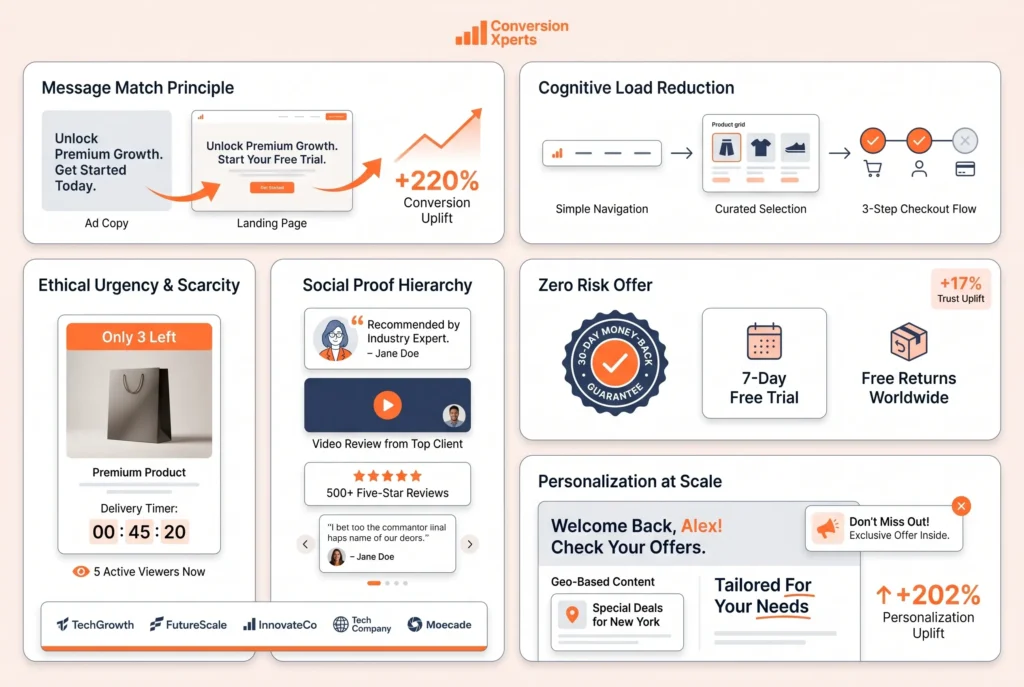
Conversion optimization draws from psychology, design, analytics, and copywriting. These are the techniques that move the needle most consistently.
Technique 1: The Message Match Principle
Message match means aligning what your ad says with what your landing page says. When a visitor clicks an ad for “best running shoes for flat feet” and lands on your homepage showing all shoes, the disconnect causes immediate bounces.
When the landing page headline mirrors the ad copy and speaks directly to flat footed runners with images of the specific shoes and copy addressing their exact concern, conversion rates typically double or triple versus sending the same traffic to a generic page.
According to a 2024 Unbounce report, dedicated landing pages with strong message match outperform generic pages by 220% on average. Creating unique landing pages for your highest spend ad groups is one of the highest return conversion optimization moves available to any marketer.
Technique 2: Reducing Cognitive Load
Every choice your visitor faces increases their mental effort and reduces the chance they convert. This is called decision fatigue, and it is backed by decades of psychology research.
Practical applications in conversion optimization:
Navigation on landing pages: Remove the main navigation menu from dedicated landing pages. It gives visitors 20 escape routes. A page with one goal and one CTA converts better than a page with many options.
Product choice architecture: If you sell 200 products, curate a “Best Sellers” or “Staff Picks” section. Amazon does this extremely well. The choice feels unlimited but the path to purchase feels clear.
Checkout steps: Break a complex checkout into a clear multi step flow with a progress indicator. “Step 2 of 3” is far less intimidating than a single long form.
Technique 3: Urgency and Scarcity Without Manipulation
Genuine urgency (a real sale ending tonight, genuinely limited stock) is a powerful conversion driver. Fake countdown timers that reset every time you visit are manipulation and destroy trust when visitors notice.
Effective and ethical urgency tactics include:
- Real time inventory displays (“Only 3 left in stock”)
- Genuine limited time promotions with hard end dates
- Dynamic messaging showing how many people are viewing a product
- Delivery deadline timers (“Order in the next 2 hours for delivery by Thursday”)
According to a 2024 Baymard Institute study, real inventory scarcity messaging increases product page conversions by 9% to 27% depending on the industry.
Technique 4: The Power of Zero Risk Offers
The biggest psychological barrier to conversion is fear of making a bad decision. Every visitor is asking: “What if this does not work for me? What if I regret this?”
Zero risk offers eliminate that fear. These include:
- 30 day or 60 day money back guarantees
- Free trials with no credit card required
- Free returns and exchanges
- Performance guarantees (results or your money back)
The counterintuitive truth about guarantees is that offering them rarely increases the refund rate. But not offering them consistently reduces conversions. According to a 2024 Invesp study, adding a money back guarantee to a product page increases conversions by an average of 17%.
Technique 5: Social Proof Hierarchy
Not all social proof is equal. Here is the hierarchy from most to least powerful:
Expert endorsements: Quotes or mentions from recognizable authorities in your space carry the most weight.
User generated video reviews: Real customers showing and explaining results are more convincing than text reviews.
Specific written testimonials with photos: “This software saved us 12 hours a week” is 10x more powerful than “Great product, highly recommend.”
Star ratings and review counts: A product with 4.7 stars from 1,200 reviews converts better than one with 5 stars from 2 reviews, because volume signals real usage.
Logos of known customers: For B2B businesses, displaying logos of recognizable companies you have worked with instantly communicates credibility.
Technique 6: Personalization at Scale
Personalization is showing different content to different visitors based on what you know about them. It is one of the highest ROI conversion optimization techniques for businesses with significant traffic.
According to a 2024 Epsilon study, personalized experiences deliver 8 times the ROI of generic campaigns. Personalized CTAs alone improve conversion rates by 202% compared to generic ones, according to HubSpot research.
Personalization examples in CRO:
- Showing returning visitors a “Welcome back” message with their last viewed products
- Displaying different hero images to visitors from different geographies
- Changing the headline based on the traffic source (visitors from a Facebook ad see different copy than those from Google)
- Triggering exit intent popups only to first time visitors who have been on the page for more than 60 seconds
How ConversionXperts Helps You Get Results Faster
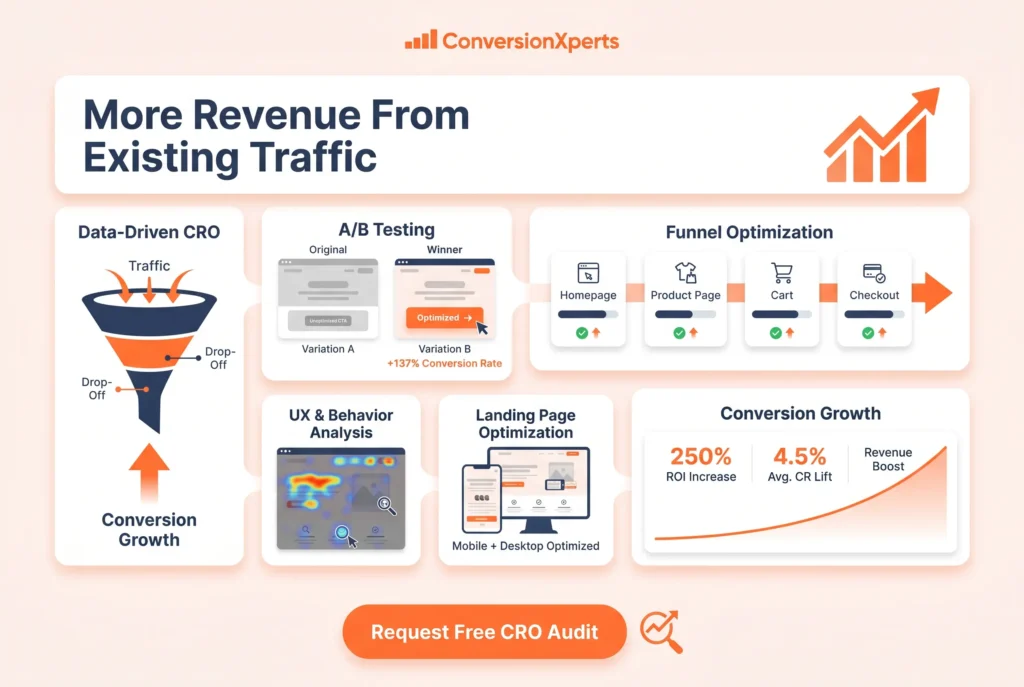
Learning conversion rate optimization is one thing. Executing it effectively, systematically, and at scale is another. That is where a specialist CRO agency makes a significant difference.
ConversionXperts is a global conversion rate optimization agency built for one specific purpose: helping ecommerce stores and online businesses make more money from the traffic they already have.
What ConversionXperts Does
ConversionXperts is not a generalist digital agency that offers CRO alongside 20 other services. They specialize exclusively in conversion optimization, which means their entire methodology, team, and toolstack is purpose built for improving conversion rates.
Their core services include:
Conversion Rate Optimization (CRO): End to end programs that identify friction in your visitor journey and systematically eliminate it through structured testing and data driven improvement.
A/B Testing and Experimentation: Professional design, setup, and analysis of split tests. This includes writing strong hypotheses, designing statistically valid experiments, and interpreting results correctly so you implement winners and learn from losers.
Landing Page Optimization: Building and refining high converting landing pages with strong message match, clear value propositions, and frictionless paths to conversion.
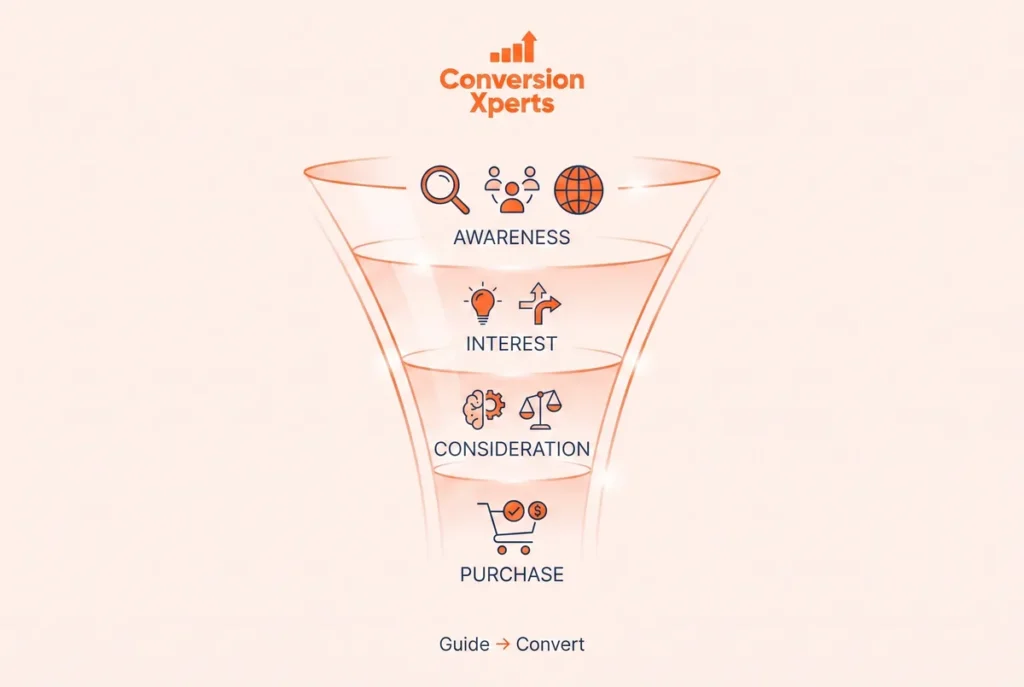
Funnel Optimization: Mapping and improving every step of your conversion funnel, from first click to final purchase, to find and fix the drop off points costing you revenue.
UX Research and Behavior Analysis: Using heatmaps, session recordings, user surveys, and behavioral data to understand how real visitors experience your site and what prevents them from converting.
Website Analytics Strategy: Setting up proper tracking, goal configuration, and reporting so your team always knows what is working and what needs attention.
What Makes ConversionXperts Different
Most businesses that try CRO fail because they treat it as a project rather than a program. They run a few tests, see mixed results, and move on. ConversionXperts is built around a different model.
Their approach is grounded in psychology, data science, and structured experimentation. As they put it: “We believe sustainable growth comes from optimizing what already exists, refining user journeys, clarifying messaging, and eliminating friction.”
They do not rely on assumptions or gut feel. Every recommendation is backed by analytics and structured experimentation. Every test is designed to answer a real business question, not just try something different.
For new clients, ConversionXperts starts with a free CRO audit and strategy consultation. Their team reviews your website performance, identifies your highest value optimization opportunities, and schedules a discovery call to present findings and next steps.
Initial insights typically appear within weeks, and meaningful statistical results from structured testing programs develop over 60 to 90 day testing cycles, depending on your traffic volume.
Who ConversionXperts Works With
ConversionXperts works with businesses of various sizes, including ecommerce stores, SaaS companies, and service businesses that receive meaningful website traffic. Their team operates globally and provides remote optimization services.
If your website is getting traffic but underperforming on conversions, ConversionXperts can help you turn that gap into revenue.
To get started, you can visit ConversionXperts.com to request a free website review and discover what your biggest conversion opportunities are.