Retail Conversion Strategy: The Complete Playbook for Store Owners Who Want More Sales From Every Visitor
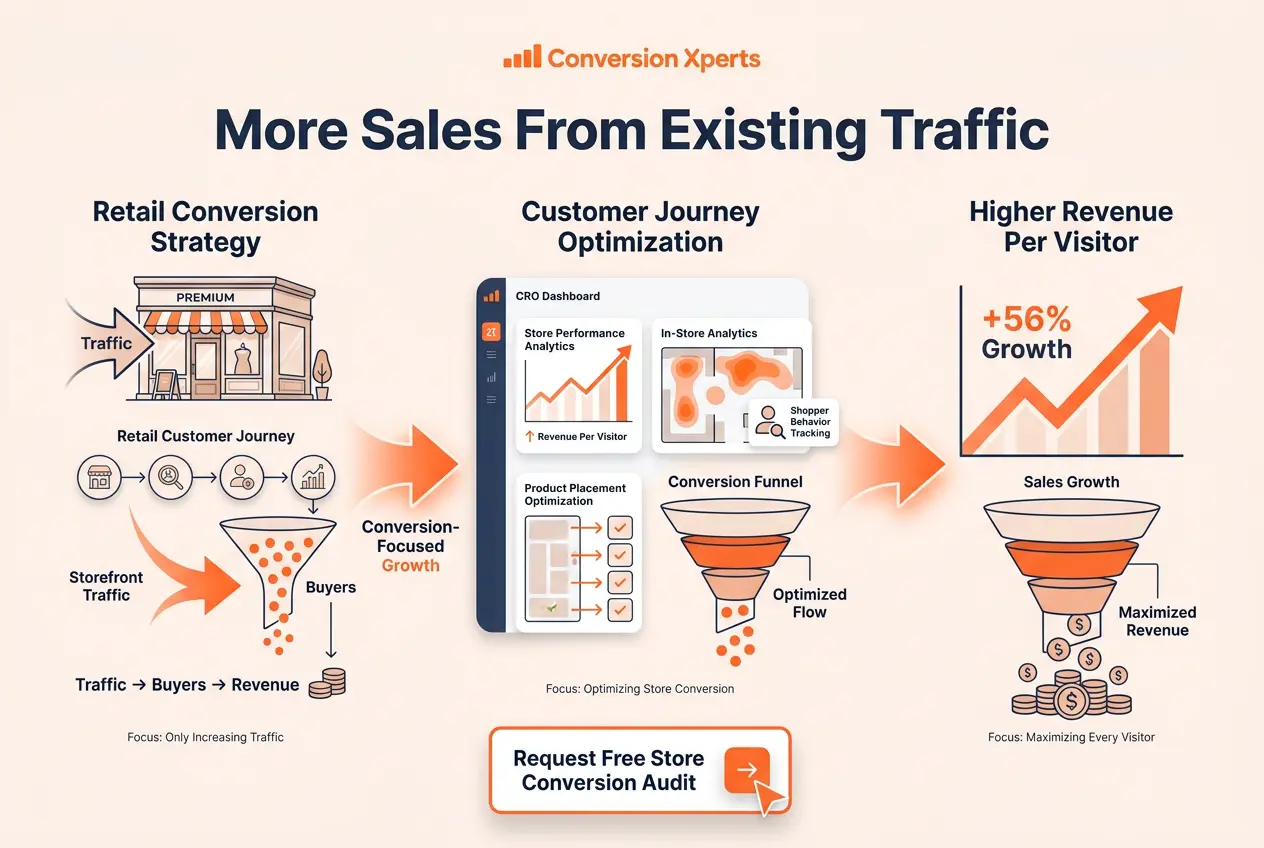
Most retail businesses spend the majority of their marketing budget trying to get more people through the door. Yet research from RetailNext shows that the average retail store converts fewer than one in three visitors into a paying customer. That means for every 100 people who walk in, 70 or more walk out empty-handed.
A well-built retail conversion strategy does not ask you to spend more money on advertising. It asks you to do more with the traffic you already have. Shifting your strategic focus from acquisition to conversion is one of the most financially intelligent decisions any store owner or retail manager can make, because it compounds. A better-converting store generates more revenue, which funds better inventory, which attracts better customers, which raises conversion again.
This article is the cluster content companion to our pillar guide on how to increase store conversion rate. Where the pillar covers the full landscape of tactics, this guide goes deeper on strategy: the thinking frameworks, decision structures, prioritization models, and long-term systems that transform a reactive retail operation into a conversion-optimized business engine.
In this guide you will learn how to build a retail conversion strategy from the ground up, how to prioritize the highest-impact levers for your specific store type, how to align your team around conversion as a cultural value, and how to measure and compound your improvements over time.
What Is a Retail Conversion Strategy and Why Most Stores Do Not Have One
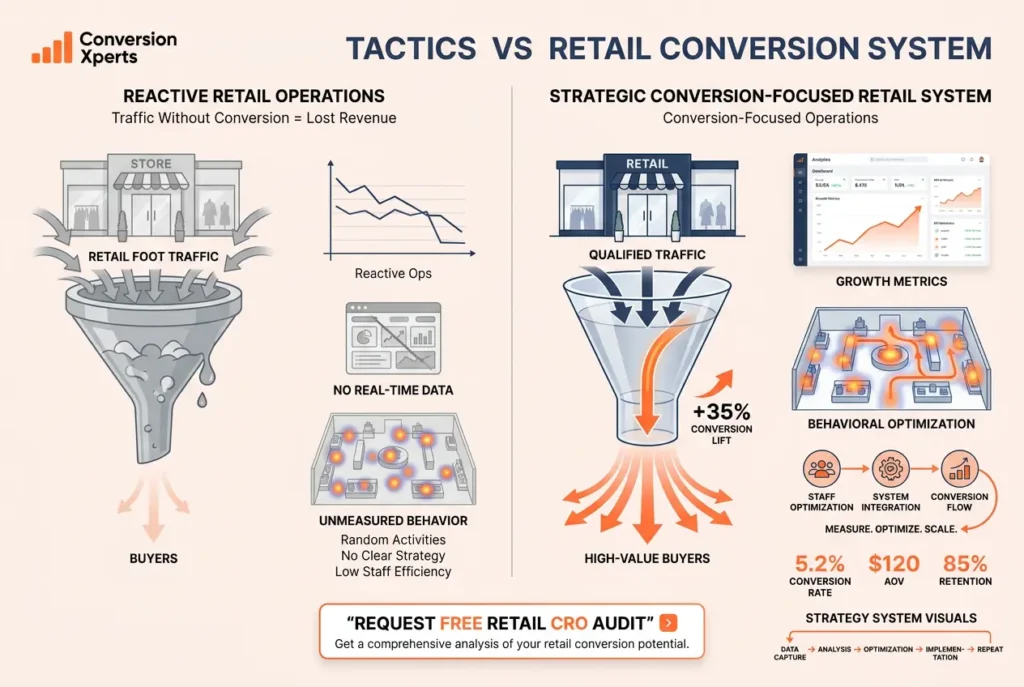
A retail conversion strategy is a documented, deliberate system for increasing the percentage of store visitors who complete a purchase, using a combination of environmental design, staff behavior, pricing architecture, technology, and customer experience decisions.
The key word in that definition is documented. Most store owners have tactics. They know they should greet customers quickly, keep the store clean, run promotions during slow periods, and train their staff. But having a collection of tactics is not the same as having a strategy.
A strategy has a defined goal (a target conversion rate by category, time window, or customer segment), a clear prioritization of which levers to pull first based on potential impact and implementation ease, a measurement infrastructure to track whether changes are working, and a review cadence to refine and iterate over time.
Without these elements, a retail business is essentially running conversion improvement on intuition. Some things will work. Many things will not. And the business will never know which is which.
The Gap Between Retail Leaders and the Rest
According to a 2024 Deloitte Insights report on retail operations, stores in the top quartile of their category on conversion rate are not just doing more tactics. They think about conversion differently. They treat it as an operational discipline, the same way a manufacturing company treats quality or a logistics company treats on-time delivery. Conversion rate is not a marketing metric for them. It is a core business health indicator reviewed at every level of the organization.
This mindset shift, from conversion as a side concern to conversion as a primary operational KPI, is the single biggest structural difference between high-converting and average-converting retailers. The rest of this guide is built around helping you make that shift in a practical, step-by-step way.
Why Conversion Strategy Gets Neglected
There are three common reasons retail conversion strategy gets neglected even by experienced operators.
First, it feels less urgent than other problems. A broken HVAC, a staff member who called in sick, a supplier who missed a delivery: these are all visible, loud, and immediate. Conversion rate sits in the background, quietly costing you money every day without sending an alert.
Second, it requires measurement infrastructure most retailers have not built. Without a people counter and a system for segmenting that data, conversion rate is invisible. And retailers cannot focus on what they cannot see.
Third, it requires cross-functional thinking. Conversion improvement touches store design, staff training, pricing, marketing, inventory planning, and technology simultaneously. Most retail businesses are organized around functional silos rather than cross-functional outcomes, so nobody owns conversion holistically.
The good news is that all three of these obstacles are solvable, and solving them is exactly what a retail conversion strategy provides.
The Retail Conversion Funnel: A Framework for Systematic Improvement
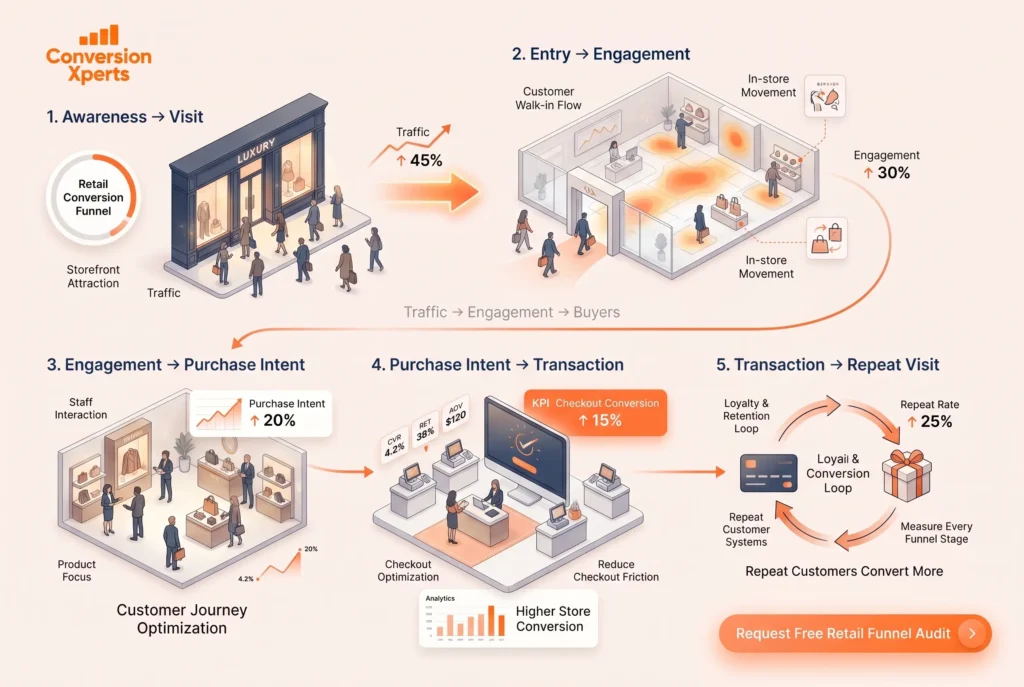
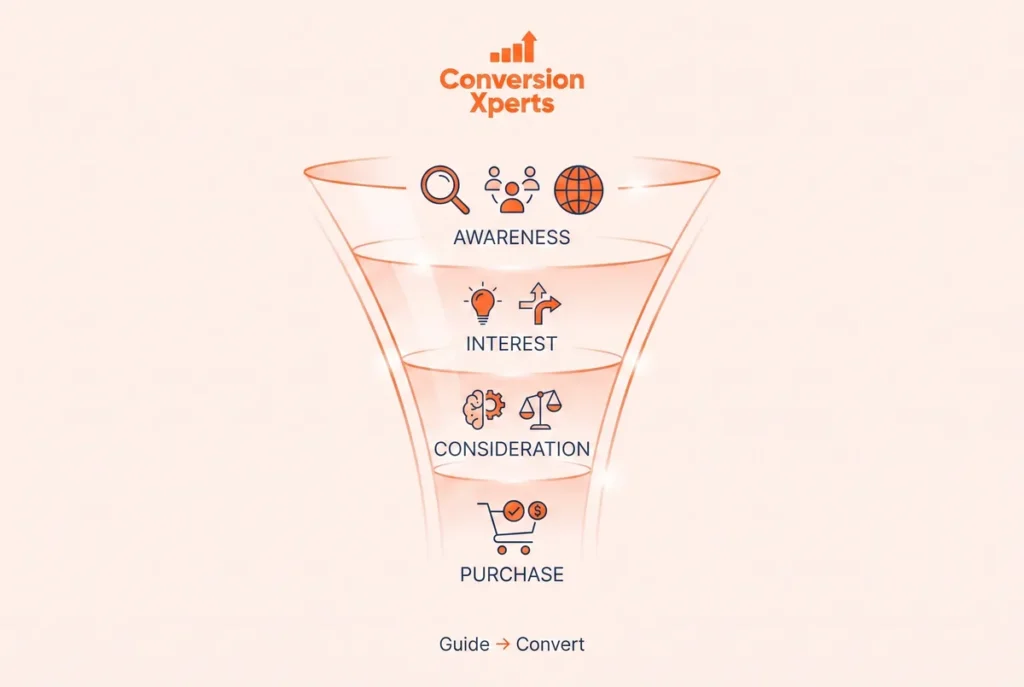
The retail conversion funnel is a model for understanding the journey a customer takes from initial awareness of your store to completed purchase and beyond. Each stage of the funnel has its own conversion rate, and understanding where the largest drops occur tells you exactly where to focus your strategy.
Stage 1: Awareness to Visit (Pre-Store Conversion)
The first stage is getting a potential customer who is aware of your store to actually walk through the door. This is the territory of your storefront, your signage, your window display, your Google Business Profile, your social media presence, and your local advertising.
Pre-store conversion is often overlooked in retail conversion strategy discussions, but it matters enormously. A compelling window display has been shown to increase walk-in rate by 20% to 35%, according to a 2023 study by the Visual Merchandising and Display Association. Your Google Business Profile, particularly your photos, hours accuracy, and review score, directly determines whether a nearby person who searches for your category chooses to visit you or a competitor.
For retailers in pedestrian locations or shopping centers, the conversion from passerby to walk-in is the very first funnel stage, and improving it by even 10% has the same financial effect as increasing in-store conversion by several percentage points.
Stage 2: Entry to Engagement
The second funnel stage is the conversion from a person who has entered your store to one who is actively engaging with your merchandise or staff. This is where decompression zones, initial sensory experience, wayfinding clarity, and the speed of first staff contact all play their critical roles.
Engagement rate is a metric most retailers never explicitly track, but it is highly observable. Walk the floor during a busy period and count how many visitors pick up a product, ask a staff member a question, or move deeper than two sections into the store. That percentage is your engagement rate, and it is a leading indicator of final purchase conversion.
Stage 3: Engagement to Purchase Intent
Purchase intent is the moment when a customer transitions from passive interest to active buying consideration. They are asking about price, checking their phone for competitive comparison, carrying items toward a fitting room, or asking about availability in a different variant. This is the highest-leverage stage of the funnel for staff intervention.
Retailers who train their associates to recognize the behavioral signals of purchase intent and respond with timely, non-pushy assistance consistently see 15% to 25% higher conversion at this stage compared to stores with reactive or absent floor coverage, based on client benchmarking data from retail consultancy Envirosell.
Stage 4: Purchase Intent to Transaction
This is the final conversion step: the customer decides to buy and completes the transaction. Friction at this stage is a major and widely underestimated conversion killer. Long checkout lines, complex return policies, limited payment options, and hard-sell upsell pressure at the register all create conversion abandonment at the last possible moment.
A 2023 Square retail research study found that 27% of shoppers who intended to make a purchase abandoned the transaction due to checkout friction, primarily line length and limited payment methods. This is the retail equivalent of cart abandonment in ecommerce, and it deserves the same strategic attention.
Stage 5: Post-Transaction to Repeat Visit
The final funnel stage converts a one-time buyer into a repeat customer. This is where loyalty programs, post-purchase outreach, personalized recommendations, and experience quality all compound. Repeat customers consistently convert at 2x to 5x the rate of first-time visitors, making post-transaction strategy one of the highest-return elements of any long-term retail conversion strategy.
Customer Psychology at the Core of Every Effective Retail Conversion Strategy
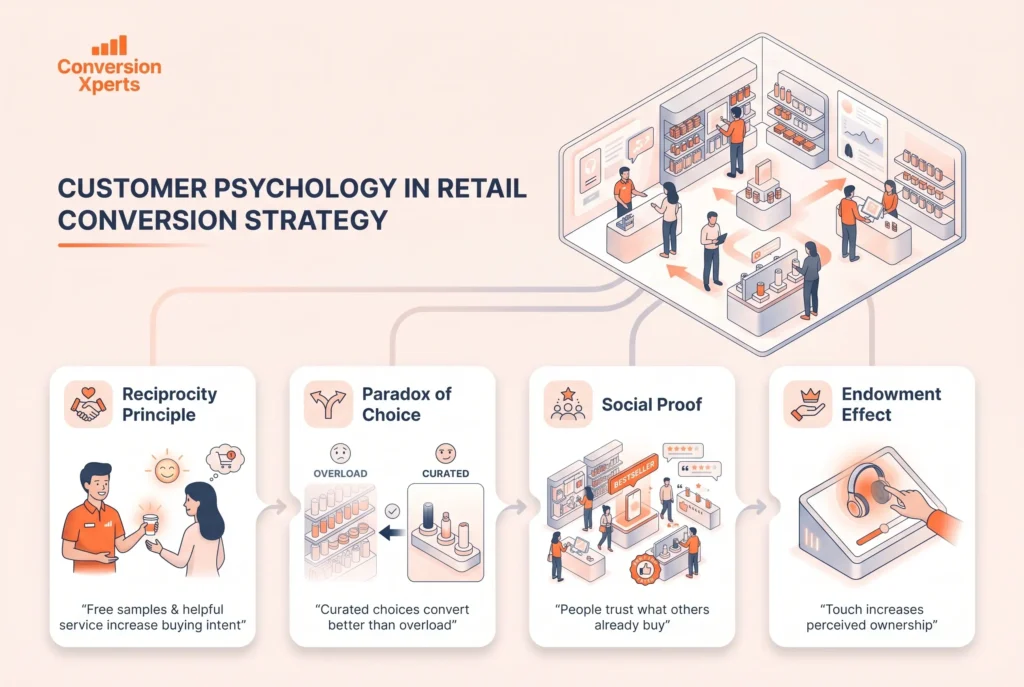
Understanding how human psychology drives buying behavior in physical retail is not a soft skill. It is the scientific foundation of every high-converting store environment. The retailers who deeply understand these principles make better decisions faster and with more confidence.
The Principle of Reciprocity in Retail
Reciprocity is one of the six principles of influence identified by psychologist Robert Cialdini, and it is one of the most powerful tools available in retail. When a store gives something to a customer, whether it is a free sample, a free alteration, a gift-with-purchase, or simply exceptional service, the customer feels a psychological pull toward reciprocating with a purchase.
Wine stores that offer tastings convert browsers to buyers at dramatically higher rates than those that do not. Cosmetics counters that offer sample applications convert walk-bys into seated consultations that close at rates above 60%. Cheese shops and specialty food retailers that offer samples consistently report that sampled products sell at 2x to 5x the rate of non-sampled adjacent products on the same day.
Reciprocity does not require a financial giveaway. Exceptional, personalized service creates the same effect. A staff member who spends 10 minutes genuinely helping a customer find the right product, even one that is lower-priced than the one they first showed, creates a social obligation to buy that is more powerful than any discount.
The Paradox of Choice and Assortment Curation
More options do not increase conversion. In retail, they frequently suppress it. Barry Schwartz’s foundational research on the paradox of choice demonstrated that when consumers face too many options in a category, decision fatigue increases, satisfaction decreases, and purchase probability drops.
Sheena Iyengar and Mark Lepper’s famous jam study at Stanford showed that a display of 24 jam varieties attracted more initial interest but converted at only 3%, while a display of 6 varieties converted at 30%. This is a 10x conversion difference driven entirely by assortment size.
In practical retail terms, this means that curation is a conversion strategy. Editing your assortment to the best 4 to 8 options in each sub-category, with clear differentiation between them, consistently outperforms stocking 20 options and hoping customers find the right one. For retailers who feel pressure to carry every variant and SKU, this research provides a compelling strategic argument for restraint.
Social Proof as a Conversion Driver
Customers in physical retail look to other customers for validation of their choices. This is why busy stores feel more appealing than empty ones, why staff recommendations carry weight, and why signage that calls out bestsellers, new arrivals, or “staff pick” items drives disproportionate sales.
A 2022 study in the Journal of Consumer Psychology found that “bestseller” labels on retail shelf products increased purchase probability by 38% compared to identical unlabeled products. Crucially, this effect held even when customers were told that the label was applied by the store, not by an independent ranking body. The social signal of others choosing that product was enough to influence behavior.
The implication for your retail conversion strategy is to make social proof visible and specific. Not “popular item” but “our most requested piece this season.” Not “on sale” but “7 sold this week.” Specificity makes social proof feel real rather than manufactured.
The Endowment Effect and Tactile Engagement
The endowment effect is the well-documented psychological phenomenon where people place higher value on things they own or have physically touched compared to identical items they have not handled. In retail, this means that getting a product into a customer’s hands is a powerful conversion trigger.
Stores designed to maximize tactile engagement, where products are at accessible heights, not locked in cases, where testers and demos are available and clearly invited, where staff offer to let customers try things rather than observe them, consistently outperform stores where products are displayed behind barriers or positioned as aspirational rather than accessible.
Apple’s retail store design is the most cited example of tactile engagement done right. Every device is unlocked, charged, live, and at an ergonomically natural touching height. The result is one of the highest revenue-per-square-foot figures in the history of retail: over $5,500 per square foot annually as of 2023 per Forbes reporting.
Building Your Retail Conversion Strategy Around Store Segments
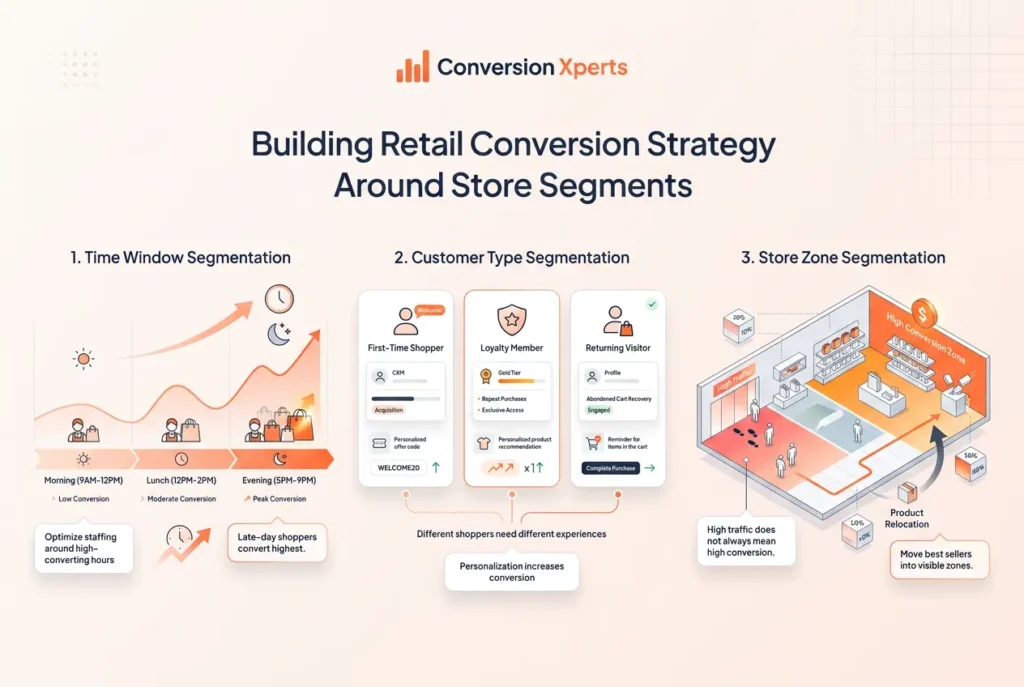
A single conversion rate for your whole store is a starting point, not a strategy. The most powerful retail conversion work happens at the segment level, where you can identify specific conversion problems and design specific solutions.
Segmenting by Time Window
Every store has conversion patterns across the day and week that reveal specific operational problems. Common patterns include:
Morning conversion dip: The first hour of opening typically sees lower conversion because the store is under-stocked, staff are still settling in, and early visitors tend to be habitual rather than purchase-intent-driven. Retailers who prepare displays the night before, ensure full shelves at opening, and schedule experienced staff for the first shift typically recover 3 to 8 conversion points in the morning window.
Lunch-hour collapse: Retailers who lose staff to lunch breaks without coverage experience conversion drops of 10 to 15 percentage points in the 12 PM to 2 PM window. Staggered break scheduling is a straightforward fix that many operators never implement.
Late-day surge: The hour before closing is often the highest-conversion window of the day because customers arriving then have already decided to buy. Ensuring full floor staffing, a tidy store, and no premature close-down activity in the final hour captures these high-intent conversions reliably.
Segmenting by Customer Type
First-time visitors, loyalty members, and returning non-member customers behave differently and respond to different conversion strategies. If your POS and door-counting system can differentiate between these groups (loyalty card swipe at entry or transaction-linked visit tracking), you can design targeted experiences for each.
First-time visitors need orientation, discovery cues, and a low-friction entry point (a clear good-better-best product ladder, visible staff availability). Loyalty members respond to personalization and exclusive offers. Returning non-members represent your highest conversion opportunity with relatively modest intervention: a well-timed loyalty invitation, a personalized product recommendation, or a modest welcome-back gesture.
Segmenting by Store Zone
Not all areas of your store convert equally. Zone-level conversion analysis, made possible through heat mapping and people counting that tracks movement through defined zones rather than just the entry, reveals which areas are high-traffic-low-conversion (a navigation problem or a product problem) and which are low-traffic-high-conversion (hidden gems that need relocation to a higher-visibility zone).
A typical independent specialty retailer who conducts zone-level analysis for the first time discovers that their highest-converting products are in their lowest-traffic zones, and their highest-traffic zones contain products with mediocre conversion rates. Simply relocating two or three product groups based on this insight can lift overall store conversion rate by 5 to 10 percentage points without any additional investment.
The Seven Pillars of a High-Converting Retail Store
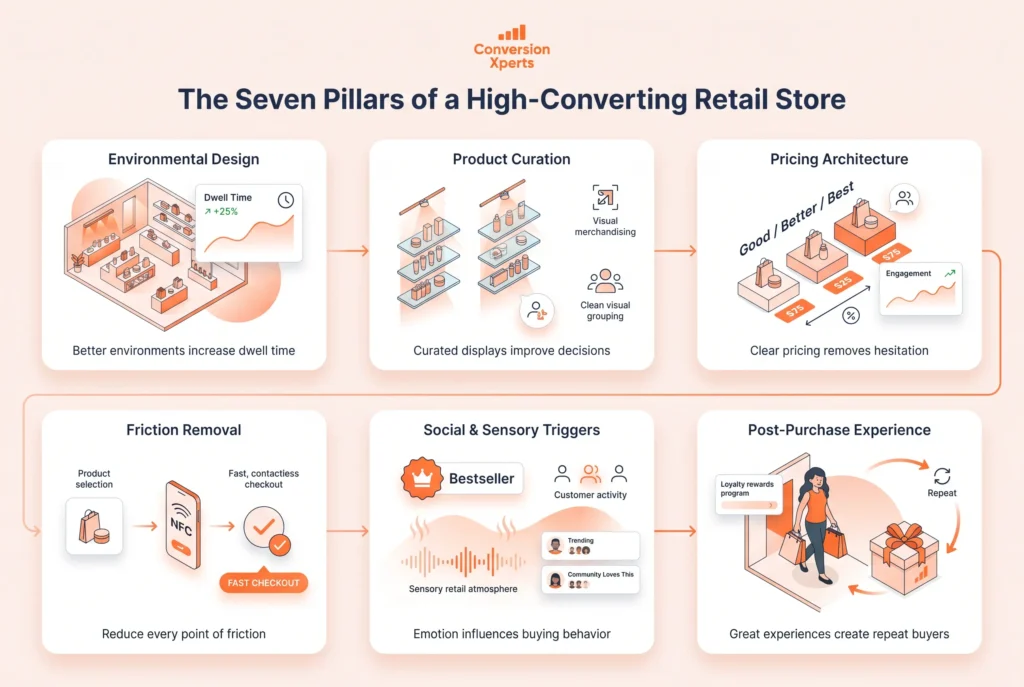
Every high-converting retail store, regardless of category, size, or price point, is built on seven foundational pillars. These pillars are not independent. They interact and amplify each other. Weakness in one suppresses the performance of all others.
Pillar 1: Environmental Design
Your store environment communicates your brand values, organizes the customer journey, and determines how long customers stay. Longer dwell time correlates directly with higher conversion: a 2024 study by Sensormatic Solutions found that customers who spend more than 10 minutes in a store convert at a rate 4.2x higher than those who spend under 3 minutes.
Environmental design encompasses layout (loop vs. grid vs. freeform), lighting (intensity, color temperature, and spotlighting of key products), sound (tempo, genre, volume calibrated to your target demographic), scent, cleanliness, and temperature. Each element has been studied in controlled retail environments and each has a measurable effect on conversion.
Pillar 2: Product Curation and Presentation
Curated assortments with clear visual merchandising outperform large, undifferentiated assortments in conversion rate in almost every retail category studied. The principle is simple: make it easy for customers to identify the right product for their needs, and make that product look compelling enough to justify the purchase.
Visual merchandising best practice focuses on the rule of three (grouping products in odd numbers for visual appeal), vertical color blocking (organizing shelves by color family for visual navigation), and feature stacking (displaying coordinated collections or outfit concepts rather than single items in isolation).
Pillar 3: Pricing Clarity and Architecture
Unclear pricing is a direct conversion killer. When a customer cannot easily find the price of a product, a percentage of them will choose not to ask, and they will leave without buying. Price tags should be consistent in size and placement, clearly visible at natural sightlines, and free of confusing abbreviations or codes.
Beyond clarity, pricing architecture, specifically the good-better-best structure across each category, ensures that every customer who enters has an appropriate entry point. This prevents the scenario where budget-conscious buyers cannot find an affordable option and leave, even when one exists.
Pillar 4: Staff Capability and Engagement
Staff performance is the most variable pillar and therefore the highest opportunity pillar for most retailers. The spread between a top-performing associate and an average one in terms of personal conversion rate is commonly 20 to 30 percentage points, according to research from the Retail Learning Institute.
Staff capability encompasses product knowledge (can they answer detailed questions confidently?), selling skills (can they move a customer from interest to decision?), and emotional intelligence (can they read customer signals and adapt their approach?). Staff engagement, meaning their genuine investment in the store’s success, is the multiplier on all three.
Pillar 5: Friction Removal
Every point of friction in the customer journey reduces conversion probability. Friction includes locked display cases that require staff to open them (reducing impulse conversion), checkout lines that suggest a long wait (driving abandonment), return policies with excessive conditions (reducing confidence), and limited payment options (excluding customers who prefer specific payment methods).
A systematic friction audit, where you walk through your store as a customer and note every moment of hesitation or inconvenience, almost always reveals 5 to 10 friction points that can be eliminated with minimal cost.
Pillar 6: Social and Sensory Triggers
Social triggers include visible bestseller labels, staff recommendations displayed as handwritten shelf cards, loyalty member testimonials near the register, and the social proof of a busy, well-populated sales floor. Sensory triggers include the scent, sound, and tactile experience of your store environment.
Both categories of triggers work below the threshold of conscious decision-making, which is precisely why they are so powerful. A customer who is consciously comparing prices and features is using rational evaluation. Social and sensory triggers engage the emotional, intuitive brain, which is where most actual purchase decisions are made, even when customers rationalize them afterward with logical justifications.
Pillar 7: Post-Purchase Experience
The post-purchase experience does not convert today’s visitor. It converts next month’s visitor. How a customer feels leaving your store, both about their purchase and about the experience itself, determines whether they return and whether they recommend you to others.
A customer who leaves feeling genuinely well served by knowledgeable staff, delighted by an unexpected detail (gift wrapping, a handwritten receipt note, a sample tucked into the bag), or pleasantly surprised by the ease of checkout, becomes a repeat-buying brand advocate. Repeat customers convert at 2x to 5x the rate of first-time visitors and cost zero to acquire.
Retail Conversion Strategy for Different Store Types
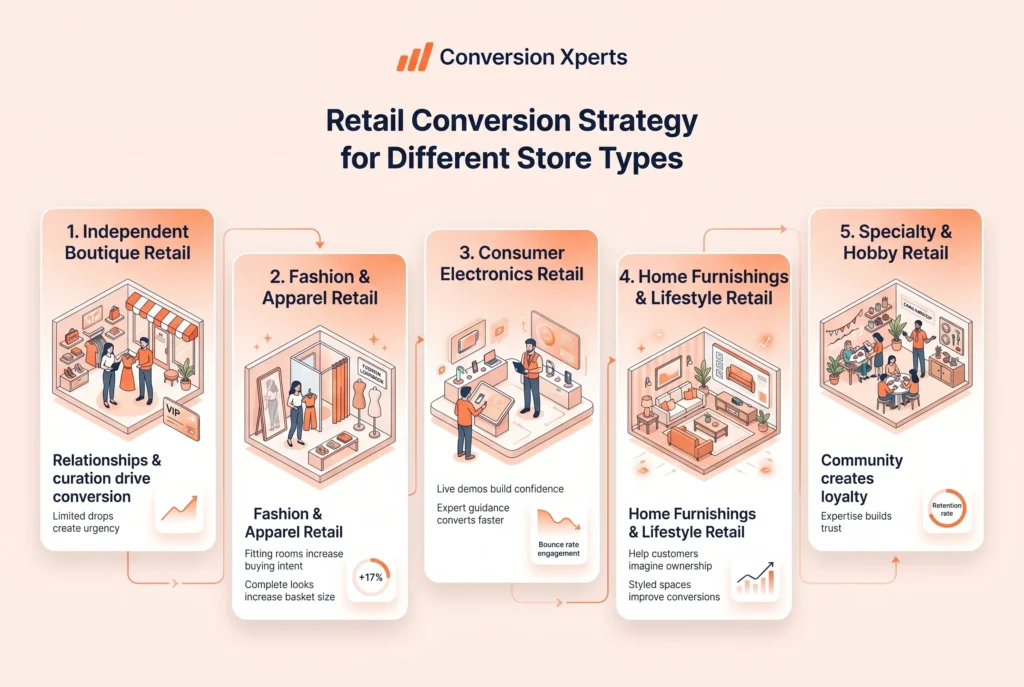
The universal principles above apply across retail, but the highest-leverage tactics differ meaningfully by store type. Here is how retail conversion strategy adapts across the most common formats.
Independent Boutique Retail
Independent boutiques compete on curation, personality, and relationship, not price or selection breadth. For boutique retailers, the highest-leverage conversion strategies are:
Staff-customer relationship building through name recognition and purchase history recall, either memorized or CRM-assisted. The moment a customer walks in and is greeted by name, conversion probability increases dramatically because they feel seen and valued.
Hyper-curated assortments with strong editorial storytelling. Each product in the store should have a story that staff can tell. The brand behind it, the craftsperson who made it, the customer who came back to buy three of them. These stories transform product evaluation from a rational price comparison into an emotional connection.
Waitlist and pre-order mechanics. For boutiques with limited stock runs, a waitlist creates urgency and commitment that converts browsers who might otherwise delay a decision indefinitely.
Fashion and Apparel Retail
Apparel conversion strategy centers on the path to the fitting room. Every tactic that increases the percentage of visitors who try something on increases conversion, because customers who enter the fitting room convert at 5x the rate of those who do not.
Fitting room attendants who actively participate in the session (bringing alternatives, noting what works, suggesting pairings) are the highest-value staff role in an apparel store from a conversion perspective. Scheduling your strongest associate as a dedicated fitting room attendant during peak traffic windows is a high-return staffing decision.
Lookbook and outfit displays increase basket size by presenting complete looks rather than individual items, which converts single-item browsers into multi-item buyers. Dressing a mannequin in a complete outfit and labeling every component with its product number and price typically lifts the average transaction value for items featured on that display by 30% to 50%.
Consumer Electronics and Technology Retail
Electronics retail conversion strategy is built on demonstration and expertise. Customers enter a consumer electronics store with questions, not certainty. The associate who can confidently answer those questions, compare options objectively, and demonstrate the product in use converts at the highest rates.
Demo quality is critical. A live demo that works flawlessly converts. A demo device with a cracked screen, a dead battery, or a slow operating system actively destroys conversion because it makes the product look poor even when the actual retail units are fine.
Consultative selling training, where staff are trained to ask diagnostic questions before recommending products (what are you primarily using it for? what are you using now?), consistently outperforms feature-led selling in electronics retail conversion rate studies.
Home Furnishings and Lifestyle Retail
Lifestyle retail conversion depends on imagination activation: helping the customer visualize the product in their own home. Vignette displays, where furniture and decor are arranged as complete room scenes rather than by product category, are the most powerful visual merchandising tool in this segment.
IKEA’s entire store design is built on this principle, but independent home stores can apply it at any scale. A single table styled with place settings, a runner, candles, and a vase converts at dramatically higher rates than the same table displayed with its siblings in a row of identical tables.
Room planning services, whether offered by staff or via an in-store iPad tool, convert hesitant customers who love a piece but are unsure whether it will work in their space. Offering a free 15-minute room planning consultation converts the “I need to think about it” delay into an in-store commitment.
Specialty and Hobby Retail
Specialty retailers (bookstores, craft stores, hobby shops, sporting goods specialists) convert most powerfully through community and expertise. Their customers are passionate about the category, and they can detect authentic expertise versus surface-level sales knowledge immediately.
Staff recruitment strategy matters here more than in any other retail segment. A genuinely passionate cyclist working at a bike shop will outperform a conventionally trained sales associate every single time. Hiring from within the hobbyist community is itself a conversion strategy.
In-store events, workshops, demonstrations, and community gatherings bring high-intent customers into the store repeatedly, build loyalty, and create conversion opportunities that extend beyond the initial purchase into ongoing replenishment and upgrade cycles.
Aligning Your Team: Turning Retail Conversion Strategy Into Store Culture
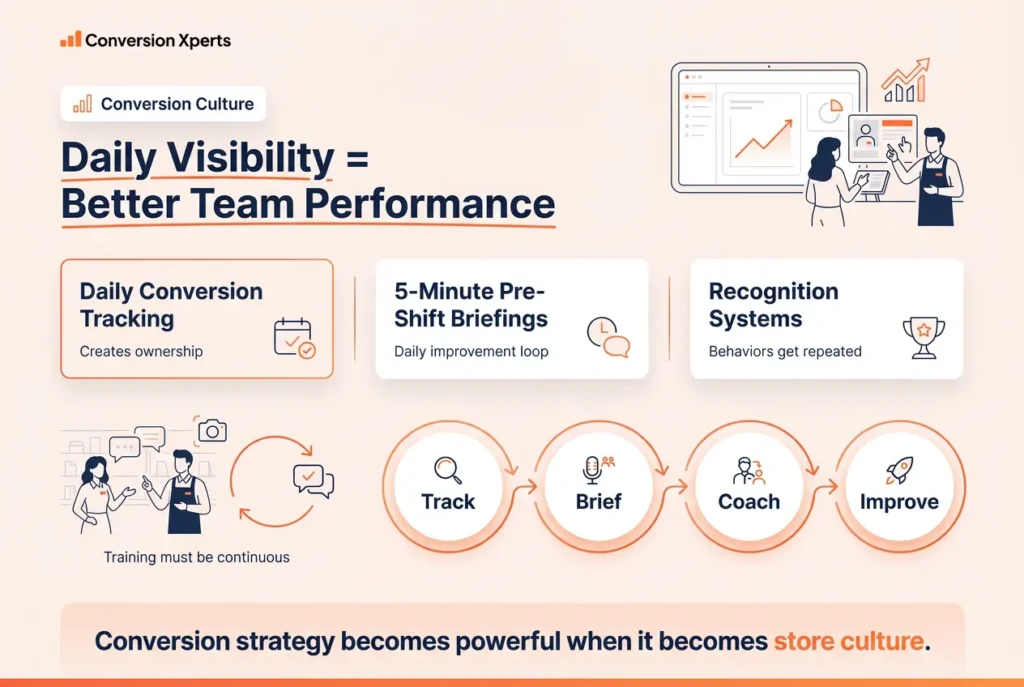
A retail conversion strategy that lives in a document but is not embedded in the daily behavior and thinking of your team will not deliver results. Culture change is the hardest and most rewarding element of any serious conversion improvement program.
Making Conversion a Team Metric
The first step in building a conversion culture is making the metric visible to everyone who can influence it. A daily conversion rate displayed on a screen in the staff room, discussed in every pre-shift briefing, and celebrated when it rises creates collective ownership of a number that was previously invisible to most of the team.
This does not mean creating pressure or punishing poor results. It means creating awareness. Staff members who can see that conversion dropped on Tuesday afternoon during their shift naturally become curious about why. That curiosity is the beginning of continuous improvement thinking.
Conversion-Focused Pre-Shift Briefings
A 5-minute pre-shift briefing that includes the previous day’s conversion rate, one specific observation about what drove it (either up or down), and one specific goal for the current shift is one of the most cost-effective management tools available in retail. It takes no budget, minimal preparation, and creates a daily feedback loop between strategy and execution.
Effective pre-shift briefing structure: start with yesterday’s conversion rate and whether it was above or below target, share one specific win from yesterday (a staff member who handled an objection well, a display that drove strong conversion), identify one focus for today (monitor the fitting room queue, actively suggest the seasonal collection to apparel buyers, ensure the demo station is live at all times), and close with any promotional or inventory updates relevant to today’s traffic.
Recognition and Reinforcement
Behavior that gets recognized gets repeated. Building a recognition framework around conversion behaviors, not just sales totals, reinforces the actions that actually drive results. Recognizing the associate who had the highest personal greeting rate, the one who generated the most fitting room visits, or the one who received the most positive feedback from customers builds the right behaviors systematically.
Many retailers make the mistake of recognizing only total sales volume, which rewards results but not the specific behaviors that produce those results. This matters because a high-sales associate who achieves their numbers through aggressive pressure selling is damaging long-term conversion (through poor customer experience and low return visit rates) even while appearing to succeed on short-term metrics.
Training Cadence and Skill Development
Conversion skills deteriorate without reinforcement. A one-time staff training event improves conversion for two to four weeks before behavior drifts back to default patterns. Sustained conversion improvement requires a training cadence: monthly skill refreshers, weekly observation and feedback, and regular role-plays that address the specific objections and scenarios your staff actually encounter.
The most effective training format for retail conversion skills is observed role-play with structured feedback, where a manager or peer observes a simulated customer interaction and provides specific, behavioral feedback afterward. Generic training videos and manuals produce minimal behavior change compared to this hands-on format.
Seasonal Conversion Strategy: How to Lift Performance Throughout the Year
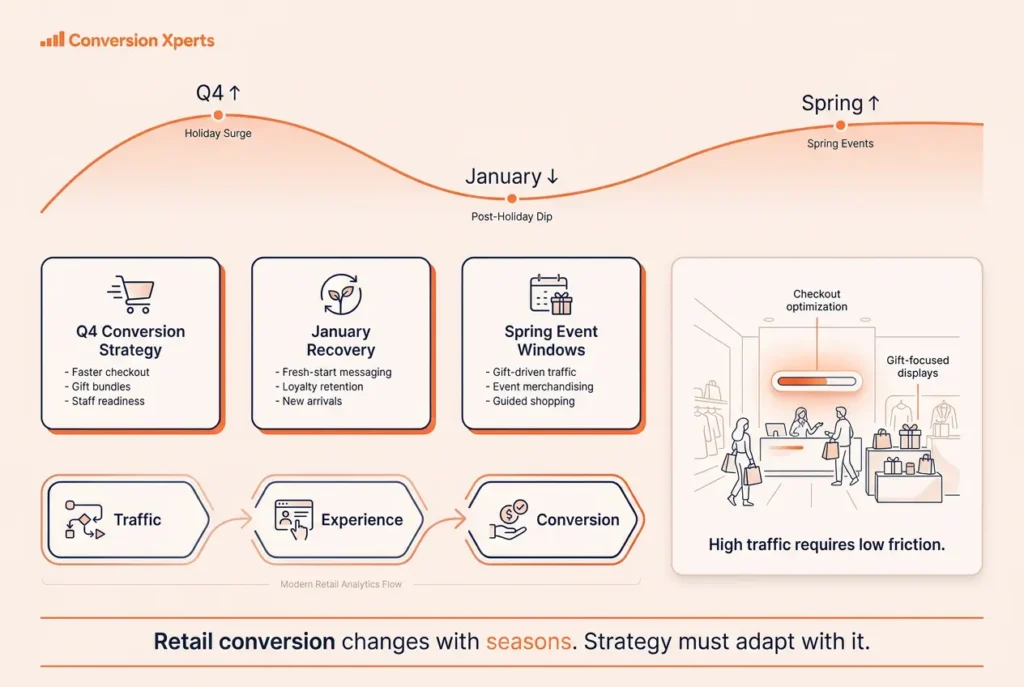
Retail conversion rates are not static across the year. They follow predictable seasonal patterns that, once understood, can be strategically managed rather than simply endured.
Q4 and Holiday Conversion Strategy
The holiday season brings the highest traffic volumes of the year to most retail categories, but not necessarily the highest conversion rates. Traffic surges often overwhelm staff, create checkout friction, and lead to stock-outs in key items, all of which suppress conversion precisely when the financial stakes are highest.
A proactive Q4 conversion strategy prepares for this with additional temporary staffing trained specifically on conversion behaviors, a stock replenishment cadence that prevents gaps on key displays, a queue management system that reduces checkout abandonment, and gift-focused visual merchandising that makes purchase decisions easier for the large segment of holiday shoppers buying for others.
Retailers who invest in gift guidance tools, whether physical gift guides at the register, staff training on “who is this for?” consultative questioning, or curated gift set bundles, consistently report higher Q4 conversion rates than those who maintain their standard year-round approach during the holiday surge.
Post-Holiday Conversion Tactics
January is the most challenging month for retail conversion in most categories. Consumers are experiencing spending fatigue, returns traffic drives store visits without purchase intent, and the emotional high of the holiday season has deflated. The retailers who navigate January best are those who treat it as a new beginning rather than a hangover.
January conversion strategy focuses on value messaging (fresh-start, new-year positioning rather than clearance-only), new inventory arrivals that give non-sale-motivated customers a reason to buy, and loyalty engagement that converts one-time holiday gift recipients into regular customers.
Spring and Event-Driven Conversion Windows
Spring brings a series of high-conversion events: Mother’s Day, graduation season, Father’s Day, and back-to-school periods, all of which drive gift-motivated traffic with clear purchase intent. Retailers who build event-specific conversion strategies around these windows, with dedicated gift selections, event signage, staff training on gifting conversations, and gift service offerings, consistently outperform those who treat them as generic sales periods.
Advanced Retail Conversion Strategy Tactics for Experienced Retailers
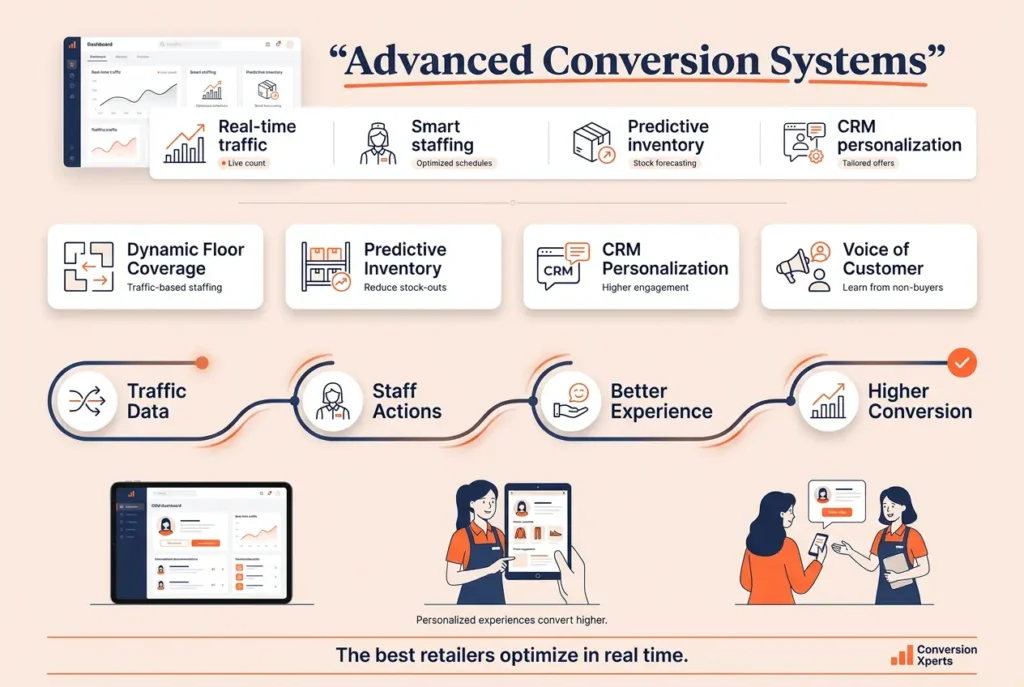
For retailers who have already implemented the foundational elements of a conversion strategy and are looking for the next level of performance improvement, these advanced tactics represent the cutting edge of what is working in high-performing stores today.
Dynamic Floor Coverage Optimization
Advanced retailers use real-time traffic data from their people-counting system to dynamically adjust floor coverage throughout the day. Rather than fixed break schedules and static staff deployment, they move associates to high-traffic zones as traffic patterns develop and pull back coverage from low-traffic areas to reduce idle time.
Some enterprise retailers have implemented automated staff scheduling systems that use historic traffic patterns combined with real-time data to generate daily coverage plans that consistently outperform manually designed schedules on both conversion rate and labor cost.
Predictive Inventory Management for Conversion
Stock-outs are conversion killers. A customer who comes in for a specific product in their size, color, or configuration and finds it unavailable leaves without buying, often without returning. Predictive inventory management, using sales velocity data combined with traffic forecasting, reduces stock-out frequency and ensures that high-conversion products are available during high-traffic windows.
Modern POS platforms with built-in inventory forecasting can reduce stock-out frequency by 30% to 60% compared to manual reordering, according to a 2024 report from Lightspeed Commerce’s retail benchmark data. For retailers in categories where variant availability (size, color, style) is a primary purchase criterion, this improvement translates directly to measurable conversion rate gains.
Personalization at Scale Through CRM
The most sophisticated retail conversion strategies use CRM data to deliver personalized experiences at scale. When a staff member knows before a customer arrives (via a pre-visit notification from a loyalty app check-in) that this customer typically buys in a specific category, has not purchased in 60 days, and responded positively to their last email about a specific brand, they can deliver a genuinely personalized experience that feels like a relationship rather than a transaction.
This level of personalization is not limited to large retailers. Modern retail CRM platforms like Lightspeed, Salesfloor, and Clienteling by Endear make this capability accessible to independent and mid-market retailers at affordable price points. The conversion impact is significant: personalized clienteling interactions convert at 40% to 60% higher rates than standard floor interactions, according to Salesfloor’s 2024 platform benchmarking data.
Voice of Customer Feedback Loops
High-performing retailers build systematic mechanisms for capturing customer feedback at the point of exit, both from buyers and from non-buyers. Post-purchase satisfaction feedback (via receipt QR codes, short SMS surveys, or tablet kiosks near the exit) captures buyer experience quality. Non-buyer exit surveys, while harder to execute, provide the most valuable data of all: why didn’t you buy today?
Common answers to non-buyer surveys are consistently illuminating. They reveal pricing perception issues, assortment gaps, stock-out problems, staff interaction quality, and checkout friction in their exact frequency and priority. This data, reviewed monthly, provides a conversion strategy roadmap directly authored by the customers who chose not to buy.
Building a 90-Day Retail Conversion Strategy Roadmap
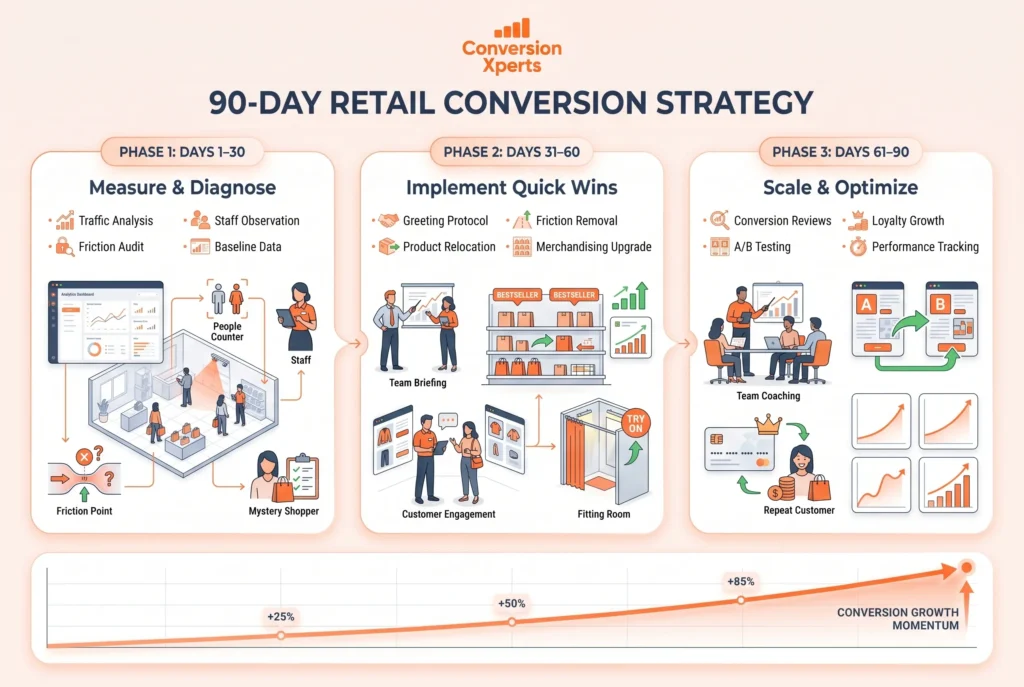
A great strategy without an implementation plan remains theoretical. Here is a structured 90-day roadmap for building and executing a retail conversion strategy from scratch.
Days 1 to 30: Measure and Diagnose
Install or calibrate your people-counting system. Establish your baseline conversion rate by time window, day of week, and staff member. Conduct a full store walk-through friction audit. Identify your three highest-traffic, lowest-conversion windows. Review your last 90 days of POS basket data for cross-merchandising opportunities. Conduct two hours of observed floor coverage during peak traffic to assess current staff engagement and greeting rates. Complete a mystery shop using a friend or family member and document their experience.
By the end of Day 30 you should have a clear picture of where your biggest conversion gaps are, which makes prioritization straightforward rather than guesswork.
Days 31 to 60: Implement High-Impact Low-Cost Changes
Begin pre-shift conversion briefings. Implement an observation-based greeting protocol and conduct two role-play sessions with staff. Relocate your highest-converting products to right-side power zone positions. Remove or reduce the two biggest friction points identified in your audit. Add bestseller and staff-pick labels to your top-conversion products. Rearrange at least one store section into a cross-merchandising vignette. Review fitting room protocols and implement attendant-assisted entry if applicable.
Measure conversion rate weekly throughout this period and note changes. By the end of Day 60 you should be seeing measurable improvement in at least two or three of your targeted time windows.
Days 61 to 90: Compound and Systematize
Formalize your weekly conversion review process. Begin individual associate conversion rate tracking and implement peer coaching between top and average performers. Launch or optimize your loyalty program with a focus on visit-to-purchase linkage. Implement your first A/B test: change one display and measure conversion before and after. Begin planning your seasonal conversion calendar for the next quarter. Document what is working so it can be replicated across any additional locations.
By Day 90, a retail business that executes this roadmap faithfully will typically see an overall conversion rate improvement of 8 to 15 percentage points from their baseline, depending on their starting point and category.