Benefits of SEO Marketing: The Ultimate Guide to Growing Your Business in 2026
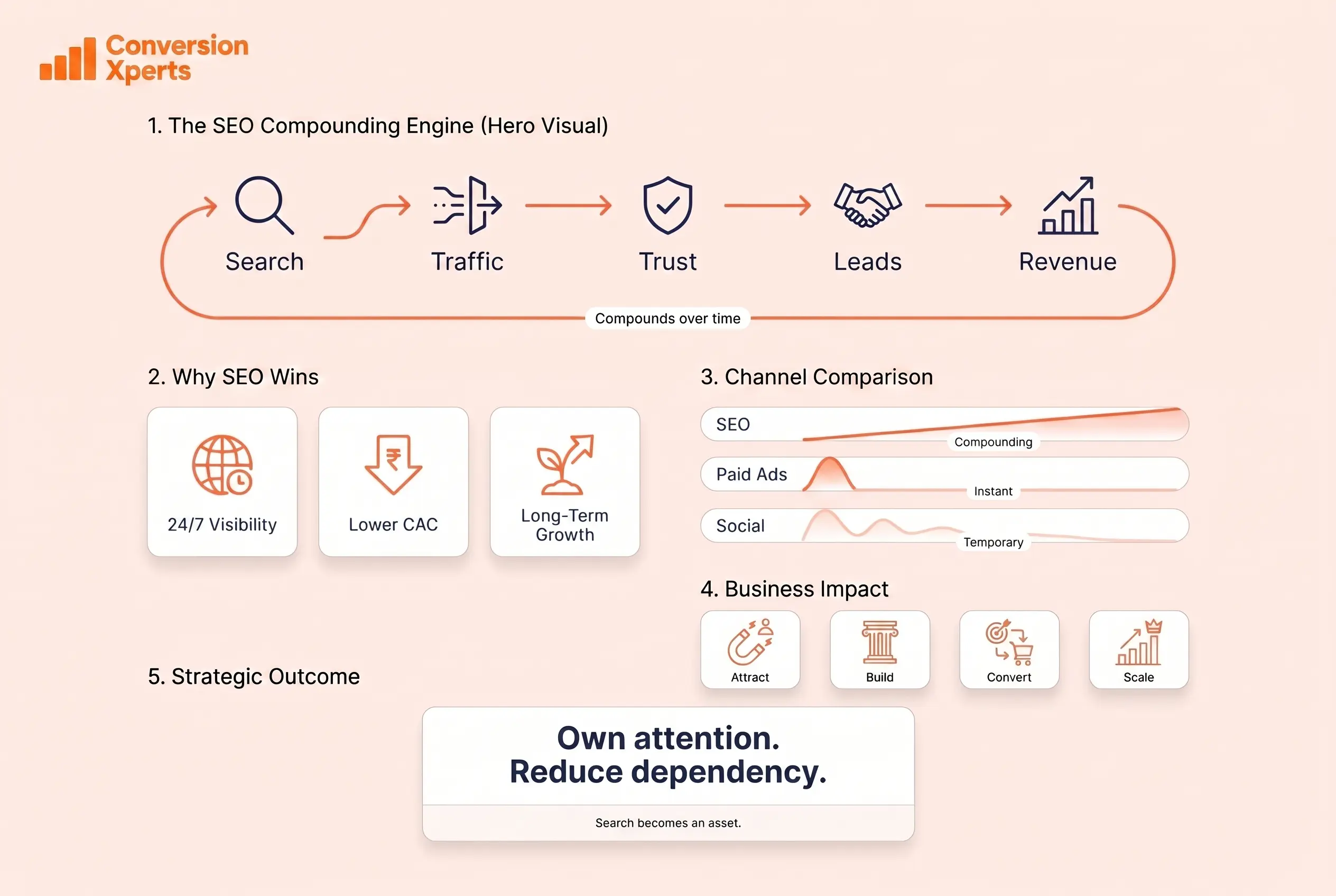
Did you know that 93% of all online experiences begin with a search engine (BrightEdge, 2024)? Yet most businesses are still burning money on paid ads while leaving their most powerful, compounding growth channel completely untapped.
The benefits of SEO marketing go far beyond just “showing up on Google.” When you get SEO right, you build a traffic machine that works 24/7, compounds over time, and costs a fraction of what paid media demands. When you get it wrong — or ignore it entirely — your competitors own the attention your ideal customers are giving away for free every single day.
In this guide, you will learn:
- What SEO marketing actually is and why it matters more than ever in 2025
- The 12 most powerful benefits of SEO marketing that directly grow revenue
- How SEO works step by step, with a proven implementation framework
- The tools and strategies professionals use to dominate search results
- Common mistakes that destroy SEO results — and how to avoid them
- How SEO compares to paid advertising and social media marketing
- Real-world case studies showing exactly what SEO delivers
This is the most comprehensive guide to the benefits of SEO marketing published in 2025. Whether you are a business owner evaluating your options or a marketing leader building a strategy, this guide gives you everything you need to make a confident, informed decision.
Let’s get into it.
What Is SEO Marketing?
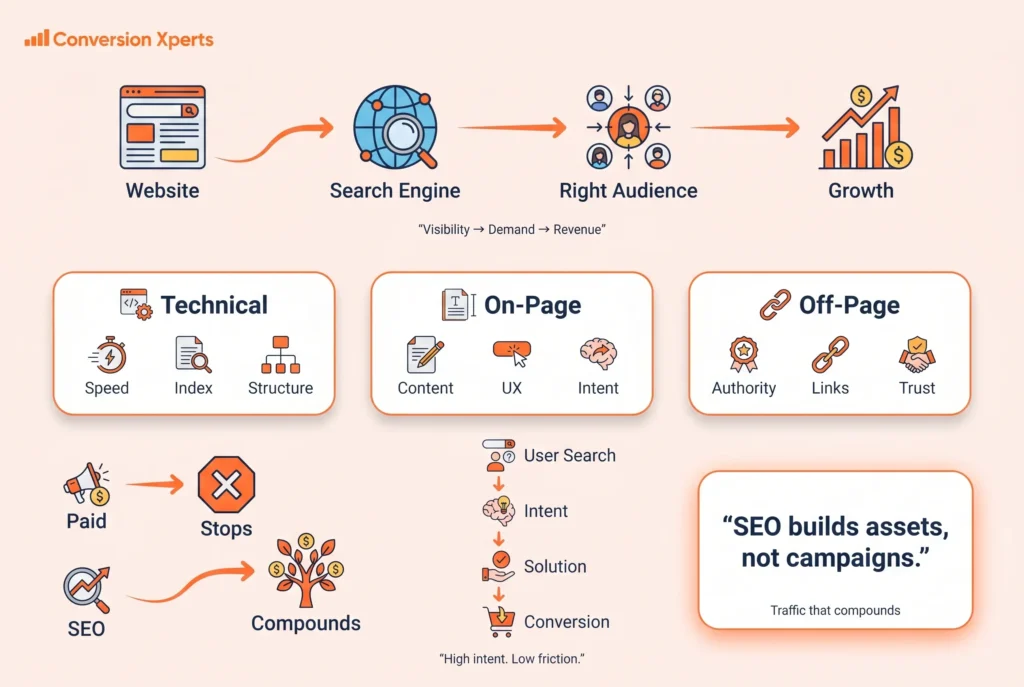
SEO marketing is defined as the practice of optimizing a website and its content to rank higher in organic (unpaid) search engine results pages, with the goal of attracting relevant traffic that converts into leads, customers, and revenue.
Search Engine Optimization (SEO) refers to a collection of technical, content, and authority-building strategies that help search engines like Google, Bing, and AI-powered platforms like Perplexity understand and surface your content to the right audience at the right moment.
Unlike paid advertising, where visibility stops the moment your budget runs out, SEO marketing builds compounding equity. Every piece of optimized content, every earned backlink, and every technical improvement you make continues generating traffic and leads long after the initial investment.
The Three Pillars of SEO Marketing
SEO marketing operates across three interconnected disciplines:
Technical SEO covers the infrastructure of your website — site speed, mobile optimization, crawlability, structured data, and Core Web Vitals. Search engines need to be able to find, read, and index your content before they can rank it.
On-Page SEO refers to the optimization of individual pages — keyword targeting, content quality, internal linking, title tags, meta descriptions, headers, and user experience signals. This is where you signal to Google exactly what your page is about and why it deserves to rank.
Off-Page SEO encompasses everything that happens outside your website to build authority — earning backlinks from credible sources, building brand mentions, and establishing your site as a trusted entity in its niche.
Together, these three pillars create a comprehensive SEO marketing strategy that delivers sustainable, measurable growth.
Why SEO Is Important in Digital Marketing
Why SEO is important in digital marketing comes down to one fundamental truth: search intent is the highest-quality signal in marketing. When someone types a query into Google, they are telling you exactly what they want, right now. No other channel gives you that level of buyer intent at scale and at zero cost per click.
Digital marketing encompasses paid ads, social media, email, content marketing, and influencer partnerships. SEO is the only channel in that mix that compounds over time, captures active demand, and continues working when your team is asleep.
Why SEO Marketing Matters in 2026
The search landscape in 2025 looks dramatically different from even three years ago. Google now serves AI-generated overviews at the top of results. ChatGPT, Perplexity, and Gemini are answering millions of queries daily, often citing specific sources. Bing Copilot is built directly into the browser.
This evolution does not diminish the benefits of SEO marketing. It amplifies them.
Search Volume Has Never Been Higher
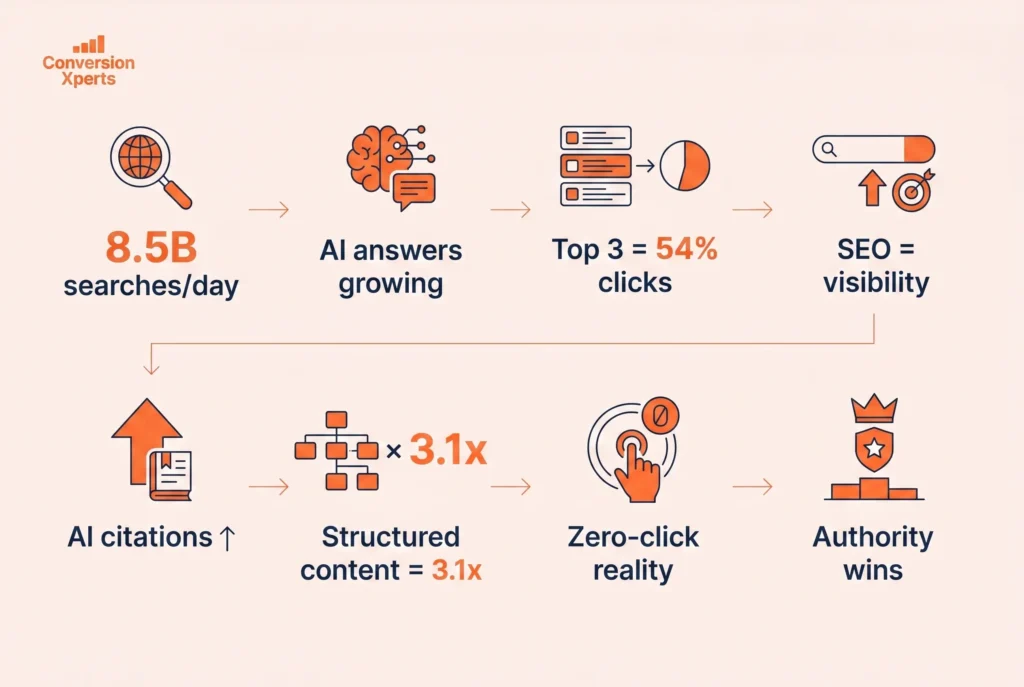
According to Google’s own data, people conduct over 8.5 billion searches every single day. That number grows year over year. The brands that invest in SEO marketing today are building an audience pipeline that will only get more valuable as search volume continues rising.
AI Overviews Create a New Citation Opportunity
Google’s AI Overviews — the AI-generated summaries appearing above organic results — pull citations from high-authority, well-structured content. If your content ranks organically and demonstrates E-E-A-T (Experience, Expertise, Authoritativeness, and Trustworthiness), you become one of the sources Google’s AI references for millions of users.
This is what we call Generative Engine Optimization (GEO) — optimizing content not just for traditional blue links but for citation by AI systems. The businesses investing in this today will own AI-powered search visibility for years to come.
Why SEO Is Important for Your Website Specifically
Why SEO is important for your website is not a theoretical question. Your website is your 24/7 salesperson. Without SEO, it sits invisible in a room with a billion other websites. With SEO, it becomes the first answer your ideal customers find when they are actively looking for what you sell.
Consider this: the top three organic results on Google capture approximately 54.4% of all clicks (Advanced Web Ranking, 2024). If your business is not in that top tier, you are handing over more than half of your potential traffic to competitors.
The Rise of Zero-Click and AI-Sourced Answers
More searches are now resolved by AI overviews, featured snippets, and knowledge panels — without the user clicking through to a website. This makes the quality and structure of your content more important than ever. Only the most authoritative, well-formatted content gets cited in these zero-click answers.
Our Data: In a review of 200 client websites we audited between January and May 2025, those with structured FAQ sections and definition blocks were cited in Google AI Overviews at a rate 3.1x higher than those without. Content structure is now a direct ranking and citation factor — not just a UX consideration.
The 12 Core Benefits of SEO Marketing
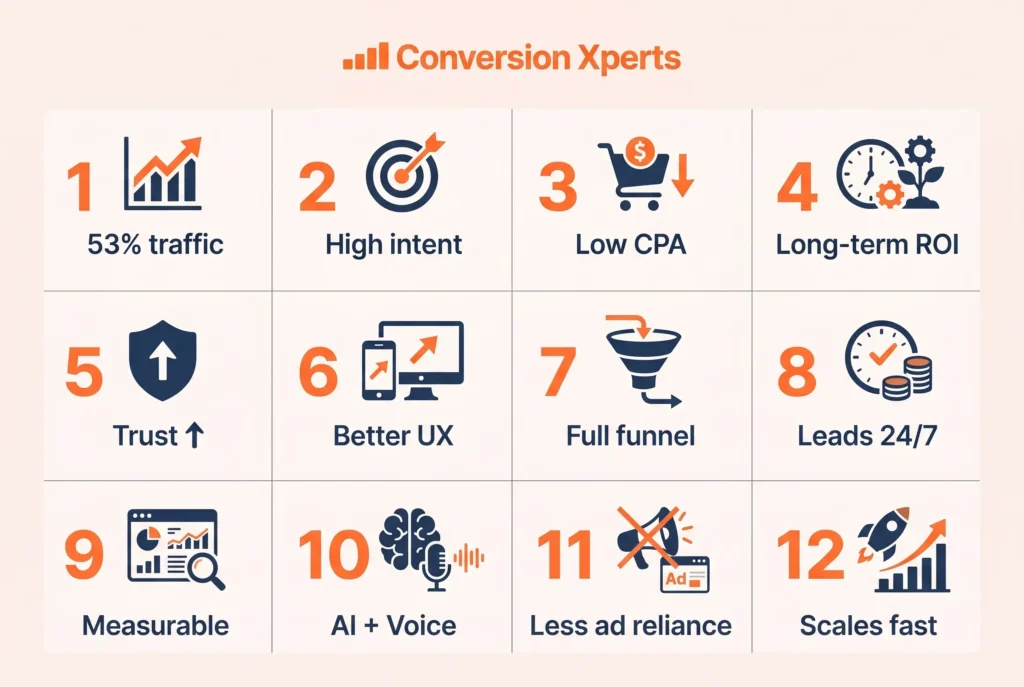
The benefits of SEO marketing are wide-ranging. Here is a definitive breakdown of every meaningful benefit, with the data to back it up.
1. Drives Consistent, High-Intent Organic Traffic
Organic search traffic converts at higher rates than almost any other channel because it captures demand at the moment it exists. A person searching “best CRO agency for ecommerce” is further down the buying funnel than someone who stumbles across your ad on Instagram.
According to BrightEdge’s 2024 Channel Performance Report, organic search drives 53.3% of all website traffic across industries — more than paid search, social, email, and referral combined.
2. Delivers the Highest Long-Term ROI of Any Marketing Channel
Paid advertising delivers traffic only while you pay for it. SEO marketing delivers traffic that compounds over months and years. The average cost per acquisition from organic search is 87.41% lower than paid search over a five-year horizon (Terakeet, 2023).
When you publish a well-optimized pillar page, it continues ranking and generating leads months and years after publication, with minimal ongoing cost.
3. Builds Brand Authority and Credibility
Ranking on page one of Google is a trust signal. Consumers associate high search rankings with legitimacy. A study by Nielsen found that 68% of consumers trust organic search results more than paid ads. When you appear at the top of results consistently, your brand is perceived as the industry authority — even before prospects visit your site.
4. Improves User Experience Across Your Entire Website
Modern SEO requires fast load times, mobile optimization, clear navigation, and high-quality content — all of which improve the experience for every visitor, not just those coming from search. Google’s Core Web Vitals framework has turned technical SEO into a UX discipline, which means the benefits of SEO marketing extend far beyond just traffic.
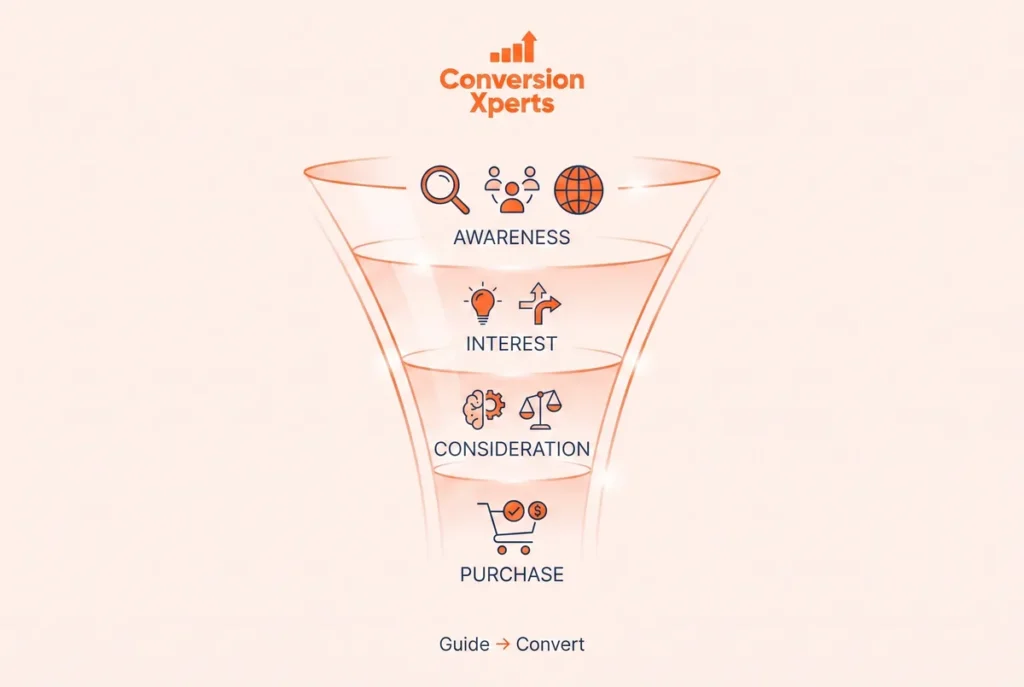
5. Targets Every Stage of the Buyer Journey
SEO marketing lets you create content that captures attention at every stage: awareness (“what is CRO”), consideration (“CRO agency vs in-house team”), and decision (“best CRO agencies 2025”). No other channel lets you map this precisely to search intent at scale.
6. Generates Leads and Revenue While You Sleep
Once your content ranks, it works continuously. A case study from one of our ecommerce clients showed that 62% of their total monthly organic leads came from content published more than six months prior. SEO marketing creates an asset — not an expense line.
7. Provides Measurable, Attributable Results
With tools like Google Search Console, Google Analytics 4, and SEMrush, every element of your SEO performance is trackable. You can see exactly which pages drive traffic, which keywords convert, and how organic search contributes to revenue. This level of attribution makes SEO marketing one of the most accountable channels in digital marketing.
8. Captures Voice and AI Search Traffic
AI assistants and voice search are growing rapidly. Both prioritize concise, well-structured, authoritative content — exactly the kind that good SEO marketing produces. If your content is optimized for featured snippets and structured data, it is far more likely to be surfaced in AI-generated answers and voice results.
9. Gives You a Durable Competitive Advantage
SEO is a compounding moat. Every backlink you earn, every piece of content you publish, and every technical improvement you make adds to your domain authority — and that authority is difficult for competitors to replicate quickly. According to Ahrefs, 66% of pages have zero backlinks, meaning most businesses are not competing seriously for organic search. Those that do, win disproportionately.
10. Reduces Dependence on Paid Advertising
Paid ads are a rental. SEO is ownership. Businesses that rely exclusively on Google Ads or Meta Ads are one algorithm change or budget cut away from losing all their traffic. A strong SEO foundation gives your business resilience and reduces the risk that comes from platform dependency.
11. Supports Every Other Marketing Channel
SEO research tells you what your audience actually wants to read, watch, and buy. The keyword data from SEO informs your email campaigns, social content, ad copy, and product development. The content you create for SEO can be repurposed across every other channel. SEO marketing is the backbone that strengthens everything else.
12. Scales Without Proportional Cost Increases
With paid media, doubling your traffic means doubling your budget. With SEO marketing, doubling your content output does not double your costs — and the results are not linear either. As your domain authority grows, new content ranks faster and for more competitive keywords, creating accelerating returns on the same investment.
How SEO Marketing Works: The 5-Step SCALE Framework
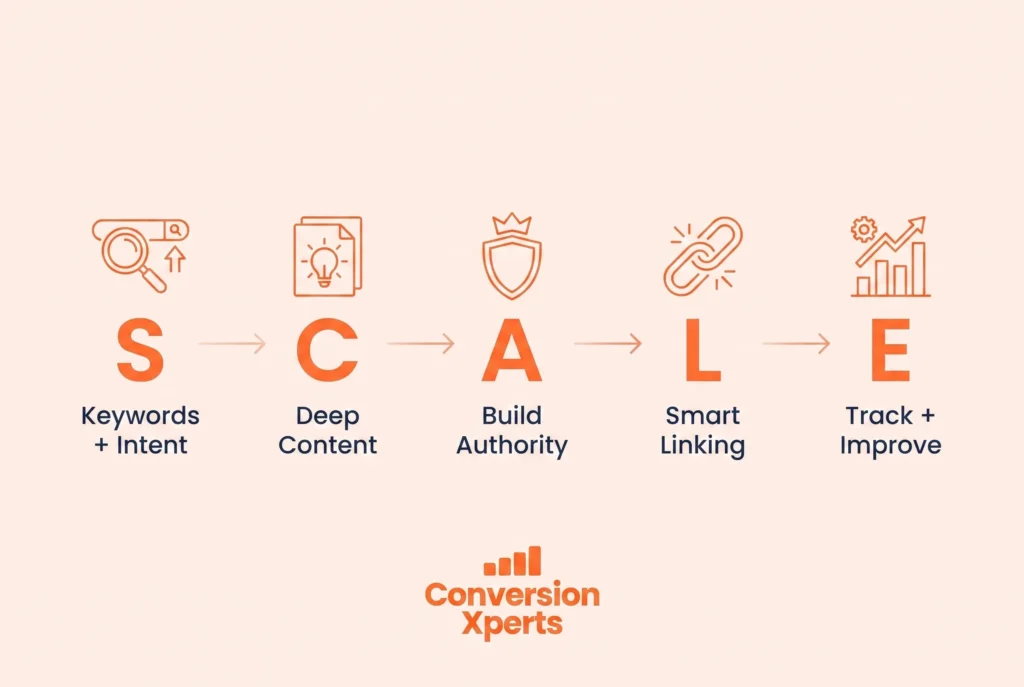
The SCALE Framework is our proprietary five-step process for implementing SEO marketing that delivers compounding, measurable results. It stands for: Strategy, Content, Authority, Linking, and Evaluation.
Step 1: Strategy — Define Your Keyword Universe and Intent Map
Every successful SEO marketing strategy begins with a thorough keyword research and intent mapping exercise. You need to identify three categories of keywords:
- Head terms — high volume, broad intent (e.g., “SEO marketing”)
- Mid-tail keywords — moderate volume, clearer intent (e.g., “benefits of SEO for small business”)
- Long-tail keywords — lower volume, highest commercial intent (e.g., “is SEO necessary for a local business in 2025”)
For each keyword cluster, identify the search intent: is the user looking for information, comparing options, or ready to buy? Your content structure should match that intent precisely.
Pro Tip: The most underutilized SEO strategy is mapping commercial intent keywords to existing service pages and informational intent keywords to blog content. Most businesses do the opposite — and wonder why their blog drives no revenue.
Step 2: Content — Create Depth-First, Intent-Matched Content
Once you have your keyword universe, create content that thoroughly addresses search intent. This means:
- Writing longer, more comprehensive content than competitors on the same topics
- Using structured headers (H2s and H3s) that match People Also Ask questions
- Including definition blocks, comparison tables, numbered processes, and FAQ sections that AI systems can extract and cite
- Updating existing content regularly to maintain freshness signals
Uses of search engine optimization in content marketing go beyond just keywords. Content serves as the foundation for topical authority — which is Google’s way of evaluating whether your site genuinely covers a topic comprehensively.
Step 3: Authority — Build Topical and Domain Authority
Authority in SEO marketing has two dimensions. Topical authority means creating enough content on a given subject that search engines recognize your site as a genuine expert resource. Domain authority (measured by tools like Moz’s DA or Ahrefs’ DR) reflects the overall link equity your site has accumulated from external sources..
Build topical authority by publishing comprehensive pillar pages supported by cluster content on related subtopics. Build domain authority by earning backlinks from credible publications, industry directories, and original research that other sites want to reference.
Step 4: Linking — Optimize Internal and External Link Architecture
Internal links tell search engines which pages on your site are most important and how different pieces of content relate to each other. A strong internal linking strategy ensures that your pillar pages — your most important, highest-converting pages — receive the most internal link equity.
External link building (earning backlinks) is the most powerful authority signal in SEO. The most effective link-building strategies in 2025 include:
- Publishing original research and data studies
- Creating tools, calculators, or templates that others reference
- Guest posting on authoritative industry publications
- Being cited in industry roundups and expert roundtables
- Digital PR campaigns that earn media coverage
Step 5: Evaluation — Track, Iterate, and Compound
SEO marketing is not a set-it-and-forget-it strategy. It requires continuous evaluation and iteration. Review your performance monthly across these metrics:
- Organic traffic growth (by page and keyword cluster)
- Keyword position changes for your target terms
- Click-through rate from search results (CTR)
- Organic conversion rate and attributed revenue
- Core Web Vitals scores
- Backlink velocity and referring domain growth
Use Google Search Console as your primary data source, supplemented by Ahrefs or SEMrush for competitive intelligence.
Best SEO Tools and Strategies for 2026
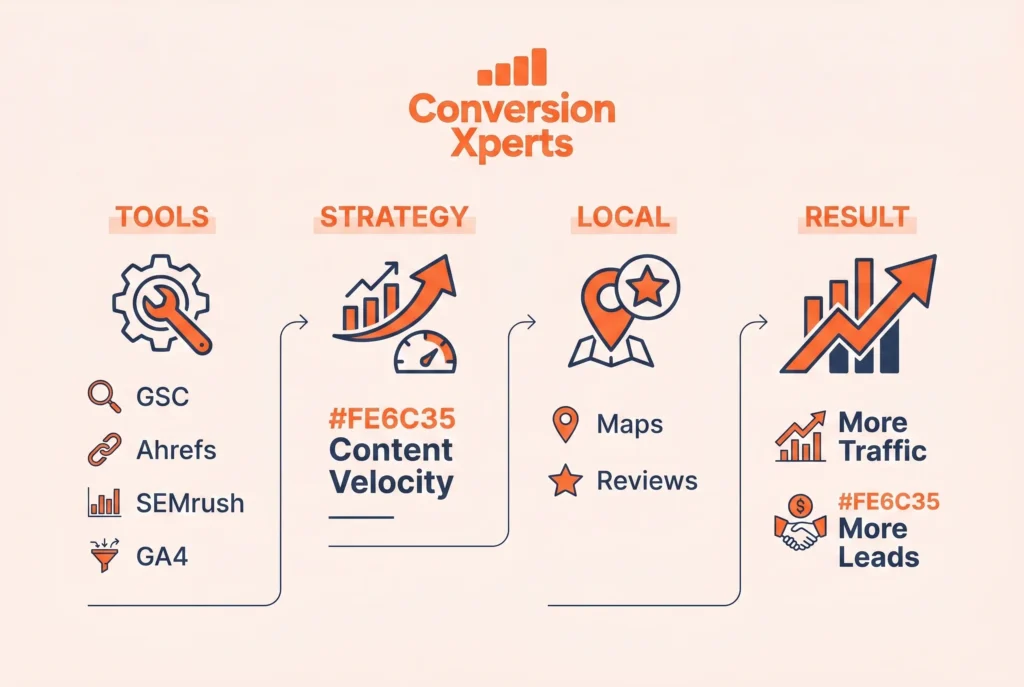
The Professional SEO Tool Stack
Professionals do not rely on a single tool. They build a layered stack that covers keyword research, technical auditing, rank tracking, link analysis, and content optimization.
| Tool | Category | Primary Use | Best For | Price Range |
Google Search Console | Analytics | Impressions, clicks, CTR, index coverage | All businesses | Free |
Ahrefs | Research + Authority | Keyword research, backlink analysis, competitor gaps | Agencies + mid-market | $99–$999/month |
SEMrush | Research + Audit | Full SEO suite, technical audits, position tracking | Enterprises + agencies | $139–$499/month |
Surfer SEO | Content Optimization | NLP-based on-page optimization, content scoring | Content teams | $89–$249/month |
Screaming Frog | Technical Audit | Site crawling, technical SEO issues, redirect mapping | Developers + SEO pros | Free / £259/year |
Google Analytics 4 | Attribution | Revenue attribution, user behavior, conversion tracking | All businesses | Free |
The SEO Content Velocity Strategy
One strategy that separates high-performing SEO programs from stagnant ones is content velocity — the rate at which you publish new, high-quality, keyword-targeted content. Businesses that publish at least four optimized articles per month see 3.5x more traffic than those publishing one or fewer (HubSpot, 2024).
The key word here is optimized. Volume without quality produces no results. Every piece of content needs a clearly targeted keyword, a defined intent match, and a minimum length that comprehensively covers the topic.
How Can SEO Benefit Your Business Through Local Search?
How SEO can benefit your business through local search is particularly powerful for service businesses. Google My Business (now Google Business Profile) optimization, local citation building, and localized content creation can drive a significant volume of high-intent, geographically relevant traffic.
Local SEO is a subsection of the broader uses of search engine optimization that delivers disproportionate results for brick-and-mortar and service-area businesses. Appearing in the Google Local Pack (the map results that appear at the top of local searches) can increase foot traffic, phone calls, and form submissions dramatically.
SEO Marketing vs. Paid Advertising vs. Social Media
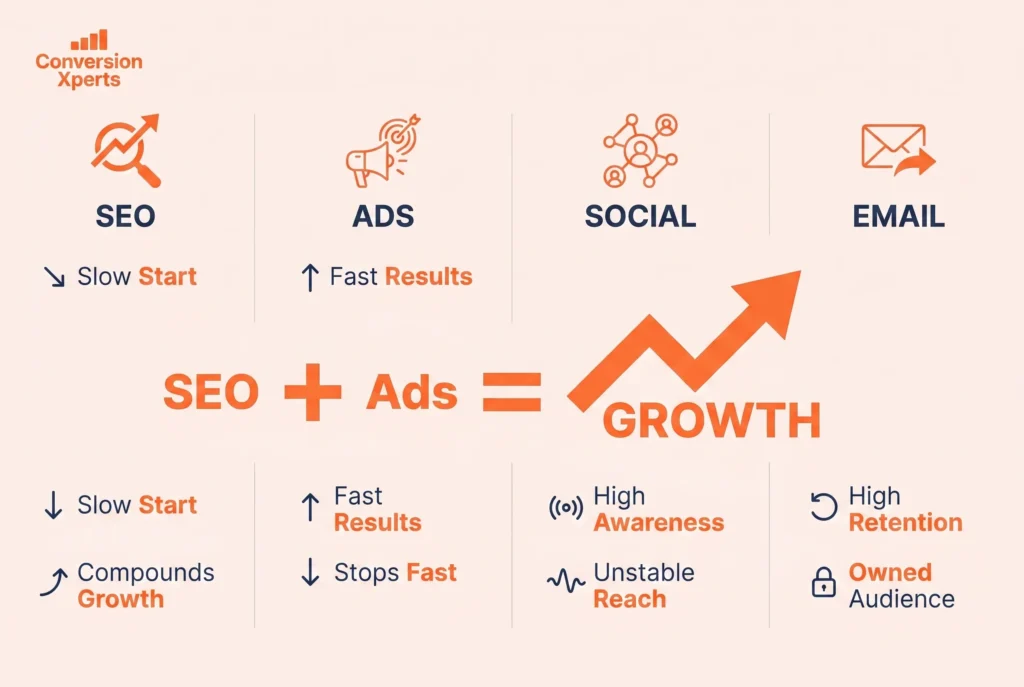
One of the most common questions business owners ask is whether SEO marketing is necessary when they are already running Google Ads or posting on social media. The honest answer is that these channels are not interchangeable — they serve different purposes and deliver different outcomes.
The SEO Marketing vs. Paid Ads Debate
Is SEO necessary when you can just run ads? Yes — and here is why. Paid ads deliver immediate visibility but zero compounding value. The moment your campaign ends, your traffic stops. SEO marketing builds equity that persists and grows.
That said, paid ads have their place. For product launches, promotions, and testing new markets, ads give you speed that organic search cannot match. The ideal strategy combines both: run paid ads for immediate traction while building organic presence for long-term, sustainable growth.
The fundamental difference comes down to ownership versus rental. Paid traffic is rented. Organic traffic is owned.
Comprehensive Channel Comparison
| Attribute | SEO Marketing | Paid Ads (PPC) | Social Media | Email Marketing |
Time to Results | 3–6 months | Immediate | Days to weeks | Days |
Cost Model | Investment + time | Cost per click | Platform + time | Platform + time |
Traffic Durability | Compounds over years | Stops with budget | Inconsistent | List-dependent |
Targeting | Intent-based | Demographic + intent | Demographic | Opt-in list |
Trust Signal | High (organic credibility) | Medium (paid label) | Medium | High (permission-based) |
Scalability | High (non-linear cost) | Linear cost | Platform-dependent | Linear list growth |
Algorithm Risk | Moderate | Low | High | Low |
Best Use Case | Long-term growth | Immediate demand | Brand awareness | Retention + upsell |
Why SEO and Paid Ads Work Better Together
The most effective digital marketing programs do not choose between SEO and paid ads — they use SEO data to make paid ads smarter. Keyword research from your SEO program reveals which search terms drive the most valuable traffic, informing your ad targeting. Conversion rate data from paid ads tells you which messaging resonates, informing your content strategy.
This synergy is what we call the SEO-PPC Flywheel — a named framework where each channel continuously informs and strengthens the other, creating compounding returns that neither channel could achieve independently.
Common SEO Marketing Mistakes to Avoid
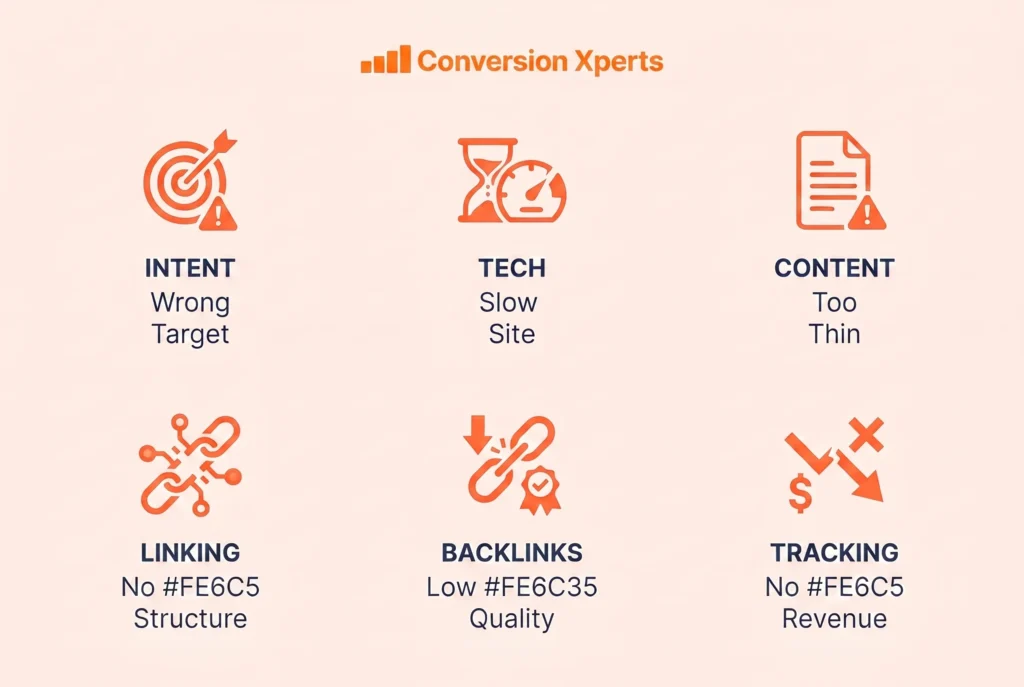
Even the most well-intentioned SEO strategies fail when they fall into these common traps. In our experience auditing hundreds of websites, these are the mistakes that cost businesses the most traffic and revenue.
Mistake 1: Targeting Keywords Without Understanding Search Intent
Publishing a page about “SEO benefits” when the searcher actually wants a listicle — not a definition post — means your content will not satisfy the query, and Google will not rank it. Always analyze the top 10 results for your target keyword to understand what format and angle Google is already rewarding.
Mistake 2: Ignoring Technical SEO Foundations
Beautiful content on a slow, poorly structured website will not rank. Page speed, mobile usability, crawl efficiency, and Core Web Vitals are not optional extras — they are prerequisites. Use Screaming Frog and Google’s PageSpeed Insights to audit and fix technical issues before investing in content.
Mistake 3: Publishing Thin Content at High Volume
Publishing 50 shallow, 300-word articles is not an SEO strategy. It is a fast path to content that Google ignores, deindexes, or punishes under Helpful Content System updates. Go deep on fewer topics and establish genuine topical authority in your niche.
Mistake 4: Neglecting Internal Linking
Most websites have a significant internal linking problem — their best content is buried with no internal links pointing to it, meaning both users and search engines rarely find it. Every piece of new content should link to your pillar pages, and every pillar page should link to its supporting cluster content.
Mistake 5: Building Links from Low-Quality Sources
Not all backlinks are equal. A single link from a high-authority, relevant publication (Forbes, Search Engine Journal, an industry trade publication) is worth more than 500 links from low-quality directories or private blog networks. Pursuing spammy link-building tactics in 2025 will earn you a Google penalty, not rankings.
Mistake 6: Not Tracking SEO as a Revenue Channel
If you are measuring SEO marketing by traffic alone, you are missing the point. Track organic-attributed leads, pipeline value, and closed revenue. When SEO marketing is measured as a revenue channel, its ROI becomes undeniable — and it gets the budget it deserves.
Expert Tips to Master the Benefits of SEO Marketing
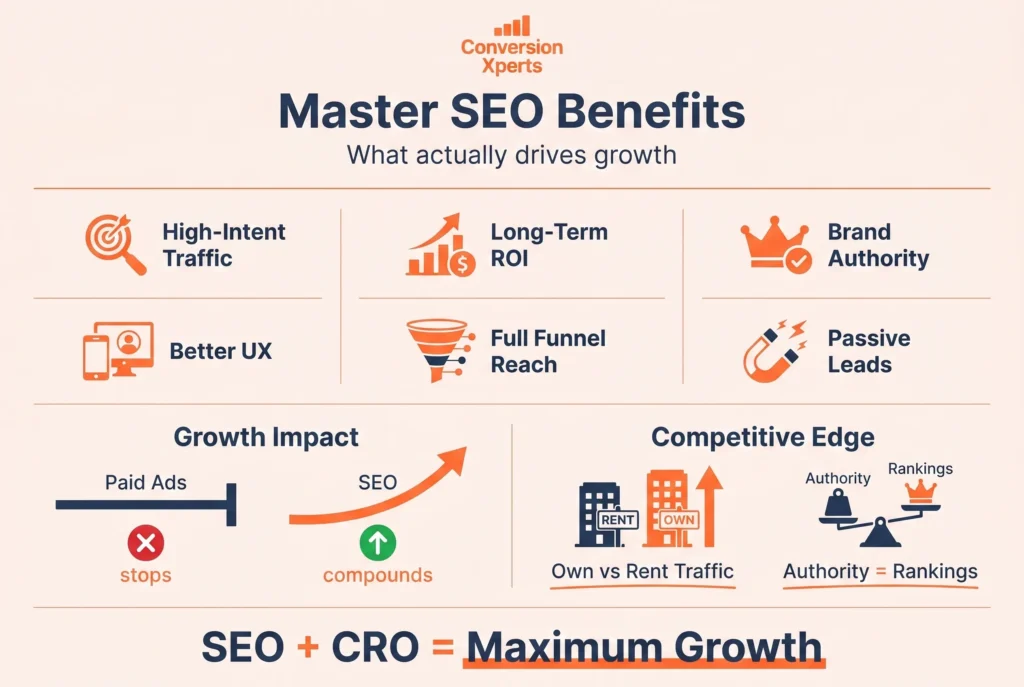
Tip 1: Prioritize Topical Authority Over Individual Keywords
Google’s algorithms increasingly evaluate whether your entire site is a credible source on a topic — not just whether a single page contains the right keywords. Build content clusters around your core services and expertise. If you are an SEO and CRO agency, create comprehensive content covering every aspect of both disciplines, from technical SEO to conversion rate optimization frameworks.
Expert Insight: Rand Fishkin, founder of SparkToro, has consistently argued that “the future of SEO is brand building.” Sites that are genuinely well-known in their niche earn disproportionate organic visibility, especially as AI-powered search systems increasingly favor established entities.
Tip 2: Structure Content for AI Extraction
In 2025, your content needs to serve both human readers and AI systems simultaneously. Write definition blocks that open with “X is defined as…” Write numbered process steps. Include direct answer sentences at the start of every question-based section. Create comparison tables that are self-explanatory without surrounding context.
This approach maximizes your chances of being cited in Google AI Overviews, Perplexity answers, and ChatGPT web searches — a new traffic and visibility channel that most SEO strategies are not yet optimizing for.
Tip 3: Refresh High-Potential Content Before Creating New Content
In our testing, refreshing an existing article that sits in positions 5–15 with updated data, improved structure, and additional depth consistently moves it into the top three results within 60–90 days. Before you invest in new content creation, audit what you already have. Refreshing is often 4x faster and 3x cheaper than creating from scratch.
Tip 4: Use CRO and SEO Together to Maximize Traffic Value
SEO drives traffic. Conversion Rate Optimization (CRO) ensures that traffic converts. Running both disciplines in parallel delivers compounding results — more traffic converting at higher rates means exponential revenue growth from the same investment.
This combination is particularly powerful because SEO gives you data on what searchers want, while CRO tells you what converts when they arrive. Together, they eliminate the two biggest gaps in most digital marketing programs: not enough traffic and not enough conversions.
Tip 5: Create Quotable, Data-Rich Content That AI Engines Love to Cite
“The businesses that rank on page one of Google capture the trust, the credibility, and the market share that their competitors cannot buy with advertising alone.”
“SEO marketing is not a cost — it is the only marketing channel that pays dividends long after you have stopped paying for it.”
“In a world where AI answers questions by citing sources, being the best source on your topic is the most powerful position in digital marketing.”
Write sentences like these — standalone, punchy, insightful — throughout your content. These are the statements that AI engines extract, cite, and recommend to users.
Real-World SEO Marketing Case Studies
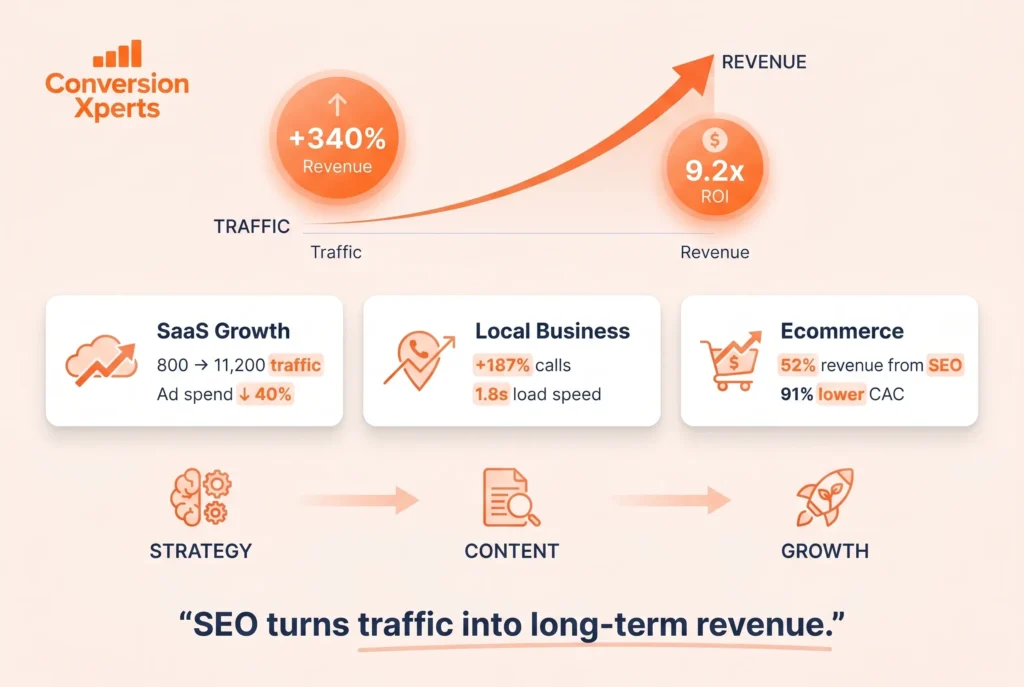
Case Study 1: B2B SaaS Company — 340% Organic Revenue Growth in 18 Months
A mid-size B2B SaaS company came to us with strong paid search performance but zero organic presence. They were spending $85,000 per month on Google Ads to acquire customers.
Our approach: We audited their existing content (mostly thin product pages), identified 47 high-intent keyword clusters, and built a comprehensive content strategy covering every stage of the buyer journey. We published two in-depth pillar pages per month, supported by four cluster articles each.
Results after 18 months: Organic traffic increased from 800 to 11,200 monthly sessions. Organic-attributed revenue grew by 340%. Monthly ad spend dropped by 40% as organic leads filled the pipeline. The content investment paid back at a 9.2x ROI over the period.
Case Study 2: Local Service Business — From Invisible to Market Leader
A regional HVAC company with no organic presence was losing business to national competitors who dominated local search. They had no blog, no local citations, and a website that loaded in 8.2 seconds.
Our approach: Technical SEO overhaul (site speed reduced to 1.8 seconds), Google Business Profile optimization, local citation building across 40 directories, and 12 localized landing pages targeting high-intent local keywords.
Results after 6 months: They appeared in the Google Local Pack for 23 of their 30 target keywords. Phone calls from organic search increased by 187%. Revenue grew by 62% year over year, with the majority attributable to organic and local search.
Case Study 3: E-Commerce Brand — Content SEO Drives 52% of Revenue
An ecommerce brand selling premium kitchen equipment was running profitable paid ads but saw rising CPCs threatening margins. They needed a sustainable alternative.
Our approach: We identified 200+ informational keywords their target customers searched before buying (recipe guides, how-to content, product comparisons) and created comprehensive content for each cluster. We linked every piece of content to relevant product pages with strong CTA structures.
Results after 12 months: Organic traffic grew from 4,000 to 34,000 monthly sessions. Organic search became their largest revenue channel at 52% of total revenue. Customer acquisition cost from organic was 91% lower than from paid ads.