Best AI Search Engine Optimization Tools in 2026: The Ultimate Guide
Introduction
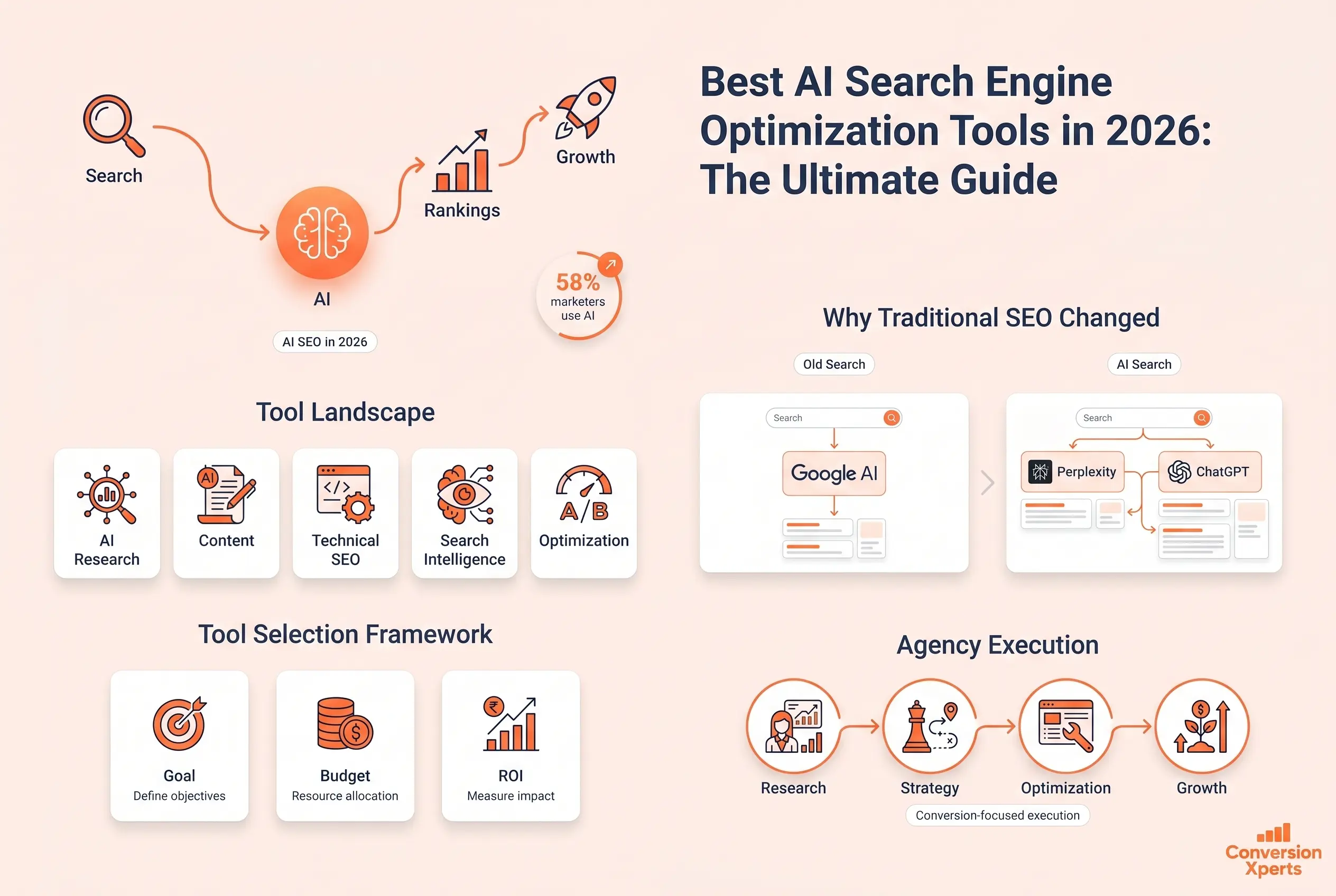
Search has changed more in the last two years than in the ten before it. Google says its AI Overviews now reach more than 2 billion people a month, ChatGPT has passed 800 million weekly users, and Perplexity handles hundreds of millions of questions every month. Ranking first on a results page is no longer the only goal. Getting your brand quoted inside an AI answer matters just as much.
That is why AI search engine optimization tools have become a standard part of every serious SEO program in 2026. Whether you run a small business, a SaaS product, or an online store, the tools you pick decide how fast you grow and how much you spend getting there. And if you would rather hand the work to a team that uses these tools every day, ConversionXperts can help.
In this guide, you will learn:
- What AI SEO tools are and how they differ from older SEO software
- The best free and paid tools for different budgets
- How to pick the right SEO platform for your goals
- How ConversionXperts uses these tools to get results for clients
- Clear answers to the questions people ask most about AI SEO
What Are AI Search Engine Optimization Tools?
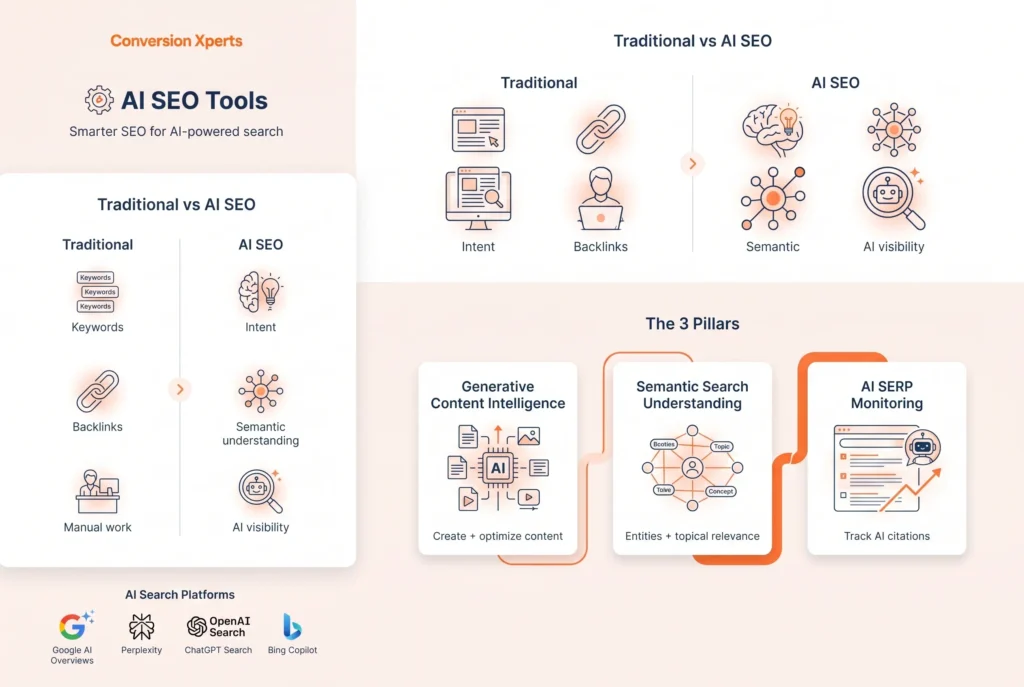
AI search engine optimization tools are software platforms that use machine learning, natural language processing (NLP), and large language models (LLMs) to speed up SEO work that used to take hours by hand.
They do far more than keyword research. They read search intent, build content briefs, audit technical site health, and track rankings in both classic Google results and AI answer engines like Google AI Overviews, ChatGPT, and Perplexity. Some can even run test prompts to show which sources an AI model cites for a topic, so you can see what it takes to earn a mention.
How AI SEO Tools Differ from Traditional SEO Software
Older SEO tools were built around keyword volume and backlink counts. AI-driven tools look at meaning, context, and how machines read your content.
| Feature | Traditional SEO Tools | AI Search Optimization Tools |
| Keyword research | Search volume and CPC data | Intent clusters and topic mapping |
| Content strategy | Keyword density | Topical authority scoring |
| Competitor analysis | Backlink gaps | Entity and SERP feature analysis |
| Ranking signals | Page authority | Entity and topic relevance |
| AI search visibility | Not covered | Tracks AI Overview and chatbot citations |
| Automation | Low | High (bulk briefs, drafts, audits) |
| Learning curve | Moderate | Low to moderate (AI-guided setup) |
The Three Pillars of AI-Driven SEO
Most AI SEO tools fall into one or more of these groups:
- Content intelligence: Tools that help you plan, write, and fact-check content that works for human readers and AI crawlers alike.
- Semantic search modeling: Platforms that map how search engines group topics, entities, and relationships, instead of looking at single keywords.
- AI visibility tracking: A newer category that checks whether your brand shows up in AI answers on Google, ChatGPT, Perplexity, Gemini, and Copilot.
Why Traditional SEO Tools Are No Longer Enough
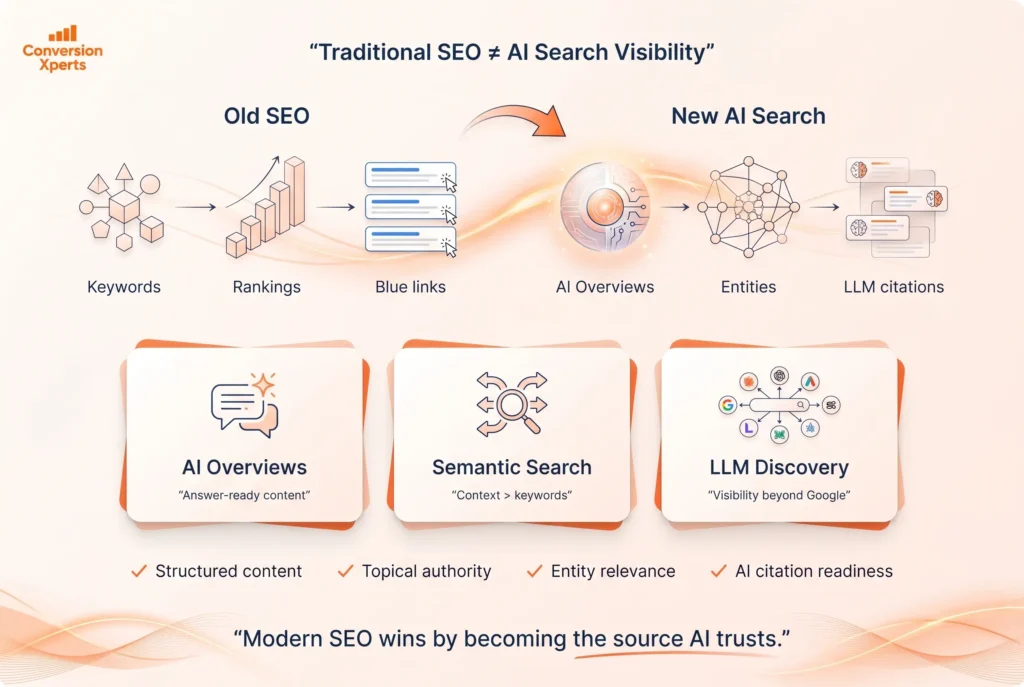
If your SEO process has not changed since 2022, you are probably missing traffic. Three big shifts explain why.
AI Overviews and Zero-Click Search
Google’s AI Overviews now sit at the top of a large share of informational searches. These summaries pull from a small group of trusted, well-structured pages, and many people get their answer without clicking anything. Several industry studies have found lower click-through rates on searches that show an AI Overview.
To compete here, you need tools that help you:
- Format content with clear, quotable answers
- Build topical authority across a full subject cluster
- Add schema markup so machines read your pages correctly
- Earn citations in AI answers, not only blue-link rankings
Semantic Search Has Replaced Keyword Matching
Google’s ranking systems reward helpful, people-first content and push down pages written only for search engines. Repeating a keyword over and over no longer works and can hurt you. Search engines now understand entities, relationships, and intent, so your tools need to work at that level too.
AI SEO content optimization tools close this gap. They study the pages that already rank and show you which related topics, questions, and entities your page should cover to be seen as complete.
AI Assistants Are Now Search Engines
ChatGPT passed 800 million weekly users in late 2025, and Perplexity reported about 780 million queries in May 2025 alone. People now ask these assistants questions they used to type into Google, and the assistants cite sources in their answers.
A modern AI search strategy has to account for how these models pick their sources. Freshness, credibility, clear writing, and structured data all play a big part.
Best AI Search Optimization Tools: Full Breakdown
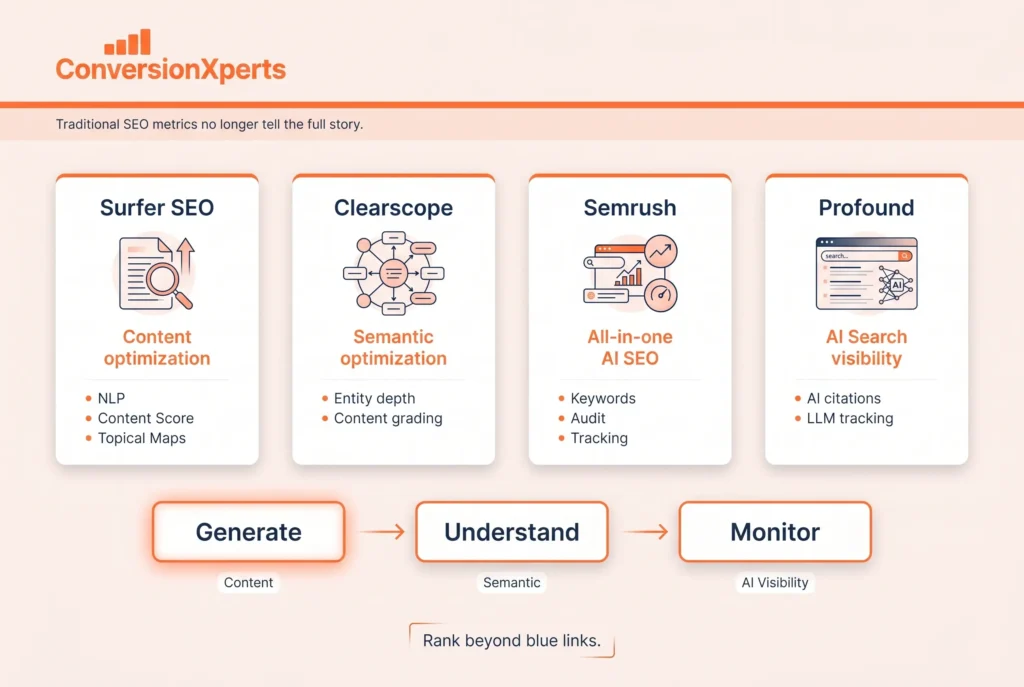
Here is a category-by-category look at the leading tools in 2026, with key features, starting prices, and who each one suits best. Prices change often, so check each vendor’s pricing page before you buy.
AI Content Optimization Platforms
Surfer SEO
Surfer SEO is one of the most popular content optimization tools. Its Content Editor compares your draft against the top-ranking pages for your keyword and gives you a live score as you write.
Key features:
- Term suggestions pulled from top-ranking pages
- Content Score that shows how well your page covers the topic
- AI drafting with Surfer AI
- Topical Map for planning content clusters
- AI search tracking to see how your brand shows up in AI answers
Pricing: Plans start at $49/month (Discovery, billed yearly). The Standard plan is $99/month billed yearly.
Best for: Content teams, bloggers, and agencies that need on-page optimization at scale.
Clearscope
Clearscope is a favorite among enterprise content teams. It works inside Google Docs and WordPress, so writers can optimize without leaving the tools they already use.
Key features:
- Content grades based on how fully a page covers its topic
- Keyword and entity discovery
- Content inventory that flags pages losing traffic
- Google Search Console integration
Pricing: Essentials starts at $129/month, with a 14-day free trial.
Best for: Enterprise content teams and agencies managing large sites.
Frase
Frase focuses on fast content briefs and AI-assisted writing. It suits teams that need to publish a lot of content without letting quality slip.
Key features:
- AI content briefs built from search results
- Answer engine optimization to target featured snippets and AI citations
- AI writer that follows SEO guidelines
- Topic scores based on competitor pages
Pricing: Starter is $49/month, or $39/month billed yearly, with a 7-day free trial.
Best for: Freelancers and small teams focused on publishing speed.
AI Keyword and Technical SEO Tools
Semrush
Semrush has grown from a keyword research tool into one of the most complete SEO platforms on the market. Its newer plans combine classic SEO data with AI search visibility tracking.
Key features:
- Keyword Magic Tool with one of the largest keyword databases available
- ContentShake AI for drafting SEO articles
- Position Tracking that flags AI Overview appearances
- Site Audit with prioritized fixes
- AI Visibility reports that show how often your brand appears in AI answers
Pricing: The SEO plan starts at $139/month. Plans that add AI search tools start at $199/month. A free plan gives you 10 reports per day.
Best for: Agencies and full-service marketing teams.
Ahrefs
Ahrefs is best known for its backlink data, and it has added a solid set of AI features over the last two years.
Key features:
- One of the largest live backlink indexes available
- AI Content Helper for on-page optimization
- AI keyword clustering
- Content Explorer for finding content gaps
- Brand Radar for tracking brand mentions in AI answers
Pricing: Lite starts at $129/month. A Starter plan costs $29/month, and Ahrefs Webmaster Tools is free for sites you own.
Best for: SEO specialists focused on link building and competitor research.
Tools for AI Search Visibility (LLM SEO)
Profound
Profound is built to track and improve how your brand appears in AI answers across ChatGPT, Perplexity, Google AI Overviews, Gemini, and Copilot.
Key features:
- Brand mention tracking across major AI platforms
- Prompt testing to see how AI tools answer questions in your space
- AI visibility comparison against competitors
- Citation analysis that shows which sources AI models trust
Pricing: Free trial available. Enterprise pricing is custom, and a self-serve plan is offered for agencies.
Best for: Brands and agencies that treat AI visibility as a core channel.
BrightEdge
BrightEdge is an enterprise SEO platform that has added AI Overview tracking and automated recommendations driven by its own AI.
Key features:
- AI recommendations for content and technical fixes
- AI Overview tracking and content gap detection
- Data Cube, a large database of search and content data
- Autopilot for automated page-level improvements
Pricing: Enterprise only, with custom pricing.
Best for: Large companies with significant organic traffic.
Free vs. Paid SEO Tools: What You Actually Get
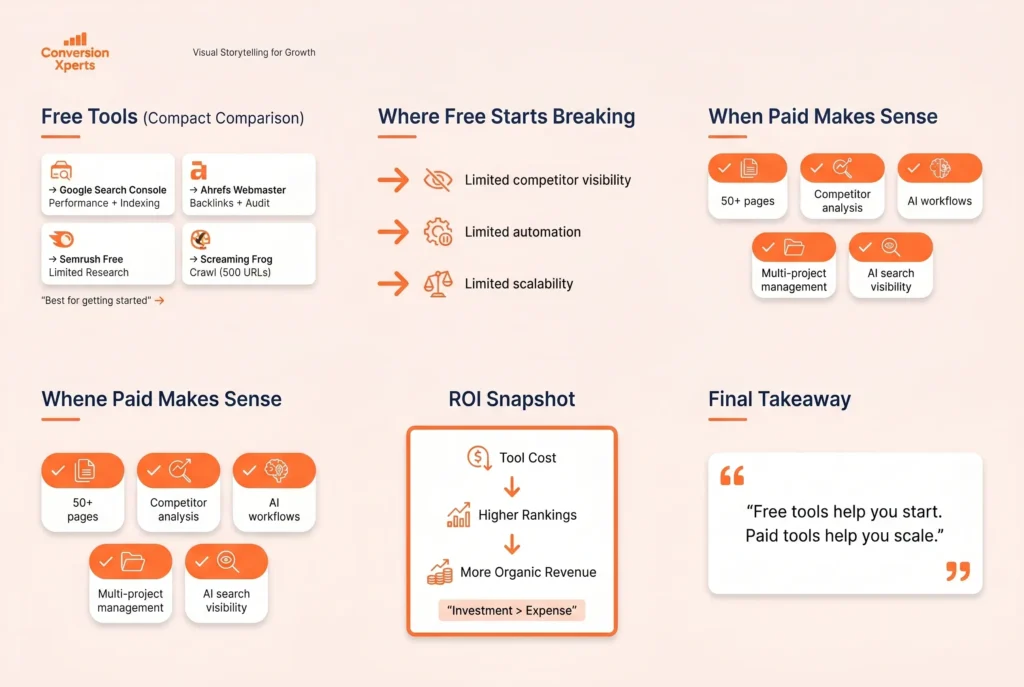
A question we hear often at ConversionXperts: “Can I get real results with free SEO tools, or do I need paid software?”
The short answer: free tools are a fine place to start, but they will limit how far you can grow.
Best Free SEO Tools Worth Using
| Tool | What You Get for Free | Limitation |
| Google Search Console | Indexing, performance, and Core Web Vitals data | No competitor data |
| Ahrefs Webmaster Tools | Site audit, backlinks, and keywords for your own site | Your verified sites only |
| Ubersuggest (free) | A few daily searches and keyword ideas | Very limited volume |
| AnswerThePublic (free) | Question-based keyword ideas | Daily search cap |
| Semrush Free | 10 reports per day | Limited data, one project |
| Google Keyword Planner | Keyword volume ranges | Needs a Google Ads account |
| Screaming Frog (free) | Full crawl data for up to 500 URLs | 500 URL cap |
Free tools work well for:
- Auditing a small site or a single landing page
- Early keyword research in a new niche
- Reviewing your current Google Search Console performance
- Learning SEO basics before paying for software
When to Upgrade to a Paid AI SEO Platform
It is time for a paid platform when:
- You manage more than 50 pages of content
- You need competitor data on keywords, backlinks, and content gaps
- You run campaigns for several clients or projects
- You want AI content briefs, writing help, or automation
- You need rank tracking for more than a handful of keywords
- Visibility in Google AI Overviews, ChatGPT, or Perplexity is part of your plan
The math is simple. A $150/month tool that helps you win a first-page ranking worth $5,000/month in organic traffic pays for itself many times over.
How to Choose the Best SEO Platform for Your Business
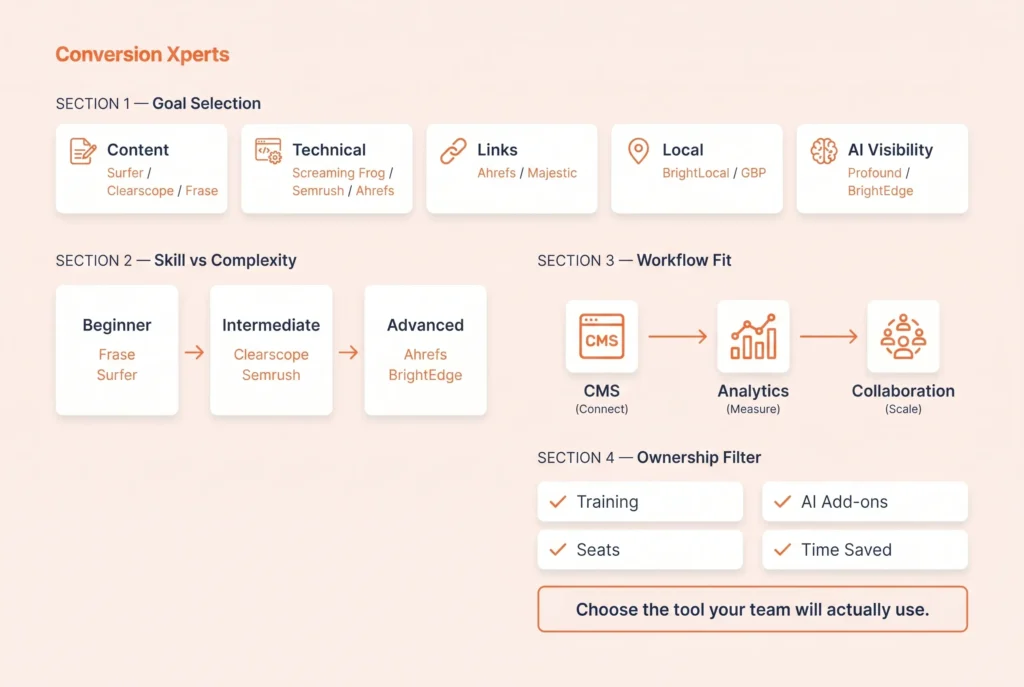
There are dozens of options, and picking one can feel overwhelming. Here is the framework we use with every client at ConversionXperts.
Step 1: Define Your Main SEO Goal
Different tools lead in different areas:
- Content optimization: Surfer SEO, Clearscope, Frase
- Technical SEO: Screaming Frog, Semrush Site Audit, Ahrefs Site Audit
- Link building: Ahrefs, Semrush, Majestic
- Local SEO: BrightLocal, Whitespark, Google Business Profile
- AI search visibility: Profound, Semrush AI Visibility, Ahrefs Brand Radar
Step 2: Match the Tool to Your Team’s Skill Level
Some tools are made for power users. Others are made for marketers who want quick wins.
| Tool | Skill Level Needed | Time to Value |
| Frase | Beginner to intermediate | Less than 1 day |
| Surfer SEO | Beginner to intermediate | 1 to 2 days |
| Clearscope | Intermediate | 1 to 2 days |
| Semrush | Intermediate to advanced | About 1 week |
| Ahrefs | Advanced | 1 to 2 weeks |
| BrightEdge | Advanced / enterprise | Several weeks |
Step 3: Check How It Fits Your Workflow
The best tool is the one your team will actually use every week. Look for platforms that:
- Connect to your CMS (WordPress, Webflow, HubSpot, and others)
- Pull data from Google Search Console and Google Analytics
- Offer API access if you build custom workflows
- Support team collaboration if several people write or edit
Step 4: Work Out the Total Cost
Look past the monthly price and count:
- Setup and training time
- Add-on costs (many platforms charge extra for AI features or AI tracking)
- Extra seats for team members
- The manual work the tool would save you
AI SEO Content Optimization Tools: A Deep Dive
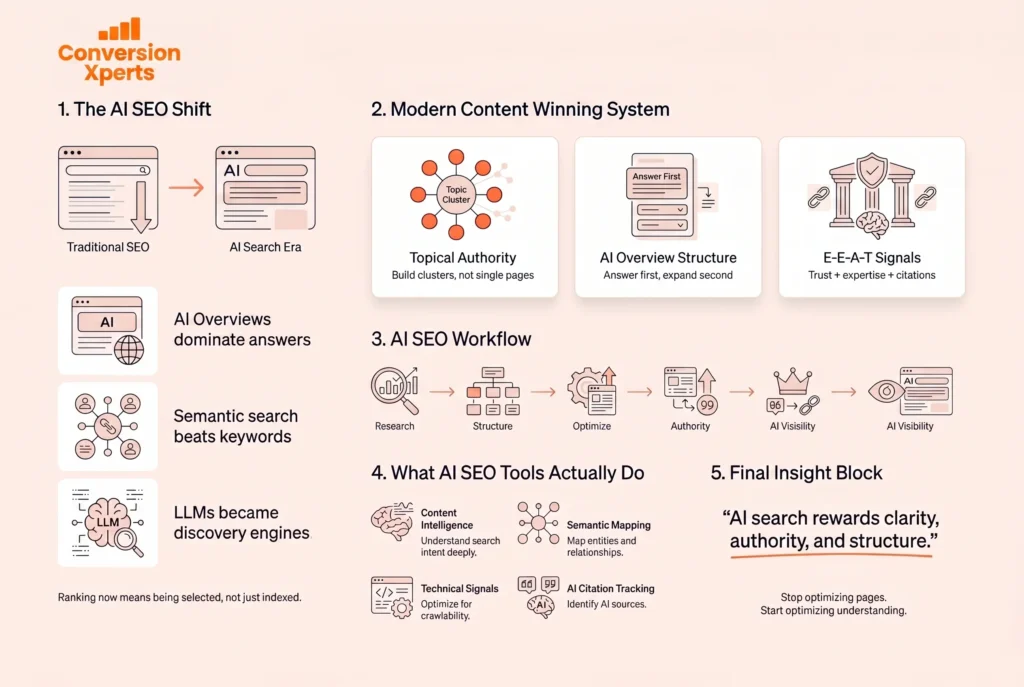
Content is still the base of SEO, but what counts as good content has changed. Here is how content optimization tools help you win in 2026.
Topical Authority: Why One Article Is Not Enough
Google tends to reward sites that cover a topic in depth across several connected pages, not a single heavily optimized article. Tools like Semrush Topic Research, Surfer’s Topical Map, and Frase’s topic scores help you:
- Find every related subtopic and question in your niche
- Plan pillar pages and supporting cluster articles
- Link related pages together so authority flows between them
- Spot content gaps your competitors have missed
Structuring Content for AI Overview Citations
To get cited in Google AI Overviews, ChatGPT, or Perplexity, write for people and machines at the same time:
- Put the answer first. AI systems often pull the first clear, factual answer on a page. Lead with the conclusion, then explain.
- Add schema markup. Article, FAQ, HowTo, and Organization schema help machines read and trust your page.
- Write short, clear sentences. Plain sentences are easier for AI models to quote correctly.
- Cite primary sources. Links to research, government data, and industry reports show that your facts hold up.
The Role of E-E-A-T in AI SEO
Google’s E-E-A-T guidelines (Experience, Expertise, Authoritativeness, Trustworthiness) matter more now that AI-written content is everywhere. Content optimization tools help you show E-E-A-T through:
- Clear author bios with author schema
- Steady publishing within your niche to build author credibility
- Mentions and backlinks from respected sites
- Accurate, regularly updated content
- Structured data that shows author credentials and publish dates
How ConversionXperts Uses AI SEO Tools to Drive Results
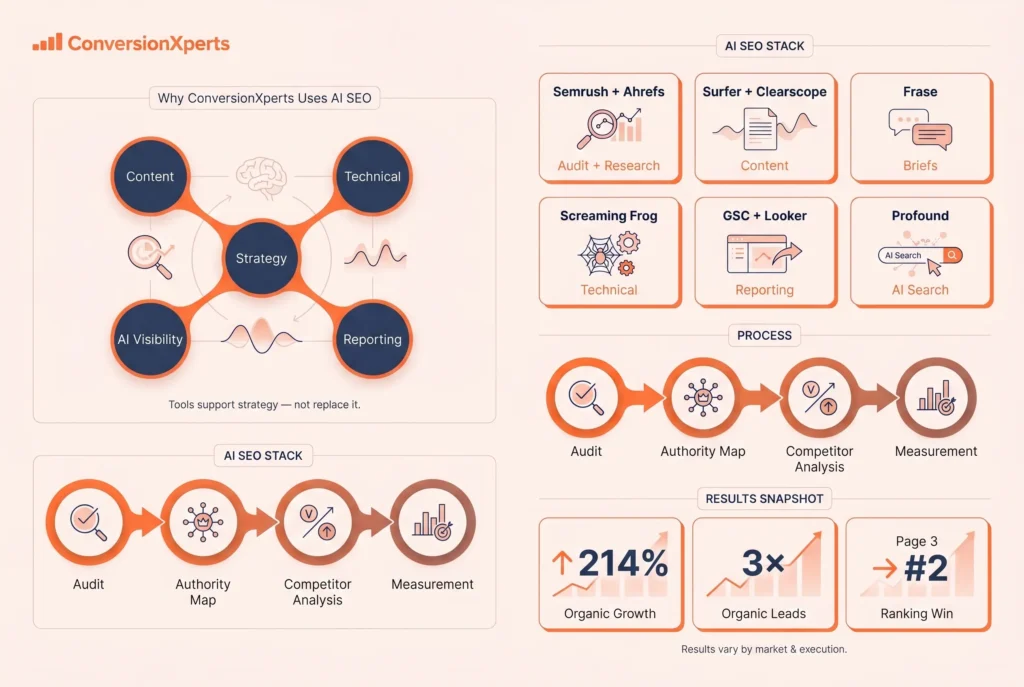
At ConversionXperts, we do not just recommend AI SEO tools. We build full client strategies around them. Here is how our process works.
Our AI SEO Stack
We combine the best tools for each part of SEO:
- Semrush and Ahrefs for technical audits, keyword research, and competitor research
- Surfer SEO and Clearscope for on-page content optimization
- Frase for fast content briefs at scale
- Screaming Frog for deep technical crawls
- Google Search Console and Looker Studio for tracking and reporting
- Profound for AI search visibility
Our Approach: Strategy Before Tools
Tools do not create results. Strategy does. Before we open a single platform, our team:
- Audits your site. We find technical issues, content gaps, keyword cannibalization, and weak spots in your link profile.
- Maps your topical authority. We pick the keyword clusters you can realistically win and build a 12-month content roadmap.
- Studies your competitors. We find the pages, keywords, and backlinks driving their rankings and what it will take to beat them.
- Sets up clear reporting. We track organic traffic, ranking milestones, organic leads, and AI search visibility.
Results We Have Delivered for Clients
Our AI-driven SEO work has produced measurable results across industries:
- Ecommerce brand: 214% more organic traffic in 9 months after rebuilding the content structure around topic clusters.
- B2B SaaS company: Moved from page 3 to position 2 for a main keyword worth an estimated $40,000/month in traffic value.
- Professional services firm: 3x more organic leads after optimizing for featured snippets and AI Overview citations.
Want to see what AI-powered SEO can do for your business? Book a free strategy session.