Retail Conversion Tips That Turn Browsers Into Buyers
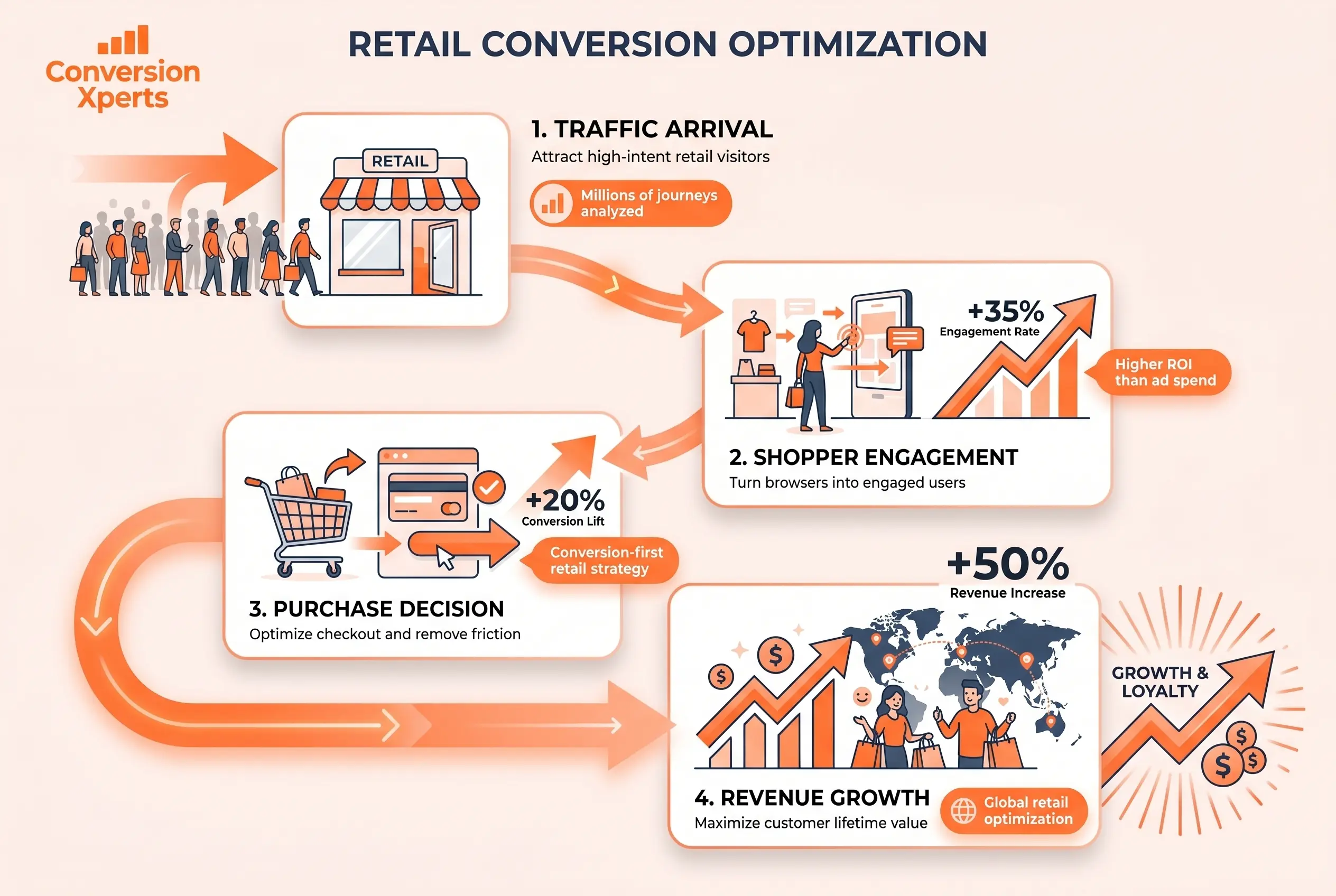
Every retailer around the world faces the same relentless challenge. Foot traffic arrives. Online visitors land. And then most of them leave without spending a single dollar, euro, pound, or peso. That is not a traffic problem. That is a retail conversion problem. And it is 100 percent solvable.
At ConversionXperts, we have spent years working with retail brands across North America, Europe, Asia Pacific, Latin America, and the Middle East. We have tested thousands of variables, analyzed millions of customer journeys, and distilled the results into a single truth: retail conversion rate optimization is the highest return investment a retail business can make. Not more ad spend. Not another social media campaign. Conversion optimization.
This guide delivers the most powerful retail conversion tips available anywhere. We have organized them by funnel stage, backed them with real world data, and built them for global application across every retail format, whether you operate a single boutique, a multi location chain, or a high volume ecommerce store serving customers in dozens of countries.
If you are spending money to bring shoppers to your door or your website and you are not equally invested in converting those shoppers into paying customers, you are running your growth engine at half capacity. These retail conversion tips will show you exactly how to fix that.
Understanding Retail Conversion Rate Optimization Before You Optimize
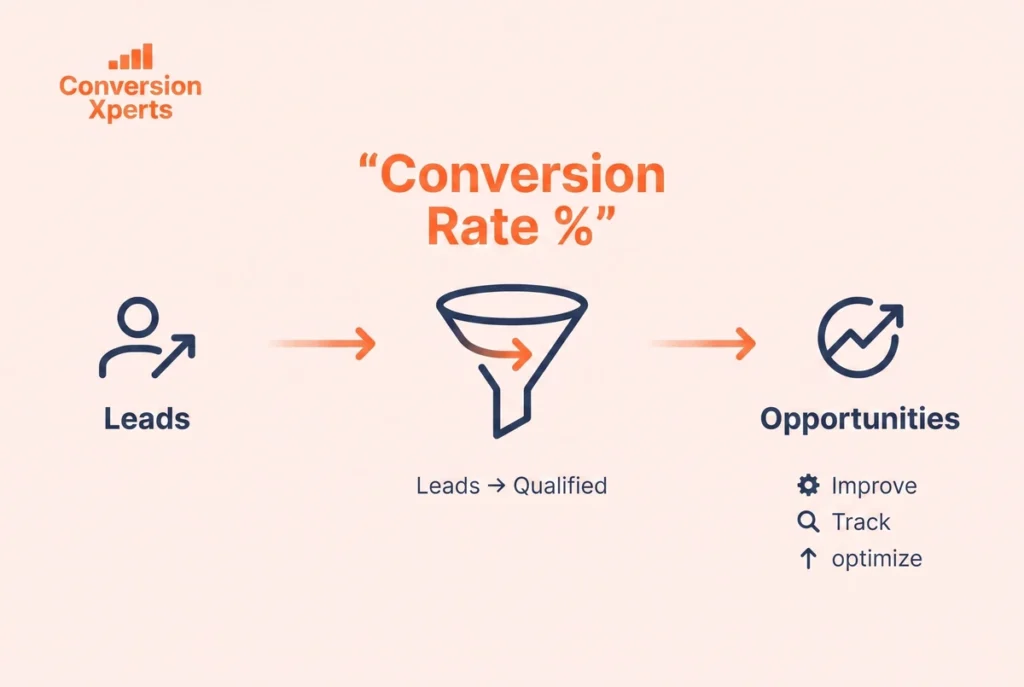
Before diving into tactical retail conversion tips, it is critical to understand what retail conversion rate optimization actually means in a global context. Your retail conversion rate is the percentage of store visitors or website sessions that result in a completed purchase. It is the most direct indicator of how well your store experience aligns with buyer intent and buyer readiness.
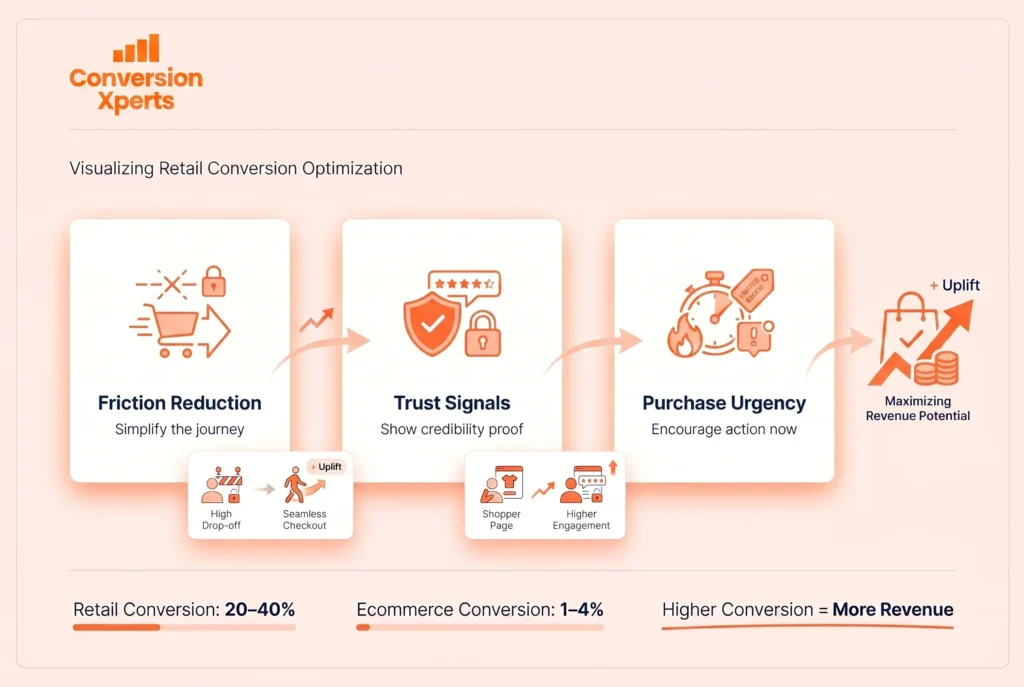
For physical retail stores globally, conversion rates range between 20 and 40 percent on average. For ecommerce stores, the global benchmark sits between 1 and 4 percent. Luxury brands, specialty retailers, and category specific stores often see different benchmarks based on the level of purchase intent that customers arrive with.
The gap between where most retailers sit and where top performers operate represents pure revenue waiting to be unlocked. A business generating one million dollars in annual sales with a 2 percent conversion rate would generate two million dollars at a 4 percent conversion rate without adding a single new visitor. That is the power of retail conversion optimization done well.
The variables that affect retail sales conversion fall into three core areas that every retail conversion expert focuses on. The first is friction reduction. Every barrier between a shopper and a completed purchase costs you money. Friction includes slow page load times, confusing navigation, complex checkout flows, and unclear value propositions. The second is trust and social proof. Buyers globally need to feel safe and confident before spending. Reviews, trust badges, clear return policies, and social validation drive this emotional readiness to convert. The third is purchase urgency and motivation. Even motivated shoppers often need a reason to act now rather than later. Limited availability, promotional pricing, and personalized offers create the behavioral push that moves intent into action.
The Top Retail Conversion Tips Proven to Drive Measurable Revenue Growth
These are not generic observations or theoretical frameworks. These are conversion rate optimization strategies applied directly with retail clients at ConversionXperts, refined through real world testing across different retail verticals, geographies, and customer segments. Every tip here has measurable evidence behind it.
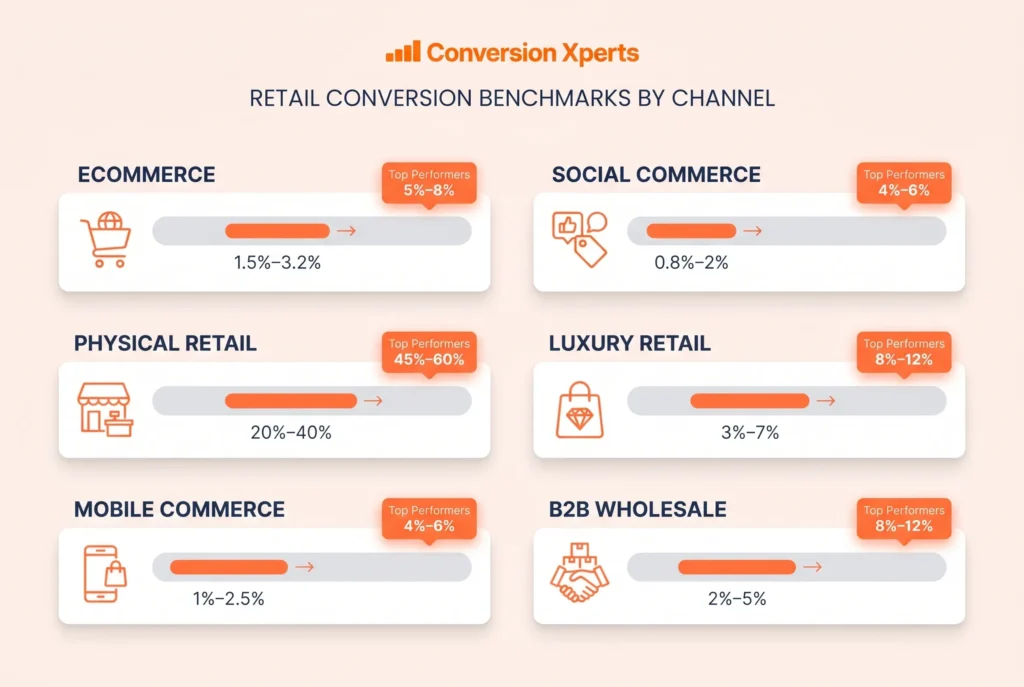
1. Master the Retail Conversion Funnel From Awareness to Purchase
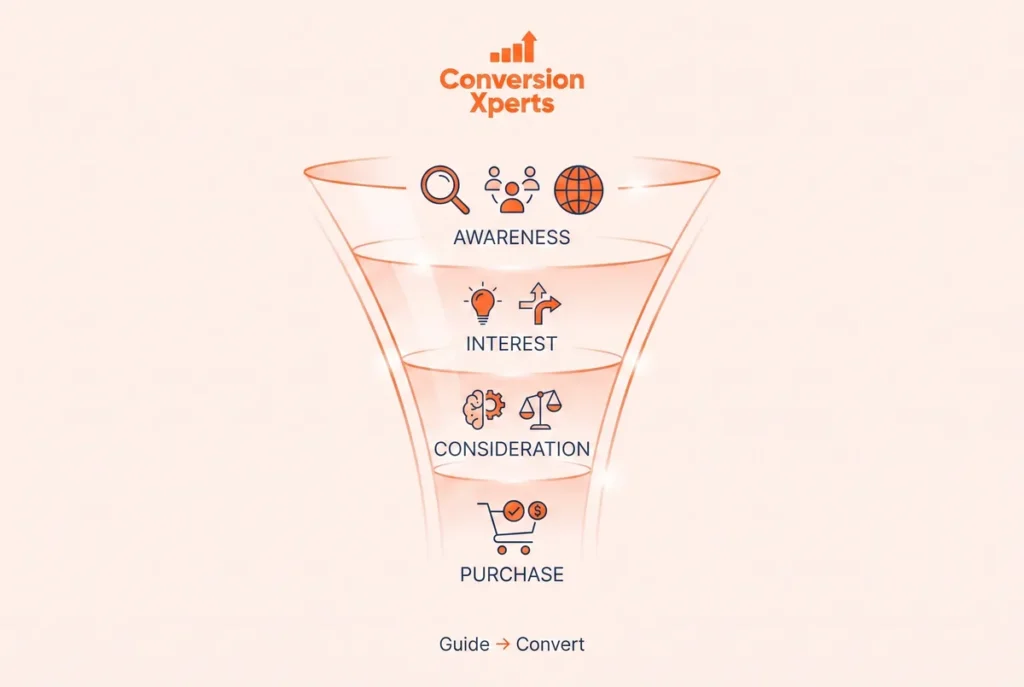
The single biggest mistake retailers make is treating their store as a destination rather than a journey. Your retail conversion funnel has distinct stages: awareness, consideration, intent, and purchase. Each stage demands a different strategy and a different type of customer experience.
At the awareness stage, your goal is capturing attention and communicating category relevance quickly. Shoppers need to know within seconds that you sell what they are looking for and that you are worth their time. At the consideration stage, you need to demonstrate superior value compared to the alternatives they are evaluating. At the intent stage, you must remove every barrier to the decision. This is where friction kills sales. At the purchase stage, the checkout experience either closes the sale or destroys it entirely.
Mapping your current funnel drop off points using analytics tools such as Google Analytics 4, Hotjar, or Microsoft Clarity is step one of every conversion audit ConversionXperts conducts. Knowing precisely where customers leave your funnel tells you exactly where to invest your optimization energy first and where every dollar of improvement effort will generate the highest return.
2. Optimize Product Pages for Global Audiences and Purchase Intent
Your product page is where the majority of purchase decisions are made or broken. Poor product pages are the number one killer of retail conversion rates globally, and they are also the most straightforward thing to fix with the right framework.
A high converting product page requires five non negotiable elements working together. The first is high resolution imagery with multiple angles, zoom capability, and lifestyle context shots that help shoppers visualize the product in their own lives. The second is benefit driven product descriptions that speak to outcomes and emotional rewards, not just specifications and features. The third is visible and specific social proof including star ratings, total review count, and verified buyer testimonials with real names and photos. The fourth is clear pricing with any discounts prominently displayed and anchored against the original price to communicate value. The fifth is a single dominant call to action button that is visually distinct from everything else on the page and uses action oriented language.
For global retailers, localizing product descriptions, pricing display, and imagery to match cultural preferences in each target market significantly boosts retail conversion rates region by region. What resonates and converts in Germany often needs meaningful adjustment for Brazil or Japan. Visual aesthetics, communication styles, trust signals, and even color psychology differ across cultures. ConversionXperts offers geo specific conversion audits for exactly this reason, helping retailers unlock conversion performance in each of their key international markets.
3. Implement Checkout Optimization as a Core Retail Conversion Strategy
Checkout abandonment accounts for up to 70 percent of all lost retail sales globally. Shoppers who have already chosen a product, added it to their cart, and started the checkout process still leave without buying. This is one of the most expensive and preventable forms of revenue loss in retail, which is why checkout optimization sits at the top of every effective list of retail conversion tips.
The principles of checkout optimization are universal: reduce steps, reduce required form fields, provide multiple payment options that match local preferences, display trust signals throughout the process, and make it effortless for customers to complete the transaction on any device.
Global retailers must also offer locally preferred payment methods or they will face systematic conversion suppression in each market where their checkout feels foreign. In China, Alipay and WeChat Pay are the dominant and expected options. In Brazil, Pix and Boleto are critical for conversion. In the Netherlands, iDEAL is the default expectation. In India, UPI has transformed mobile payment behavior. Failing to match local payment expectations is one of the most common and costly conversion mistakes international retailers make.
In our global client work at ConversionXperts, adding a guest checkout option alone increased retail conversion rates by an average of 22 percent in the first 30 days after implementation. Never force account creation before purchase. The moment you put a registration wall between a buyer and their transaction, you are prioritizing your CRM data collection over your customer’s purchase experience. The revenue cost of that trade off is consistently significant.
4. Deploy Social Proof and Trust Signals at Every Touchpoint
Social proof is not a nice to have feature on a product page. It is the fuel of conversion psychology and one of the most universally effective retail conversion tips across every global market, retail format, and product category. When potential buyers see that other people like them have purchased, used, and recommended your product, their psychological resistance to buying collapses.
The forms of social proof that drive the highest retail conversion impact are verified customer reviews with accompanying photos, real time purchase notifications that show other shoppers are buying right now, star ratings displayed prominently on both category pages and product pages, expert endorsements from credible voices in the relevant category, influencer validation that resonates specifically with local market audiences, and detailed case studies for B2B retail environments where purchase decisions involve more deliberation.
Review recency matters enormously and is consistently underestimated by retailers. A product with 500 reviews from two years ago converts at a meaningfully lower rate than a product with 80 reviews from the last 90 days. Freshness of reviews signals ongoing demand, current quality, and active customer satisfaction. Retailers who build systematic post purchase review collection into their customer journey see measurable lifts in store conversion rates within weeks of implementation.
5. Use Behavioral Personalization to Increase Both Conversion Rate and Average Order Value
Personalization is where modern retail conversion rate optimization delivers its most dramatic results. When a shopper sees products, promotions, and content that are directly relevant to their behavior, preferences, and stage in the buying journey, both conversion rates and average order values increase simultaneously. This double benefit makes personalization one of the highest return areas of retail conversion investment.
Behavioral personalization in retail ecommerce includes product recommendation engines that surface recently viewed items, frequently bought together suggestions, and curated collections based on browse and purchase history. Email retargeting for cart abandonment recovery consistently recovers between 5 and 15 percent of abandoned carts globally when executed with well timed, relevant, and personalized messaging rather than generic reminder emails.
For physical retail stores, personalization translates into trained staff who use customer data from loyalty programs to make relevant product recommendations, customized in store events for high value customer segments, and targeted promotional offers based on individual purchase history. The customer who feels recognized and understood in your store converts at a dramatically higher rate and returns more often.
6. Optimize Mobile Retail Conversion for the Global Mobile First Shopper
Globally, more than 60 percent of ecommerce traffic now arrives from mobile devices. Yet average mobile retail conversion rates remain 2 to 3 times lower than desktop conversion rates. This gap represents one of the largest and most accessible untapped revenue opportunities in retail today. If you are not actively optimizing for mobile conversion, you are systematically underperforming on your majority traffic channel.
Mobile retail conversion optimization requires a fundamentally different approach than desktop optimization. Thumb friendly navigation that places key actions within easy reach, tap sized call to action buttons that are impossible to miss and easy to activate, single column layouts that prioritize scannable information hierarchy, compressed imagery that loads quickly on variable mobile network speeds, and mobile specific checkout flows that minimize typing are all essential elements of a high converting mobile retail experience.
In emerging markets across Southeast Asia, Sub Saharan Africa, and Latin America, mobile is not just the dominant device. It is often the only device customers use to discover, research, and purchase products. Retailers who treat mobile optimization as a secondary priority after desktop are systematically excluding their fastest growing global customer segments from converting. The competitive advantage available to retailers who lead on mobile conversion in these high growth markets is substantial and available right now.
7. Apply Scarcity and Urgency Tactics Ethically and Effectively
Purchase urgency is one of the most powerful retail conversion drivers available when applied with authenticity and integrity. Scarcity and urgency messaging communicate that the opportunity to purchase at current terms is limited in some meaningful way, which activates the well documented fear of missing out behavioral mechanism and motivates faster purchase decisions.
Effective and ethical retail urgency tactics include accurate low stock indicators on product pages that reflect real inventory levels, countdown timers attached to genuine time limited promotions, real time displays of how many other shoppers are viewing a product right now, and clear communication of shipping cutoff times that create natural deadline awareness for time sensitive purchases.
The word ethical in the previous paragraph is load bearing. Manufactured scarcity and urgency that does not reflect reality destroys customer trust permanently the moment shoppers recognize the deception, and in many global markets it creates significant regulatory and reputational risk. When urgency messaging is accurate, relevant, and honest, it consistently lifts retail conversion rates between 8 and 20 percent depending on the product category and market context. That is a compelling return available to retailers who operate with integrity.
8. Invest in Retail Staff Training as a Conversion Rate Investment
For physical retail stores around the world, your frontline staff is your most powerful conversion asset and your most commonly neglected one. The quality of customer engagement at every point in the in store journey directly determines whether a browser becomes a buyer, and whether a buyer becomes a loyal repeat customer.
Staff training focused specifically on retail conversion should cover consultative selling techniques that match customer needs to product benefits rather than simply describing features, deep product knowledge that gives staff confidence to handle questions and objections, upselling and cross selling delivered at the appropriate moment in the customer journey rather than feeling forced or transactional, and the creation of post sale experiences that generate positive emotional associations and drive repeat visits.
Retailers who invest in structured conversion focused staff training typically see in store conversion rate improvements of 15 to 25 percent within 90 days of implementation. That improvement compounds over time as skills become habits and the entire store culture shifts toward a conversion orientation.
Retail Conversion Rate Benchmarks by Channel and Region
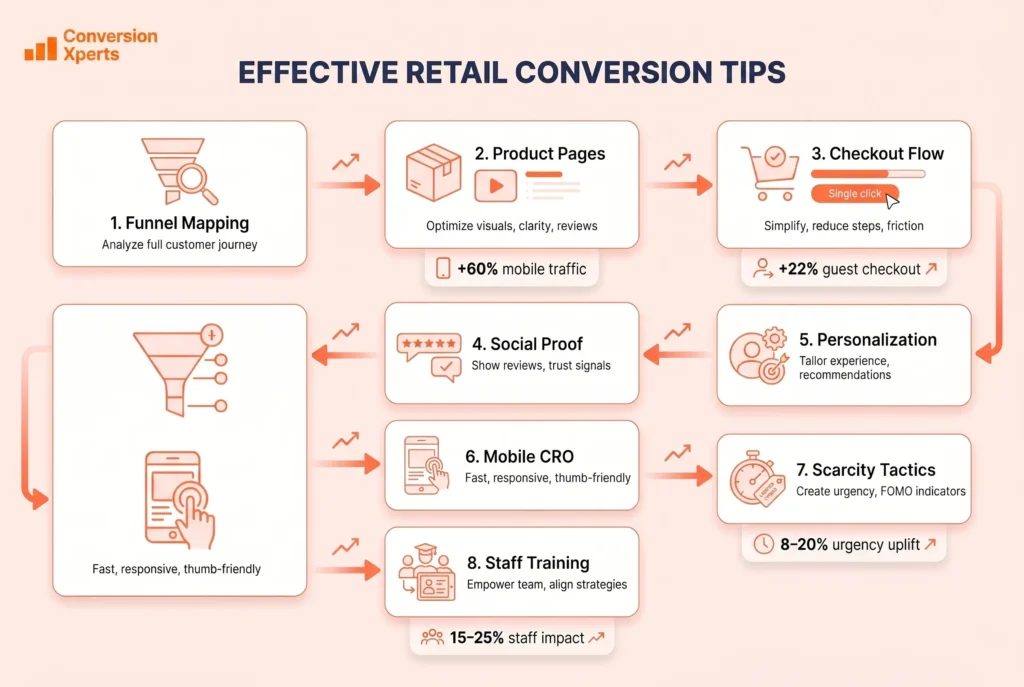
Understanding how your conversion rates compare to global benchmarks helps you prioritize where to focus your retail conversion optimization investment and set realistic improvement targets. Ecommerce global average conversion rates sit between 1.5 and 3.2 percent, with top performing retailers achieving between 5 and 8 percent through sustained conversion optimization programs. Physical retail globally converts between 20 and 40 percent of visitors, with top performers reaching 45 to 60 percent through store experience excellence and staff training. Mobile commerce globally averages between 1 and 2.5 percent, with leaders hitting 4 to 6 percent through dedicated mobile conversion optimization. Social commerce converts between 0.8 and 2 percent on average. Luxury retail globally sees rates between 3 and 7 percent due to elevated purchase intent. B2B retail and wholesale typically converts between 2 and 5 percent with sophisticated account tools pushing leaders to 8 to 12 percent.
Advanced Retail Conversion Strategies for Scaling Brands
Once foundational retail conversion tips are implemented and delivering results, scaling brands require more sophisticated conversion rate optimization strategies to continue growing. These are the advanced tactics ConversionXperts deploys for enterprise retail clients operating across multiple markets and channels simultaneously.
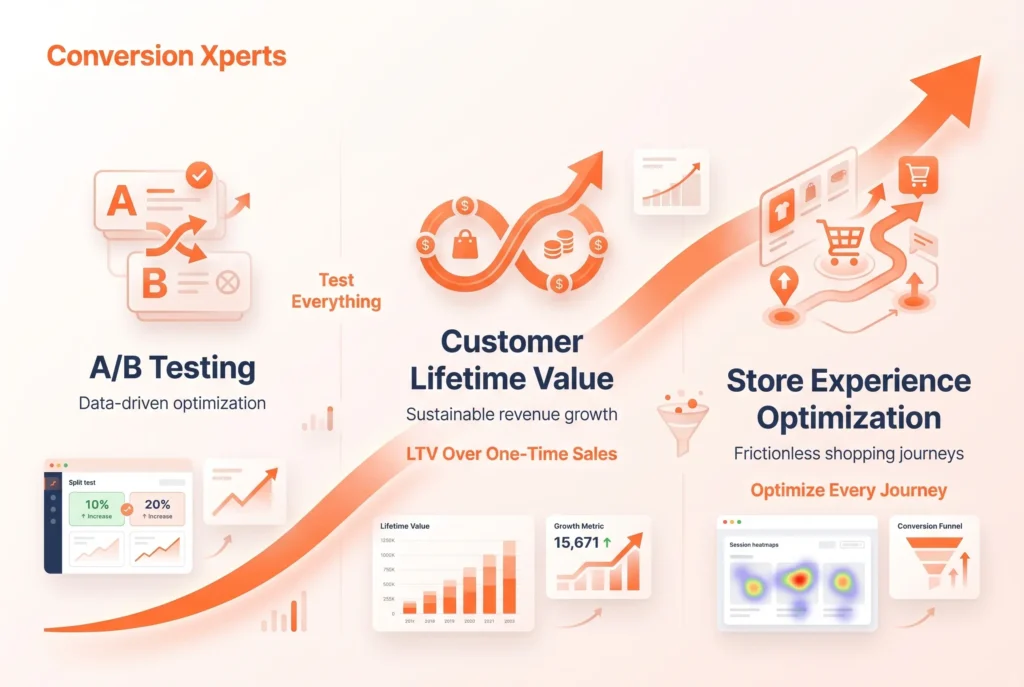
Systematic A/B testing is the engine of sustained retail conversion rate improvement. Without testing, you are guessing. With testing, you are compounding learning into ongoing revenue growth. Every significant element of your retail experience should be tested continuously: headline copy, call to action button text and placement, product image presentation format, pricing display options, trust badge placement and type, checkout form design and field sequence, and promotional messaging variations. The discipline of retail experimentation requires a clear testing methodology, sufficient traffic volume to reach statistical significance, and a genuine organizational culture of following data over opinions.
The most sophisticated retail brands no longer optimize purely for first purchase conversion. They optimize for customer lifetime value. A customer who converts at a lower initial margin but purchases 12 times per year is worth dramatically more than a one time buyer who converted at full price. Optimizing for lifetime value reshapes how you approach retail conversion strategy entirely. It means investing in post purchase experience quality, loyalty program design, personalized reengagement marketing, and community building around your retail brand.
For physical retail stores, layout and visual merchandising are the direct equivalent of website UX in ecommerce. The path customers travel through your store, the placement of high margin products, the use of lighting and sensory environment, and the strategic positioning of impulse purchase opportunities all directly influence retail conversion rates and basket size. High converting physical retail environments guide customers through a deliberate discovery journey that progressively builds purchase intent from entry to checkout.
Building a Retail Conversion Culture at Your Organization
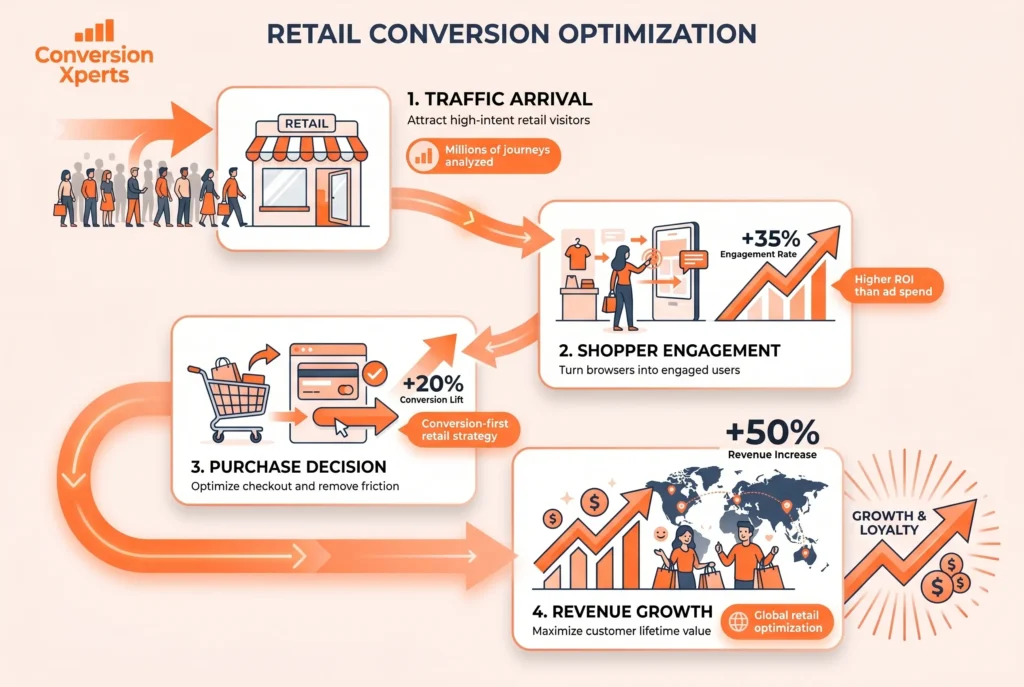
All the retail conversion tips in the world deliver limited long term results without the organizational infrastructure to test, learn, and apply insights continuously. Building a genuine conversion culture inside your retail business is what separates companies that achieve 30 percent annual revenue growth from those that manage 5 percent while spending the same amount on marketing.
A retail conversion culture requires executive ownership of conversion rate metrics at the leadership level, cross functional collaboration between marketing, technology, merchandising, and operations teams, regular conversion performance reviews where data drives decisions rather than assumptions or opinions, and a genuine organizational willingness to run experiments that challenge existing practices and comfortable assumptions.
At ConversionXperts, we build and embed conversion programs inside our client organizations rather than simply delivering reports and leaving. We transfer the knowledge, tools, processes, and habits that make conversion optimization self sustaining and continuously improving inside your team. Because sustainable revenue growth comes from building internal capability, not dependency on external consultants.