How to Improve Ecommerce Conversion Rate: Every Strategy That Actually Works in 2026
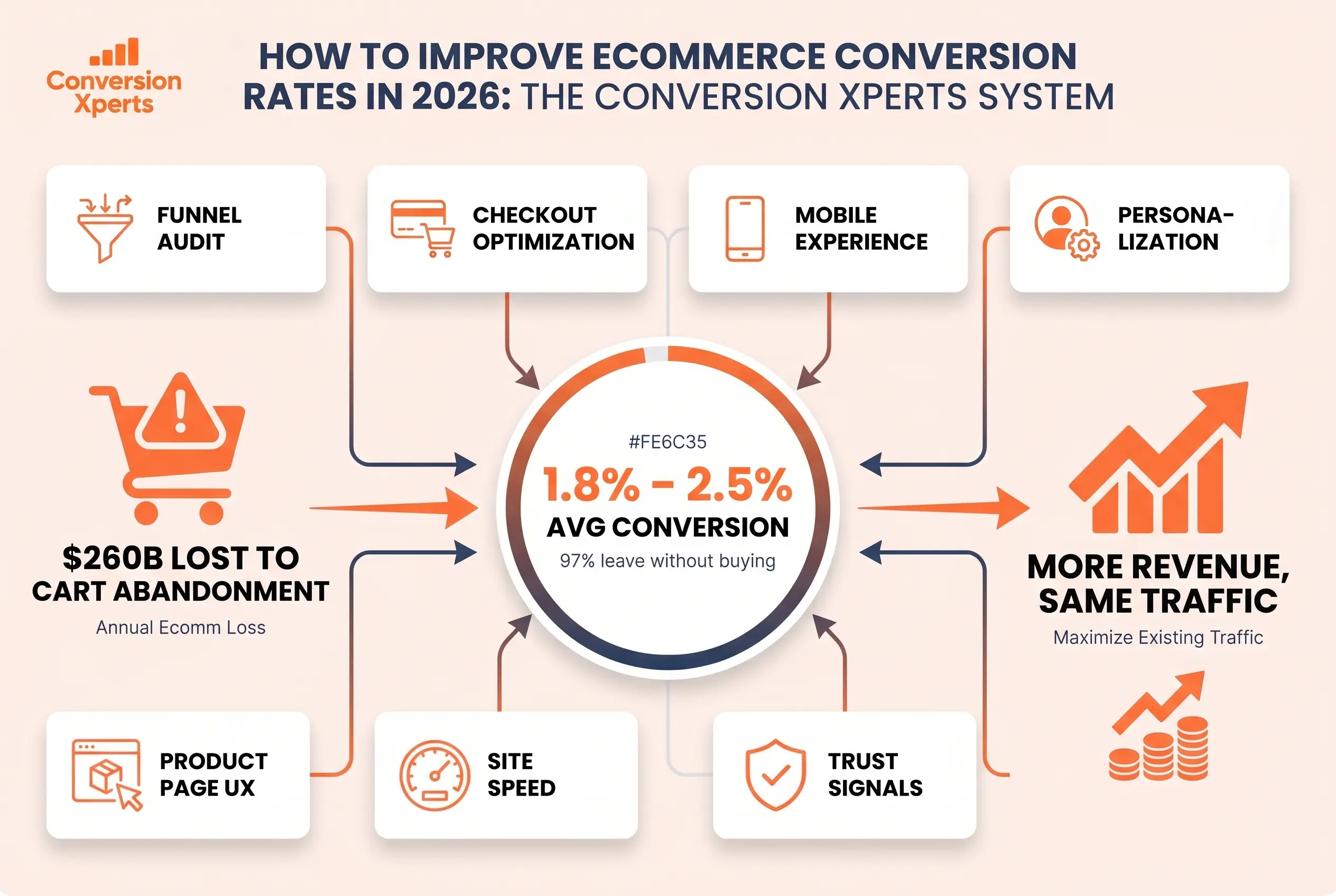
What Ecommerce Conversion Rate Optimization Actually Means in 2026
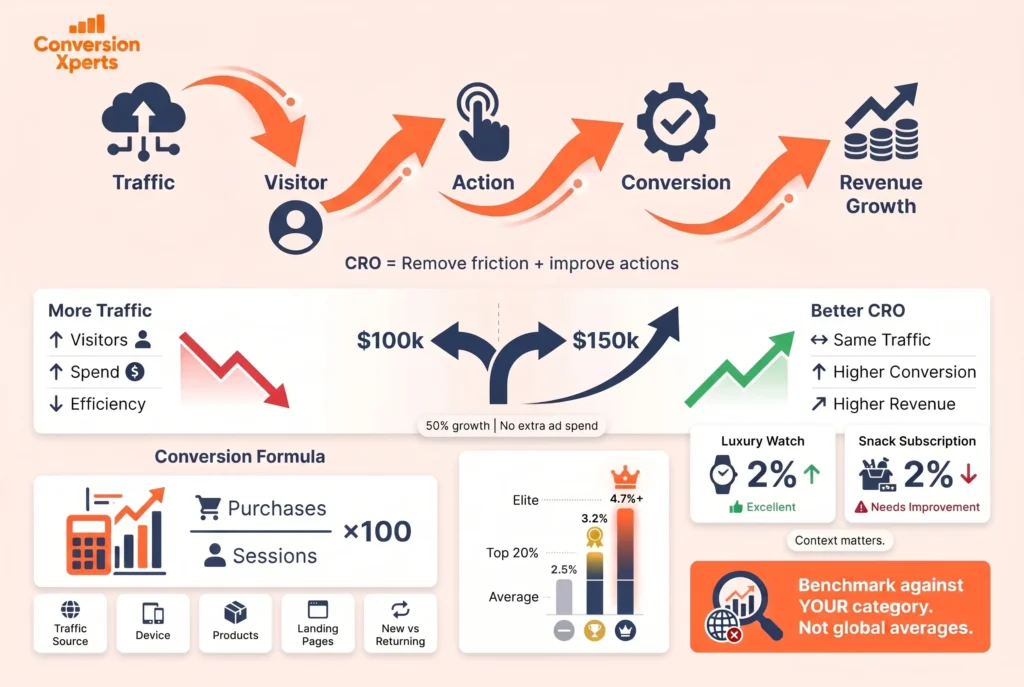
Ecommerce conversion rate optimization, commonly called CRO, is the systematic process of increasing the percentage of website visitors who complete a desired action, most commonly a purchase. It is not guesswork. It is not aesthetic preference. It is a structured discipline of identifying friction, forming data-driven hypotheses, testing changes, and measuring outcomes.
The definition matters because a lot of what gets called CRO is actually just design opinion dressed up as strategy. Real CRO starts with evidence. It asks why visitors are not converting before suggesting how to fix it.
Why CRO Beats More Traffic Every Time
Most ecommerce businesses default to buying more traffic when revenue stagnates. That instinct is understandable but often expensive and inefficient. Paid social drove 12% more traffic in 2025 but bounce rates went up 9.2% and conversions dropped 10.6% according to Contentsquare’s 2025 benchmark of 90 billion sessions. More visitors, worse results.
The math of CRO is more compelling than the math of traffic. A store generating $100,000 in monthly revenue at 2% conversion would reach $150,000 at 3% conversion, assuming traffic and average order value remain constant. That is a 50% revenue boost with zero additional ad spend.
Fixing your conversion rate is the highest-leverage activity available to most ecommerce businesses. You are making more money from the traffic you already have, which means every future dollar you spend on acquisition works harder too.
The Right Way to Measure Your Conversion Rate
Before you can improve your ecommerce conversion rate, you need to measure it correctly. The formula is simple. Divide the number of completed purchases by the total number of unique sessions and multiply by 100.
For benchmark comparisons, always use sessions, not users. Most industry studies calculate conversion based on sessions, and using users instead will artificially inflate your rate by two to three times.
Beyond your overall site-wide conversion rate, you should be tracking conversion rate by traffic source, by device, by product category, by landing page, and by customer type (new vs returning). Each of these segments tells a different story and points to different optimization opportunities.
What a Good Ecommerce Conversion Rate Looks Like in 2026
The global average ecommerce conversion rate reached 2.5% in Q3 2025, up 0.4% year over year according to Smart Insights. Stores converting above 3.2% rank in the top 20% of all ecommerce sites. If you are hitting 4.7% or higher, you are in the top 10%.
However, industry matters enormously. A 2% conversion rate would be excellent for a luxury watch brand but mediocre for a snack subscription company. Conversion rates correlate inversely with average order value and purchase complexity.
Always benchmark against your specific vertical. A home furnishings store at 1.8% is outperforming its category. A food and beverage brand at 1.8% has serious work to do.
Start Here: How to Audit Your Ecommerce Funnel Before Optimizing
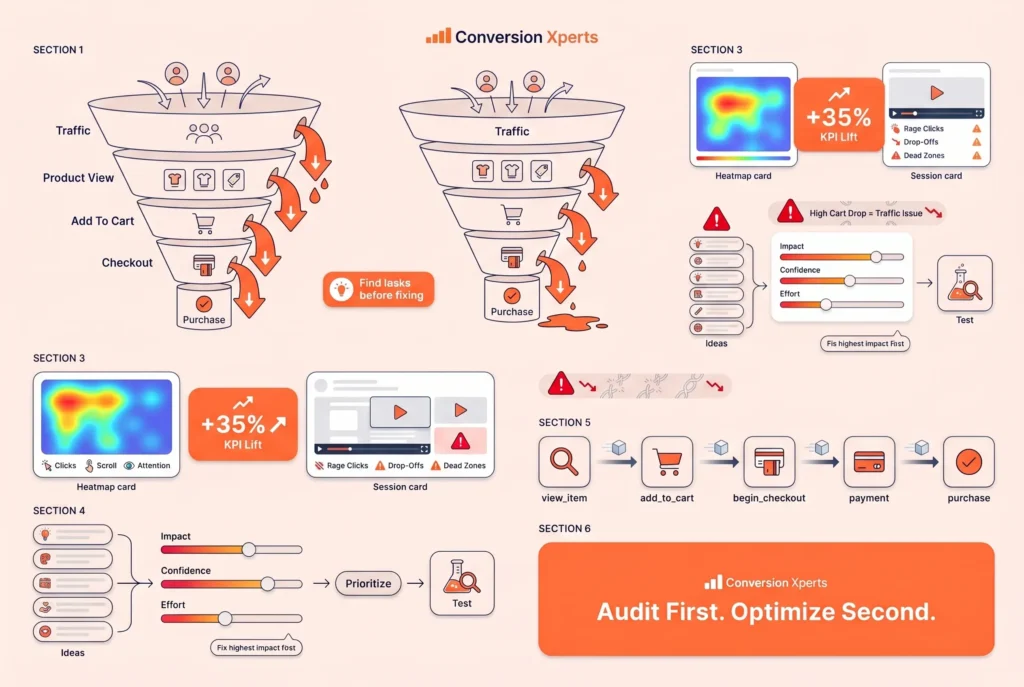
The single biggest mistake in ecommerce CRO is jumping straight to solutions without understanding the actual problem. Stores that optimize based on gut feel or “best practices” lists waste months on changes that do not move the needle. Stores that audit first, then optimize, consistently see faster and larger improvements.
Map Every Stage of Your Funnel
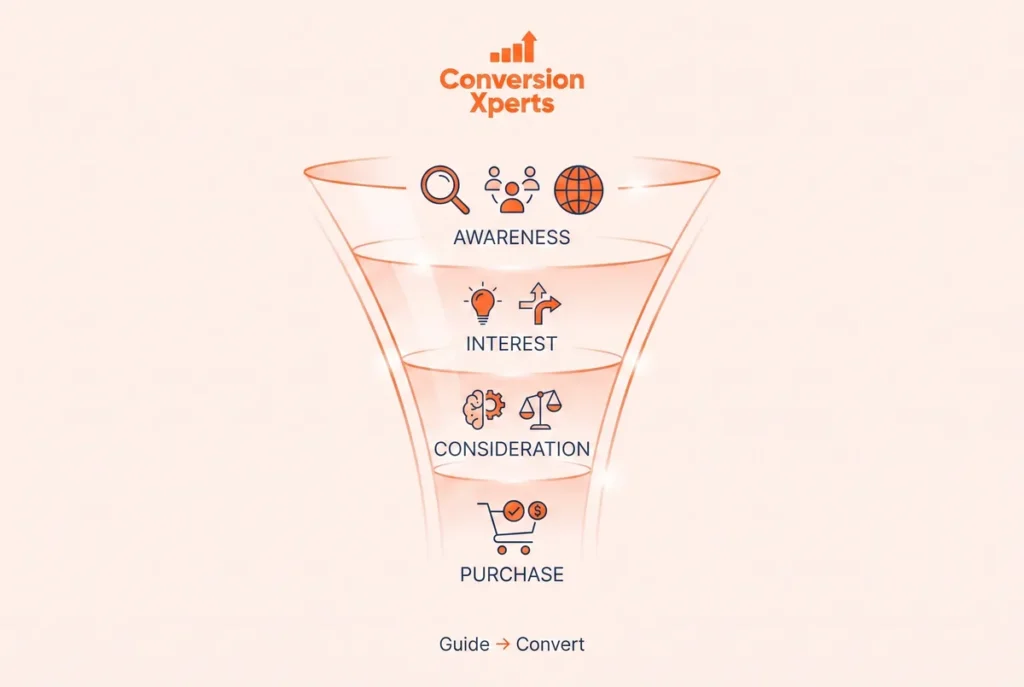
Your ecommerce funnel has multiple stages, each with its own conversion rate and its own failure modes. Traffic arrives on your site. A portion views a product page. A portion adds to cart. A portion initiates checkout. A smaller portion completes the purchase. Each transition between stages is a conversion, and each one can be measured and improved.
The average add-to-cart rate across ecommerce is 2.34%. The average cart abandonment rate is 70.32%. Social media traffic has the highest cart abandonment rate at 77.54%, while search and direct traffic have the lowest at 63.81% and 69.39% respectively.
When you map these numbers for your own store, patterns emerge. If your product pages have a high bounce rate, you have a traffic quality or first-impression problem. If your add-to-cart rate is strong but cart abandonment is high, you have a checkout or trust problem. If your checkout start rate is good but completion rate is low, you have a friction or payment problem. The audit tells you where to look.
Use Heatmaps and Session Recordings
Quantitative data tells you what is happening. Qualitative data tells you why. Heatmaps show you where visitors are clicking, scrolling, and ignoring. Session recordings show you the actual behavior of real users navigating your store in real time.
Brands that add heatmap-driven fixes based on Hotjar insights report up to a 35% jump in ecommerce conversion rate optimization KPIs. Deep qualitative insight catches nuances that pure metrics miss entirely.
When reviewing session recordings, look specifically for rage clicks (users clicking repeatedly on elements that are not responding), scroll depth (how far users get down your product pages before leaving), and drop-off points (where sessions consistently end without adding to cart). These behavioral signals are far more actionable than aggregate numbers alone.
Prioritize Your Tests with a Scoring Framework
Every audit generates more improvement opportunities than you can test simultaneously. Trying to fix everything at once is a recipe for confusion and inconclusive data. You need a prioritization framework.
The most widely used frameworks in ecommerce CRO are ICE scoring and PIE scoring. ICE stands for Impact, Confidence, and Effort. You score each potential test on all three factors and rank them by their combined score. The tests with the highest impact, strongest evidence, and lowest effort get run first.
Scoring each optimization idea on Impact, Confidence, and Effort prevents loudest-voice bias and accelerates deployment of the fixes that will boost conversions fastest. Linear Design notes that ICE scoring fast-tracks landing page tests and sustains a healthy test cadence over time.
Set Up GA4 for Full Funnel Tracking
If you are not tracking your full ecommerce funnel in GA4, you are flying blind. GA4’s event-based architecture makes it possible to see exactly where visitors drop off between each stage of the buying journey.
The core events to track are view_item, add_to_cart, begin_checkout, add_payment_info, and purchase. Each gap between these events represents a conversion opportunity. Once you have clean funnel data flowing in GA4, you can segment by traffic source, device type, and user type to identify where your biggest improvement opportunities are hiding.
Product Page Optimization: Where Most Conversions Are Won or Lost
Your product page is the most critical conversion point in your entire store. It is where a visitor decides whether to keep moving toward a purchase or leave. Most product pages fail not because the product is wrong but because the page does not give buyers enough confidence, clarity, or conviction to act.
Write Product Copy That Converts, Not Just Describes
Most ecommerce product copy describes what a product is. High-converting product copy explains what a product does for the buyer. There is an enormous difference between the two.
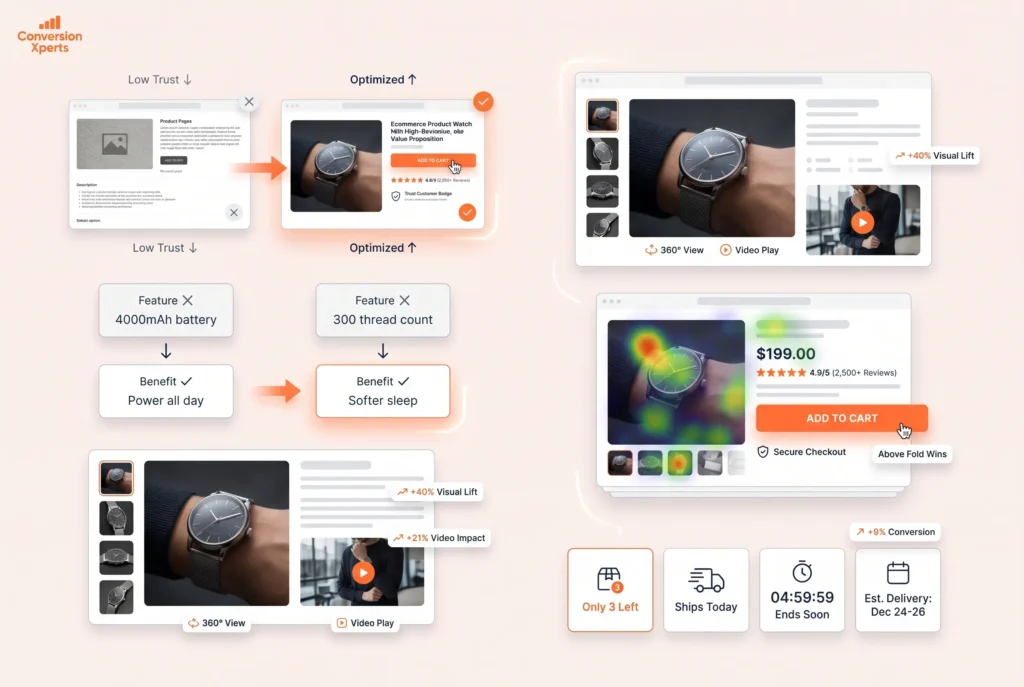
Features tell. Benefits sell. Instead of “made from 300-thread-count Egyptian cotton,” write “softer than anything you have slept in before, and it only gets better after washing.” Instead of “4,000mAh battery,” write “enough battery to get through a full day without hunting for an outlet.”
The copy on your product page should answer every question a hesitant buyer has before they even think to ask it. What is this made of? Will it fit me? How long will it last? What happens if I need to return it? Is this brand trustworthy? Does anyone else love this product?
In one documented CRO case study, rewriting product copy to focus on benefits rather than features, adding interactive sizing tools, and integrating customer photos and reviews contributed to a 287% conversion increase over 90 days.
Invest Heavily in Product Photography and Video
Visual content is not decoration. For ecommerce, it is the primary selling tool. A visitor who cannot hold your product in their hands needs to feel as though they can. Your photography determines whether that happens.
Every product needs multiple high-resolution images showing different angles, lifestyle contexts, and scale references. For apparel, show the product on multiple body types. For furniture, show it in a realistic room setting. For electronics, show it in use rather than just isolated on a white background.
Ecommerce brands optimizing product pages with high-quality imagery see conversion lifts of up to 40%, according to ecommerce performance research.
Product video goes even further. Adding product videos increases ecommerce conversions by 21% on average. A 60-second product video showing the item in use, demonstrating scale, and highlighting key details does more conversion work than any block of written copy.
Optimize Your Product Page Layout for Decision-Making
The layout of a product page should guide a visitor toward adding to cart without distraction or confusion. Every element should serve that single purpose.
The most important elements for conversion should appear above the fold without scrolling. This means a clear product name, your strongest product image, the price, a prominent add-to-cart button, and your most important trust signal (usually star rating and review count or a key guarantee).
Below the fold you can expand into detailed product descriptions, multiple images, specifications, reviews, and related products. But the visitor should be able to make a decision from what they see immediately, without needing to scroll.
Your add-to-cart button deserves special attention. It should be visually dominant, clearly labeled, and placed where the eye naturally lands. Avoid weak copy like “submit” or “continue.” Use action-oriented language that reinforces the decision: “Add to Cart,” “Get Yours,” or for high ticket products, “Request a Quote.”
Show Scarcity and Urgency Authentically
Urgency and scarcity are powerful conversion drivers when they are real, and they can severely damage trust when they are fake. Do not display “only 3 left in stock” when you have 500 units. Do not run countdown timers that reset every time a visitor refreshes the page.
Authentic urgency works exceptionally well. Real-time inventory alerts increase purchase rates by 8%, and product scarcity messages that reflect genuine stock levels increase conversions by 11%.
If you genuinely have limited stock, say so clearly. If your sale genuinely ends at a specific time, show the timer. If a product genuinely ships in 24 hours, highlight that. Real urgency accelerates decisions. Fake urgency destroys trust and ultimately hurts your long-term conversion rate.
Display Estimated Delivery Dates Prominently
One of the most underused conversion levers on product pages is delivery transparency. Buyers want to know when their order will arrive before they commit to purchasing, not after.
Showing estimated delivery dates on product pages increases conversions by 9%. This is a small, simple implementation that consistently delivers measurable results. “Order by 3pm today and receive it by Thursday” is one of the most compelling pieces of copy you can put on a product page for a time-sensitive buyer.
Checkout Optimization: Stop Losing Buyers at the Last Step
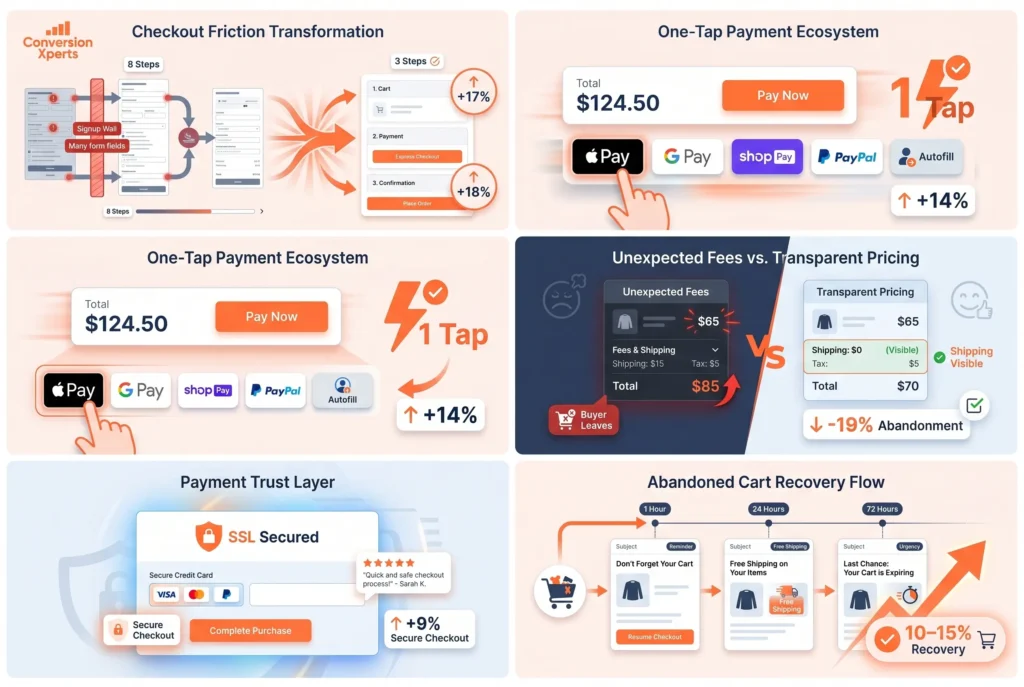
Checkout abandonment is one of the most expensive leakages in all of ecommerce. A buyer who enters your checkout has already made their psychological commitment. They want to buy. When they abandon at this stage, it is almost always because you put something in their way.
Simplify Your Checkout to the Bare Minimum
Every additional field, step, or decision you add to your checkout process is another opportunity for a buyer to reconsider. The goal is to get from “I want this” to “I bought this” as quickly and as frictionlessly as possible.
Simplifying checkout to a single page improves conversions by 17%. Adding guest checkout boosts conversions by 18%.
Removing forced account creation alone has been shown to recover significant revenue for stores that implement it. A buyer who has to create a username and password before buying will often abandon rather than go through the process, even if they genuinely want the product. Let them buy first and create an account afterward if they choose.
One documented CRO case study showed that replacing an 8-step checkout with forced registration with a 3-step guest checkout with optional registration was a central part of a dramatic conversion rate improvement.
Offer Digital Wallets and One-Tap Payment Options
Payment friction is one of the most consistent conversion killers in ecommerce. Every moment a buyer spends typing in their card number, billing address, and security code is a moment they might change their mind.
In 2024, about 53% of shoppers worldwide used a digital wallet for online purchases. Digital wallet transactions globally are projected to reach extraordinary scale by 2027.
Offering PayPal or digital wallets increases ecommerce conversions by 14%. Autofill-enabled form fields boost form completion by 12%.
Shop Pay, Apple Pay, and Google Pay all enable one-tap checkout experiences that dramatically reduce the friction between checkout intent and purchase completion. For mobile users especially, these options can more than double checkout completion rates compared to traditional card entry forms.
Kill the Surprise Costs
Nothing destroys checkout conversion like a surprise. A buyer who sees a $65 total on the product page and suddenly encounters an $85 total at checkout including shipping, taxes, and handling fees is not going to complete that purchase. They are going to feel deceived and leave.
Showing total cost earlier in the shopping process reduces cart abandonment by 19%. Meanwhile, 24% of users abandon carts specifically due to unexpected fees.
The solution is radical transparency before checkout. Show shipping costs (or a shipping calculator) on the product page. Display tax estimates based on location before the checkout summary screen. Make your pricing completely predictable so the only thing that happens at checkout is confirmation, not revelation.
Add Trust Signals at the Payment Step
The moment a buyer is about to enter their payment information is the moment when anxiety peaks. This is when doubts about brand legitimacy, data security, and purchase safety are loudest. Your checkout page needs to address these concerns directly.
Trust signals at checkout increase conversions by 9%. Exit popups during checkout recover an additional 7% to 10% of abandoned carts.
A documented case study from ConversionTeam found that adding trust badges to a store increased conversions by 12.2% and revenue by 16.6%.
Effective trust signals at checkout include SSL security indicators, payment provider logos (Visa, Mastercard, PayPal), return policy reminders, and brief testimonials from real customers. Each of these signals reduces anxiety and keeps buyers moving toward completion.
Implement Abandoned Cart Recovery Sequences
No matter how well you optimize your checkout, some buyers will still abandon. The question is what you do next. A well-structured abandoned cart recovery sequence can recover a meaningful percentage of that lost revenue.
Email remarketing campaigns targeting cart abandoners recover 10% to 15% of lost conversions.
Your recovery sequence should send the first email within one hour of abandonment, while the purchase intent is still fresh. The second email should arrive 24 hours later and can introduce a value-add like free shipping or a modest discount. The third email, if you send one, should arrive 72 hours later and focus on social proof and urgency.
Personalize these emails with the specific product the buyer abandoned. Show the product image, remind them of the price, reiterate your key trust signals and return policy, and make it one click to return to their cart. The less thinking required, the higher the recovery rate.
Site Speed and Mobile Experience: The Foundation Everything Else Builds On
You can have the world’s best product copy, the most compelling trust signals, and the smoothest checkout flow in your industry. None of it matters if your site takes 5 seconds to load or if your mobile experience is a broken mess. Speed and mobile usability are the foundation that every other conversion optimization sits on.
Page Speed Has a Direct, Measurable Impact on Conversion Rate
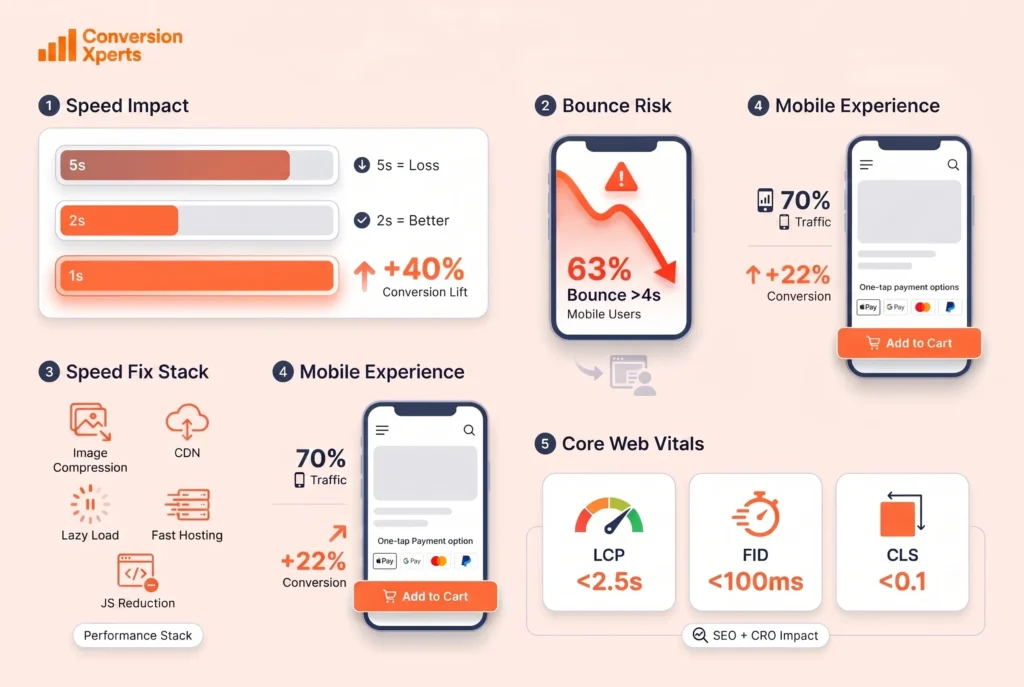
63% of visitors bounce from pages that take over 4 seconds to load according to Yottaa’s 2025 Web Performance Index, which analyzed 500 million visits across 1,300 ecommerce sites.
Reducing page load time by just one second can result in a 17% uptick in conversions.
A Portent study found that a 1-second load time delivers nearly 40% conversion rate. At 2 seconds it drops to 34%, and at 6 seconds it falls to just 18%.
The practical implications are stark. If your store is loading in 4 seconds, improving to 2 seconds could potentially double your conversion rate before you change a single word of copy or a single element of design.
The most impactful speed improvements for ecommerce stores are image compression and next-gen format conversion, implementing a content delivery network (CDN), reducing JavaScript execution time, enabling lazy loading for images below the fold, and moving to faster hosting infrastructure.
Mobile Optimization Is Non-Negotiable
Mobile devices account for 70% to 75% of all ecommerce traffic in 2026. Yet for most stores, mobile still converts at meaningfully lower rates than desktop. This gap is a revenue leak hiding in plain sight.
53% of mobile users abandon sites that take more than 3 seconds to display content, according to Google’s mobile speed research.
Mobile-optimized checkout flows alone increase conversions by 22%.
The most impactful mobile optimizations for ecommerce are ensuring your add-to-cart button is large enough to tap easily without zooming, compressing all images specifically for mobile viewports, simplifying navigation to make product discovery fast on a small screen, enabling one-tap payment options like Apple Pay and Google Pay, and removing any elements that require horizontal scrolling or pinch-zooming.
Think about how your highest-converting product pages look on a 390px-wide phone screen. If you would not buy from that experience yourself, your mobile visitors will not either.
Core Web Vitals Matter for Both SEO and Conversion
Google’s Core Web Vitals measure three specific aspects of page experience: Largest Contentful Paint (how fast the main content loads), First Input Delay (how fast the page responds to the first user interaction), and Cumulative Layout Shift (how much the page layout jumps around as it loads).
Poor Core Web Vitals hurt your organic search rankings, which reduces the quality of traffic arriving at your store. Poor Core Web Vitals also directly hurt conversion rates because they create a frustrating user experience that erodes confidence before a visitor even reads your first headline.
Aim for an LCP under 2.5 seconds, an FID under 100 milliseconds, and a CLS score below 0.1. These are not just technical benchmarks. They are conversion rate determinants.
Trust Signals and Social Proof: The Conversion Levers Most Stores Underuse
Trust is the most fundamental requirement for any ecommerce transaction. A visitor who does not trust your store will not buy from it, no matter how compelling your product or how competitive your price. Building trust systematically is one of the highest-impact activities in ecommerce CRO.
Reviews and Ratings: The Non-Negotiable Foundation
Social proof in the form of customer reviews is the single most broadly impactful trust signal available to ecommerce stores. Buyers trust other buyers more than they trust brands.
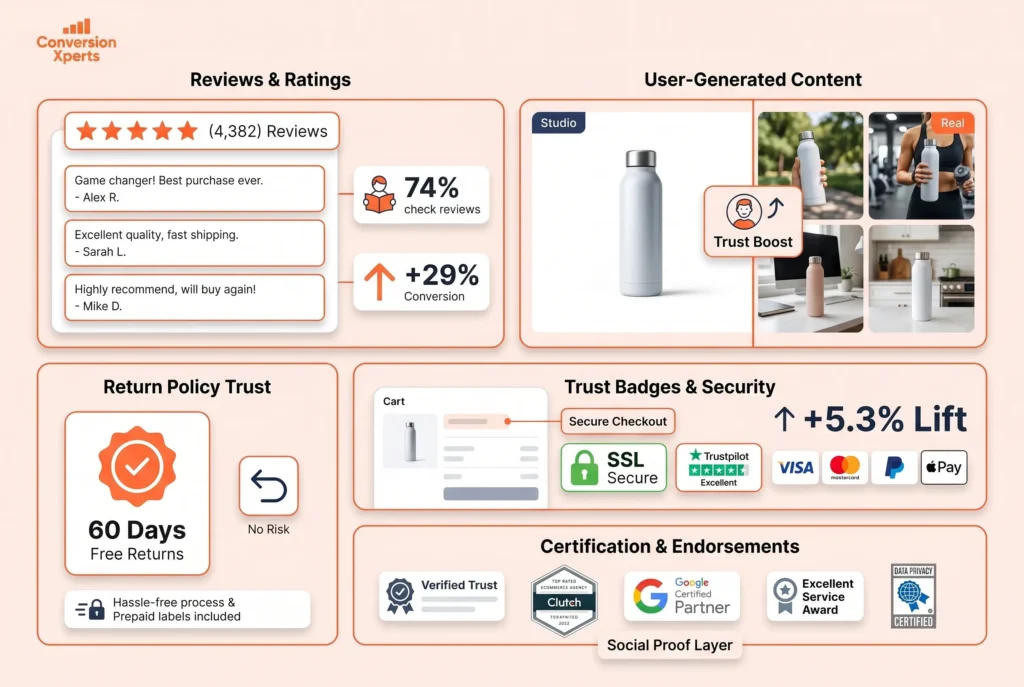
BrightLocal’s 2025 report shows that 74% of consumers check at least two review platforms before buying. Over half are specifically looking for positive experiences.
Ecommerce brands leveraging user-generated content report conversion rate increases of up to 29%.
Reviews work best when they are specific and credible. Generic five-star reviews saying “great product” do very little. Detailed reviews that describe a specific use case, address a specific concern, or compare the product favorably to alternatives do enormous conversion work.
Place reviews on your product pages close to the add-to-cart button, not buried below the fold after a long description. A star rating with review count should be visible immediately, ideally within the first screen a visitor sees on your product page.
User-Generated Content and Customer Photos
Written reviews are powerful. Customer photos are even more powerful. When a real buyer shares a photo of your product in their home, on their body, or in use in their life, it removes the abstraction that keeps hesitant buyers from committing.
Systematically collect customer photos by including a request for photo reviews in your post-purchase email sequence. Incentivize photo submissions with a small loyalty credit or discount. Feature the best customer photos prominently on your product pages and in your marketing.
The psychological mechanism behind customer photos is straightforward. A product image taken by your studio shows the product at its absolute best under controlled conditions. A customer photo taken in a real environment answers the question buyers are really asking: what will this look like in my life?
Return Policy and Guarantees as Conversion Tools
Your return policy is not just a customer service document. It is a conversion optimization tool. A clear, generous return policy directly reduces the perceived risk of a purchase and removes one of the most common reasons buyers hesitate.
Trust signals including return policies, secure payment reminders, and satisfaction guarantees placed at key decision points can tip hesitant customers into converting. Research from Baymard Institute shows that unclear policies directly affect checkout usability and conversion rates.
The best return policies for ecommerce conversion are expressed in plain language without legal hedging, prominently displayed on product pages rather than buried in a footer link, and genuinely generous rather than restrictive. “Free returns within 60 days, no questions asked” converts better than “returns accepted within 14 days with original packaging, subject to inspection.”
Certifications, Badges, and Third-Party Endorsements
Trust badges, security seals, and third-party endorsements work because they borrow credibility from institutions and brands your visitors already trust. A Trustpilot badge or a G2 rating widget on your product page immediately communicates that real customers have vetted and endorsed your store.
The introduction of trusted icons on essential pages such as the cart page led to a 5.3% surge in conversion rates in one documented case study. Considering that 88% of consumers are hesitant to share personal details when lacking confidence in a brand, these indicators play an indispensable role in creating a secure shopping atmosphere.
Make sure the badges you display are genuine and current. Fake security badges or outdated certifications can backfire badly if a sharp-eyed buyer investigates and finds they do not hold up.
Personalization and AI: The New Standard for High Converting Stores
Personalization has moved from being a competitive advantage to being a baseline expectation in 2026. Buyers increasingly expect online stores to remember them, understand their preferences, and serve them relevant products and content rather than generic experiences.
What Personalization Actually Means for Ecommerce Conversion
Personalization in ecommerce means tailoring the experience each visitor sees based on who they are, where they came from, what they have looked at, and what they have bought before. It ranges from basic product recommendations based on browsing history to dynamic homepage content that changes based on the visitor’s location, device, or referral source.
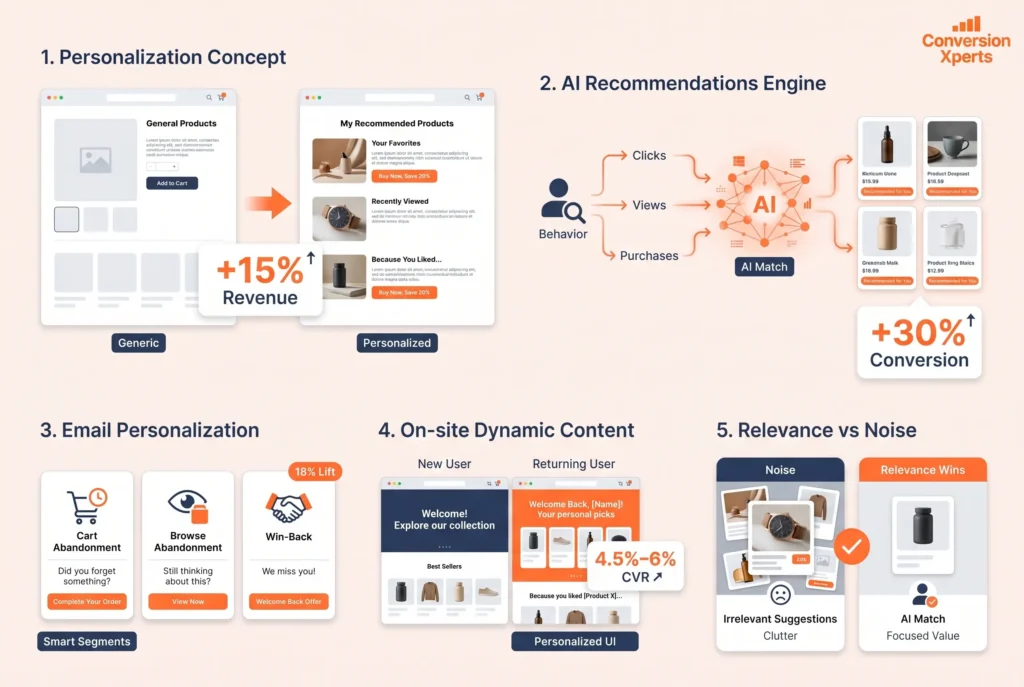
AI-powered personalization typically increases ecommerce revenue by 10% to 15%, with some implementations achieving up to 25% improvements according to McKinsey research.
Personalized product recommendations boost conversion by up to 30% when suggestions genuinely match shopper intent.
The most important thing about personalization is relevance. Showing a visitor who has been browsing running shoes a recommendation for running socks is relevant. Showing them recommendations for basketball shoes because “other people also viewed” is not. The former accelerates a decision. The latter creates noise.
AI-Powered Product Recommendations
The most widely implemented and most proven personalization tactic in ecommerce is AI-driven product recommendations. These engines analyze purchase history, browsing behavior, cart contents, and similarity data to surface the products most likely to be relevant to each individual visitor.
AI-driven recommendations have been shown to increase conversion rates by up to 30% when well-implemented. Nearly 75% of ecommerce customers expect and appreciate relevant product suggestions.
The key is implementation quality. Recommendations placed in the right location (product pages, cart pages, and post-purchase) at the right moment (when the buyer is already engaged and in a purchasing mindset) outperform recommendations placed everywhere indiscriminately.
Personalized Email Marketing
Email is the highest-converting traffic channel for ecommerce in 2026. Email marketing delivers conversion rates in the 5.3% range as a direct traffic driver, making it the most efficient conversion channel available to most ecommerce stores.
The stores that convert best from email are not sending the same newsletter to every subscriber. They are segmenting by purchase history, browsing behavior, location, and engagement level and sending communications that are specifically relevant to each segment.
Personalized emails convert 18% better than generic broadcast emails. Automated product recommendation emails lift sales by 22%. CRO-optimized email landing pages convert 20% higher than generic URLs.
The most impactful email sequences for ecommerce conversion are abandoned cart recovery (covered earlier), post-browse retargeting for visitors who viewed a product without adding to cart, replenishment reminders for consumable products, and win-back sequences for lapsed customers.
Dynamic Content and On-Site Personalization
Beyond email and product recommendations, the most sophisticated ecommerce stores are personalizing the on-site experience dynamically. This means showing different homepage banners to visitors from different geographic regions, displaying different featured products to first-time visitors versus returning customers, surfacing recently viewed items prominently for returning visitors, and adjusting promotional messaging based on what a visitor has already seen.
Returning customers convert at 4.5% to 6%, while first-time visitors convert at just 1% to 2%. Building experiences that recognize and reward returning visitors can dramatically lift your overall sitewide conversion rate.
Even simple personalization like “Welcome back” messaging or “Pick up where you left off” product carousels for returning visitors can meaningfully improve conversion rates because they signal to the buyer that your store knows and values them.
Traffic Quality and Channel Strategy: Improving What You Send to Your Store
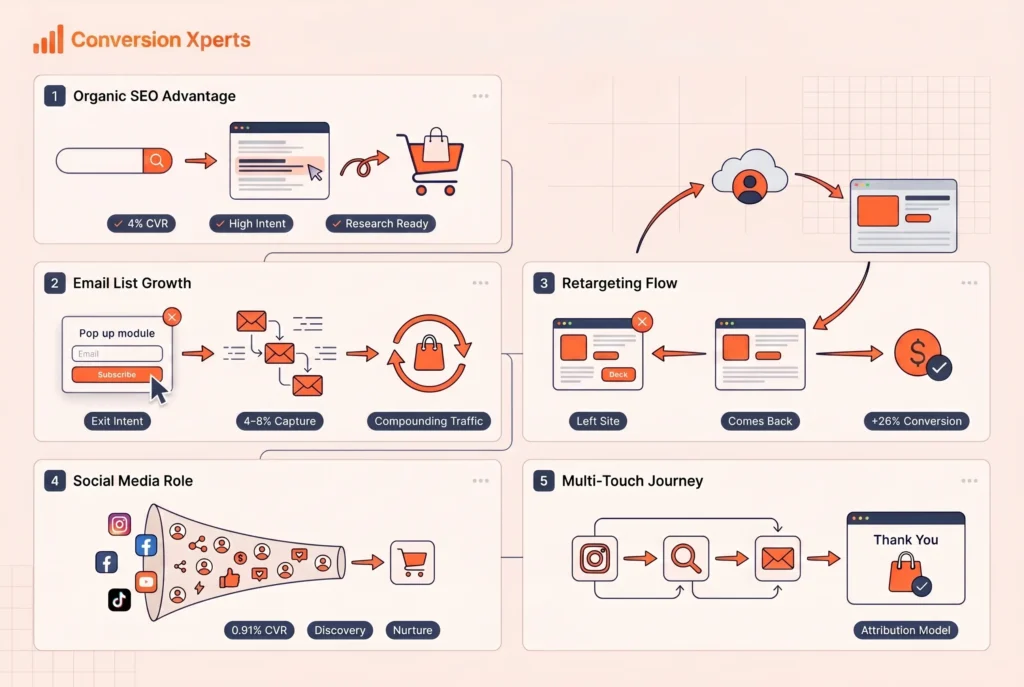
One of the most overlooked levers for improving ecommerce conversion rate is improving the quality of traffic before it arrives, not just the experience after it lands. The best product pages and the most frictionless checkout in the world will still underperform if you are sending the wrong people to them.
Organic SEO: The Highest-Converting Traffic Source
Organic search sees higher conversion rates of approximately 4% compared to paid ads at 2% to 3%. Organic leads arrive having already done substantial research, making them dramatically more purchase-ready than cold ad traffic.
For ecommerce stores, organic SEO works on two levels. Category and product pages optimized for transactional keywords (like “buy leather sofa” or “best running shoes for flat feet”) capture buyers who are actively shopping. Blog and content pages optimized for informational keywords (“how to choose a mattress” or “types of sofa fabric”) capture buyers earlier in their research journey and build trust over time.
The stores with the best organic conversion rates do both. They rank for purchase-intent keywords that bring buyers ready to add to cart today, and they rank for research-intent keywords that introduce their brand to buyers who will return and purchase in the coming weeks.
Email List Building as a Conversion Multiplier
Every email subscriber you capture from your website is a future conversion opportunity that does not require you to pay for a click. Building your email list aggressively is one of the most compounding conversion rate improvements available.
Optimonk research across 18,000 ecommerce websites found that exit-intent email popups convert 4% to 8% of abandoning visitors, representing a significant opportunity to capture buyers who would otherwise leave without a trace.
Once someone is on your email list, they become a returning visitor every time they engage with a campaign. And returning visitors convert at dramatically higher rates than first-time visitors across every ecommerce category.
Retargeting: Converting the 97% Who Left Without Buying
The reality of ecommerce is that most visitors will not buy on their first visit. They are browsing, comparing, researching. Retargeting brings those visitors back when purchase intent is higher.
Retargeting ads increase conversions by 26% according to conversion rate optimization research.
The most effective ecommerce retargeting is highly specific. Ads that show the exact product a visitor viewed, combined with a specific offer or trust-building message, convert far better than generic “come back and shop” creative. If someone spent 8 minutes on your product page for a specific sofa, your retargeting ad should show that sofa with your return policy and a customer review, not a generic brand awareness image.
Paid Social as a Discovery and Nurture Channel
Social media traffic converts at the lowest rate of any ecommerce traffic source. Social media has the lowest conversion rate at just 0.91% according to analysis across multiple ecommerce platforms. This does not mean social advertising is wasteful. It means your expectations and your measurement framework need to reflect what social actually does well.
Social is a discovery and nurture channel. It introduces your brand to buyers who did not know you existed. It keeps your brand top-of-mind for buyers who are in the consideration phase. It builds the familiarity and trust that eventually leads to a conversion when the buyer is ready, whether that conversion happens through social itself or through a later organic search or direct visit.
Measure social’s contribution to conversion through multi-touch attribution, not last-click. A buyer who first discovered you through Instagram, researched you through organic search, and converted via email is a social-influenced conversion, even though social does not get credit in a last-click model.
Advanced CRO Tactics: Beyond the Basics for Stores Ready to Scale
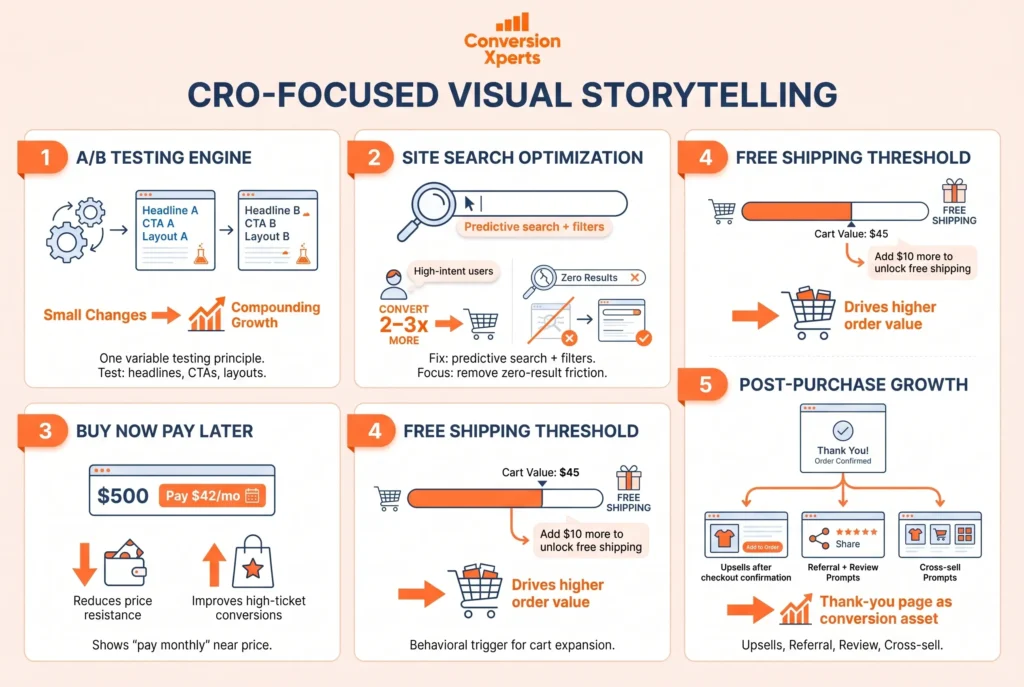
Once you have the fundamentals in place (solid product pages, smooth checkout, fast loading times, strong trust signals, quality traffic), there is a layer of more sophisticated optimization tactics that can drive additional meaningful improvements.
A/B Testing: The Engine of Continuous Improvement
Sustainable ecommerce CRO is built on continuous testing. Every assumption about what your visitors prefer should eventually be validated by data. A/B testing lets you pit two versions of a page element against each other with real traffic, measure which version converts better, and implement the winner permanently.
The most impactful elements to A/B test in ecommerce are homepage headlines, product page layouts, add-to-cart button copy and color, checkout page structure, email subject lines, and promotional offer framing. Each winning test compounds on the previous ones, building a store that converts better with each iteration.
A key principle of A/B testing is testing one variable at a time. If you change the headline, the button color, and the product image simultaneously and see an improvement, you have no idea which change drove it. Isolate your variables to learn what actually works.
Site Search Optimization
Site search users convert 2 to 3 times higher than non-searchers, highlighting the critical importance of search optimization for ecommerce conversion rate.
A visitor who uses your site search is demonstrating extremely high purchase intent. They know what they want and are actively looking for it. If your search returns poor results, zero results, or hard-to-filter results, you are losing your most motivated buyers.
Invest in a high-quality site search tool with predictive search, typo tolerance, synonym recognition, and robust filtering. Monitor your search terms report regularly to identify products buyers are looking for that your search fails to surface, and use this data to improve both your search configuration and your product catalog.
Buy Now Pay Later for Higher-Ticket Products
For any product priced above $100, offering Buy Now Pay Later (BNPL) financing can meaningfully improve conversion rates by reducing the perceived financial barrier.
BNPL options drive 40% or more improvements in average order value and reduce price sensitivity by allowing customers to spread payments over time.
The global BNPL market hit $560.1 billion in 2025, growing 13.7% year over year. It is no longer a niche payment option.
Displaying BNPL options on product pages, not just at checkout, is critical. A buyer considering a $400 purchase who sees “from $33/month” next to the price makes a completely different mental calculation than one who only sees the full price. The payment installment messaging should be present wherever the price is shown.
Free Shipping Thresholds as a Conversion and AOV Tool
Free shipping has moved from being a differentiator to being a baseline expectation in 2026. The question is not whether to offer it but how to structure it strategically.
Free shipping increases conversion rates by 20%. And 93% of consumers say they buy more when free shipping is available. Beyond that, 58% of consumers add items to their cart specifically to qualify for a free shipping threshold.
The free shipping threshold mechanic increases average order value at the same time as it improves conversion rate. If your average order value is $65 and you set a free shipping threshold at $80, you will see a meaningful percentage of buyers add an additional item to their cart specifically to cross the threshold.
Display the free shipping threshold prominently throughout the shopping experience and include a dynamic cart message showing buyers exactly how much more they need to spend to qualify. “Add $12 more for free shipping” is one of the most effective conversion messages in ecommerce.
Post-Purchase Optimization: The Revenue Hidden in Plain Sight
Most ecommerce CRO focuses on getting buyers to convert the first time. But some of the most valuable conversion opportunities come immediately after the first purchase, when a buyer is at their peak level of trust and engagement.
Post-purchase upsell pages, shown immediately after order confirmation, consistently convert at higher rates than pre-purchase upsell attempts because the buyer has already committed and their payment anxiety is gone. One-click post-purchase upsells that do not require re-entering payment information convert particularly well.
Thank-you page optimization, where you turn the order confirmation page into an active conversion opportunity rather than a dead end, can generate meaningful additional revenue. Invite buyers to refer a friend, follow you on social, leave a review, or take advantage of a time-sensitive offer on a complementary product.
How ConversionXperts.com Helps Ecommerce Brands Improve Conversion Rates
Knowing what to do and knowing how to execute it systematically at scale are two different things. Most ecommerce teams have the desire to improve their conversion rates but lack the time, expertise, or testing infrastructure to do it consistently over the long term.
This is precisely where ConversionXperts.com delivers exceptional value for ecommerce brands globally. The ConversionXperts team specializes exclusively in ecommerce conversion rate optimization, working with brands across fashion, home goods, consumer electronics, health and beauty, luxury goods, and more. Their client base spans North America, Europe, the Middle East, Southeast Asia, and beyond, giving them a uniquely global perspective on what buyers in different markets respond to.
What separates ConversionXperts from generic digital marketing agencies is their methodology. Every engagement starts with a rigorous full-funnel audit that maps conversion rates at every stage using quantitative analytics, heatmap analysis, and session recording review. From there, they build a prioritized testing roadmap that targets the highest-revenue improvement opportunities first rather than working through a generic best-practices checklist.
Their A/B testing program runs continuous experiments on the elements that matter most, product page layout, checkout flow, trust signal placement, mobile experience, and personalization architecture, compounding improvements with each test cycle. Every recommendation is backed by data, and every implementation is tracked against revenue outcomes rather than vanity metrics.
Whether your store is generating $1M per year or $50M per year, whether you sell everyday consumables or high-ticket luxury goods, ConversionXperts has the expertise, the tools, and the track record to move your ecommerce conversion rate meaningfully upward. For stores serious about turning more of their existing traffic into paying customers in 2026, ConversionXperts.com is the partner that brings both the strategy and the execution to make it happen.