Amazon Conversion Rate Optimization: Data Driven Strategies That Actually Move the Needle
- Published by: Kamran
- Last Updated: July 2026
If you sell on Amazon, you already know the feeling. You pour money into Sponsored Products, impressions climb, clicks arrive, and then… nothing. The sales dashboard barely moves. It is one of the most frustrating experiences in ecommerce, and it almost always points to the same root cause: a conversion problem, not a traffic problem.
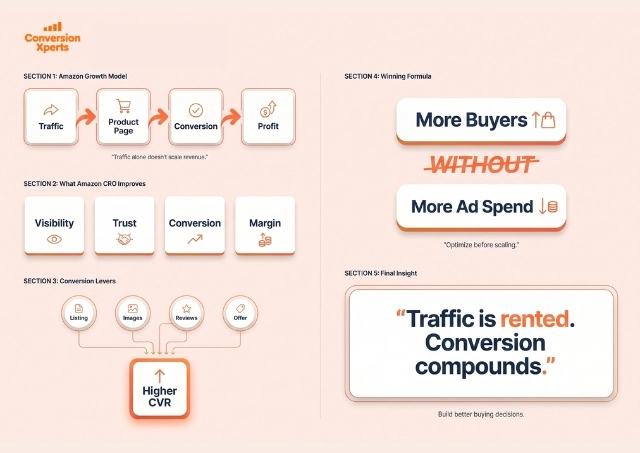
Conversion rate optimization, often shortened to CRO, is the practice of improving the percentage of shoppers who land on your product page and actually buy. On Amazon, this single metric quietly controls almost everything else. It shapes your organic ranking, your advertising costs, your Buy Box eligibility, and ultimately your profit margin. Sellers who treat conversion rate as an afterthought are, in effect, paying full price for traffic and then throwing half of it away.
This guide walks through what conversion rate really means on Amazon, what a good benchmark looks like in 2026, and the specific, data backed tactics that consistently move the number in the right direction. Nothing here is theoretical fluff. Every recommendation ties back to something measurable inside Seller Central.
What Amazon Conversion Rate Actually Means
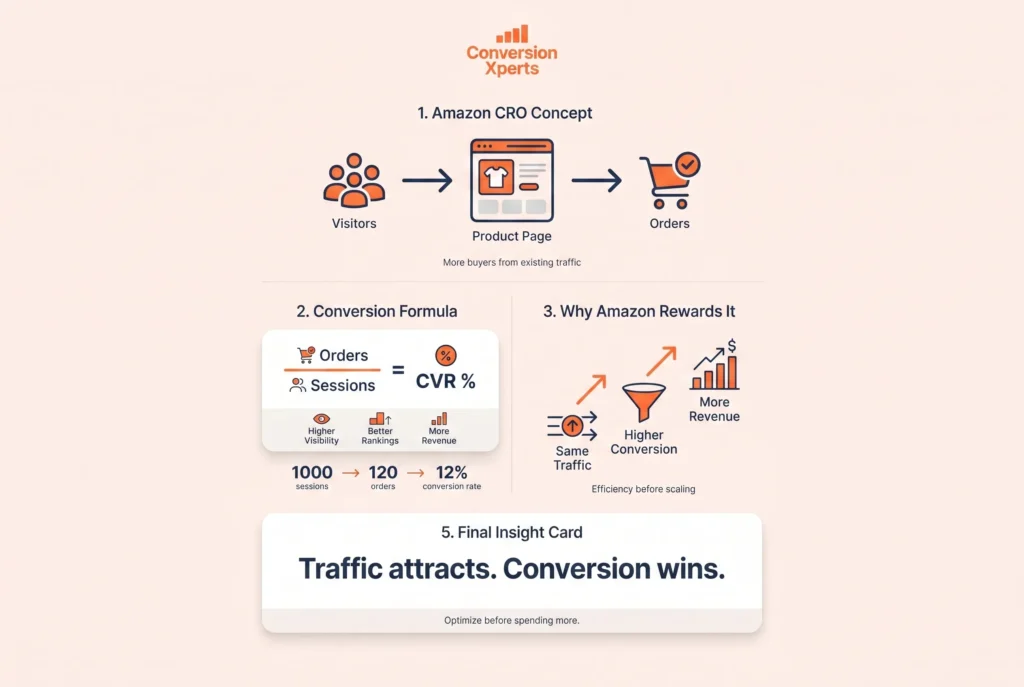
Amazon calls this metric Unit Session Percentage, and it is calculated with a simple formula: total units ordered divided by total sessions, multiplied by one hundred. A session is a single visit from one shopper within a twenty four hour window, regardless of how many times that person refreshes the page. This is different from a page view, which counts every single load, including repeat visits from the same person on the same day.
Why does this distinction matter so much? Because sellers who accidentally use page views instead of sessions end up with a conversion number that looks artificially low, and they chase problems that do not exist. Always pull your conversion data from Reports, then Business Reports, then Detail Page Sales and Traffic, and look at the column labeled Order Item Session Percentage. That is the real number.
Once you understand the calculation, the strategic question becomes obvious. If a listing sits at five percent conversion and you manage to push it to ten percent, you have just doubled revenue without spending a single additional dollar on advertising. That is the entire logic behind conversion rate optimization, and it is why experienced sellers treat it as a higher priority than simply bidding more aggressively on keywords.
Benchmarks: What Counts as Good in 2026
One of the most common questions sellers ask is deceptively simple. What is a good conversion rate? The honest answer is that it depends heavily on category, price point, and traffic source, but general benchmarks still provide a useful starting point.
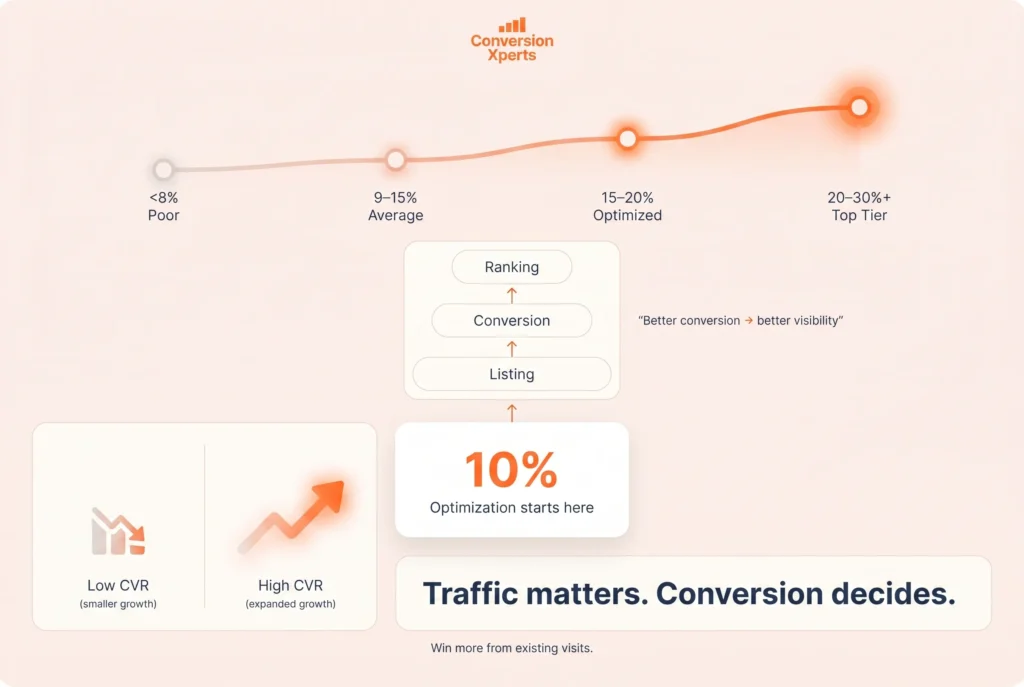
Across the platform, most sellers land somewhere between eight and twelve percent, which is already far ahead of the one to three percent typical of a standalone ecommerce website. This gap exists because Amazon shoppers arrive with strong purchase intent, built in trust from Prime membership, fast and reliable shipping, and a checkout process with almost no friction. People are not casually browsing for inspiration the way they might on a general retail site. They already know roughly what they want, and they are comparing a short list of specific options.
Within that overall range, the picture shifts by category. Consumable products such as supplements and household goods often see conversion rates between fifteen and twenty five percent because repeat purchase behavior and habit formation play a large role. Electronics and higher priced items typically sit lower, often between five and twelve percent, since shoppers spend more time comparing specifications and reading reviews before committing. Fashion and apparel tend to show inflated raw numbers that get pulled down once returns are factored in.
Listings enrolled in Fulfillment by Amazon and displaying the Prime badge consistently outperform those that are not, often converting between fifteen and twenty five percent, with the strongest listings exceeding thirty percent. The takeaway is not that every seller should expect a specific number, but rather that every seller should benchmark against their own category rather than chasing a generic average pulled from a blog post.
For a broader industry perspective on how these figures compare across different platforms and traffic sources, this collection of ecommerce conversion statistics is worth reviewing: conversion rate optimization statistics.
Why Conversion Rate Drives Almost Everything Else on Amazon
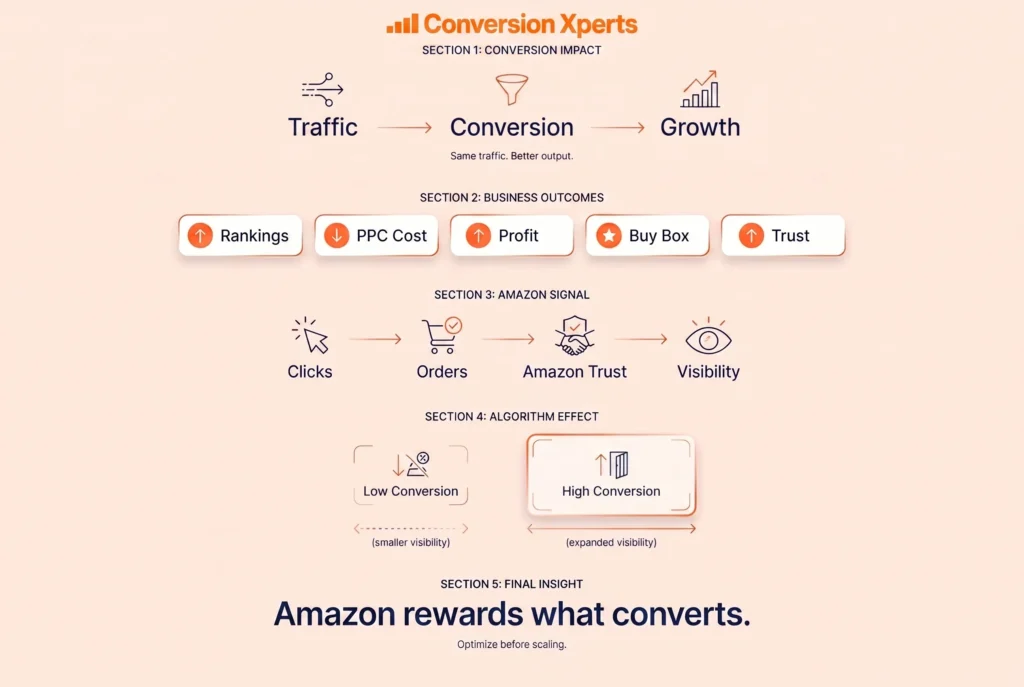
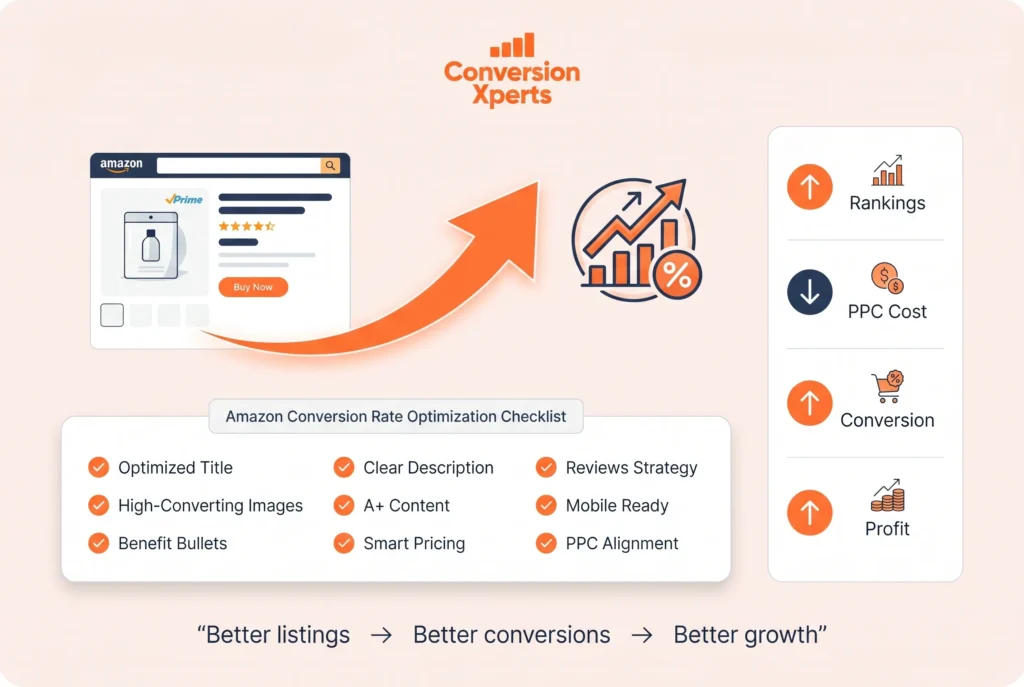
It helps to understand why Amazon cares so much about this metric internally. The A9 and A10 search algorithms are built to connect shoppers with products they are likely to purchase, not simply products that match a keyword. A listing that converts well signals to Amazon that it satisfies buyer intent, and the algorithm rewards that signal with better organic placement.
This creates a compounding effect. Better conversion leads to better ranking. Better ranking leads to more free organic traffic. More organic traffic reduces reliance on paid advertising, which lowers your advertising cost of sale and improves overall profitability. Meanwhile, strong conversion also supports Buy Box stability, since Amazon favors sellers whose listings reliably turn visitors into buyers with minimal returns or complaints.
In short, conversion rate is not just one metric among many. It sits at the center of the entire flywheel that determines whether a listing thrives or quietly fades into irrelevance on page three of the search results.
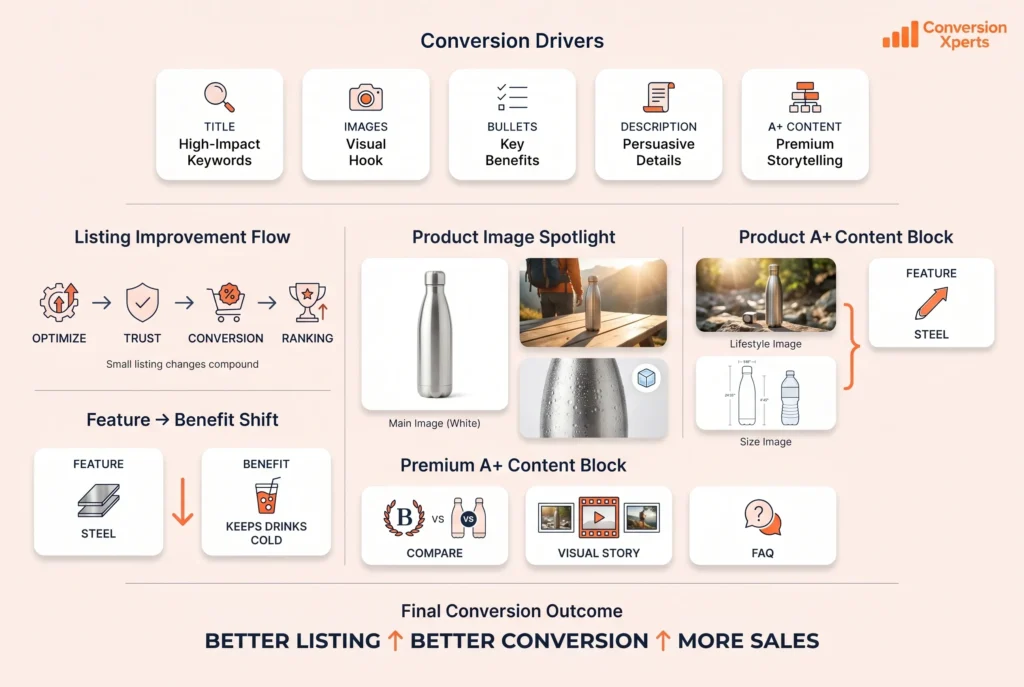
Strategy One: Rebuild Your Main Image Around Buyer Psychology
Your main image does more conversion work than any other single element on the page, because it is the first thing a shopper sees in search results before they even click through. A cluttered, low resolution, or generic image will lose the sale before the listing has a chance to make its case.
The best performing main images are shot against a pure white background as Amazon requires, show the product filling most of the frame, and communicate scale or size at a glance. Where the category allows it, a small overlay showing a key differentiator, such as a certification badge or a quantity count, can lift click through rate without violating Amazon’s image policies. Once the shopper clicks through, secondary images should answer the questions a buyer would normally ask a salesperson in a physical store: What does it look like in use? What are the exact dimensions? What is included in the box? What problem does this solve that competing products do not?
Sellers frequently underestimate how much testing matters here. Amazon’s own experimentation tool allows brand registered sellers to run controlled tests on images, titles, and other elements, showing each version to a statistically significant slice of traffic before declaring a winner. Running one variable at a time is essential. Testing a new main image and a new title simultaneously makes it impossible to know which change actually drove the result.
Strategy Two: Write Titles for Humans First, Algorithms Second
There is an old habit in Amazon selling of stuffing titles with every possible keyword variation, and it almost always backfires. A title that reads like a keyword dump is harder to scan, looks unprofessional next to competitors, and can actually depress conversion even if it helps with initial discoverability.
The strongest titles lead with the brand, followed by the core product name, then the single most important differentiator, and finally supporting details like size or quantity. Clarity wins over density. A shopper scanning a results page in two or three seconds needs to immediately understand what the product is and why it might be the right choice, and only after that does keyword placement matter for search visibility.
Strategy Three: Turn Bullet Points Into Objection Handlers
Bullet points are frequently treated as a place to list specifications, but the highest converting listings use them very differently. Rather than simply stating a feature, effective bullets connect that feature to a benefit and often preemptively address a concern that shows up repeatedly in negative reviews of competing products.
For example, instead of writing simply Stainless Steel Construction, a stronger bullet reads something like Built From Food Grade Stainless Steel So It Resists Rust And Holds Up After Years Of Daily Use, Unlike The Thin Metal Found In Cheaper Alternatives. This structure does two things at once. It communicates the feature, and it quietly reassures a hesitant buyer who has been burned before by a similar product from another brand.
A practical exercise that consistently pays off is reading through the one and two star reviews on your top three competitors and identifying the three most common complaints. Then write your bullet points so that each complaint is addressed before the shopper even thinks to worry about it. This single tactic has been shown to produce measurable conversion improvement, sometimes close to two percentage points per listing, when implemented carefully.
Strategy Four: Use A Plus Content to Build Trust, Not Just Decoration
A Plus Content, available to brand registered sellers, is often treated as a purely aesthetic upgrade, but it is one of the more reliable levers for conversion improvement when used correctly. Listings with well built A Plus Content typically see conversion increases in the range of five to ten percent compared to listings without it.
The most effective A Plus modules include comparison charts that position your product against your own other offerings or against generic alternatives, lifestyle imagery that shows the product solving a real problem, and a clear brand story section that builds the kind of trust a shopper cannot get from bullet points alone. Avoid modules that simply repeat information already covered in the bullets. Every module should add something new to the buyer’s decision making process.
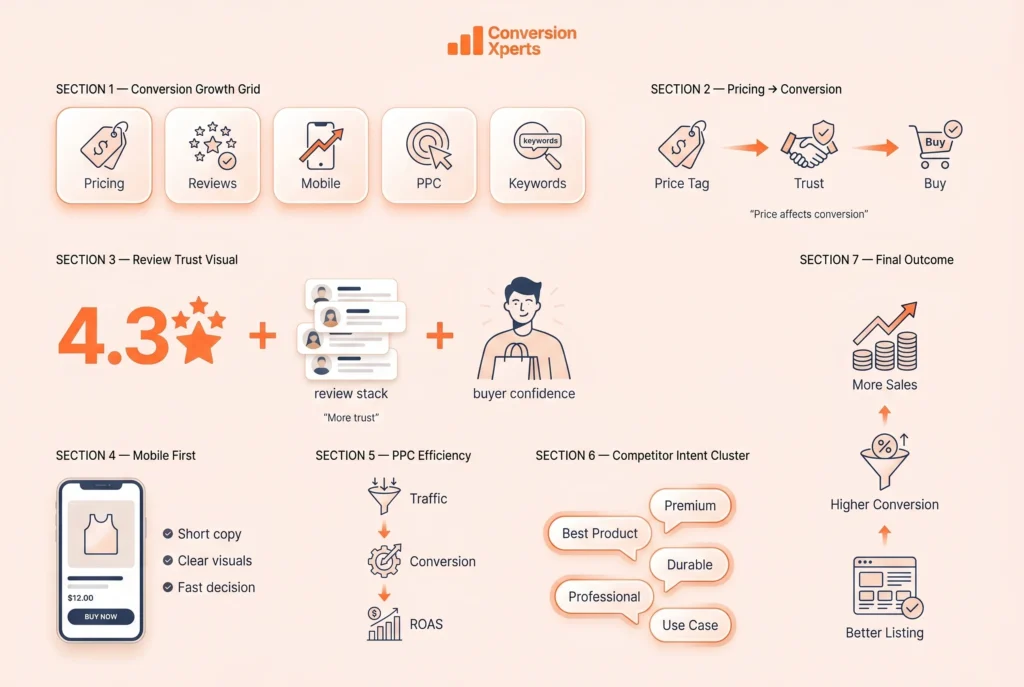
Strategy Five: Treat Pricing as a Signal, Not Just a Number
Price on Amazon functions as a trust signal as much as it does an economic decision. Every category develops an unspoken confidence band, a range shoppers expect to pay for a product of a given quality level. Price far above that band without strong justification, such as superior reviews or a well known brand, and the listing looks overpriced. Price far below it and the listing can look cheap or even suspicious.
Being the absolute lowest price in a category is rarely a winning long term strategy. It tends to attract bargain hunters who are more likely to return the product or leave lukewarm reviews, and it compresses margin in a way that makes sustainable advertising spend difficult. The better approach is aligning price with the perceived value communicated by images, copy, and reviews, then letting the strength of the listing itself justify a fair position within the category’s expected range.
Strategy Six: Reviews Remain the Single Strongest Trust Signal
No amount of clever copywriting fully substitutes for genuine social proof. Reviews and star ratings consistently rank among the top factors shoppers cite when deciding between similar products, and Amazon’s own algorithm weighs review quantity and quality heavily in ranking decisions.
Sellers can ethically encourage more reviews by responding quickly and helpfully to customer questions, using Amazon’s built in Request A Review feature at the appropriate point in the delivery cycle, and enrolling eligible new products in the Amazon Vine program to generate an initial batch of honest, verified reviews. What matters most is consistency. A steady flow of new reviews signals ongoing demand, while a listing that has not received a new review in months can look stagnant even if the underlying product is excellent.
Strategy Seven: Optimize Specifically for Mobile Shoppers
A significant and growing share of Amazon traffic now arrives through mobile devices, and mobile shoppers behave differently than desktop shoppers. Attention spans are shorter, and images carry even more weight relative to text because scrolling through dense paragraphs on a small screen is genuinely tiring.
Practical mobile focused adjustments include keeping the first two bullet points short enough to read without scrolling, front loading the most important image content within the first three photos since that is what many mobile shoppers see before scrolling further, and double checking that any A Plus Content graphics remain legible when compressed onto a phone screen rather than only checking them on a desktop monitor.
Strategy Eight: Run Structured Experiments Instead of Guessing
Amazon’s native experimentation tool, found under Brand Analytics for eligible sellers, allows controlled testing of titles, main images, and other listing elements. Each version is shown to a statistically significant sample of real shoppers, and the platform reports which version produced the stronger result.
The discipline here matters as much as the tool itself. Change one variable, let the test run long enough to reach significance, usually somewhere between four and six weeks depending on traffic volume, implement the winner, and then move on to the next hypothesis. Sellers who skip this process and instead change multiple elements at once often end up improving a listing by accident while learning absolutely nothing that can be applied to future products.
Strategy Nine: Align PPC Campaigns With Conversion Reality
There is a common mistake where sellers pour advertising budget into keywords that generate clicks but rarely convert, simply because those keywords have high search volume. A more disciplined approach ties advertising spend directly to conversion data at the keyword level. Keywords that drive traffic but consistently fail to convert should either be paused or should prompt a closer look at whether the listing itself is failing to meet the expectation set by that particular search term.
This is also where backend search terms deserve attention. The two hundred and fifty byte backend keyword field does not influence conversion directly, since shoppers never see it, but it does influence which searches bring shoppers to the listing in the first place, and mismatched backend terms can quietly funnel in traffic that was never going to convert regardless of how good the listing itself looks.
Bringing In Outside Expertise
Not every seller has the internal bandwidth to run a full conversion audit alongside everything else involved in running an Amazon business. This is where dedicated agencies can add real value. Firms such as conversionxperts.com specialize specifically in listing audits and conversion focused optimization for Amazon sellers, working through the same fundamentals covered in this guide, including imagery, copywriting, A Plus Content, and pricing strategy, but with the benefit of pattern recognition built from working across many accounts and categories at once. For sellers who want a structured, professionally managed approach rather than trial and error, bringing in a specialist team like this can shorten the path from an average performing listing to a genuinely optimized one.
Building a Repeatable Conversion Improvement Process
The sellers who see the most consistent long term gains treat conversion rate optimization as an ongoing cycle rather than a one time project. A practical version of this cycle looks like the following.
First, audit every underperforming listing using category specific benchmarks rather than a generic platform average, since a supplement listing and a furniture listing should never be judged by the same yardstick. Second, generate a specific hypothesis for each underperforming listing, such as the main image is failing to communicate scale, or the bullet points ignore a common competitor complaint. Third, test that hypothesis in a controlled way using Amazon’s experimentation tool whenever eligibility allows it. Fourth, implement whichever version wins, and document what was learned so the same insight can be applied to future listings without repeating the same research from scratch. Finally, repeat the cycle regularly, since competitor listings change constantly and a conversion advantage that exists today can quietly erode within a few months if left unattended.
Common Mistakes That Quietly Sabotage Conversion Rate
A few recurring mistakes show up across countless Amazon accounts, and each one is worth checking directly against your own listings.
Overloading titles with keywords at the expense of readability confuses shoppers and can reduce trust at first glance. Relying on stock photography or generic supplier images instead of custom photography fails to differentiate the listing from dozens of nearly identical competitors selling the same base product under different brand names. Ignoring negative reviews rather than addressing the underlying concern in the bullet points or A Plus Content leaves the same objection unresolved for every future shopper who reads that review. Chasing the absolute lowest price in a category damages margin without necessarily improving conversion, since price alone rarely overcomes a weak listing. Testing multiple variables simultaneously destroys the value of any experiment, since there is no way to isolate which change actually caused a shift in performance.
Measuring Success the Right Way
Once changes are implemented, resist the temptation to judge results based on a single day or even a single week of data. Amazon conversion rates fluctuate naturally due to factors like day of week shopping patterns, promotional activity from competitors, and seasonal demand shifts. A meaningful evaluation window typically spans at least two to four weeks, and ideally compares performance against the same period from a prior cycle rather than simply looking at raw week over week movement.
It also helps to separate organic conversion rate from advertising conversion rate, since these two numbers often move at different speeds. Advertising conversion typically lags slightly behind organic conversion because paid traffic includes shoppers earlier in their decision process, while organic traffic often includes shoppers who already have strong intent built up before they even search.
Final Thoughts
Amazon conversion rate optimization is not a single fix or a one time checklist item. It is an ongoing discipline built on understanding your specific category benchmarks, systematically testing changes rather than guessing, and treating every element of the listing, from the main image down to the backend keywords, as a lever that either builds or erodes buyer trust. Sellers who commit to this process consistently outperform competitors who continue pouring advertising budget into a listing without ever asking why the traffic they already have is failing to convert.
The math is simple and it rarely fails. Improving conversion rate improves organic ranking, which reduces advertising cost, which improves margin, and the entire cycle reinforces itself over time. Start with the listing that has the highest traffic and the weakest conversion rate relative to its category benchmark, apply the strategies above one at a time, and measure honestly before moving to the next listing on the list.
I'm Kamran Mushtaq, founder of Conversion Xperts and a CRO specialist who helps brands grow revenue from the traffic they already have, without spending more on ads. For nearly a decade I've lived in the data: studying how visitors move through a site, where they hesitate, and what finally convinces them to act.I work across four areas:Ecommerce CRO: turning more store visitors into buyers through optimized product pages, checkout flows, and full funnels Lead generation: lifting form fills, demo requests, and qualified inquiries on service and local sites B2B conversion: shortening the path from visit to inquiry for considered, high-value purchases SaaS conversion: improving signups, trial starts, and free-to-paid activationMy approach pairs rigorous analytics with genuine customer empathy. Using Google Analytics 4, Hotjar, and Google Tag Manager, I uncover the "why" behind conversion drop-offs, then run structured A/B experiments to fix them. Every recommendation is grounded in evidence, not intuition.To date I've delivered 300+ CRO audits and run thousands of A/B tests across ecommerce, B2B, SaaS, and lead generation. From a single product page to a full funnel rebuild, the goal never changes: make every visit count.