How to Master A/B Testing: A Step-by-Step Guide That Actually Works
Introduction: Why A/B Testing Is the Fastest Way to Grow Conversions Without More Traffic
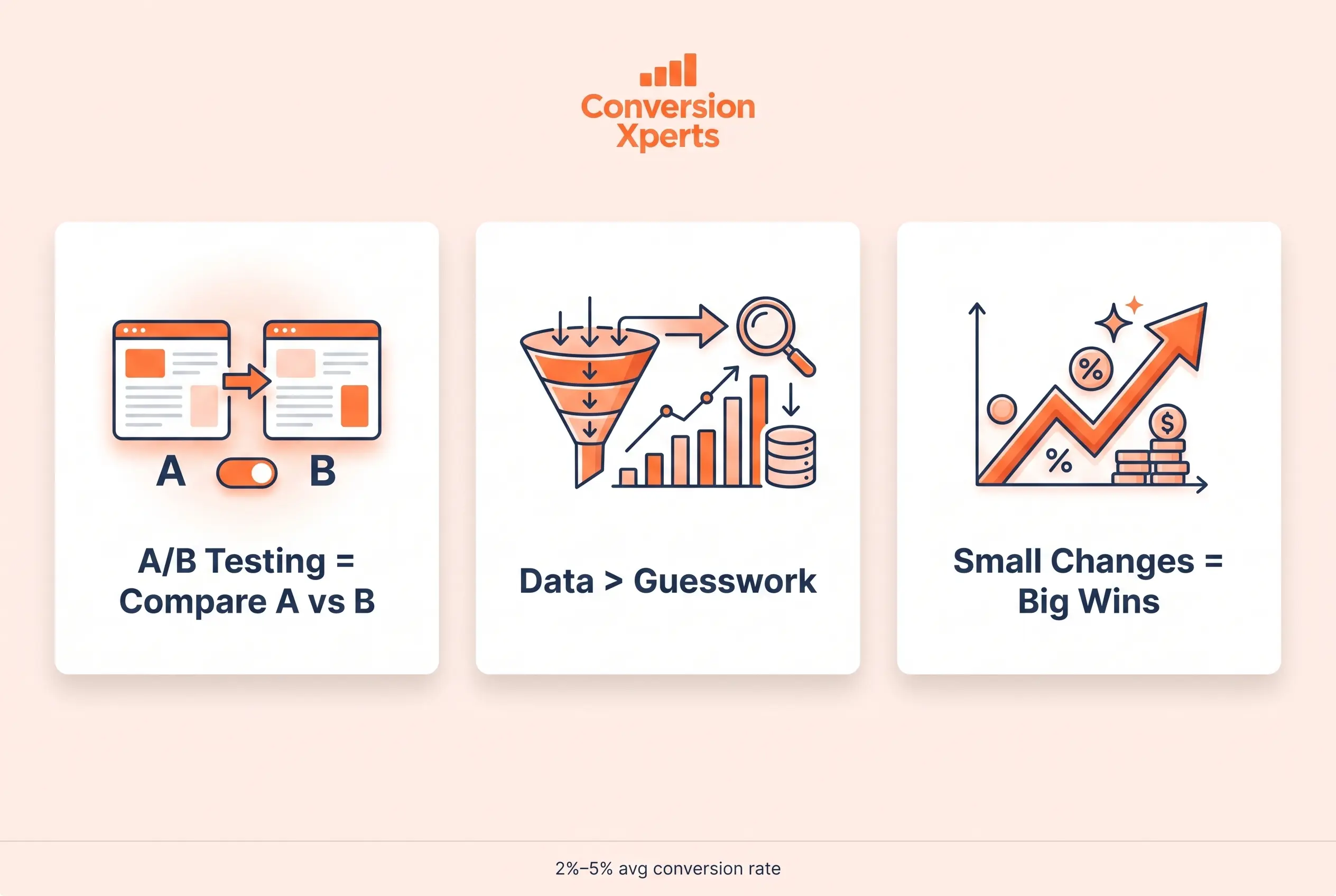
Most businesses try to fix low conversion rates by spending more on ads. But if your website isn’t converting the traffic you already have, more visitors just means more wasted budget. A/B testing conversion rate optimization flips this approach — instead of guessing what works, you let real user data decide.
A good a/b testing conversion rate typically falls between 2% and 5%, but this varies widely by industry. According to the ADI Consumer Report, health and pharmacy sites convert at 5.8%, gifts at 4.7%, while consumer electronics lag at just 1.7%. Even a small lift within your own baseline can translate into meaningful revenue.
That said, A/B testing service only works when it’s done right. Without enough traffic to reach 95% statistical significance, your results are little more than guesswork. Done properly, though, testing pays off — personalized experiences built on solid CRO testing can deliver 41% more impact than generic, one-size-fits-all pages, according to Optimizely’s analysis of 127,000 experiments.
This guide walks you through the entire process: planning your test, executing it correctly, analyzing results with confidence, and scaling what works — so every test moves your conversion rate in the right direction.
Understand the Basics of A/B Testing
What is A/B testing and why it matters
At its core, A/B testing is a methodology that allows you to compare two versions of a webpage or app to determine which one performs better. This experiment splits your traffic 50/50 between a control version (A) and a variation (B). Although it might seem like a modern digital marketing technique, A/B testing is essentially a new term for an old scientific approach—controlled experimentation.
The purpose is straightforward: to gather information that informs decisions about changes leading to improved conversion rates and user experience. Unlike subjective decision-making based on opinions or assumptions, A/B testing provides quantitative data that removes guesswork and reduces the risk of implementing ineffective updates.
Furthermore, industries where A/B testing frequently delivers significant impact include:
- Ecommerce platforms
- Entertainment products
- Social media
- Software as a service
- Online publishing
- Email marketing
How A/B testing supports conversion rate optimization
A/B testing serves as a cornerstone of conversion rate optimization (CRO) by allowing you to determine which version of your content delivers better conversion rates. Rather than relying on gut instinct or random changes, you can systematically test elements like call-to-action buttons, headlines, page layouts, and checkout processes.
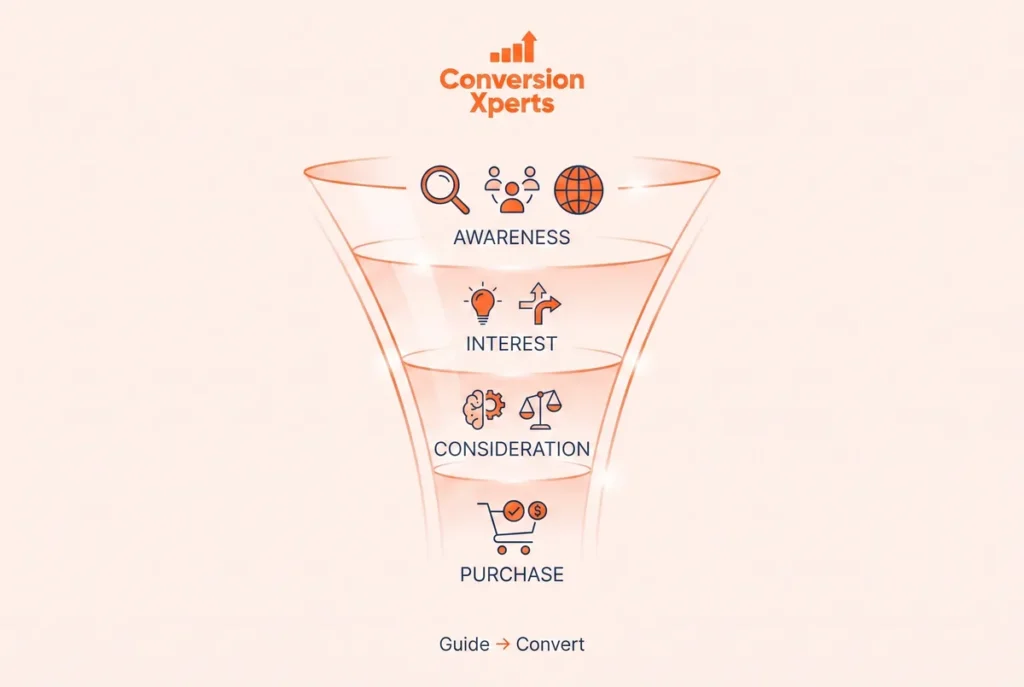
When implemented correctly, A/B testing helps pinpoint exactly where users are dropping off in your conversion funnel. Instead of spending more money acquiring new visitors, you can optimize your existing funnel to convert more of your current traffic. This approach makes A/B testing particularly valuable for identifying friction points that prevent conversions.
Consequently, continuous A/B testing creates a stream of recommendations on how to fine-tune performance. Every successful test contributes to building a culture of data-driven decision-making throughout your organization. Teams that use analytics in conjunction with their testing outperform those without by 32% per test, with an additional 16% increase when heatmapping and session recordings is also utilized.
Common misconceptions about A/B testing
Despite its effectiveness, several myths about A/B testing persist that can lead to poor implementation and disappointing results.
One prevalent misconception is that A/B testing is only suitable for large, groundbreaking changes. In reality, even minor tweaks can yield valuable insights and significant improvements. Small changes often require minimal resources and can be implemented quickly, providing precise understanding of what specific elements drive performance improvements.
Additionally, many believe effective A/B testing requires a large audience. Although more data helps achieve statistical significance faster, quality matters more than quantity. With a smaller audience, you can still gain insightful results by focusing on key performance indicators and ensuring your tests are well-structured.
Another common myth is that A/B testing delivers quick answers. Effective testing requires patience—rushing the process leads to conclusions not backed by substantial data. Tests typically need several weeks to run, allowing enough time to capture variations in user behavior across different times and days.
Finally, perhaps the most dangerous misconception is assuming that successful test results are permanent. External factors such as market trends, seasonality, and audience behavior change over time, potentially causing even well-performing variations to lose effectiveness. Continuous optimization through regular updates and re-testing is essential for maintaining performance.
Set Up for Success: Planning Your A/B Test
 Proper planning is the foundation of successful A/B testing. Before launching your first test to improve conversion rates, you need a structured approach that maximizes the likelihood of gaining actionable insights.
Define your conversion goal
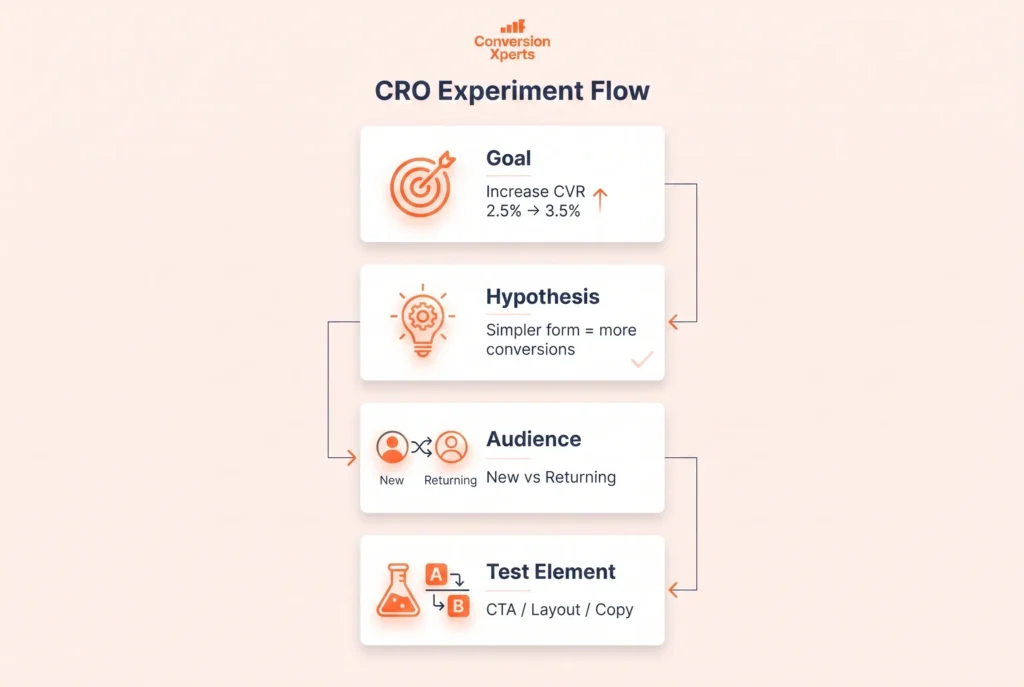
First, clearly identify what specific metric you’re trying to improve. Without a well-defined goal established upfront, you’ll never have a clear understanding of whether your test was successful. Your conversion goal provides the framework for designing your A/B test and crafting your hypothesis.
For example, if you want to improve your donation page, your goal might be “total number of donations.” For a banner ad, you might measure “clicks” or “landing page visits.” For an email newsletter form, your goal could be “form submissions”.
Remember to set quantifiable goals beyond vague notions like “increasing conversions.” Define exactly which metric you want to improve, including both the baseline performance and your target numeric increase. For instance, “Increase landing page conversion rate from 2.5% to 3.5%”.
Formulate a clear hypothesis
Once you’ve defined your goal, create a hypothesis that addresses the specific idea you believe can improve your conversion rate. A good hypothesis:
- Is testable and measurable
- Solves a conversion problem
- Provides market insights whether the test “wins” or “loses”
Your hypothesis should follow this format: “We believe that doing [A] for people [B] will make outcome [C] happen. We’ll know this when we see data [D] and feedback [E]”.
For instance, a strong hypothesis might be: “Removing friction from the giving process by eliminating unnecessary form fields will increase donations”. This clearly indicates that your treatment page will have fewer form fields than your control.
Moreover, your hypothesis can test multiple elements at once if they support the same underlying concept. For example, “A more personal email will lead to more donations” could involve testing a plain-text email with personal copy against a heavily designed template.
Segment your audience properly
Segmentation allows you to gain specific insights into visitor behavior and test changes for particular user groups. This approach is particularly effective when you want to target segments that are key sources of a problem.
Common segments include:
- New versus returning visitors
- Mobile versus desktop users
- Geographical locations
- High-value customers versus one-time shoppers
Nevertheless, be cautious not to create segments that are too small. Only segment when you have sufficient traffic, start with common segments like new versus returning visitors, and ensure your segment size supports statistical significance.
Choose the right page elements to test
Select elements that will have the greatest positive impact on your conversion goals. Focus on changes that align with your business objectives and are likely to yield the best return.
Prioritize high-traffic pages like your homepage, category pages, or product pages, as these have the most opportunity to influence key metrics. Use analytics to identify pages with high drop-off rates or areas where visitors struggle, then focus your testing efforts there.
When selecting specific elements to test, consider:
- Headlines and copy
- Call-to-action buttons (text, color, placement)
- Images and visuals
- Form fields and checkout processes
- Page layout and navigation
Above all, avoid testing too many variables simultaneously. Isolate key variables and make specific, measurable changes to ensure you can accurately determine what impacted your metrics. For instance, test button color OR button text, but not both together, unless your hypothesis specifically addresses both changes.
By following these planning steps, you’ll create A/B tests that deliver meaningful insights about your users’ behavior and preferences, ultimately leading to improved conversion rates.
Run the Test: Execution and Tools
 Now that your test is properly planned, it’s time to execute it effectively. Launching your test requires careful implementation to ensure reliable results that genuinely improve your conversion rates.
Create and deploy test variants
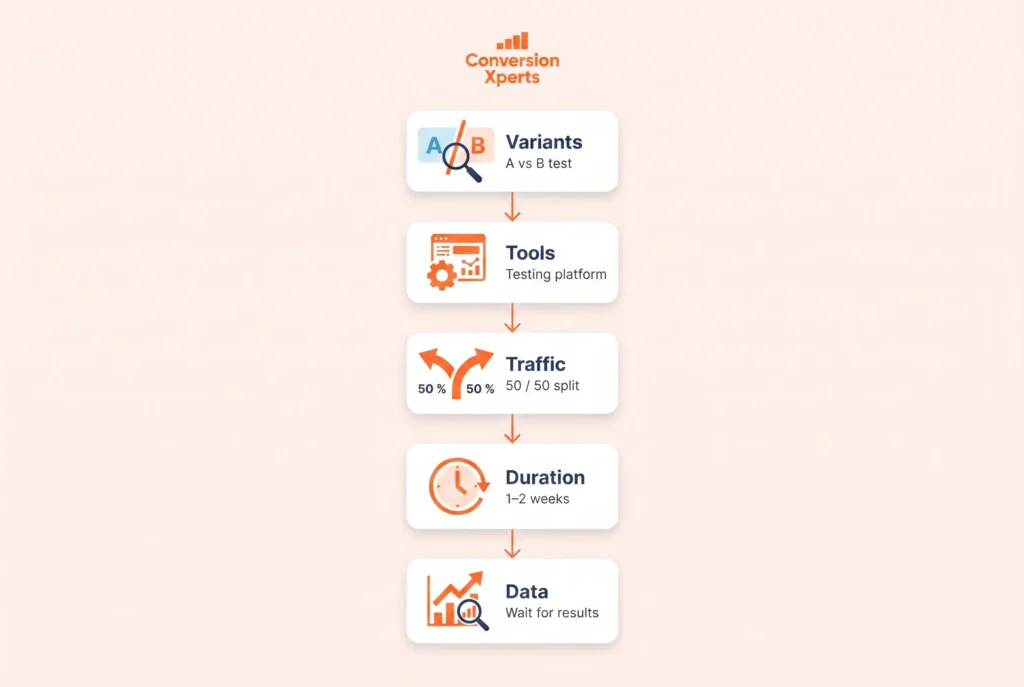
First, create distinct versions of your test element, keeping the control (A) unchanged to serve as your benchmark. Your variation (B) should feature clear, meaningful changes that align with your hypothesis while maintaining visual and functional consistency with your brand identity.
Prior to launch, verify that all variations display correctly across different devices and browsers to prevent technical issues from skewing results. Remember that each variation should be distinct enough to produce measurable differences in user behavior.
Select the right A/B testing tools
Choosing the appropriate testing platform is crucial for execution success. Leading tools include VWO (combining testing with heatmaps and session recordings), Optimizely (offering comprehensive features), Google Optimize (integrating with Google Analytics), and Convert Experiences (privacy-focused with GDPR compliance).
Consider your specific needs when selecting a tool. For testing marketing messages or landing pages, VWO or AB Tasty might be ideal. For app analytics, AppMetrica offers strong mobile capabilities, whereas LaunchDarkly provides deeper control through feature flags for product or development teams.
Ensure proper traffic distribution
Once your variants are ready, implement random traffic assignment to eliminate bias. This typically involves splitting visitors evenly between variations or using a predetermined ratio that adds up to 100%.
Two main traffic allocation methods exist:
- Manual allocation: Traffic splits evenly between variations until statistical significance is reached. Ideal for testing layout and UX changes with long-term implementation goals.
- Automatic allocation (multi-armed bandit): Gradually routes more traffic to better-performing variations as data accumulates. Perfect for short-lived campaigns or promotions where immediate optimization matters more than long-term learning.
Determine test duration and sample size
Calculate your required sample size before launching the test based on:
- Your baseline conversion rate
- Minimum detectable effect (smallest change you want to identify)
- Statistical significance threshold (typically 95%)
- Desired statistical power (usually 80%)
Run your test for at least one full business cycle (typically a week) to account for daily and weekly variations in user behavior. This helps capture a true representation of your audience’s response patterns.
Despite early promising results, avoid stopping tests prematurely. Early fluctuations often settle over time, and cutting tests short risks making decisions based on incomplete data. Patience during testing leads to more reliable conversion optimization results.
Analyze and Interpret Results
 After your A/B test has collected sufficient data, proper analysis becomes critical for making informed decisions about your website improvements.
Measure conversion rate changes
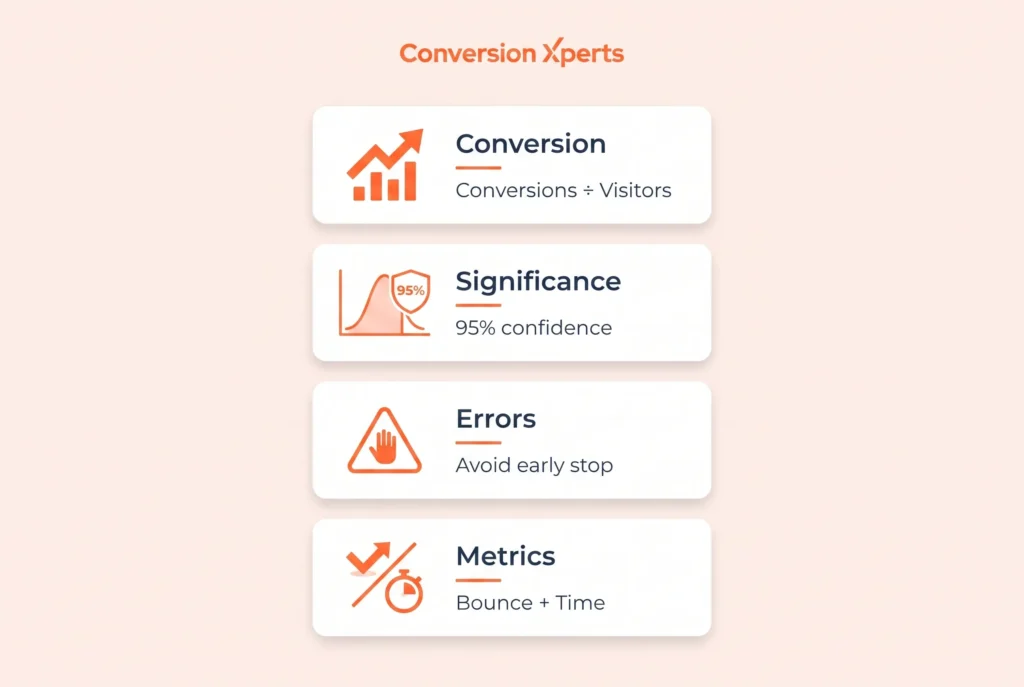
Calculating conversion rate is straightforward—simply divide the number of conversions by your total visitors and multiply by 100. This formula provides the percentage of users who completed your desired action.
Notably, presenting results as relative improvement rather than absolute differences makes more sense to stakeholders. For instance, instead of saying “conversion increased by 0.4%,” frame it as “conversion improved by 2.7%”. This relative approach speaks the language of business decision-makers who think in percentage terms daily.
Understand statistical significance and confidence intervals
Statistical significance determines whether your results occurred due to your changes or mere chance. A 95% confidence level—the industry standard for conversion rate optimization testing—means you’re 95% certain the observed difference is real.
A p-value below 0.05 indicates your results are statistically significant. Meanwhile, confidence intervals provide an expected range of outcomes, displayed as a margin of error (e.g., “+13% ± 1%”). As your sample size increases, this margin narrows, providing greater certainty.
Avoid false positives and negatives
False positives (Type I errors) occur when you incorrectly believe your test produced meaningful results. Conversely, false negatives (Type II errors) happen when you fail to detect actual improvements.
To minimize these errors:
- Wait until you’ve collected enough data rather than peeking at early results
- Set stricter significance thresholds (99% vs. 80%)
- Avoid running multiple tests without statistical corrections
- Ensure proper randomization of traffic assignment
Use supporting metrics like bounce rate and session time
While conversion rate remains your primary focus, supporting metrics provide valuable context. Bounce rate measures the percentage of users who leave without taking further action, whereas average session duration tracks how long users actively engage with your content.
These secondary metrics help identify whether seemingly positive changes might have unintended consequences. For example, a higher click-through rate might lead to more visitors leaving quickly if the landing page doesn’t match expectations. Examining these supporting metrics ensures your optimization efforts truly benefit your business rather than simply boosting a single data point.
Optimize and Scale Your Learnings
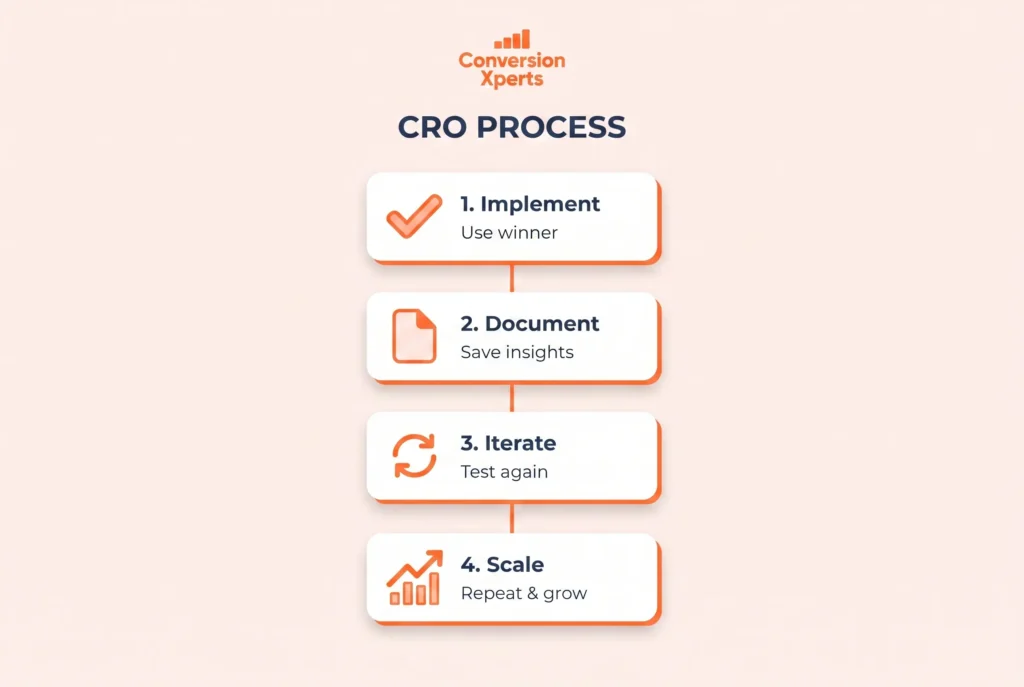
The true power of A/B testing emerges when you transition from one-off projects to a continuous business function, creating insights that competitors cannot easily replicate.
Decide what to implement
Once testing concludes, immediately implement the winning version might seem obvious—yet this approach wastes opportunity. Instead, create new variations of your winner and run subsequent tests. This incremental approach prevents false positives from becoming permanent mistakes as user behaviors evolve over time.
Document and share insights
Maintain a structured repository of all test results—both successes and failures—to prevent redundant testing and accelerate decision-making. As Sarah Hodges, Co-founder at Intelligent.ly notes, “I tracked tests in a spreadsheet including fields for start and end dates, hypotheses, success metrics, confidence level, and key takeaways”. Organizing tests by funnel stage and elements tested creates an accessible knowledge base for future reference.
Iterate with new A/B testing ideas
A/B testing isn’t a one-time effort but rather a cycle of constant iteration. Return to successful tests with new variations while continuously examining previously inconclusive results through a different lens. This “upcycling” approach allows you to revisit past tests with fresh insights, designing better experiments that build upon previous learning.
Build a culture of continuous experimentation
Companies like Booking.com run approximately 25,000 tests annually, demonstrating that experimentation should be embedded in organizational DNA. Foster this culture by celebrating both wins and learnings from failed tests, as both contribute to becoming more innovative and customer-centric.
Conclusion: Turn A/B Testing Into a Long-Term Growth Engine
A/B testing conversion rate optimization isn’t a one-off project — it’s a repeatable system for turning assumptions into evidence. When you follow a clear process — defining a goal, building a testable hypothesis, running the test long enough to reach statistical significance, and analyzing results honestly — you stop guessing and start growing with confidence.
The businesses that win aren’t the ones that run one perfect test. They’re the ones that test constantly, document everything, and treat every result — win or lose — as a data point that sharpens the next experiment. Harvard Business Review, Booking.com’s 25,000 annual tests aren’t an outlier strategy; they’re proof that experimentation compounds.
And the math backs it up: moving your conversion rate from 2% to 2.5% isn’t a “minor” tweak — it’s a 25% revenue increase from traffic you’re already paying for.
Start with one well-planned test. Document the outcome. Iterate. Over time, that discipline becomes your biggest competitive advantage.
Key Takeaways
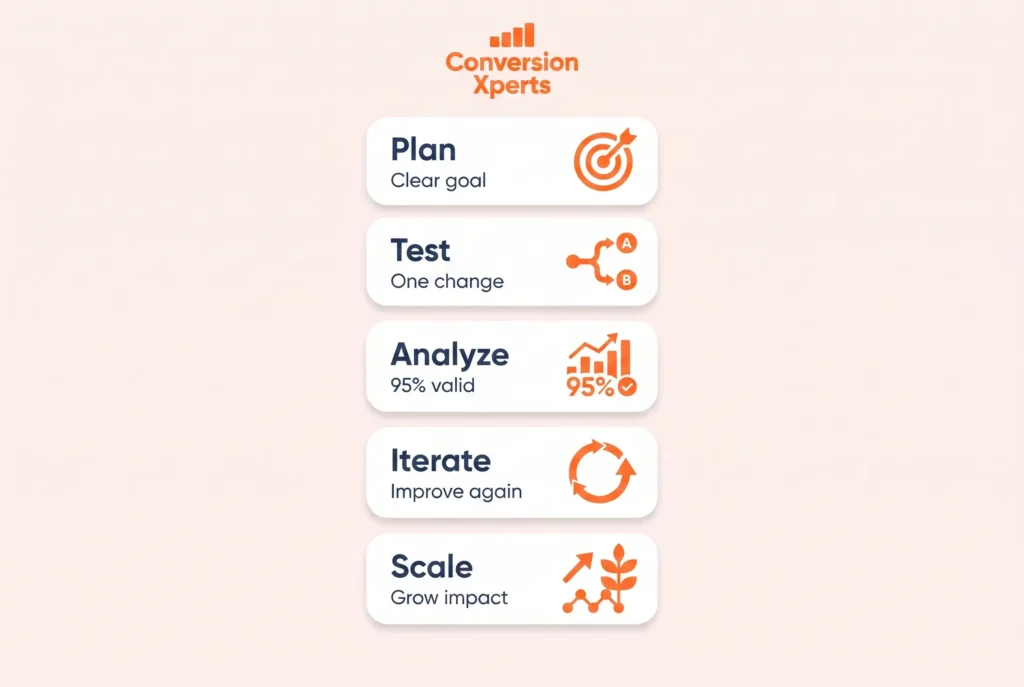
- Plan with precision: Define clear conversion goals and testable hypotheses before launching tests to ensure meaningful, actionable results.
- Focus on statistical significance: Run tests for full business cycles and collect sufficient data to reach 95% confidence levels before making decisions.
- Test systematically, not randomly: Prioritize high-traffic pages and test one variable at a time to accurately identify what drives performance improvements.
- Build a continuous experimentation culture: Document all results and iterate constantly—companies like Booking.com run 25,000 tests annually for competitive advantage.
- Small changes create big impact: Even minor improvements like increasing conversion from 2% to 2.5% represent a 25% revenue boost for your business.
Remember that A/B testing isn’t a one-time project but an ongoing process of optimization. Every test—whether it wins or loses—provides valuable insights about your users’ behavior and preferences, ultimately leading to better products and higher conversion rates.