How to Choose the Right Conversion Rate Optimization Agency for Your Business
Why Conversion Rate Optimization Matters More Than Ever in 2026
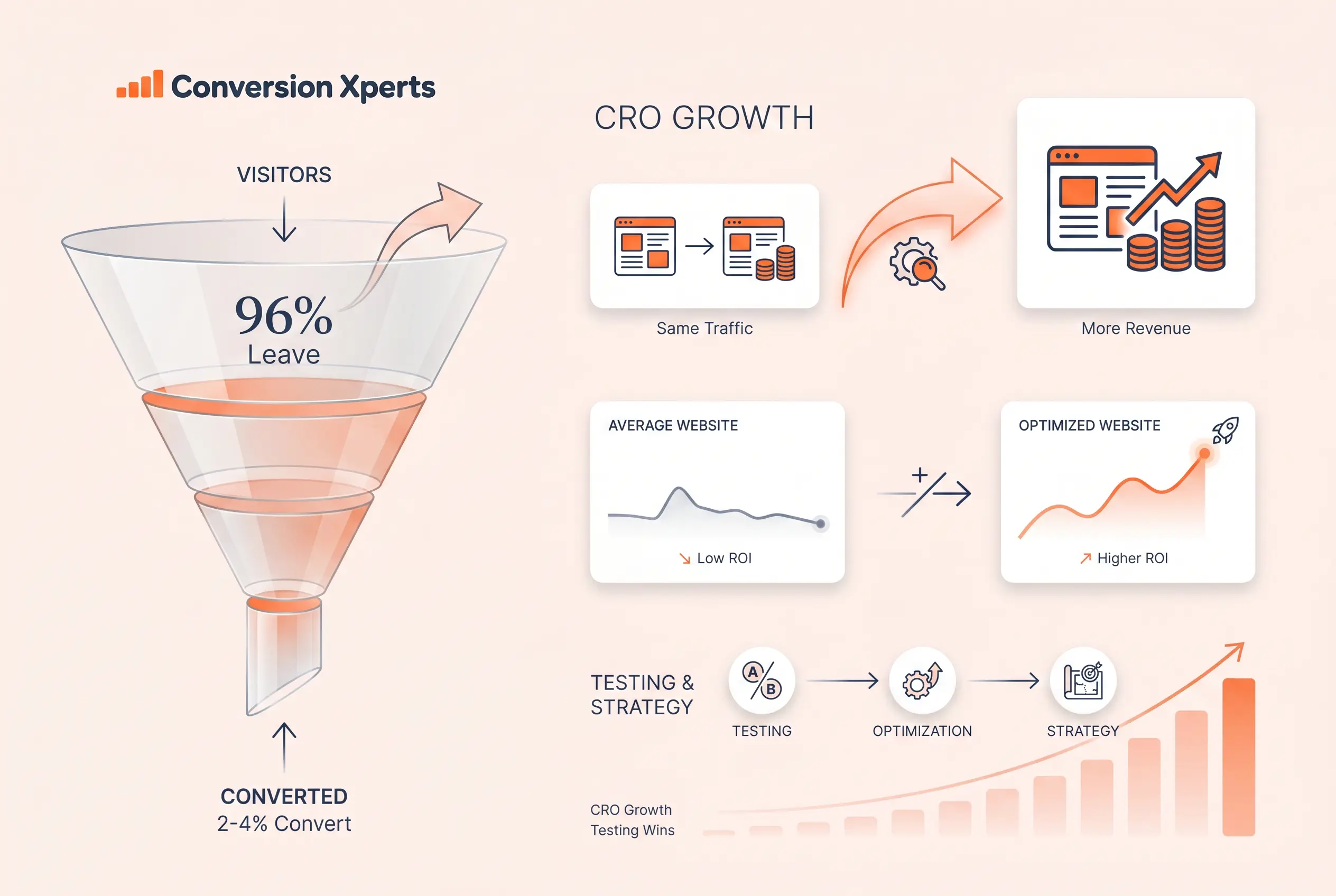
Most websites operate at a critical disadvantage without realizing it. While the average website converts only 2-4% of its visitors into paying customers, this means that between 96-98 out of every 100 visitors leave without taking any action. This represents a massive untapped opportunity for business growth.
The good news? You don’t have to accept these poor conversion rates. By partnering with a specialized Conversion Rate Optimization (CRO) agency, businesses are discovering they can dramatically increase revenue from the exact same traffic they’re already paying to attract.
In 2026, the most successful businesses understand a fundamental truth: getting traffic is only half the battle. Converting that traffic into paying customers is what separates industry leaders from struggling competitors. This comprehensive guide walks you through everything you need to know about CRO agencies, how they work, what to expect, and exactly how to choose the right partner for your business.
Part 1: Understanding Conversion Rate Optimization Agencies
What Exactly is a Conversion Rate Optimization Agency?
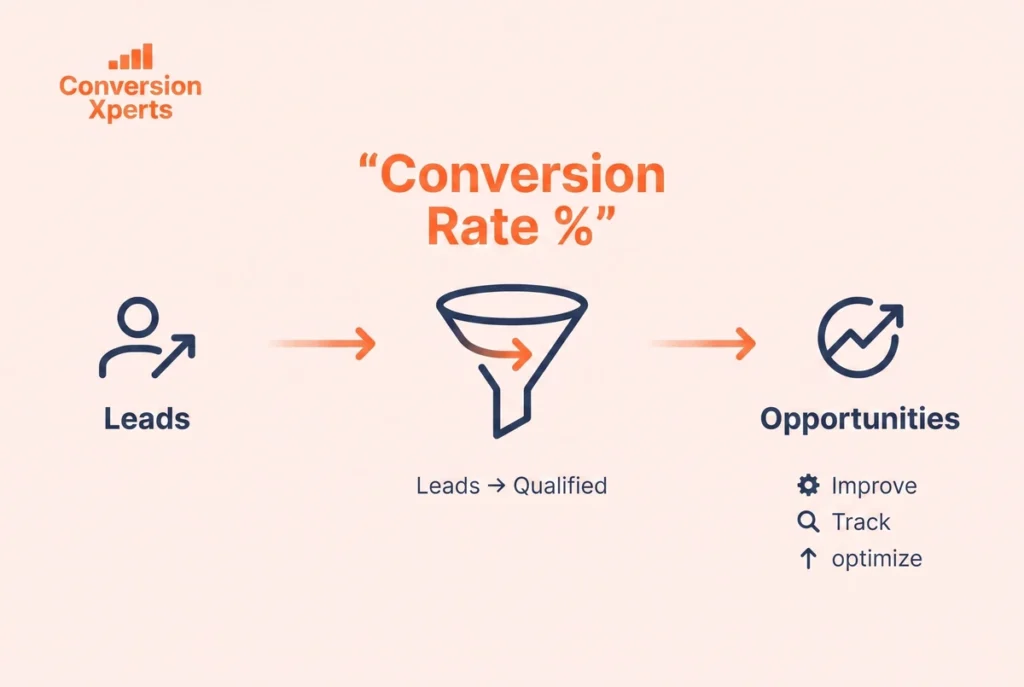
A Conversion Rate Optimization (CRO) agency is a specialized firm that focuses on one critical objective: converting more of your website visitors into paying customers without requiring you to increase your advertising budget.
These agencies work differently from traditional marketing firms. While marketing agencies excel at driving traffic to your website, CRO agencies maximize the value of every single visitor you already have.
Here’s what separates top CRO agencies from the rest:
Data-Driven Decision Making: The best conversion rate optimization companies never rely on guesses or assumptions. They implement rigorous testing methodologies, using real user behavior data to identify exactly why visitors aren’t converting. Every change they recommend is backed by statistical evidence and measurable results.
Comprehensive Analysis: CRO specialists examine every element of your website—from the overall user experience and navigation structure to individual button colors, headline copy, form fields, and page loading speeds. They understand that even small friction points can dramatically impact your bottom line.
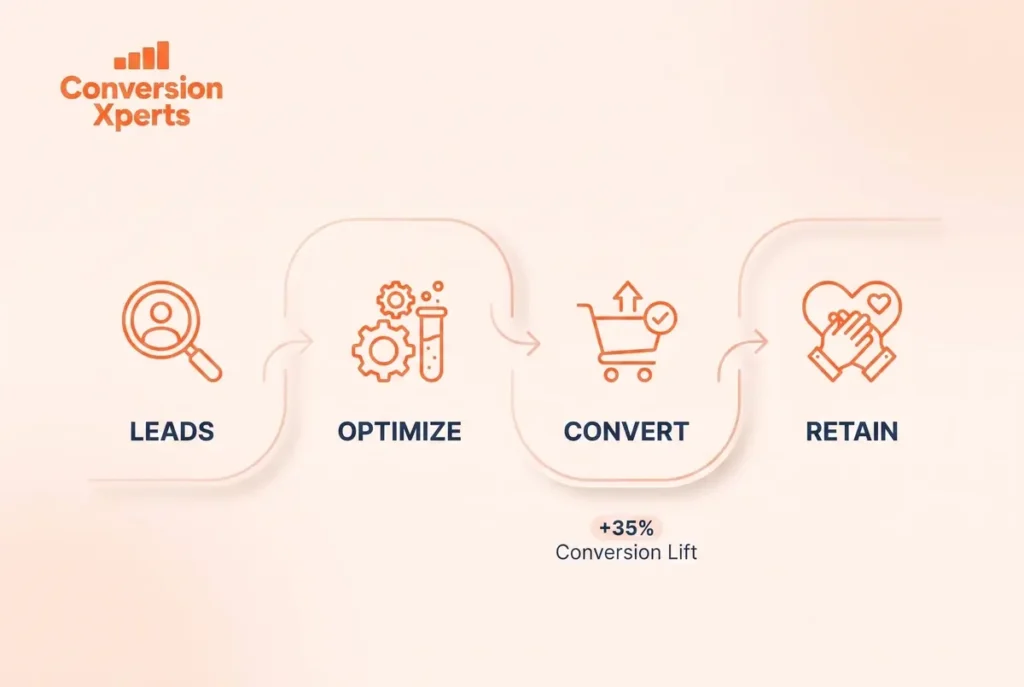
Continuous Improvement: Unlike one-off website redesigns, CRO is an ongoing process. The best agencies view your website as a living, breathing system that requires constant testing and optimization to maintain competitive advantage.
How CRO Agencies Create Real Business Impact
Let’s look at a concrete example to understand the power of professional CRO work:
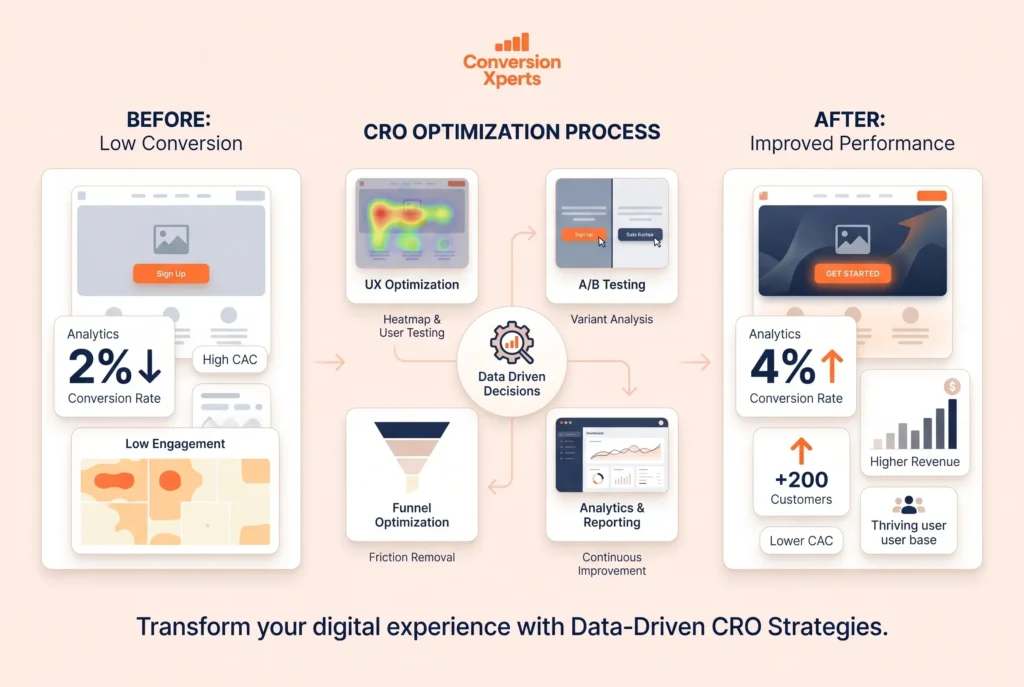
Scenario: You operate an e-commerce store receiving 10,000 visitors per month. Currently, your conversion rate sits at 2%, generating 200 customers monthly. You’re spending $10,000 on advertising to acquire these customers, meaning each customer costs $50 to acquire.
After CRO Optimization: A skilled CRO agency increases your conversion rate to 4%—a realistic improvement for many businesses. That same 10,000 visitors now converts to 400 customers. You’ve doubled your customer base without increasing your advertising spend by a single dollar.
The Financial Impact:
- Additional customers: 200 per month
- If average order value is $100: Additional revenue of $20,000 monthly
- Annual additional revenue: $240,000
- CRO agency cost (typical): $15,000-$20,000 monthly
- Net additional profit (year 1): $180,000 – $240,000
This is why leading CRO agencies report that their services generate some of the highest returns on investment of any marketing service. According to industry data, the best conversion rate optimization companies have collectively generated over $2 billion in additional sales for their clients.
Part 2: Why Your Business Needs CRO Services in 2026
The Rising Cost of Customer Acquisition
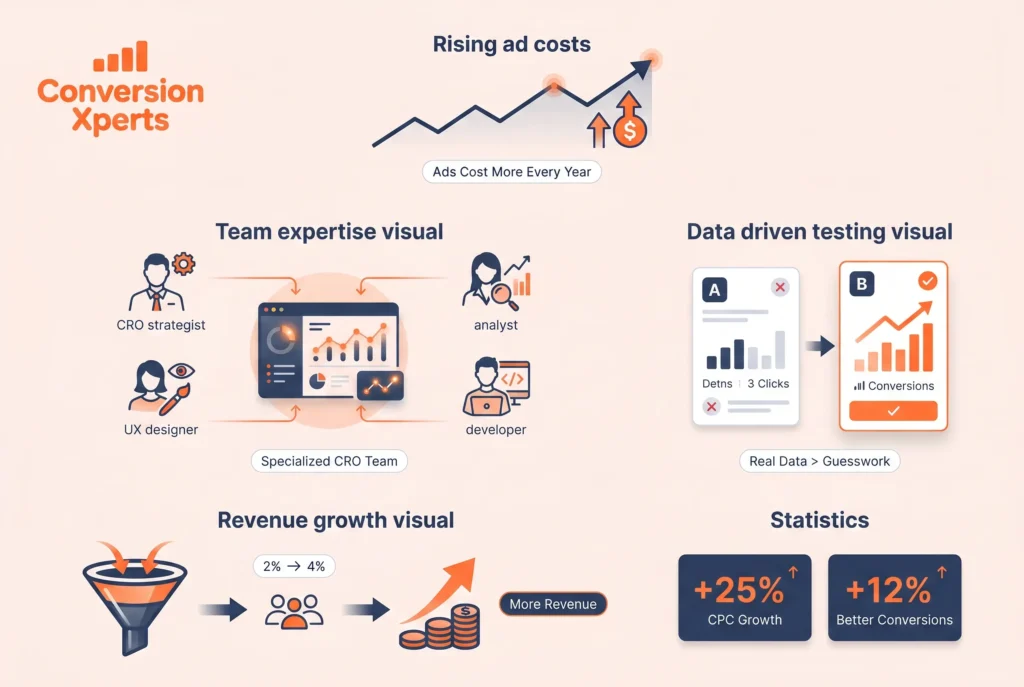
Every year, acquiring new customers costs more. Google Ads, Facebook Ads, LinkedIn Ads, and other paid advertising channels experience consistent price increases due to increased competition and platform algorithm changes. The cost per click for competitive keywords has increased by 15-25% year-over-year in many industries.
This creates a critical situation: You can’t afford to ignore the traffic you’re already paying for.
If your conversion rate remains static while customer acquisition costs rise, your profit margins shrink. CRO agencies solve this problem by helping you extract maximum value from every marketing dollar you spend.
You Lack the Specialized Skills In-House
Building an effective CRO team requires expensive specialists:
- CRO Strategists with expertise in consumer psychology and testing methodology
- Data Analysts who can interpret complex user behavior data
- UX/UI Designers who understand conversion principles
- Copywriters trained in persuasive messaging for specific conversion stages
- Front-End Developers who can implement and manage tests quickly
- Qualitative Researchers who conduct user interviews and usability testing
Hiring this team in-house typically costs $150,000-$300,000+ annually. A full-service CRO agency provides access to all these specialists for a fraction of that cost, plus they bring accumulated knowledge from working with dozens of clients across multiple industries.
Professional CRO Uses Real Data, Not Guesses
This is perhaps the most important distinction between amateur and professional approaches to optimization:
- Amateur approach: “I think visitors would respond better if we made the button red instead of blue”
- Professional CRO approach: “We ran a statistically valid A/B test showing that red converts 12% better than blue for our audience, with 95% confidence level”
The difference isn’t subtle—it’s the foundation of credibility and measurable results. Professional agencies invest in tools like Optimizely, Google Optimize, Convert, and VWO that enable sophisticated testing at scale. They understand statistical significance, sample size requirements, and how to avoid false positives.
Part 3: What Conversion Rate Optimization Agencies Actually Do
Comprehensive Website Audit and Analysis
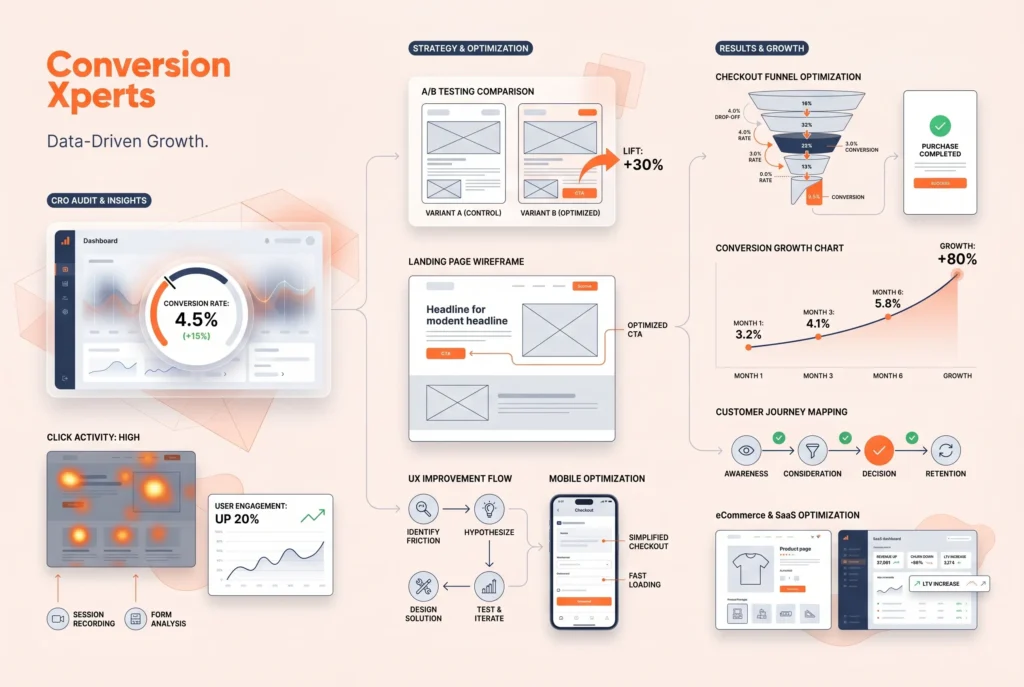
Every engagement with a reputable CRO agency begins with a thorough audit. This isn’t a surface-level review—it’s an intensive analysis covering:
Technical Performance Analysis:
- Page load speed across all devices (mobile, tablet, desktop)
- Core Web Vitals (Largest Contentful Paint, First Input Delay, Cumulative Layout Shift)
- Mobile responsiveness and usability
- Cross-browser compatibility
- SSL certificate validity and security signals
User Behavior Mapping:
- Where visitors enter your website
- Which pages have the highest exit rates (indicating potential problems)
- How long visitors spend on each page
- Scroll depth analysis (how far down pages users scroll)
- Click heatmaps showing which elements attract attention
Conversion Funnel Analysis:
- Identification of drop-off points in your sales process
- Comparison of funnel performance across traffic sources
- Analysis of mobile vs. desktop conversion rates
- Segment analysis (by location, device, traffic source, etc.)
Competitive Intelligence:
- Analysis of top competitors’ website structures
- Comparison of conversion elements (CTAs, forms, social proof, pricing presentation)
- Identification of industry best practices
- Benchmarking against industry conversion rate standards
Quick Wins Identification:
- Obvious problems that can be fixed immediately
- Low-hanging fruit that often includes broken forms, unclear messaging, or poor CTAs
Deep Customer Understanding and User Research
Understanding why visitors behave the way they do is fundamental to effective optimization. Top CRO agencies employ multiple research methodologies:
Qualitative User Research:
- Moderated user testing sessions: Real people attempt tasks on your website while researchers observe and ask clarifying questions
- User interviews: In-depth conversations with current customers and lost prospects to understand motivations and pain points
- Customer surveys: Targeted questions designed to identify barriers to conversion
- Session replay analysis: Watching actual user behavior videos to identify where people struggle
Quantitative User Research:
- Heat mapping: Visualization of where users click, move their mouse, and scroll
- Form analytics: Understanding which form fields cause abandonment
- Scroll depth tracking: Determining if users see important content
- Engagement metrics: Time on page, bounce rate, pages per session
Behavioral Segmentation:
- First-time visitors vs. returning customers
- Device type (mobile, tablet, desktop)
- Traffic source (organic, paid, referral, direct)
- Geographic location
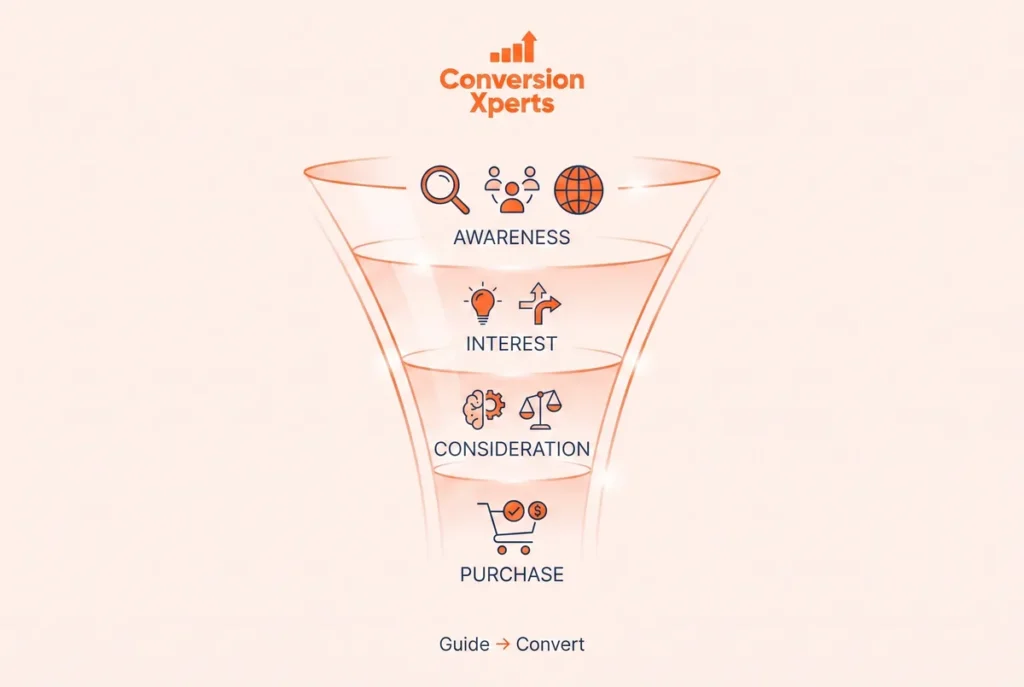
- Buyer stage (awareness, consideration, decision)
This research reveals critical insights: Maybe your mobile conversion rate is half your desktop rate. Perhaps visitors from Google ads have different needs than those from Facebook. Maybe your form requires too many fields, causing abandonment. These insights become the foundation for testing hypotheses.
A/B Testing and Multivariate Testing
This is where CRO agencies create measurable improvements. The best agencies don’t run tests haphazardly—they implement a systematic testing framework:
Test Planning Process:
- Hypothesis formation based on research insights
- Sample size calculations to ensure statistical validity
- Minimum test duration requirements (usually 1-2 weeks minimum)
- Clear success metrics and guardrails
What Gets Tested:
- Headline variations (different value propositions)
- Button copy (“Add to Cart” vs. “Buy Now” vs. “Get Started”)
- Button colors and placement
- Form field requirements and order
- Social proof elements (testimonials, reviews, security badges)
- Page layout and element hierarchy
- Product photography and video
- Pricing presentation and discount messaging
- Trust signals and guarantees
Advanced Testing Approaches:
- Multivariate testing: Simultaneously testing multiple elements to find optimal combinations
- Sequential testing: Running tests in sequence to build on winning variations
- Split testing across traffic sources: Different audiences may respond to different messaging
- Personalization testing: Showing different content to different segments
Top CRO agencies run 3-10 simultaneous tests, compounding improvements over time. After 12 months of systematic testing, cumulative gains typically reach 50-150% increases in conversion rates.
Landing Page Optimization
For businesses running paid advertising, landing page performance determines ROI. CRO agencies optimize landing pages by:
Message-to-Ad Alignment:
- Ensuring the landing page headline matches the ad headline
- Maintaining consistent messaging and visual style
- Matching user intent at each stage of the funnel
Above-the-Fold Optimization:
- Positioning the most compelling offer at the top of the page
- Clear value proposition that immediately resonates
- High-quality, relevant imagery or video
- Prominent call-to-action button
Trust Building Elements:
- Customer testimonials and case studies
- Industry certifications and awards
- Customer logos and trust badges
- Social proof indicators (number of customers, ratings, reviews)
- Clear company information and contact details
- Money-back guarantees or risk removal
Form Optimization:
- Reducing required form fields (every additional field reduces conversions by 5-10%)
- Intelligent form progression (multi-step forms for longer processes)
- Smart field validation
- Mobile-optimized form layouts
Mobile-First Design:
- With 73% of online shoppers now using mobile devices, mobile optimization isn’t optional
- Thumb-friendly button placement
- Reduced form friction on mobile
- Fast-loading mobile pages
- Clear mobile navigation
E-Commerce Specific Optimization
For online stores, CRO agencies focus on specific challenges unique to e-commerce:
Product Page Optimization:
- High-quality product photography and zoom functionality
- Detailed, benefit-focused product descriptions
- Clear product variants and selection
- Detailed specifications matching buyer questions
- Customer reviews prominently displayed
- Related product recommendations
- Stock level indicators (creating urgency when appropriate)
Checkout Process Improvement:
- Simplified checkout process (industry standard: 3 steps maximum)
- Guest checkout option (reducing registration friction)
- Clear progress indicators
- Security badges visible throughout
- Multiple payment options (credit card, PayPal, Apple Pay, Google Pay)
- Transparent shipping costs before final step
- Clear return policies
Cart Abandonment Solutions:
- 70-80% of shopping carts are abandoned before purchase
- Exit-intent popups with last-minute offers
- Email recovery campaigns
- Retargeting to abandoned cart visitors
- Analysis of why items are being abandoned
Average Order Value Optimization:
- Intelligent product recommendations
- Bundle offers and quantity discounts
- Free shipping thresholds encouraging larger orders
- Complementary product suggestions on product and checkout pages
Full-Site Optimization Strategies
Beyond individual pages, comprehensive CRO includes site-wide improvements:
Navigation Optimization:
- Simplified menu structure based on user behavior
- Improved search functionality with autocomplete
- Logical product categorization
- Breadcrumb trails helping users understand location
Content Optimization:
- Clearer, more benefit-focused copy
- Better headline hierarchy
- Improved readability (short paragraphs, bullet points, white space)
- Stronger calls-to-action throughout
Technical Performance:
- Page speed optimization (3-second load time targets)
- Image optimization and lazy loading
- Code minification
- Content Delivery Network (CDN) implementation
- Mobile performance optimization
Accessibility Improvements:
- WCAG compliance for users with disabilities
- Screen reader optimization
- Keyboard navigation support
- Sufficient color contrast
- Alt text for all images
Part 4: CRO Agencies vs. Other Service Providers
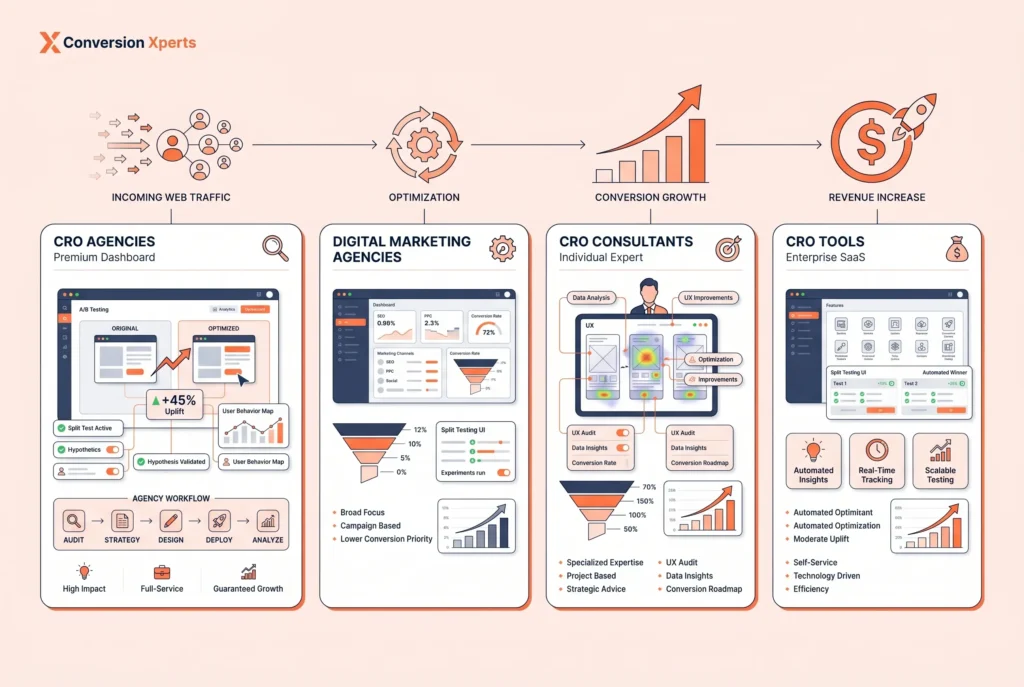
CRO Agencies vs. General Digital Marketing Agencies
Digital Marketing Agencies:
- Focus on driving traffic through SEO, paid ads, social media, content marketing
- Expertise in customer acquisition
- Measure success by traffic volume and lead generation
- Typically charge based on ad spend percentage or monthly retainer
CRO Agencies:
- Focus on converting existing traffic into customers
- Expertise in user psychology and behavior optimization
- Measure success by conversion rates and revenue per visitor
- Typically charge based on results or monthly optimization retainer
The Reality: Businesses need both. A marketing agency without CRO is like building a pipeline with no pump. A CRO agency without traffic generation is like having a perfect website that nobody visits. The best results come from integrating both services.
CRO Consultants vs. CRO Agencies
CRO Consultants:
- Individual practitioners or small teams
- Specialized expertise in specific areas
- Lower costs
- May lack bandwidth for multiple simultaneous tests
- Dependent on consultant availability
CRO Agencies:
- Dedicated teams with complementary skills
- Access to expensive optimization tools
- Ability to run 3-10 simultaneous tests
- Continuity even if a team member leaves
- Deeper industry experience across multiple clients
For most businesses, agencies provide better value due to their combination of skills and testing capacity.
CRO Tools vs. CRO Agencies
Testing Tools (Optimizely, Google Optimize, Convert, VWO):
- Enable A/B testing capability
- Provide analytics and heatmaps
- Automate test deployment
- Measure traffic and conversion data
What Tools Can’t Do:
- Identify what to test (requires research and strategy)
- Interpret results in business context
- Develop testing roadmaps
- Synthesize learning across tests
- Handle implementation complexity
This is why tool vendors emphasize partnering with experienced CRO professionals. The tools are necessary but not sufficient—expertise is what drives results.
Part 5: How to Choose the Best Conversion Rate Optimization Agency for Your Business
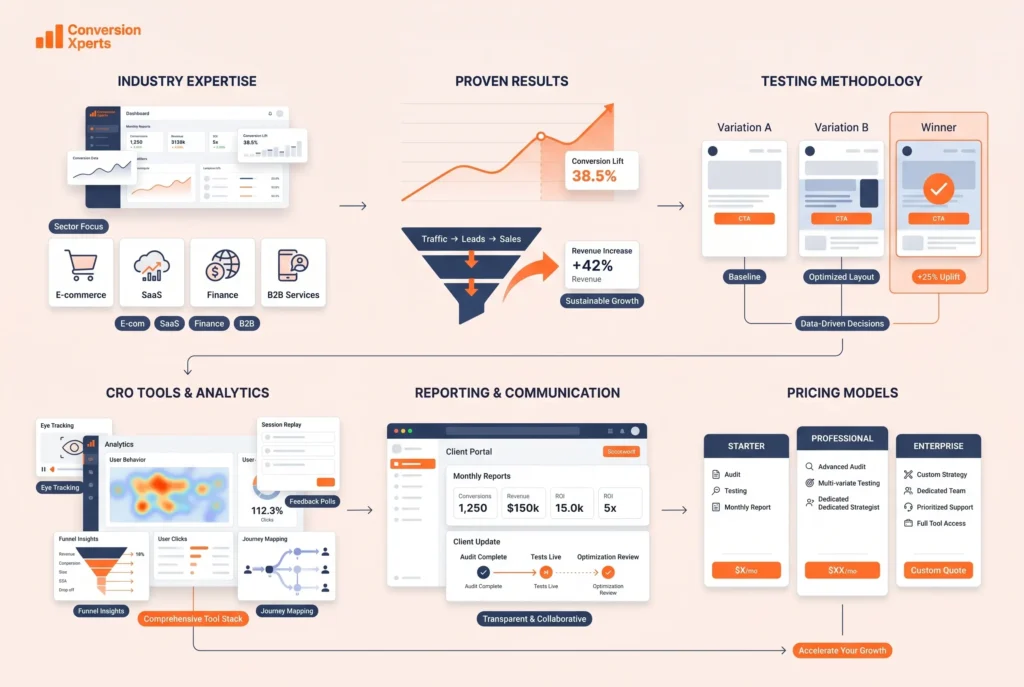
Criteria 1: Industry Experience and Vertical Expertise
Different business models require different optimization approaches. The best agencies develop deep expertise in specific verticals:
E-Commerce CRO Agencies:
- Understand product page optimization
- Specialized in checkout and cart abandonment
- Experience with platforms like Shopify, WooCommerce, BigCommerce, Magento
- Expertise in product images, descriptions, reviews, and pricing psychology
- Knowledge of industry benchmarks for e-commerce conversion rates
B2B Lead Generation Agencies:
- Focused on form optimization and lead quality
- Understanding of complex sales cycles
- Experience with contract value and deal size optimization
- Expertise in creating high-intent landing pages
- Sales funnel optimization skills
SaaS Conversion Agencies:
- Specialized in free trial optimization
- Understanding of activation metrics
- Expertise in improving trial-to-paid conversion rates
- Onboarding flow optimization
- Expansion revenue opportunities
Insurance and Financial Services:
- Understanding of complex buying decisions
- Expertise with compliance and regulatory requirements
- Trust-building optimization
- Quote form optimization
Look for an agency that has worked with businesses similar to yours. Case studies demonstrating success in your industry are particularly valuable.
Criteria 2: Proven Results and Transparent Reporting
Don’t trust promises—demand evidence. When evaluating CRO agencies, ask for:
Specific Performance Metrics:
- Percentage conversion rate increases achieved
- Range of results across different clients
- Time frame required to see results
- Before-and-after revenue impact
Case Studies with Details:
- Client business type and starting conversion rate
- Specific optimization strategies implemented
- Statistical validity of results
- Time period over which results were achieved
- Honest discussion of what worked and what didn’t
Client References:
- Direct contact with current clients
- Questions about agency communication quality
- Whether promised results were actually delivered
- Overall satisfaction with the partnership
Red Flags:
- Agencies guaranteeing specific conversion rate increases (results vary)
- Refusal to provide client references
- Unwillingness to discuss methodology
- Promises of results before analyzing your website
- Vague case studies without specific numbers
Criteria 3: Clear Testing Methodology and Process
The best agencies transparently explain their process:
Month 1: Discovery and Research
- Website audit and analysis
- User behavior research
- Customer interviews
- Competitive analysis
- Identification of quick wins
- Goal setting and success metrics
- Testing roadmap creation
Month 2-3: Testing and Learning
- Hypothesis-driven test initiation
- Simultaneous multiple tests
- Real-time monitoring
- Weekly optimization meetings
- Documentation of learnings
- First round of results analysis
Month 4+: Scaling and Expansion
- Analysis of cumulative impact
- Expansion testing to new areas
- Building on successful experiments
- Continuous improvement cycles
- Quarterly strategy reviews
Success Criteria to Discuss:
- How many tests per month?
- How many tests typically succeed? (Should be ~50%)
- How long before seeing meaningful results?
- What happens if a test fails?
- How are results validated statistically?
Criteria 4: Technology Stack and Tools
Top CRO agencies use professional-grade tools:
Testing Platforms:
- Optimizely or Convert (enterprise A/B testing)
- Google Optimize (WordPress-based testing)
- VWO (affordable but capable testing)
- Unbounce or Instapage (landing page builders with built-in testing)
Analytics and Insights:
- Google Analytics 4 (traffic and conversion tracking)
- Mixpanel or Amplitude (advanced behavioral analytics)
- Hotjar or Crazy Egg (heatmaps and session recording)
- Lucky Orange or FullStory (session replay and analytics)
User Research:
- UserTesting or TryMyUI (remote user testing)
- SurveySparrow or Typeform (customer surveys)
- Formstack or Qualtrics (advanced survey tools)
Integration Capabilities:
- CRM integration (HubSpot, Salesforce)
- Email platform integration
- Ecommerce platform integration
- Custom API connections
Don’t get distracted by tool proliferation—what matters is that agencies use tools appropriately for your specific situation.
Criteria 5: Communication and Transparency
You need an agency that keeps you informed:
Standard Reporting Should Include:
- Weekly test status updates
- Monthly performance reports
- Explanation of results in business context (not just statistical data)
- Recommendations for next testing phases
- ROI calculations showing impact on revenue
Communication Expectations:
- Primary contact who knows your business
- Designated communication channel and response time
- Regular strategy meetings (weekly or bi-weekly)
- Quarterly business reviews discussing broader strategy
- Easy access to test results and analytics
Questions to Ask:
- Who will be my primary contact?
- How often will we communicate?
- What’s the response time for questions?
- How do you report results to clients?
- Can we schedule regular check-in meetings?
Criteria 6: Pricing Models and Value Assessment
CRO agencies use different pricing approaches:
Monthly Retainer Model:
- Typical range: $5,000-$50,000+ per month
- Best for: Ongoing optimization and continuous testing
- Advantages: Predictable costs, committed improvement
- Disadvantages: Requires monthly budget
Results-Based Pricing:
- Agency shares percentage of revenue increases
- Typical range: 20-40% of revenue lift
- Best for: Results-focused partnerships
- Advantages: Alignment with business outcomes
- Disadvantages: May incentivize aggressive optimization over sustainable testing
Project-Based Pricing:
- Fixed price for specific scope of work
- Typical range: $10,000-$50,000+ per project
- Best for: One-time optimization initiatives
- Disadvantages: May not address ongoing optimization needs
Hybrid Models:
- Base retainer plus performance bonus
- Typical range: $5,000 base + 10-20% of revenue lift
Evaluating Value: Remember that CRO is an investment with quantifiable returns. A $10,000 monthly investment should generate at minimum $30,000+ in additional revenue within 3-6 months to be worthwhile.
Part 6: Geographic Considerations in Choosing Your CRO Partner
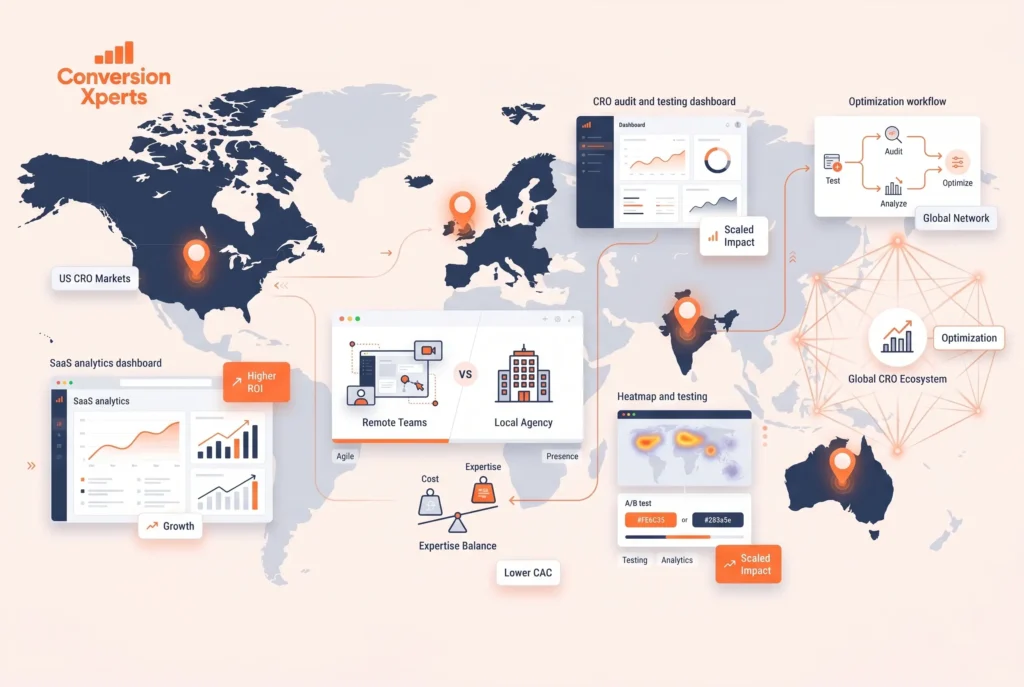
Top CRO Markets by Region
United States
Major Tech Hubs:
- New York City CRO Agencies: Specializing in fashion, finance, luxury goods, and media. Top agencies leverage the city’s concentration of ecommerce and DTC brands. Best for: High-budget optimization, complex multi-channel campaigns.
- San Francisco Bay Area CRO Agencies: Software as a Service (SaaS), technology, and venture-backed companies. Expertise in B2B optimization and free trial conversion. Best for: Tech-native companies, SaaS platforms, growth-stage startups.
- Austin CRO Services: Growing ecosystem of startup-focused agencies. Expertise in founder-led business optimization. Cost structure typically 20-30% below coastal cities. Best for: Early-stage companies, bootstrapped businesses.
- Seattle CRO Agencies: Tech and ecommerce concentration. Expertise in subscription models and membership optimization. Best for: Subscription businesses, technology products.
Southern United States:
- Miami: Serving Latin American markets and tourism-focused businesses. Bilingual expertise and cross-border optimization. Best for: International expansion, Latin American market entry.
- Dallas: Enterprise B2B expertise. Understanding of manufacturing, healthcare, and software sales. Higher average deal values. Best for: B2B enterprises, complex sales cycles.
- Houston: Energy sector specialization. Healthcare and industrial optimization. Best for: Oil and gas, energy, healthcare businesses.
- Atlanta: Growing tech scene. Retail optimization focus. Regional expertise. Best for: Southeastern US market focus.
Midwest:
- Chicago: Manufacturing and B2B expertise. Strong enterprise experience. Best for: B2B manufacturing, industrial sales.
- Denver: Tech and outdoor industry focus. Cost structure lower than coasts. Best for: Outdoor brands, adventure tech companies.
- Minneapolis: Retail and healthcare specialization. Best for: Retail businesses, healthcare providers.
- Columbus: Education and government sector focus. Best for: Educational institutions, government technology.
West Coast:
- Portland: Creative-focused agencies. E-commerce and sustainability brand expertise. Best for: Creative brands, sustainable/eco-conscious businesses.
- Phoenix: Rapidly growing market. Competitive pricing with quality expertise. Best for: Growing companies wanting cost-efficiency.
- San Diego: Tourism, biotech, and healthcare focus. Best for: Tourism, healthcare, biotech companies.
- Sacramento: Government and agriculture sector focus. Best for: Agricultural businesses, government contracts.
International CRO Services
United Kingdom:
- GDPR and European data privacy expertise
- Understanding of European customer psychology
- Expertise in UK and EU markets
- Quality comparable to US agencies with European market knowledge
- Typical cost: £5,000-£30,000 monthly
India-Based CRO Agencies:
- Significant cost advantages (40-60% lower than US)
- Strong technical implementation teams
- Round-the-clock availability across time zones
- Best suited for: Implementation-heavy work, technical optimization
- Caution: Ensure sufficient strategic oversight and cultural understanding of your market
Australia:
- Asian-Pacific market expertise
- Understanding of Australian and New Zealand markets
- Growing tech and ecommerce expertise
- Good time zone overlap for North American businesses
- Typical cost: Similar to US pricing
Canada:
- Similar to US market but often with lower costs
- Strong bilingual (English/French) expertise
- Regulatory familiarity with North American requirements
Emerging Markets:
- Philippines, Brazil, Ukraine showing rising CRO expertise
- Significant cost advantages
- Risk: Quality variability, communication challenges
Remote vs. Local Agencies: What Actually Matters
The traditional assumption that you need a local agency is increasingly outdated:
Advantages of Remote/Distributed Agencies:
- Access to specialized expertise regardless of location
- 24-hour availability across time zones for global businesses
- Often lower costs
- Diverse team perspective on user behavior
- Proven ability to work with clients worldwide
When Location Might Matter:
- Your business is local/regional (restaurant, retail, local services)
- You prefer in-person meetings and relationship building
- You need rapid response times in your timezone
- You’re building a long-term advisory relationship
Reality Check: The world’s best CRO expertise isn’t concentrated in any single city. Top agencies exist in every region and deliver excellent results remotely. Many businesses get superior results working with specialized remote agencies compared to mediocre local options.
Part 7: Types of CRO Agencies and Their Specializations
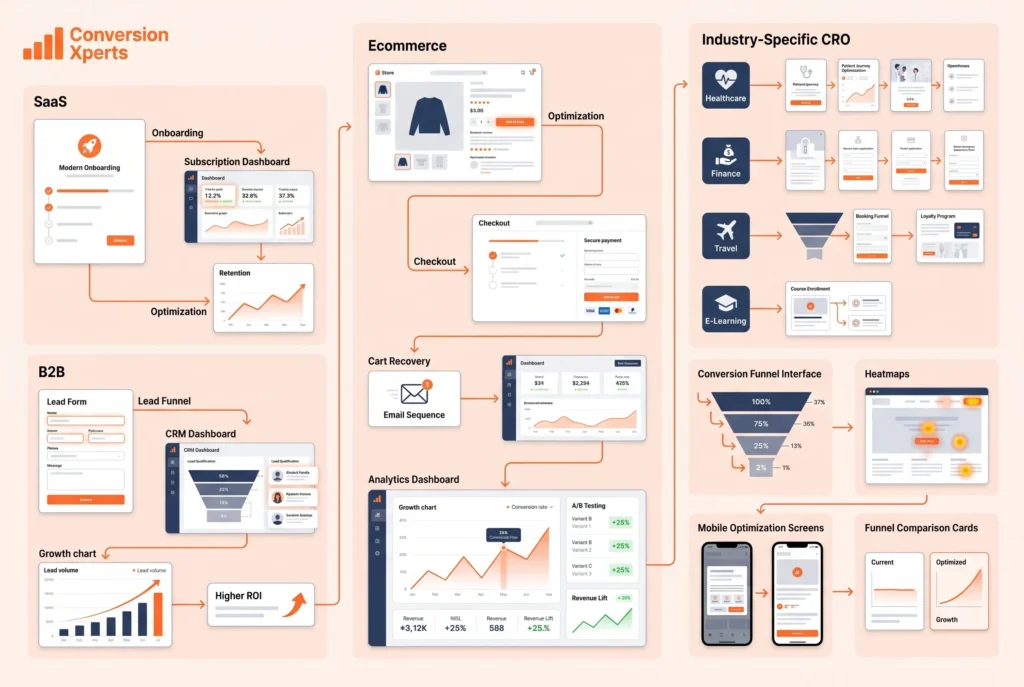
E-Commerce Conversion Rate Optimization Agencies
Specific Services:
- Product page optimization (photography, descriptions, variants)
- Shopping cart analysis and abandonment reduction
- Checkout flow simplification
- Cross-sell and upsell optimization
- Review and rating system optimization
- Shipping and delivery messaging optimization
Platform Expertise:
- Shopify CRO (most popular platform for agencies)
- WooCommerce optimization
- BigCommerce specialization
- Magento for enterprise
- Custom ecommerce platforms
Key Metrics Tracked:
- Average order value
- Cart abandonment rate
- Product return rate
- Customer lifetime value
- Repeat purchase rate
Typical Results: 15-50% increase in average order value over 6 months
B2B Lead Generation and Sales Optimization
Specific Services:
- Landing page optimization for different buyer personas
- Form optimization and lead qualification
- Demo request optimization
- Sales collateral optimization
- Lead nurturing automation
- Sales funnel analysis
Focus Areas:
- Reducing friction in complex B2B sales processes
- Improving lead quality over quantity
- Optimizing for sales team conversion
- Account-based marketing support
- Content marketing for conversion
Key Metrics Tracked:
- Lead volume and quality
- Cost per qualified lead
- Lead-to-pipeline conversion
- Average deal size
- Sales cycle length
Typical Results: 25-75% improvement in qualified lead generation
SaaS and Software Company Optimization
Specific Services:
- Free trial signup page optimization
- Onboarding flow improvement
- Feature discovery and adoption
- Trial-to-paid conversion
- Upgrade and expansion revenue optimization
- Churn reduction strategies
Platform Experience:
- Stripe integration optimization
- In-app messaging and onboarding
- Subscription flow optimization
- User engagement and retention
Key Metrics Tracked:
- Free trial signup rate
- Trial-to-paid conversion rate
- Activation rate (time to first valuable action)
- Monthly recurring revenue (MRR) growth
- Customer lifetime value
- Churn rate
Typical Results: 20-60% improvement in trial-to-paid conversion
Industry-Specific CRO Agencies
Financial Services and Insurance:
- Quote form optimization
- Trust-building and compliance expertise
- Complex decision support
- Multi-step qualification processes
Healthcare Providers:
- Appointment scheduling optimization
- Patient form simplification
- Telehealth platform optimization
- Insurance verification flows
Hospitality and Travel:
- Booking flow optimization
- Review and rating systems
- Dynamic pricing presentation
- Seasonal optimization
E-Learning and Online Education:
- Course signup optimization
- Learning outcome communication
- Trial access optimization
- Payment plan presentation
Part 8: What Happens When You Partner With a CRO Agency
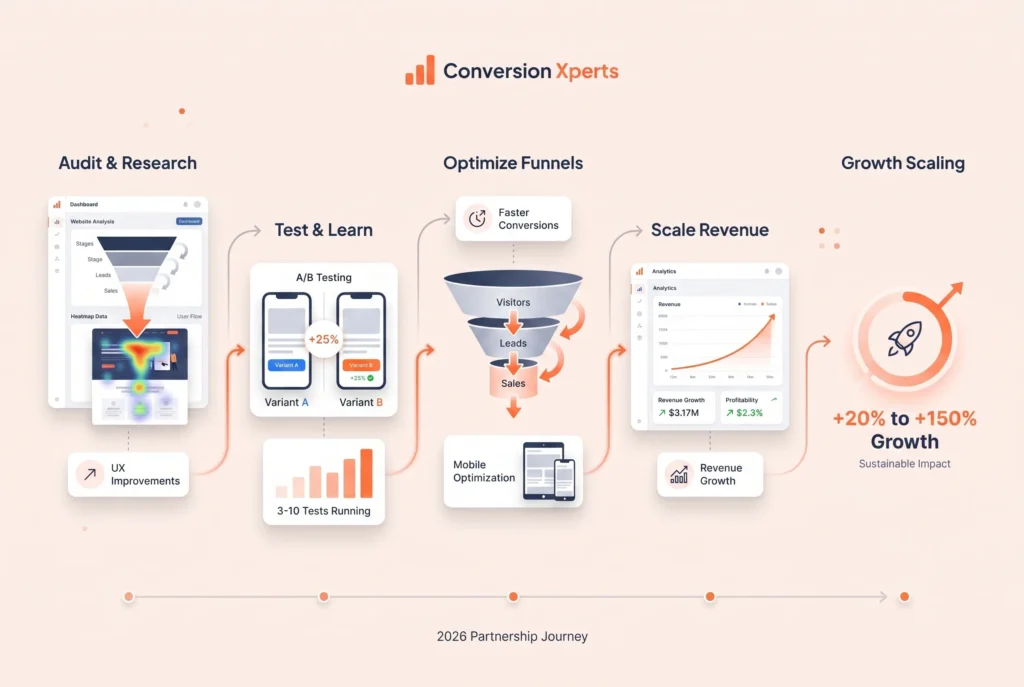
Weeks 1-2: Discovery Phase
During this period, the agency:
- Gains complete access to your website analytics
- Reviews historical conversion data and trends
- Interviews key stakeholders about business goals
- Identifies current pain points and opportunities
- Conducts website audit (technical, UX, design)
- Begins user behavior analysis
Your Responsibilities:
- Provide complete access to analytics and business data
- Schedule interviews with relevant team members
- Share customer feedback and support tickets
- Discuss business goals and objectives
- Clarify budget and timeline expectations
Expected Deliverables:
- Initial audit report
- Identified quick wins
- Preliminary testing roadmap
- Success metrics agreement
Weeks 3-4: Research and Planning
Agency Activities:
- Conduct user interviews and usability testing
- Analyze user session recordings
- Complete competitive analysis
- Develop detailed testing hypotheses
- Create prioritized testing roadmap
- Set up analytics and tracking
Your Involvement:
- Participate in user interviews (observing real customer feedback)
- Provide competitive context
- Review and approve testing roadmap
- Ensure proper analytics setup
- Discuss implementation constraints
Deliverables:
- Research findings report
- Testing roadmap (prioritized by impact potential)
- Baseline metrics established
- Tracking setup verification
Month 2+: Continuous Testing and Optimization
Weeks 5-8:
- Launch initial testing batch (typically 3-5 simultaneous tests)
- Daily monitoring of test health
- Real-time issue resolution
- Weekly progress updates
- Learning documentation
Weeks 9-12:
- First wave of results analysis
- Winning variations locked and implemented
- Learnings applied to next batch of tests
- Testing roadmap updates
- ROI calculation for month 2
Monthly Thereafter:
- Continuous test launches (3-10 simultaneous tests)
- Incremental optimization
- Cumulative results tracking
- Quarterly strategy reviews
- Expansion into new areas of optimization
Month 3-6: Accelerating Results
What to Expect:
- Cumulative conversion rate improvements becoming obvious
- Multiple winning tests generating compounding effects
- Testing process becoming more efficient
- Deeper insights revealing larger opportunities
- Expansion testing to new site sections
Typical Timeline:
- Month 1: Setup and research (minimal conversion improvement)
- Month 2: First tests running (potential 0-5% improvement)
- Month 3: Results accumulating (potential 5-15% improvement)
- Month 6: Significant cumulative gains (potential 20-50% improvement)
- Month 12: Substantial transformation (potential 50-150% improvement)
These timelines vary based on traffic volume, test quality, and website baseline.
Part 9: Measuring Success and ROI From CRO Services
Primary Success Metrics
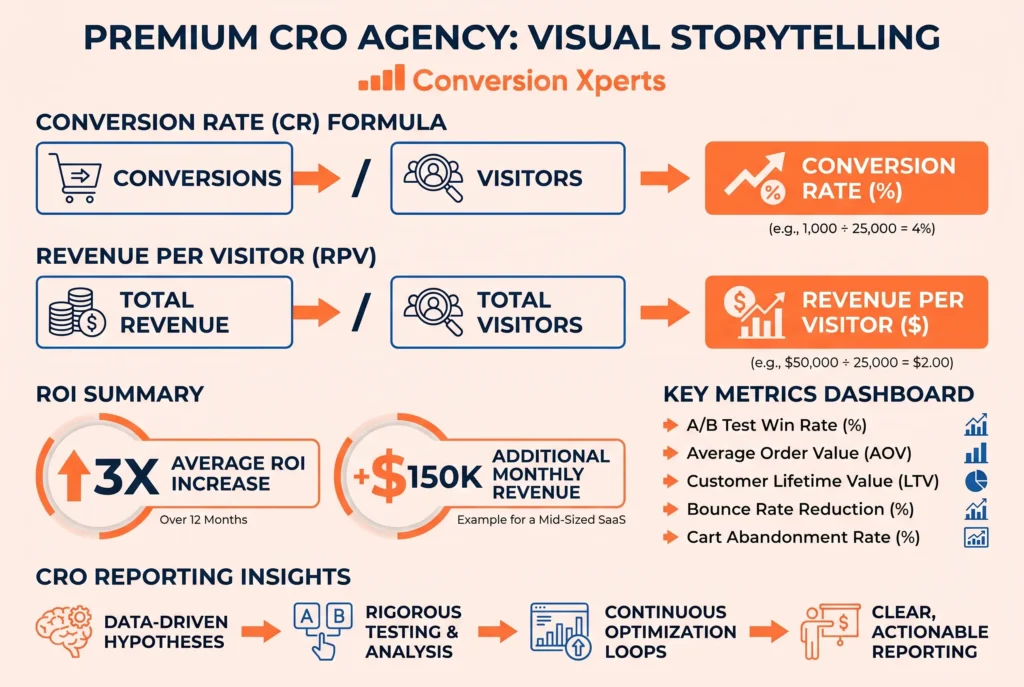
Conversion Rate:
- Definition: Percentage of visitors who complete desired action
- Formula: (Conversions / Total Visitors) × 100
- Example: 250 purchases / 10,000 visitors = 2.5% conversion rate
- Target: Industry-specific, but 3-5% is healthy for most sectors
Revenue Per Visitor (RPV):
- Definition: Total revenue divided by total visitors
- Formula: Total Revenue / Total Visitors
- Importance: True measure of visitor value
- More important than conversion rate alone
Customer Acquisition Cost (CAC):
- Definition: Cost to acquire one customer
- Formula: Total Marketing Spend / New Customers
- Importance: Understanding sustainability of growth
- Should decrease as conversion rates improve
Average Order Value (AOV):
- Definition: Average revenue per transaction
- Formula: Total Revenue / Total Orders
- Importance: Cross-sell and upsell opportunities
- Often increases through optimization
Secondary Performance Indicators
Bounce Rate:
- Percentage of visitors who leave without interaction
- Lower is better (depending on page type)
- Important for understanding engagement
Pages Per Session:
- Average number of pages viewed per visitor
- Higher engagement often correlates with conversion
Time on Page:
- How long visitors spend on each page
- Context-dependent (brief for clear pages, longer for complex)
- Important for content comprehension
Cart Abandonment Rate (E-commerce):
- Percentage of shopping carts abandoned before purchase
- Industry average: 70-75%
- Significant optimization opportunity
Form Abandonment Rate:
- Percentage of visitors abandoning forms mid-completion
- Higher abandonment on earlier fields indicates issues
- Each additional field typically reduces completion 5-10%
ROI Calculation for CRO Services
Simple ROI Calculation:
Starting Point:
- Monthly visitors: 10,000
- Current conversion rate: 2%
- Average order value: $100
- Monthly revenue: $20,000
- Monthly CRO cost: $10,000
After 6 Months of CRO:
- Monthly visitors: 10,000 (same)
- New conversion rate: 3.5%
- Average order value: $110 (after AOV optimization)
- Monthly revenue: $38,500
- Monthly CRO cost: $10,000
- Net monthly increase: $18,500
Year 1 ROI:
- Total CRO investment: $60,000 (6 months × $10,000)
- Additional revenue from months 1-6: $111,000
- Additional revenue from months 7-12: $222,000
- Total additional revenue year 1: $333,000
- Net profit: $273,000
- ROI: 455%
This demonstrates why CRO typically generates the highest ROI of any marketing service.
Reporting and Dashboard Metrics
Standard Agency Reports Include:
- Monthly revenue lift attribution
- Test summary and results
- Key insights and learnings
- Upcoming testing focus areas
- Competitive positioning updates
- Stakeholder visibility dashboard
Metrics Dashboard Should Show:
- Real-time conversion rate
- Revenue per visitor trends
- Cumulative lift attribution
- Test pipeline and status
- Individual test results
- Segment performance
Part 10: Common CRO Mistakes to Avoid
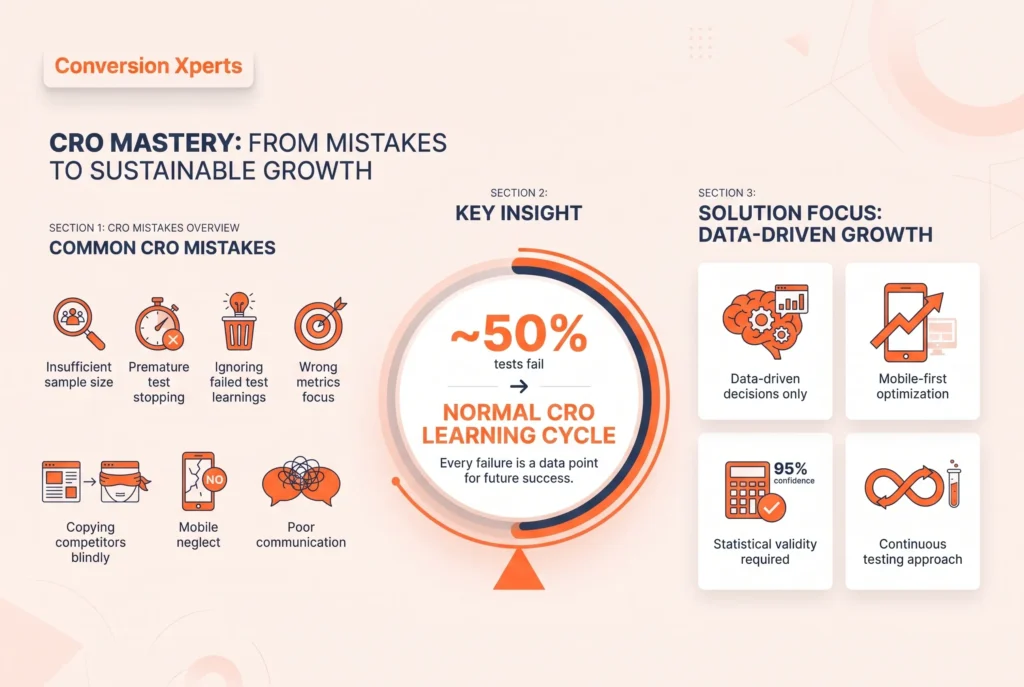
Mistake 1: Insufficient Test Sample Size
The Problem: Running tests with too little traffic leads to false conclusions. Statistical significance requires adequate sample sizes.
The Solution:
- Minimum 100-200 conversions per variation
- For low-conversion sites: Test for minimum 2 weeks
- Use power calculators to determine required sample size
- Let agencies handle statistical validation
Mistake 2: Premature Test Conclusion
The Problem: Stopping tests too early because you’re impatient leads to incorrect conclusions and wasted effort.
The Solution:
- Establish minimum test duration before starting (typically 1-2 weeks)
- Let statistical significance determine conclusion, not predetermined timeline
- Account for day-of-week effects
- Account for seasonal patterns in data
Mistake 3: Learning Nothing From Failed Tests
The Problem: Agencies or businesses that treat failed tests as waste miss valuable insights.
The Reality: ~50% of well-designed tests should fail. That’s normal and expected. Each failure teaches valuable lessons about your customers.
The Solution:
- Document all test results, winners and losers
- Analyze why tests failed
- Use failures to inform next testing phase
- Build on cumulative learning
Mistake 4: Focusing on Wrong Metrics
The Problem: Optimizing conversion rate while ignoring profit, AOV, or customer quality.
Example:
- Reducing form fields increases conversion rate but attracts unqualified leads
- Aggressive discounting increases volume but destroys margins
The Solution:
- Align optimization with business objectives (profit, not just volume)
- Track full-funnel metrics
- Optimize for revenue and profit, not just conversion
Mistake 5: Copying Competitor’s Solutions Blindly
The Problem: Assuming what works for competitors will work for you.
Reality: Different audiences, different products, different business models require different optimization approaches.
The Solution:
- Use competitive analysis as inspiration, not blueprint
- Conduct your own user research
- Test variations based on your specific audience insights
- Build testing roadmap around your unique situation
Mistake 6: Inconsistent Traffic or External Variables
The Problem: Marketing campaigns launching mid-test, seasonal changes, or traffic fluctuations skew results.
The Solution:
- Coordinate with marketing team on campaign timing
- Account for seasonal patterns
- Run tests during normal traffic conditions
- Control for external variables
Mistake 7: Neglecting Mobile Optimization
The Problem: 60-80% of traffic is mobile, yet many businesses under-optimize mobile experiences.
The Solution:
- Test mobile and desktop experiences separately
- Design mobile-first
- Ensure forms work easily on mobile
- Test button size and spacing for touch
Mistake 8: Poor Communication and Partnership
The Problem: Misalignment between business needs and CRO agency focus leads to poor results.
The Solution:
- Establish clear communication channels
- Align on metrics and success criteria
- Regular strategy reviews
- Transparent discussion of results and next steps
Part 11: 2026 Trends in Conversion Rate Optimization
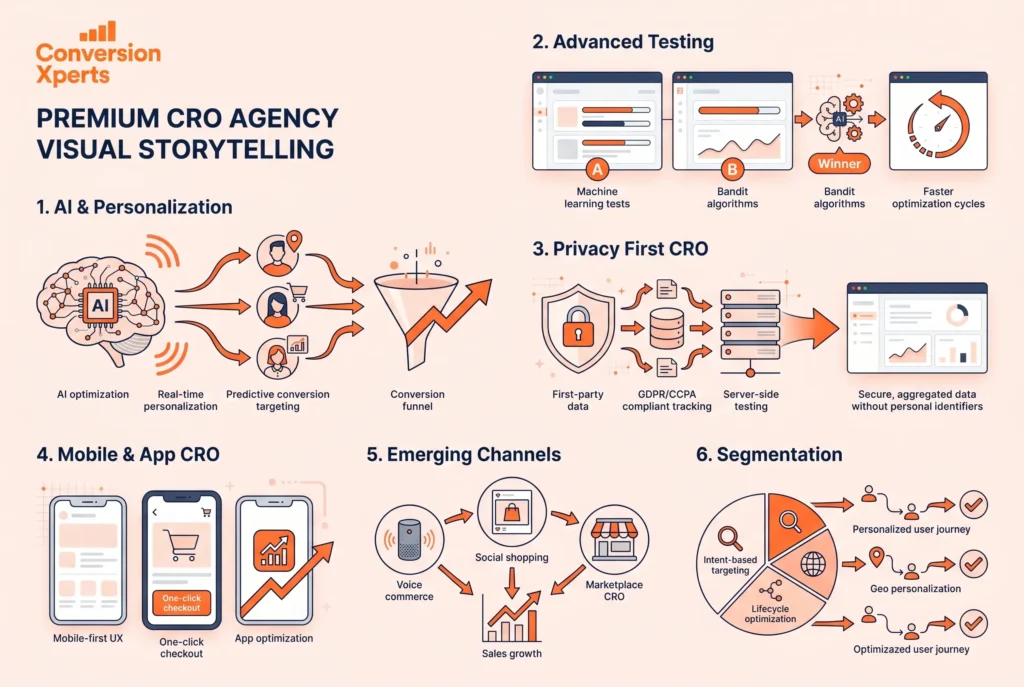
Artificial Intelligence and Personalization at Scale
AI is revolutionizing CRO by enabling true personalization:
- AI-powered content personalization: Different messages for different audience segments in real-time
- Predictive analytics: AI identifying which visitors are most likely to convert
- Dynamic pricing: Algorithms adjusting prices based on purchase probability
- Chatbot optimization: AI-powered customer service improving conversion rates
Impact: Companies implementing AI-driven personalization report 15-25% conversion rate improvements.
Multivariate and Machine Learning Testing
Beyond traditional A/B testing:
- Bandit algorithms: Real-time test optimization, automatically shifting traffic to better performers
- Predictive testing: Machine learning algorithms predicting winners before full test completion
- Combinatorial testing: Automatically finding optimal combinations of elements
Impact: Faster learning cycles and more efficient optimization.
Privacy-First Optimization (GDPR, CCPA)
Stricter privacy regulations are forcing new approaches:
- First-party data focus: Relying on direct customer data, not cookies
- Server-side testing: Test deployment in privacy-friendly ways
- Consent-based personalization: Balancing personalization with privacy
- Behavioral analysis without tracking: Inferring behavior from interaction patterns
Impact: Privacy-compliant optimization is now table stakes.
Mobile-First and App Optimization
Mobile’s dominance requires mobile-first strategies:
- App store optimization: Like SEO, but for apps
- In-app personalization: Optimizing user experience within apps
- Progressive web apps: Web experiences feeling like native apps
- Mobile payment optimization: One-click purchasing and digital wallets
Impact: Websites performing well on mobile see 2-3x higher conversion rates.
Voice Commerce and Emerging Channels
New conversion opportunities beyond web:
- Voice shopping: Optimizing for Alexa, Siri, Google Assistant
- Social commerce: Direct purchasing from social platforms
- Marketplace optimization: Optimizing for Amazon, eBay, Etsy
- Progressive web apps: App-like experiences without app downloads
Impact: Brands ignoring emerging channels miss growth opportunities.
Audience Segmentation and Behavioral Targeting
Sophisticated segmentation enables precise optimization:
- Intent-based segmentation: Showing different experiences based on user intent
- Lifecycle stage optimization: Different messaging for new vs. loyal customers
- Device/browser optimization: Tailoring experience to user’s device
- Geo-specific optimization: Location-based personalization and messaging
Impact: Properly segmented optimization approaches perform 30-50% better.
Part 12: Strategic Considerations for 2026
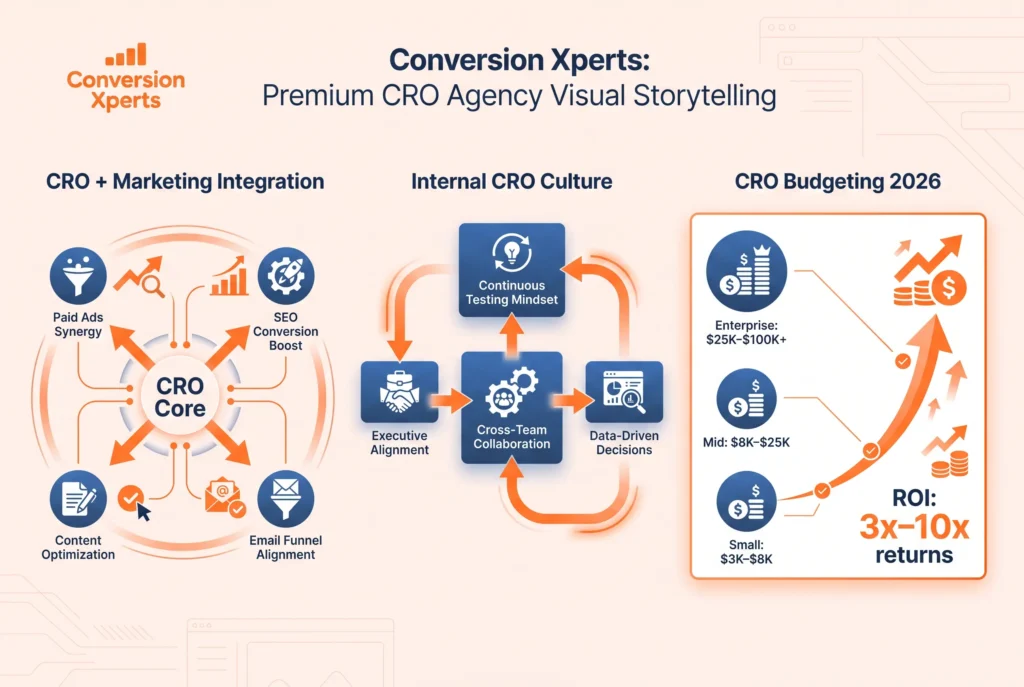
Integrating CRO With Your Overall Marketing Strategy
CRO + Paid Advertising:
- Better landing pages increase ad ROI dramatically
- Improved conversion rates reduce customer acquisition cost
- Testing landing pages directly improves ad performance
- Feedback loop: CRO insights inform ad targeting
CRO + SEO:
- Organic traffic should convert better than paid (lower friction)
- CRO identifies and fixes barriers to organic traffic conversion
- Landing page optimization supports SEO authority
- Long-form content requires conversion optimization
CRO + Content Marketing:
- Content drives awareness and trust
- CRO ensures content leads to conversion
- Testing messaging improves content effectiveness
- Conversion data informs content strategy
CRO + Email Marketing:
- Email captures warm, interested audience
- Personalized email linked to website optimization
- Email follow-up for abandoned cart/form optimization
- Consistent messaging between email and website
Building an Internal CRO Culture
While agencies provide expertise, sustainable results require organizational alignment:
Executive Alignment:
- CRO is business strategy, not just marketing tactic
- Board and C-suite understanding optimization importance
- Budget allocation for continuous improvement
Cross-Functional Collaboration:
- Marketing, product, design, and engineering working together
- Data-driven decision-making culture
- Hypothesis-driven approach to changes
Continuous Learning:
- Team training on CRO principles
- Regular sharing of optimization insights
- Building internal testing capability
Long-Term Perspective:
- Understanding optimization is continuous, not project-based
- Patience with testing timelines
- Celebrating learnings, not just winners
Budgeting for CRO in 2026
Budget Allocation Guidelines:
- Small businesses (< $1M revenue): $3,000-$8,000/month
- Mid-market ($1M-$50M revenue): $8,000-$25,000/month
- Enterprise (> $50M revenue): $25,000-$100,000+/month
- Performance-based arrangements: 20-40% of incremental revenue
Budget Justification: Remember that CRO typically generates 3-10x ROI, making it one of the most profitable marketing investments.
Part 13: Implementation and Going Live
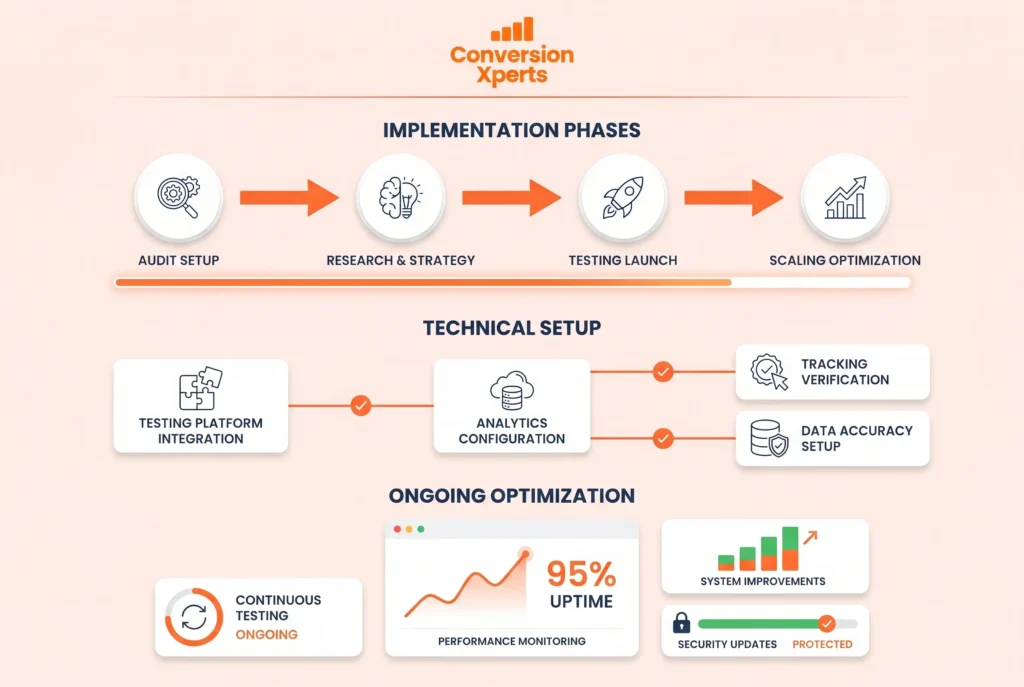
Phased Implementation Approach
Phase 1: Audit and Setup (Weeks 1-2)
- Complete website technical audit
- Analytics verification and setup
- Tracking implementation
- Baseline metrics establishment
Phase 2: Research and Strategy (Weeks 3-4)
- User research completion
- Testing roadmap development
- Hypothesis generation
- Quick wins implementation
Phase 3: Testing Begins (Week 5 onwards)
- Initial test batch deployment
- Daily monitoring
- Weekly performance reviews
- Continuous optimization
Phase 4: Scaling and Expansion (Month 3+)
- Proven testing processes scaled
- Testing roadmap expansion
- Advanced optimization techniques
- New areas of website testing
Technical Implementation Considerations
Testing Platform Setup:
- Implementation of testing software
- IT integration requirements
- Data collection verification
- Performance impact assessment
Analytics Enhancement:
- Custom event tracking
- Conversion funnel setup
- Segment creation
- Dashboard development
Ongoing Technical Needs:
- Performance monitoring
- Security and compliance
- Integration maintenance
- Regular updates and patches
Part 14: The CRO Agency Partnership Contract
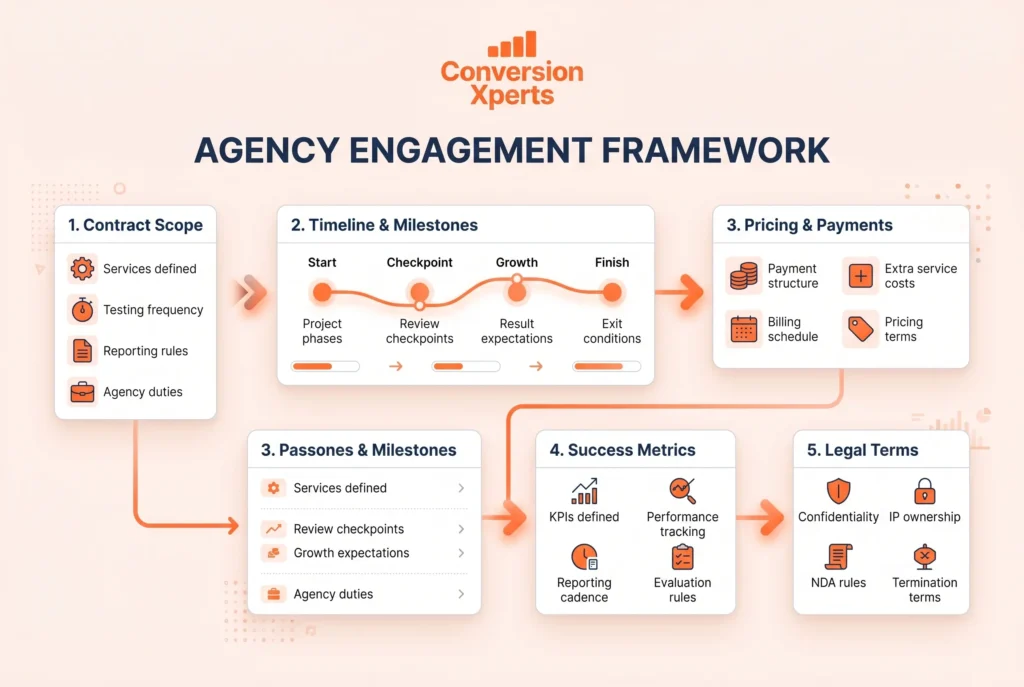
Essential Contract Elements
Scope of Work:
- Services to be provided
- Testing frequency and types
- Reporting requirements
- Agency responsibilities
Timeline and Milestones:
- Project phases and timelines
- Expected timeline to see results
- Performance review points
- Exit conditions
Pricing and Payment Terms:
- Payment structure and schedule
- Invoice timing and terms
- Cost of additional services
- Price escalation clauses
Metrics and Success:
- Key performance indicators
- Success metrics definition
- Reporting cadence
- Performance evaluation criteria
Confidentiality and IP:
- Confidentiality obligations
- Intellectual property ownership
- Non-disclosure requirements
- Competitive conflict restrictions
Termination Clause:
- Notice period for termination
- Termination without cause provisions
- Final deliverable requirements
- Handoff documentation
Conclusion: Making Your Decision and Moving Forward
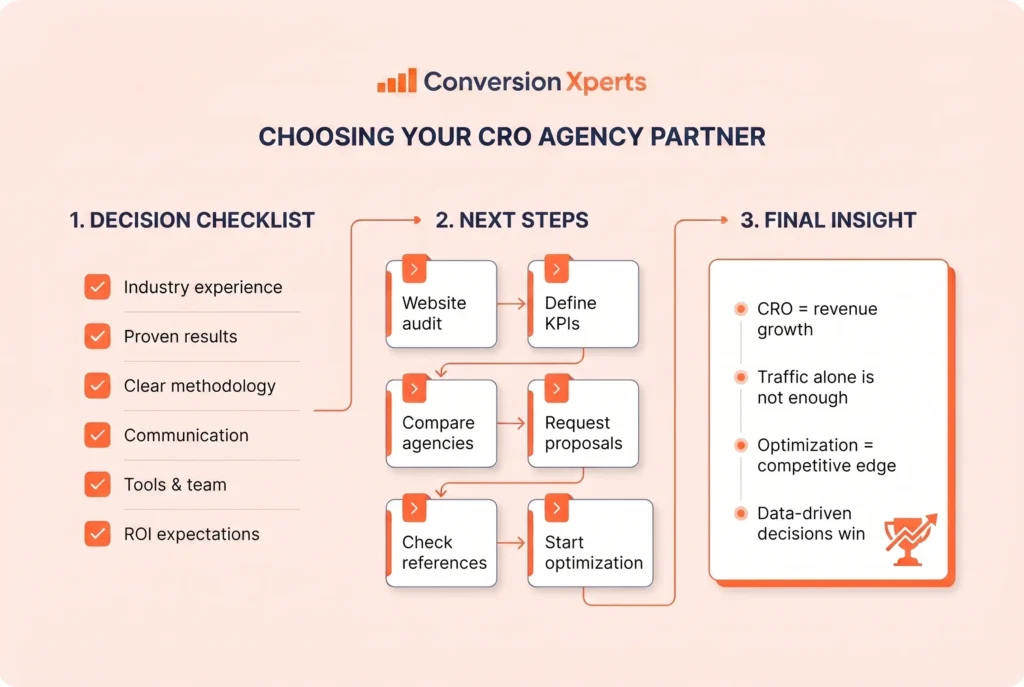
Choosing a Conversion Rate Optimization agency represents one of the highest-ROI decisions in digital marketing. The difference between a poorly optimized website and a well-optimized one often represents six to seven figures in annual revenue.
Decision Checklist
Before selecting your CRO partner, confirm:
✓ Industry Experience: Do they have proven success in your specific industry?
✓ Proven Results: Can they provide concrete case studies with real numbers?
✓ Clear Methodology: Do you understand their process and approach?
✓ Communication Style: Will they keep you informed with regular updates?
✓ Tools and Capabilities: Do they use professional-grade optimization tools?
✓ Team Structure: Do they have the diverse skills needed for your project?
✓ Realistic Expectations: Are they honest about potential timelines and results?
✓ Financial Value: Does the expected ROI justify the investment?
Next Steps
- Audit Your Current State: Use the questions in this guide to honestly assess your website’s conversion performance
- Define Success Metrics: Establish what success looks like for your business
- Research Agencies: Use this guide’s criteria to evaluate 3-5 potential partners
- Request Proposals: Ask agencies to analyze your site and provide specific recommendations
- Ask for References: Talk to existing clients about their experiences
- Start the Partnership: Choose your partner and commit to the process
- Trust the Process: Allow adequate time for testing and optimization to work
The most successful CRO partnerships combine expert agency guidance with committed client partnership. Your willingness to participate in the process, provide feedback, and make data-driven decisions determines much of the final success.
Final Thoughts
In 2026, the competitive landscape has shifted. It’s no longer sufficient to simply drive traffic to your website. Businesses that excel at converting visitors into customers gain insurmountable competitive advantage. They can outbid competitors for advertising, offer better customer experiences, and reinvest more aggressively in growth.
This guide provides everything you need to understand CRO, evaluate agencies, and launch a successful optimization initiative. The question isn’t whether you can afford to work with a CRO agency—it’s whether you can afford not to.
Your visitors are already arriving at your website. The question is: are you converting them at your full potential?