Understanding Criminal Defense Attorney Website Conversion Rate Benchmarks for 2026
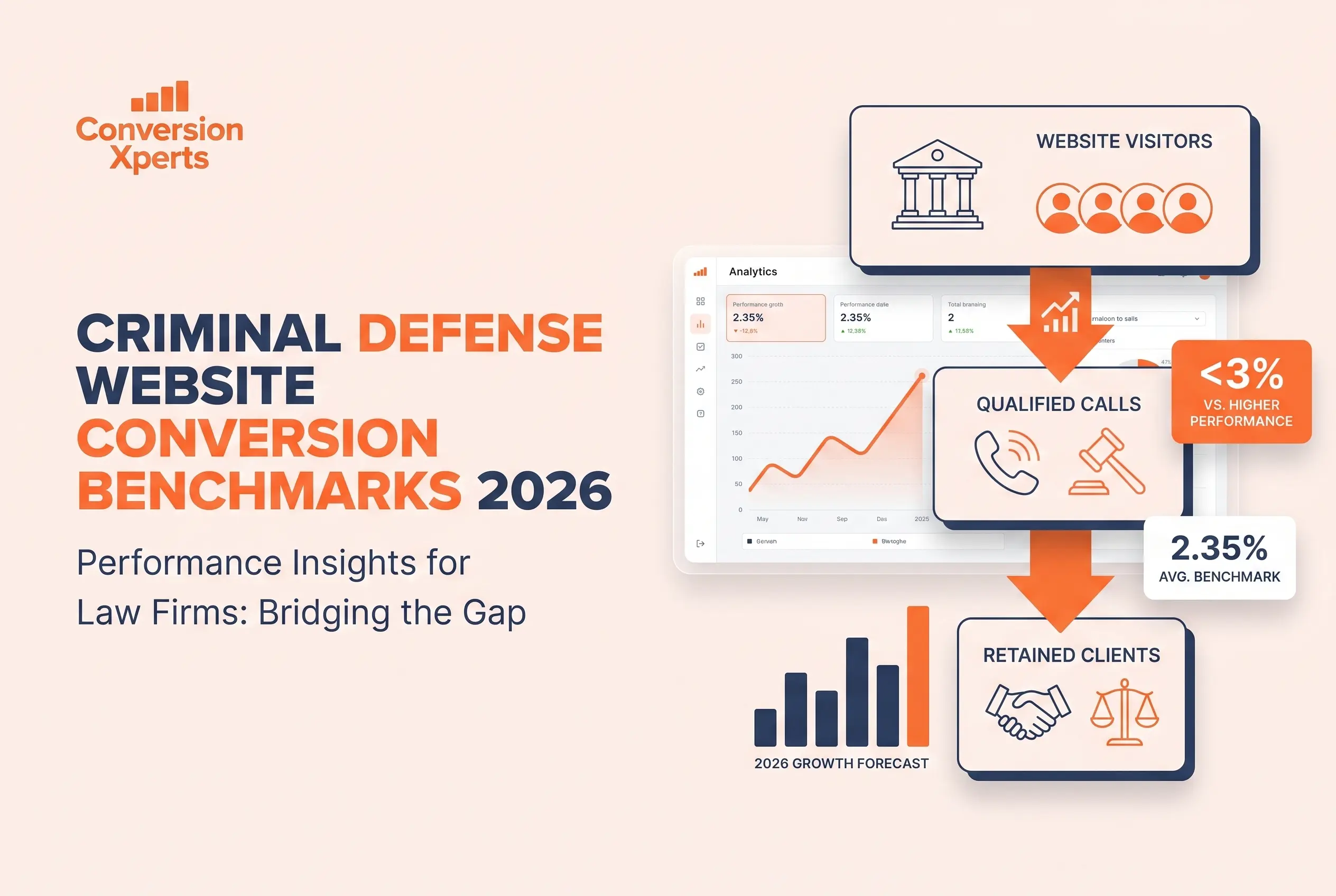
WHAT IS A WEBSITE CONVERSION RATE AND WHY IT MATTERS FOR CRIMINAL DEFENSE ATTORNEYS
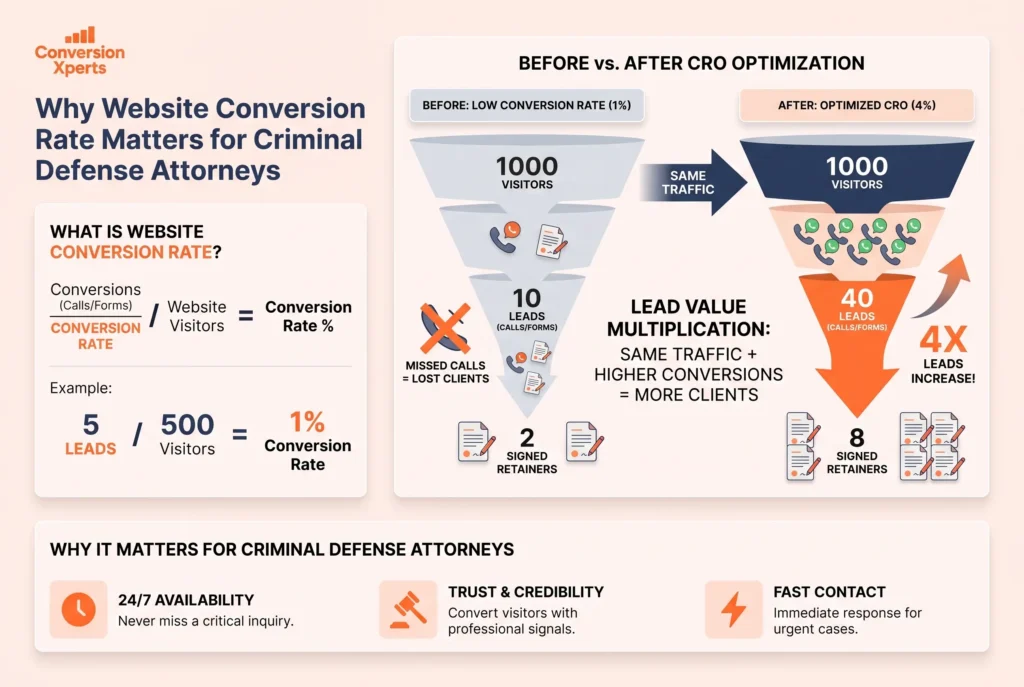
A website conversion rate is the percentage of website visitors who take a specific desired action on your site. For a criminal defense attorney, that action is typically a phone call, a contact form submission, or a live chat message.
The formula is simple. Divide the number of conversions by the total number of visitors, then multiply by 100. If 1,000 people visit your site in a month and 25 call your office, your website conversion rate is 2.5 percent.
This single number is one of the most important metrics in your entire marketing operation. Here is why.
You could be spending 5,000 dollars per month on Google Ads and getting 3,000 visitors. If your conversion rate is 1 percent, you get 30 leads. If a conversion rates agency improves that number to 4 percent, you get 120 leads from the exact same ad budget. That is four times the clients without spending a single extra dollar on traffic.
For criminal defense attorneys specifically, this matters more than almost any other type of law firm. Potential clients searching for criminal defense help are often scared, in a hurry, and searching late at night or on weekends. If your site does not immediately communicate trust, urgency, and availability, they will call someone else before they ever read your bio.
Why Most Law Firm Websites Bleed Money
Most criminal defense law firm websites are built to look good in a portfolio. They are not built to convert. They have slow load times, vague headlines, no clear call to action above the fold, and trust signals buried at the bottom of the page.
According to a 2023 report by Clio, 59 percent of legal clients say that the ability to reach an attorney immediately is a major factor in their hiring decision. If your website does not make that promise instantly visible, you are already losing the conversion battle on arrival.
The Difference Between Leads and Signed Clients
A conversion for most attorneys means a phone call or a form fill. But a true conversion for your business is a signed retainer. The website conversion rate benchmarks we cover in this guide focus on the initial contact conversion since that is the metric most agencies and analytics platforms track. Your job after that is to close the consult.
CRIMINAL DEFENSE ATTORNEY WEBSITE CONVERSION RATE BENCHMARKS FOR 2026
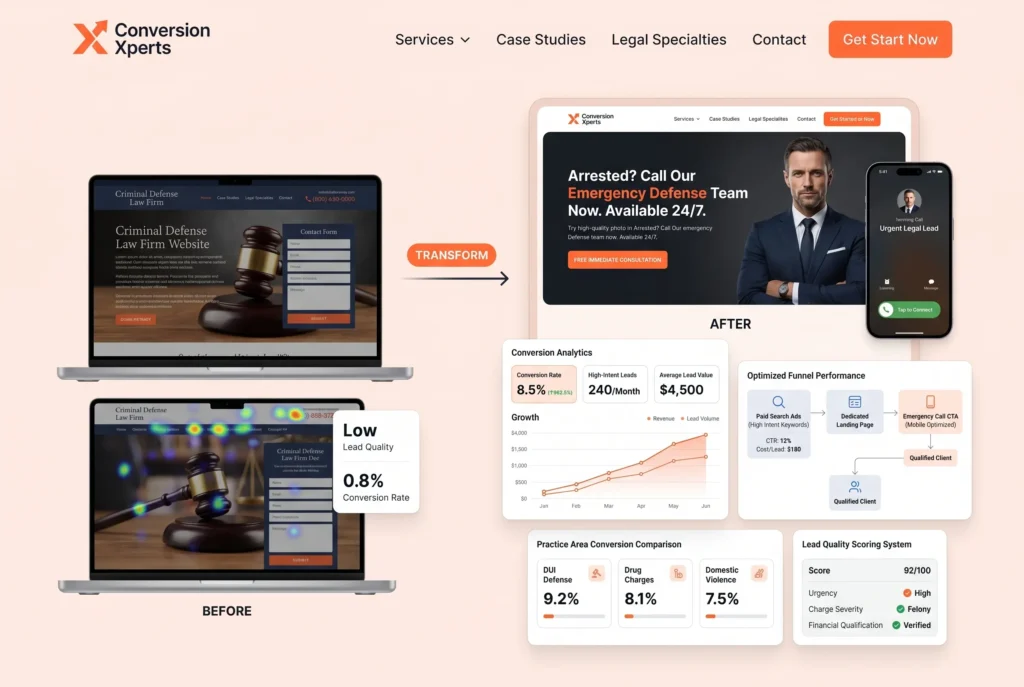
Criminal defense attorney website conversion rate benchmarks vary based on traffic source, geography, practice focus, and how well the site is optimized. Here is what the data shows across the industry.
Overall Website Conversion Rate Benchmarks for Criminal Defense Law Firms
According to data from Unbounce and legal marketing agencies who specialize in law firm CRO, criminal defense attorney websites typically convert in the following ranges.
Poor performance: below 1.5 percent Average performance: 1.5 to 3.5 percent Good performance: 3.5 to 6 percent Top performance: 6 to 12 percent or higher
The most optimized criminal defense attorney landing pages, particularly those running paid search campaigns for high intent keywords like DUI attorney near me or criminal lawyer free consultation, regularly achieve conversion rates above 10 percent.
For comparison, here is how criminal defense website conversion rates stack up against other legal practice areas and industries.
Practice Area or Industry and Average Website Conversion Rate:
Criminal Defense Attorney: 2.5 to 8 percent depending on optimization Personal Injury Attorney: 3 to 7 percent Family Law Attorney: 2 to 5 percent Immigration Attorney: 1.5 to 4 percent Real Estate Attorney: 1 to 3 percent General Legal Industry Average: 2 to 4 percent All Industry Average (WordStream 2023): 2.35 percent Top Quartile All Industries: 5.31 percent or higher
The takeaway is clear. Criminal defense has above average conversion potential because the search intent is urgent and emotionally charged. But most criminal defense websites are not built to capture that urgency, which is why so many sit in the poor to average range.
Benchmark by Website Type
A general criminal defense website with multiple practice areas and blog content typically converts at 1.5 to 3 percent. A dedicated landing page for a specific charge like DUI, drug possession, or assault with a clear single call to action can convert at 5 to 12 percent. This gap explains exactly why criminal defense attorneys who invest in dedicated service pages and landing pages outperform those relying solely on a homepage to do all the conversion work.
WHY CRIMINAL DEFENSE WEBSITES CONVERT DIFFERENTLY THAN OTHER LEGAL SITES
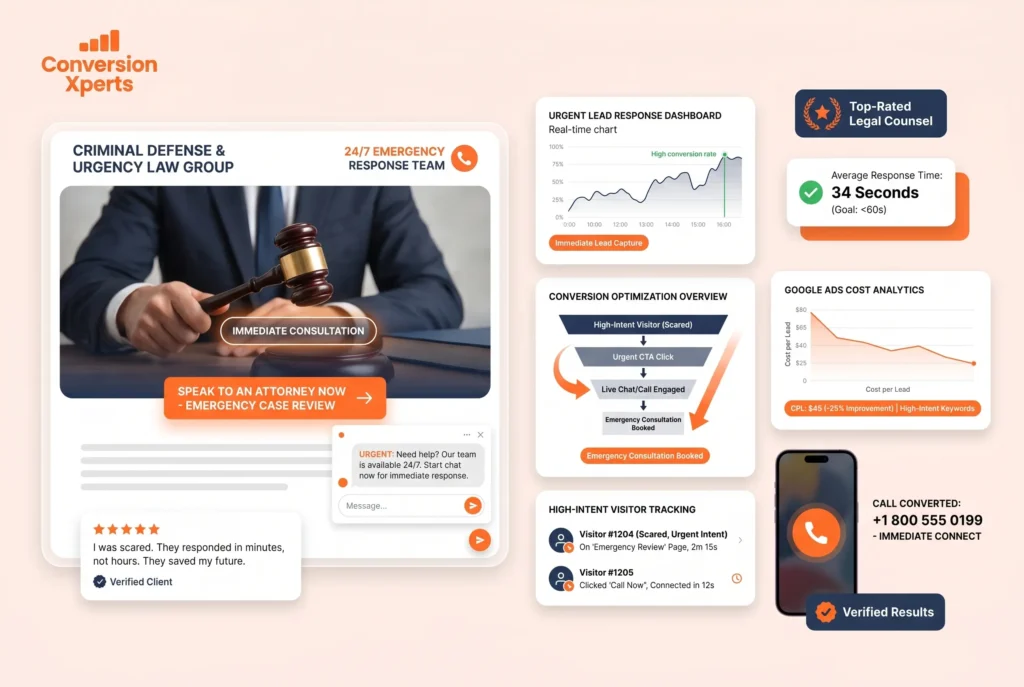
Criminal defense attorney websites operate under a unique set of psychological conditions that most legal marketing content ignores entirely. Understanding these conditions is the first step to improving your website conversion rates.
The Urgency Factor
People searching for a criminal defense attorney are almost never browsing casually. They have been arrested, they have a court date, a family member is in trouble, or they just received a target letter from a federal prosecutor. Every minute matters to them.
This level of urgency means your conversion window is extremely short. Research by Lead Connect found that responding to a lead within five minutes makes you 100 times more likely to reach that prospect compared to responding 30 minutes later. On a website, this urgency must be addressed before the visitor ever picks up the phone. Your headlines, your trust signals, and your call to action all need to speak to someone who is scared and needs help right now.
The Trust Problem
Criminal defense is one of the most trust dependent practice areas in law. Potential clients are sharing deeply personal and legally sensitive information. They need to believe three things before they convert.
First, that you are qualified and experienced. Second, that you have handled cases like theirs before. Third, that you will actually pick up the phone or call them back.
According to a 2024 survey by Thomson Reuters, 62 percent of legal clients said they researched at least three attorneys online before making contact. If your website does not immediately establish credibility, they will simply move to the next result.
The After Hours Reality
Criminal arrests do not happen during business hours. Neither does the desperate searching that follows. Data from legal marketing platforms consistently shows that a significant portion of criminal defense website traffic comes between 9 PM and 2 AM on weeknights and over weekends.
If your website does not have a live chat option, a 24 hour availability message, or an after hours answering service prominently displayed, you are invisible to the clients who need you most urgently. This single factor alone accounts for why some criminal defense websites with modest traffic dramatically outperform competitors with three times the visitors.
The Competition Density Problem
In almost every major metro area, criminal defense attorney advertising is among the most competitive in Google Ads. Cost per click for terms like criminal defense attorney in large cities can exceed 80 to 150 dollars per click according to WordStream legal industry data from 2024.
At that price, a website conversion rate of 1 percent means you are paying 8,000 to 15,000 dollars for every client lead. A website conversion rate of 5 percent reduces that to 1,600 to 3,000 dollars per lead from the exact same traffic. This math is why website conversion rate benchmarks matter so much in criminal defense and why working with a conversion rates agency is not a luxury but a necessity for any firm running paid search.
WHAT THE TOP PERFORMING CRIMINAL DEFENSE WEBSITES DO RIGHT
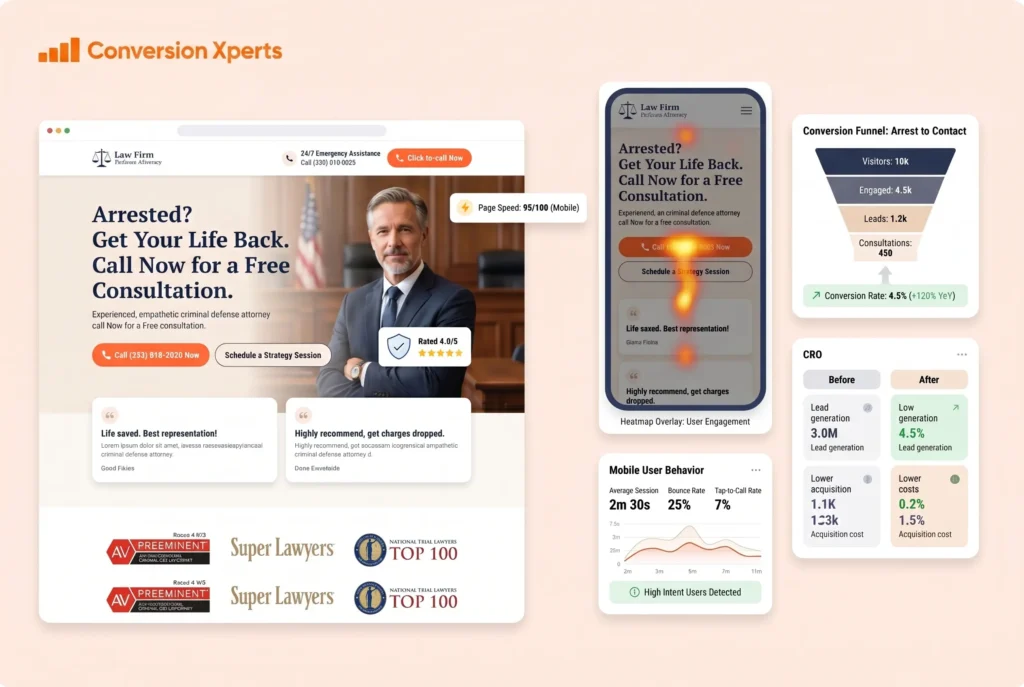
The best converting criminal defense attorney websites share a set of consistent characteristics. These are not design preferences. They are conversion principles backed by behavioral data and testing.
Above the Fold Optimization
Everything a visitor sees before they scroll is called the above the fold section of your website. This is the most valuable real estate on your entire site.
Top converting criminal defense websites use this space to answer four questions within the first three seconds of arrival. Who are you? What do you do? Why should I trust you? How do I reach you right now?
This means your headline should name the charge or situation the visitor is searching for, not just say experienced criminal defense attorney. A headline like We Defend DUI, Drug, and Assault Charges Across Texas. Call Us 24 Hours a Day tells the visitor exactly what they need to know and keeps them on the page.
According to a 2023 Nielsen Norman Group study, users spend an average of 57 percent of their page viewing time on content above the fold. If you are not converting them there, most of them will not scroll far enough to give you a second chance.
Social Proof Placement
Client reviews and testimonials are the single most powerful trust signal on a criminal defense website. But most law firms make a critical mistake. They put reviews at the bottom of the page where almost no one sees them.
The highest converting criminal defense websites place star ratings, short testimonial quotes, and review counts directly in the hero section. They also display Google Review averages, Avvo ratings, Super Lawyers badges, and bar association memberships near the top of the page and not buried in a footer.
According to BrightLocal’s 2024 Local Consumer Review Survey, 88 percent of consumers trust online reviews as much as personal recommendations. For a criminal defense attorney, a visible 4.9 star average with 200 plus reviews can be the single factor that pushes a nervous visitor to make the call.
Mobile First Design and Speed
Over 70 percent of criminal defense attorney website traffic now comes from mobile devices according to Google Search Console data from legal marketing agencies. The arrest happens. The phone comes out. Google gets searched. Your site loads in 4.2 seconds and the visitor goes back to the results.
Page speed is a direct conversion variable. According to Google’s own research, as page load time increases from one second to three seconds, the probability of bounce increases by 32 percent. From one second to five seconds, that probability increases by 90 percent.
Top performing criminal defense websites load in under two seconds on mobile, use click to call buttons that are large enough to tap with a thumb, and place the phone number in a sticky header that scrolls with the page.
Clear and Specific Calls to Action
Vague calls to action kill criminal defense conversions. Buttons that say learn more or contact us perform dramatically worse than buttons that say call for your free consultation or get help with your DUI charge now.
The best criminal defense landing pages use specific outcome language in their calls to action. They tell the visitor exactly what happens next when they click or call. We Answer 24 Hours. Free Consultation. No Obligation converts better than Contact Our Office in every A/B test because it removes uncertainty from the decision.
HOW A CONVERSION RATES AGENCY CAN FIX YOUR LAW FIRM WEBSITE
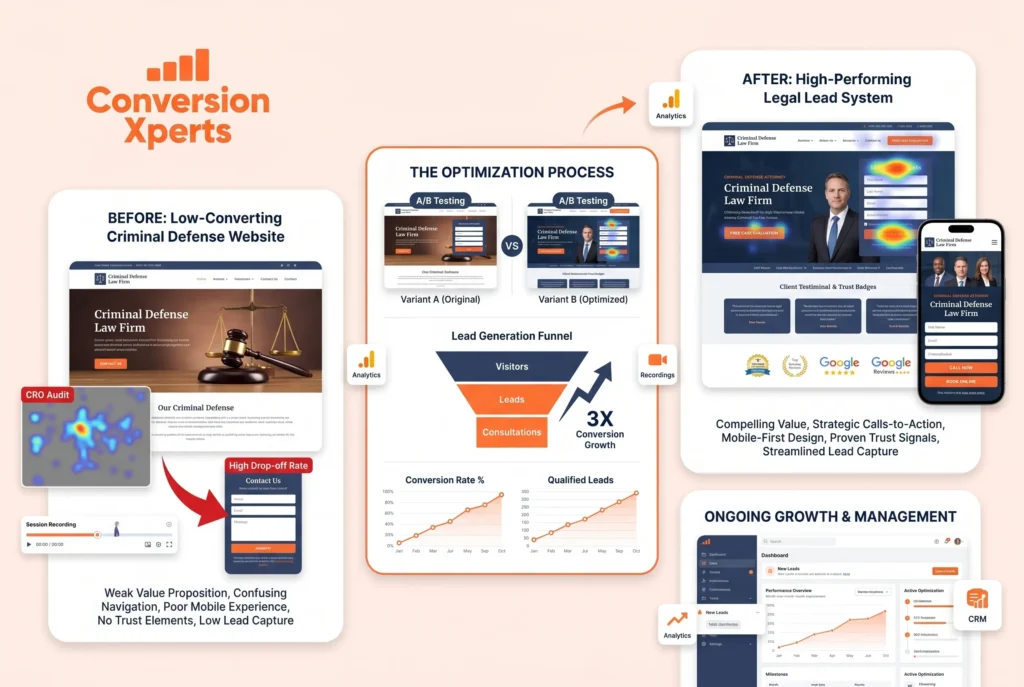
A conversion rates agency is a company that specializes in increasing the percentage of website visitors who take action. They do not focus on getting more traffic. They focus on making the traffic you already have work harder.
For criminal defense attorneys, working with a conversion rates agency typically involves the following process.
The CRO Audit
Every engagement with a conversion rates agency starts with a deep analysis of your current website. This includes reviewing your Google Analytics data to find pages where visitors drop off, using heatmap tools like Hotjar or Microsoft Clarity to see where visitors click and scroll, watching session recordings to identify confusion or friction in the user journey, and analyzing your current conversion rate against criminal defense attorney website conversion rate benchmarks.
This audit reveals the specific reasons your site is not converting and provides a prioritized roadmap for fixing them.
A/B Testing for Law Firm Pages
A/B testing means creating two versions of a page and showing each version to different visitors to see which one converts better. A conversion rates agency runs these tests on your highest traffic pages to find the combinations of headlines, layouts, trust signals, and calls to action that produce the most leads.
For criminal defense websites, common A/B tests include different hero section headlines, phone number placement, review widget positioning, contact form length, and button copy. Each test runs until it reaches statistical significance meaning the results are reliable and not random.
Landing Page Development
One of the highest impact services a conversion rates agency provides for criminal defense attorneys is dedicated landing page development. Instead of sending all your paid search traffic to your homepage, they build specific pages for each charge type or campaign.
A page built specifically for federal criminal defense in Dallas with copy, trust signals, and calls to action tailored to that exact search intent will always outperform a generic homepage. Website conversion rate benchmarks for dedicated criminal defense landing pages regularly exceed 8 to 12 percent while homepage conversion rates for the same traffic sources often sit below 3 percent.
Ongoing Optimization
Conversion rate optimization is not a one time project. It is a continuous process of testing, learning, and improving. The best conversion rates agencies provide monthly reporting, ongoing test cycles, and continuous improvement to compound your results over time.
According to a 2023 study by Econsultancy, companies with a structured ongoing approach to CRO are twice as likely to see a large increase in conversions compared to those who treat it as a one time fix.
WEBSITE CONVERSION RATE BENCHMARKS BY TRAFFIC SOURCE FOR CRIMINAL DEFENSE LAW FIRMS
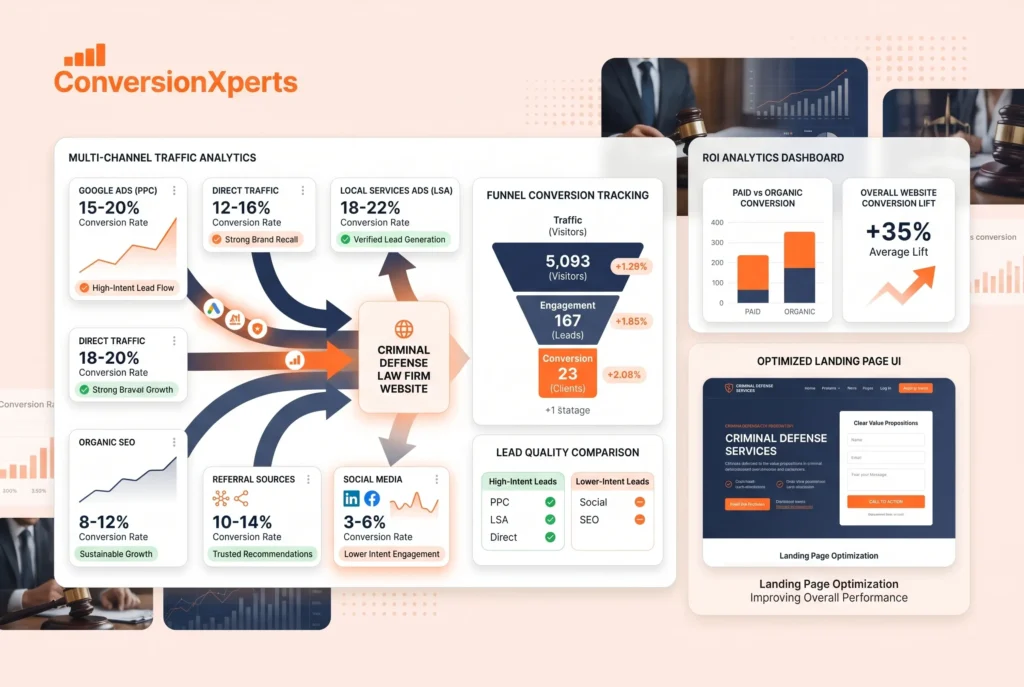
Not all website traffic converts at the same rate. Your website conversion rates will vary significantly depending on where your visitors come from. Understanding these differences helps you allocate your marketing budget more effectively.
Here is a breakdown of conversion rate benchmarks by traffic source for criminal defense attorney websites.
Organic Search (SEO Traffic): 2 to 5 percent. Visitors from organic search are actively looking for information or a specific attorney. They tend to convert at moderate rates because they are in research mode. Well optimized informational pages can still drive consultation requests.
Paid Search (Google Ads): 4 to 12 percent. This is typically the highest converting traffic source for criminal defense attorneys because every visitor has searched for a specific term related to hiring an attorney. High intent keywords drive the highest conversion rates. According to WordStream 2024 data, legal is one of the highest converting industries in Google Ads when landing pages are properly optimized.
Direct Traffic: 5 to 15 percent. Visitors who type your URL directly or come from a bookmark already know your firm. They are the most likely to convert because they have already decided they want to contact you specifically.
Referral Traffic: 2 to 6 percent. Visitors from other websites including legal directories like Avvo or Martindale Hubbell or local news sites convert at moderate to good rates depending on the quality of the referring source.
Social Media Traffic: 0.5 to 2 percent. Social media traffic generally converts at lower rates for criminal defense attorneys because the search intent is absent. A person scrolling Facebook is not in the same mindset as a person who just searched for help with a DUI arrest.
Local Service Ads (Google Guaranteed): 6 to 14 percent. These leads are extremely high intent because Google already verified your credentials. The leads who contact you through LSAs are ready to hire.
This data makes the strategic priority clear. The highest ROI activity for most criminal defense attorneys is improving the conversion rate on their paid search landing pages first, then their organic landing pages. Social media can drive brand awareness but should not be evaluated by the same website conversion rate benchmarks as paid or organic search.
HOW TO MEASURE AND TRACK YOUR CRIMINAL DEFENSE WEBSITE CONVERSION RATE
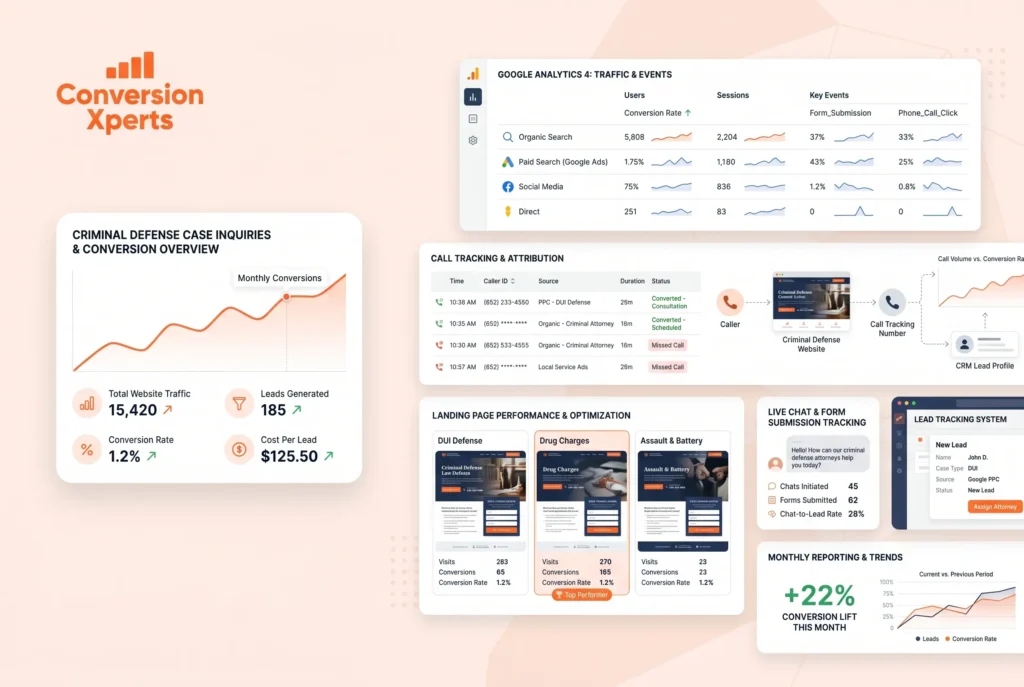
Knowing your criminal defense attorney website conversion rate benchmarks is useless if you cannot measure your own numbers accurately. Here is how to set up proper tracking.
Setting Up Google Analytics 4 for Law Firm Conversion Tracking
Google Analytics 4 is a free tool that tracks visitor behavior on your website. To measure your website conversion rate, you need to set up conversion events. For a criminal defense attorney website, the key conversion events to track are phone call clicks using call tracking software, contact form submissions, live chat conversations started, and appointment booking completions.
Without conversion tracking in place, you have no idea whether your website is performing well or poorly against industry benchmarks. Many law firms run paid ads for years without proper tracking and never know their true cost per lead.
Call Tracking for Criminal Defense Law Firms
Phone calls are the most common conversion type for criminal defense attorneys and they are also the easiest to miss in your analytics. Call tracking software like CallRail assigns unique phone numbers to each traffic source so you can see exactly which campaigns, pages, and keywords are generating calls.
This data is critical for measuring your true website conversion rate and for understanding which traffic sources are worth scaling.
Monthly Reporting Metrics That Matter
Once your tracking is in place, you should review the following metrics each month. Total website visitors, total conversions by type, overall website conversion rate, conversion rate by traffic source, conversion rate by landing page, cost per conversion for paid campaigns, and conversion rate trends over time compared against criminal defense attorney website conversion rate benchmarks.
Tracking these numbers consistently over time allows you to see whether your optimization efforts are working and where the biggest opportunities for improvement remain.