B2B CRO: The Ultimate Guide to Converting More Leads in 2026
What Is B2B CRO and Why It Is Different from B2C
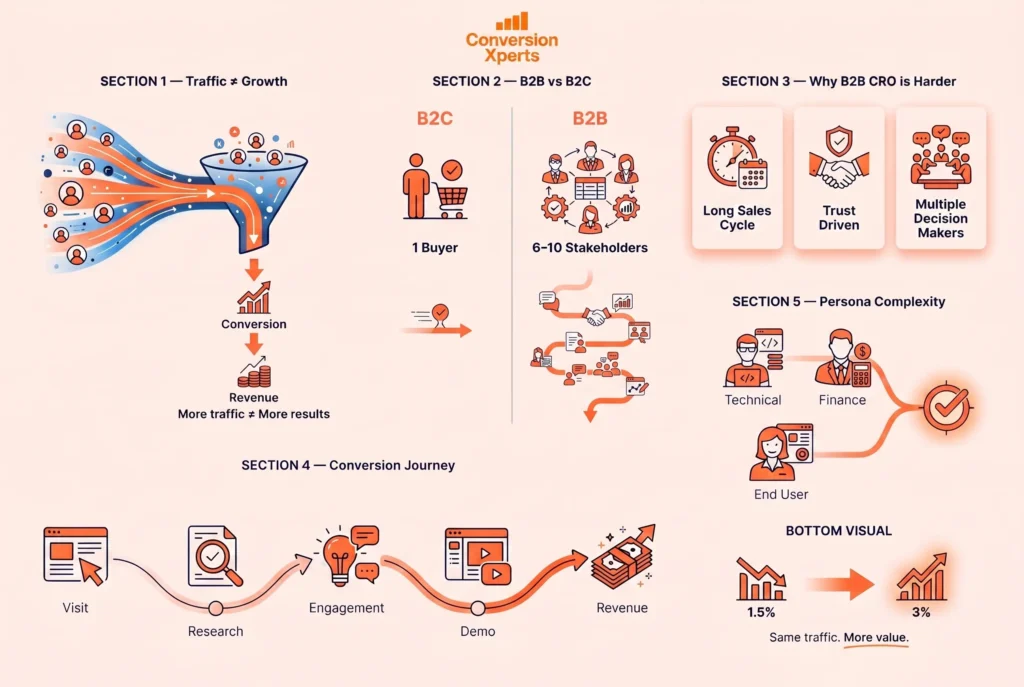
B2B CRO is the practice of using data, research, and structured experimentation to increase the percentage of website visitors who complete a desired business action. The goal is not more traffic. The goal is more value from the traffic you already have.
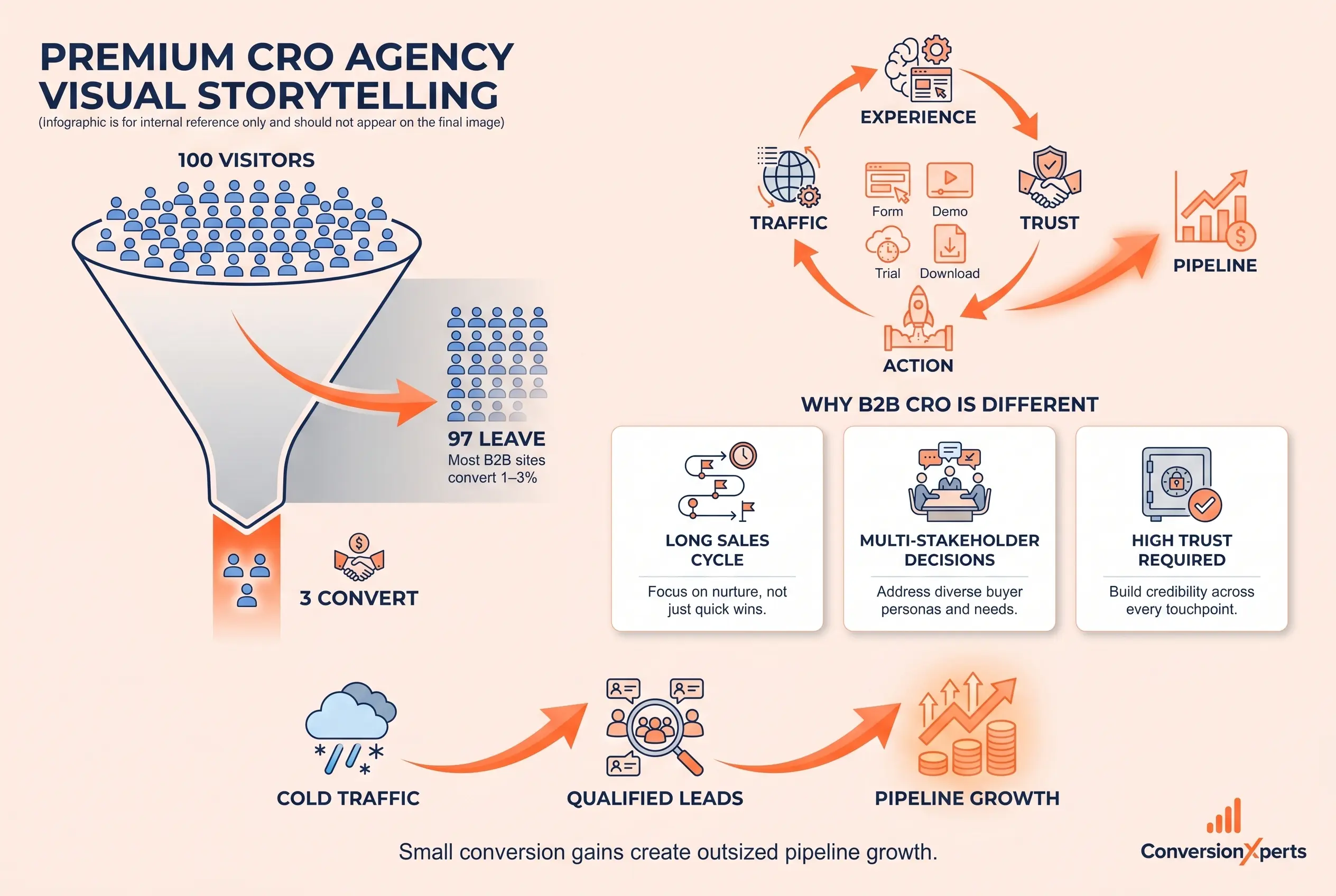
This distinction matters enormously. Most marketing teams chase more clicks, more impressions, more reach. But if your conversion rate sits at 1.5 percent, doubling your ad budget still leaves 97 out of every 100 visitors doing nothing. A jump from 1.5 percent to 3 percent, on the other hand, doubles your leads without spending a single extra dollar on acquisition.
Why B2B Buying Behavior Makes CRO Harder
In B2C, a single person decides whether to buy a pair of sneakers. In B2B, Gartner research from 2023 found that the average enterprise buying group involves 6 to 10 decision makers, each bringing their own priorities, objections, and risk thresholds. Your website has to speak to all of them simultaneously without alienating any of them.
This is why generic CRO advice pulled from ecommerce case studies often fails in B2B contexts. The psychology is different, the timeline is different, and the stakes are different. A VP of Finance evaluating a six-figure software contract is not going to be swayed by a countdown timer or a “Only 3 left!” badge.
The B2B Conversion Funnel Is Longer and More Complex
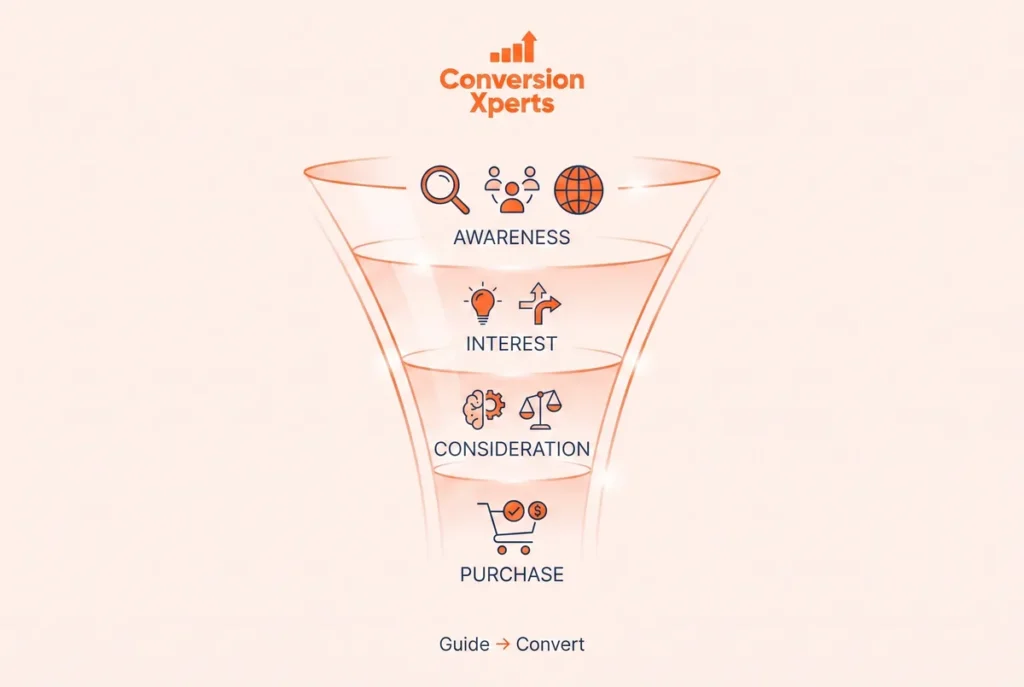
A typical B2C conversion takes minutes. A typical B2B conversion cycle takes 3 to 9 months according to Forrester’s 2024 B2B Buying Study. This means your CRO strategy must account for multiple touchpoints, progressive trust-building, and conversion micro-goals at every stage of the funnel, not just the final “buy now” moment.
In B2B CRO, a meaningful conversion might be a whitepaper download, a webinar registration, a demo request, a free trial signup, a pricing page visit, or a live chat conversation. Each of these is a step closer to revenue and each deserves its own optimization attention.
Organizational Complexity Adds Another Layer
Unlike B2C where you often know exactly who your buyer is, B2B audiences are fragmented. A single company might have the technical evaluator reading your blog, the economic buyer scanning your pricing page, and the end user watching your product demo videos, all at the same time. Your conversion rate optimization strategy has to serve each persona at the right stage without creating friction for the others.
Key B2B Conversion Rate Benchmarks You Need to Know
Before you can optimize, you need to know what good looks like. Benchmarking your current performance against industry standards is the foundation of any serious B2B CRO effort.
Average B2B Website Conversion Rates by Industry
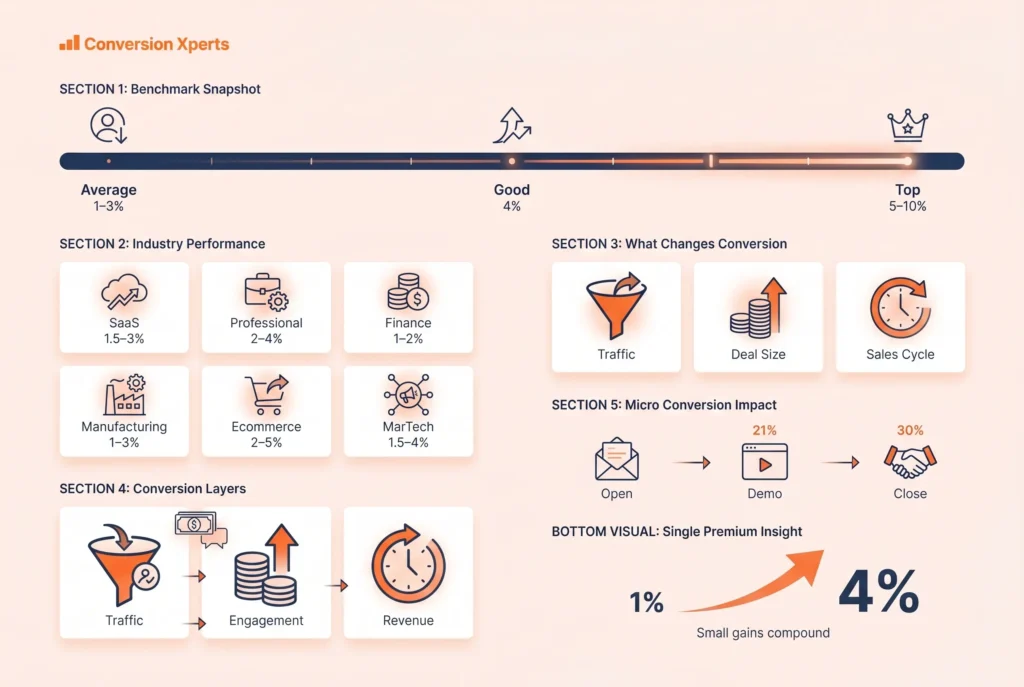
According to WordStream’s 2024 Conversion Rate Benchmarks report, average B2B landing page conversion rates vary significantly by sector. SaaS companies typically see conversion rates between 1.5 and 3 percent on cold traffic, while professional services firms like consulting, legal, and accounting firms often achieve 3 to 5 percent because visitors arrive with higher intent. B2B ecommerce sits lower, around 1 to 2 percent, due to the complexity of product catalogs and purchase approval processes.
Here is a comparison of typical B2B conversion rate benchmarks across key categories:
Industry Category / Average Conversion Rate / Top Quartile Performance
SaaS and Software: 1.5 to 3 percent, with top performers reaching 5 to 7 percent
Professional Services: 3 to 5 percent, with top performers reaching 8 to 10 percent
Manufacturing and Industrial: 0.8 to 1.5 percent, with top performers reaching 3 to 4 percent
Financial Services B2B: 2 to 4 percent, with top performers reaching 6 to 8 percent
B2B Ecommerce: 1 to 2 percent, with top performers reaching 4 to 5 percent
Marketing Technology: 2 to 3.5 percent, with top performers reaching 6 to 9 percent
What a Good B2B Conversion Rate Actually Looks Like
The honest answer is that a “good” conversion rate depends on your traffic quality, your average deal size, and your sales cycle complexity. A company selling a $200,000 enterprise contract converting at 0.5 percent from paid traffic is doing fine if those conversions turn into $2 million in pipeline. A company selling a $500 per month SaaS product converting at the same rate is likely losing significant revenue.
According to Unbounce’s 2024 Conversion Benchmark Report, the median landing page conversion rate across B2B categories is 4.02 percent. If you are below that number, you have a clear optimization opportunity. If you are above it, your goal is incremental gains that compound over time.
Micro-Conversion Benchmarks Matter Too
Optimizing only for the final form submission misses much of the opportunity. Email open rates for B2B nurture sequences average 21.5 percent according to Mailchimp’s 2024 Email Marketing Benchmarks. Demo-to-close rates in top B2B SaaS companies typically run 20 to 30 percent. Tracking and optimizing these intermediate steps is where sophisticated B2B CRO teams find their biggest gains.
The B2B CRO Framework That Actually Works
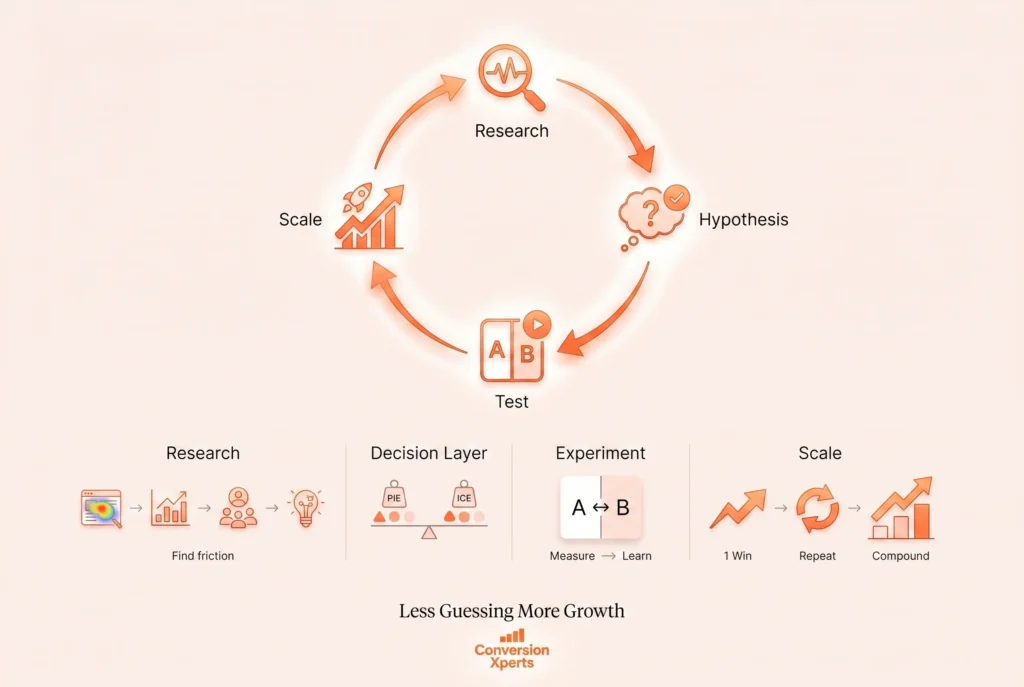
A framework keeps your optimization work structured, repeatable, and accountable. Without one, you end up running random tests based on gut feelings and getting inconsistent results. The most effective B2B CRO framework has four stages: Research, Hypothesis, Experiment, and Scale.
Stage One: Research and Diagnosis
You cannot fix what you do not understand. Before changing anything on your site, invest serious time in qualitative and quantitative research. This means running heatmap and session recording analysis through tools like Hotjar or Microsoft Clarity to see exactly where users click, scroll, and abandon. It means analyzing your Google Analytics funnel data to identify where the largest drops in engagement happen. And it means talking to actual customers and prospects.
Customer interviews are criminally underused in B2B CRO. A 30-minute call with five recent customers will reveal language patterns, objections, and decision factors that no amount of A/B testing will surface on its own. According to a 2024 study by the Baymard Institute, 68 percent of B2B form abandonments happen because users encounter unexpected friction, not because they lack interest. Research uncovers that friction.
Exit-intent surveys, on-site polls, and chat conversation analysis round out the research phase. Your goal is to build a clear picture of what your visitors want, what they fear, and what specific language resonates with their real-world problems.
Stage Two: Prioritizing Hypotheses
Once your research produces a list of potential improvements, you need a system for prioritizing them. The PIE framework, developed by WiderFunnel, scores each hypothesis on three dimensions: Potential for improvement, Importance of the page or element, and Ease of implementation. Each dimension gets a score of 1 to 10, and the average becomes the priority score.
Another popular prioritization method in B2B CRO is the ICE score, which rates each test on Impact, Confidence, and Ease. Both systems help teams avoid the common mistake of testing things that feel exciting rather than things that are likely to move revenue.
A well-formed B2B CRO hypothesis looks like this: “Because exit survey data shows 40 percent of pricing page visitors leave without converting because they cannot see ROI justification, adding a customer ROI calculator above the fold will increase demo request submissions by 15 percent.”
Stage Three: Structured Experimentation
Testing in B2B requires patience that B2C teams rarely need. Because B2B websites typically have lower traffic volumes, reaching statistical significance takes longer. A test that a large ecommerce site could conclude in 48 hours might take a B2B company 4 to 6 weeks to run properly.
This is why test design discipline is essential. Each test should have one primary variable, a clear success metric, a minimum detectable effect defined before launch, and a predetermined end date. Running tests without these guardrails produces misleading data that sends teams in the wrong direction.
Tools like VWO, Optimizely, and Convert are built for this kind of rigorous B2B testing. For smaller teams, Google Optimize’s successor and even thoughtful multivariate tools within HubSpot can produce reliable results when used correctly.
Stage Four: Scaling What Works
A winning test result is not a destination. It is a starting point. The best B2B CRO teams document every winning insight, analyze why it worked, and use that understanding to generate new hypotheses across other pages and funnels. A headline that increases demo requests on your homepage might do the same on your paid landing pages. A social proof pattern that converts on your pricing page might work equally well on your case study CTAs.
Building an internal CRO knowledge base that captures winning principles rather than just winning tests is what separates companies with a one-time improvement from companies with compounding conversion growth.
High-Impact Optimization Tactics for B2B Websites
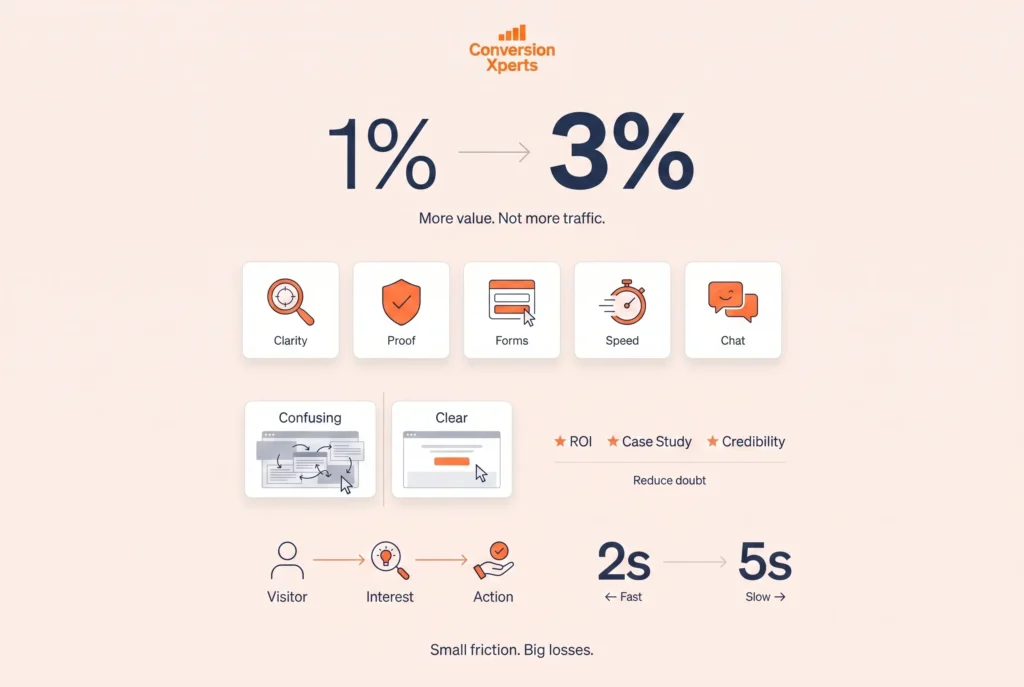
Research and frameworks are essential, but eventually you need specific tactics. These are the areas where B2B companies consistently find the most meaningful conversion rate improvements.
Optimizing Your Value Proposition for Clarity
The single biggest conversion killer in B2B is a vague or generic value proposition. When a visitor lands on your homepage and cannot answer the questions “What is this?” “Who is it for?” and “Why should I care?” within five seconds, they leave. Full stop.
MarketingExperiments research has consistently shown that clarity beats cleverness in B2B copywriting. “We help mid-size manufacturing companies reduce inventory costs by 23 percent” will always outperform “Transforming enterprise operations through intelligent supply chain synergies.” One is specific and credible. The other is noise.
Test your value proposition by showing your homepage to someone unfamiliar with your business for exactly five seconds. Then ask them to describe what the company does. If their answer is wrong or vague, your value proposition needs work before any other optimization will matter.
Social Proof Placement and Specificity
Social proof is the most reliable conversion lever in B2B, but only when it is specific and correctly placed. A generic “Trusted by 500 companies” badge contributes almost nothing. A specific testimonial that addresses the exact fear your buyer has on the page they are reading is conversion gold.
According to TrustPilot’s 2024 B2B Trust Report, 84 percent of B2B buyers say a case study with measurable outcomes directly influenced their vendor shortlist decision. Yet most B2B websites bury case studies in a resource library that fewer than 3 percent of visitors ever visit.
The fix is contextual placement. Put outcome-specific testimonials on your pricing page that address the “is it worth the investment?” question. Put technical credibility signals like security certifications and integration badges on your product pages where technical evaluators spend time. Put CEO and executive quotes from recognizable companies on your homepage where first impressions form.
Form Friction Reduction
B2B forms are almost universally over-engineered. The instinct to collect every possible data field from a first-time visitor is understandable from a sales qualification standpoint but catastrophic from a conversion standpoint.
Hubspot’s 2024 State of Marketing Report found that reducing form fields from seven to three nearly doubled conversion rates across their customer base. The principle of progressive profiling, where you collect a small amount of information initially and gather more over subsequent interactions, is now table stakes for high-performance B2B lead generation.
Beyond field count, form placement, label design, and error messaging all have measurable conversion impact. Multi-step forms consistently outperform single-page forms in B2B contexts because they lower the psychological barrier of commitment. Starting with a low-stakes question like “What is your biggest challenge?” before asking for contact details gets more people into the funnel.
Page Speed and Technical Performance
A 2023 Google study found that B2B pages loading in under 2 seconds converted at rates 2.5 times higher than pages loading in 5 seconds or more. This is not a minor footnote. Page speed is a conversion factor that affects every visitor before they read a single word of your copy.
Core Web Vitals optimization, image compression, server response time improvements, and eliminating render-blocking scripts are not glamorous CRO work. But they consistently produce some of the highest return-on-investment improvements in B2B conversion programs, particularly for companies whose sites have accumulated technical debt over years of content additions.
Chat and Conversational Conversion Paths
Live chat and AI-powered chatbots have transformed B2B conversion optimization for companies that implement them thoughtfully. Drift’s 2024 State of Conversational Marketing report found that B2B companies using conversational marketing tools saw 67 percent more qualified leads than those relying on static forms alone.
The key word is thoughtfully. An intrusive chat popup that fires within three seconds of landing on a page damages trust and increases bounce rates. A contextually triggered chat offer that appears when a visitor has spent two minutes on a pricing page and appears to be hesitating serves a genuinely useful function.
Running A/B Tests That Produce Reliable B2B Data
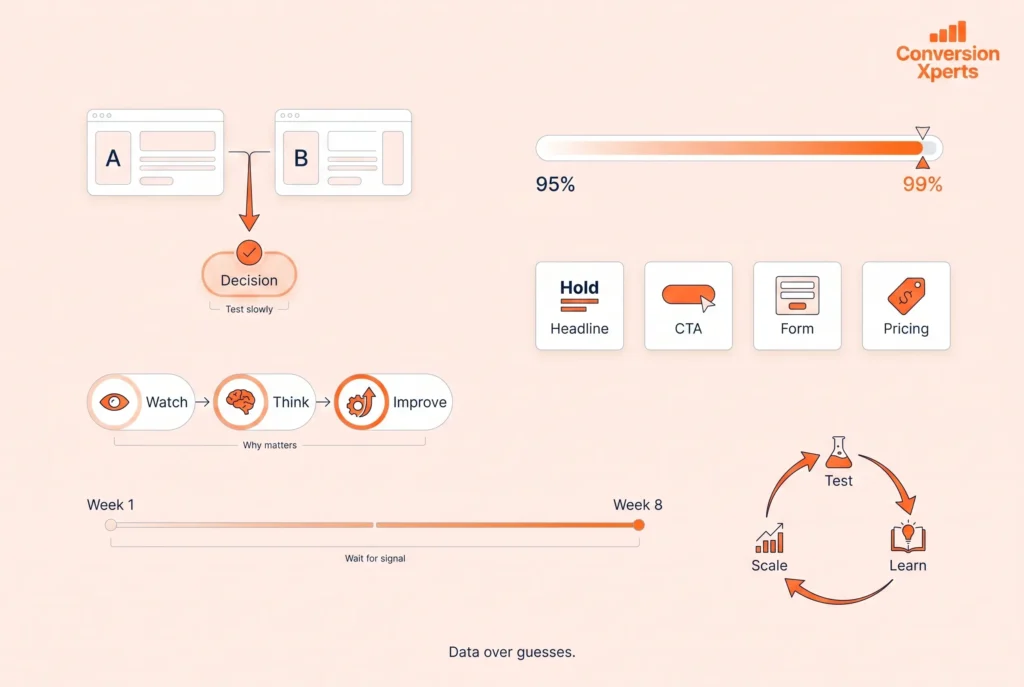
Testing in B2B contexts requires a different level of rigor than most practitioners realize. Getting this wrong is worse than not testing at all because it produces false confidence.
Statistical Significance in Low-Traffic B2B Environments
The cardinal sin of B2B A/B testing is ending tests too early. When you see your variant pulling ahead after a week, the instinct is to call it a winner and move on. But with the traffic volumes most B2B sites operate at, premature test conclusions are almost always statistical noise mistaken for signal.
The standard confidence threshold for A/B testing is 95 percent statistical significance, meaning you are accepting a 5 percent chance that your result is random. For business decisions with significant resource implications, many B2B CRO experts recommend pushing to 99 percent confidence before calling a winner.
Use a sample size calculator before launching any test. Plug in your current conversion rate, your minimum detectable effect, your target confidence level, and your daily traffic to get a realistic timeline for your test. Most B2B companies discover their tests need to run for 4 to 8 weeks to produce reliable data.
What to Test First in B2B CRO
Not all test candidates are created equal. Based on documented B2B conversion research, the highest-leverage areas to prioritize for initial testing are headlines and hero copy, CTA button text and placement, form design and field count, pricing page structure and social proof, and navigation changes that affect funnel depth.
These elements generate the most significant performance differences in tests because they influence the first impression and primary decision moment of your visitor experience. Testing button colors or image choices without first optimizing these foundational elements is a common mistake that wastes testing cycles.
Qualitative Testing Complements Quantitative Data
A/B tests tell you what happens when you change something. They rarely tell you why it happened. This is where qualitative methods like user testing sessions, five-second tests, and on-site surveys become indispensable complements to A/B data.
Services like UserTesting and Lookback allow you to watch real B2B buyers navigate your website, hear their actual spoken thoughts, and identify confusion points that no quantitative data would ever surface. A single user testing session with five B2B buyer personas will often surface more actionable insights than weeks of heatmap analysis.
B2B Landing Page Optimization Done Right
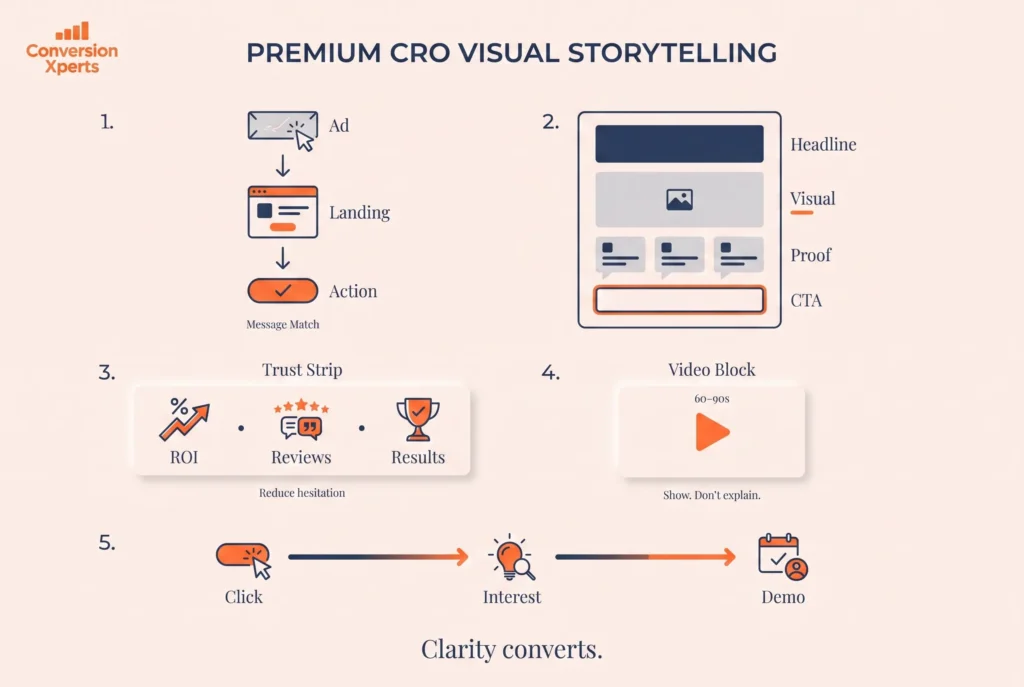
Landing pages are the highest-leverage asset in B2B CRO because they capture visitor intent at its peak. A visitor who clicked your paid search ad or LinkedIn Sponsored Content is actively looking for a solution. Your landing page either meets that intent or wastes the opportunity.
Matching Message to Intent
The most important principle in B2B landing page optimization is message match. The headline of your landing page must directly reflect the language and promise of the ad or link that brought the visitor there. When there is a disconnect between what the ad promised and what the page delivers, visitors feel misled and leave immediately.
This sounds obvious but most B2B companies send all paid traffic to their homepage, which satisfies almost no one because it tries to serve everyone. Dedicated landing pages that speak specifically to the segment, keyword, and offer that generated the click consistently convert at two to three times the rate of generic homepage destinations.
The Anatomy of a High-Converting B2B Landing Page
The structure of a high-performing B2B landing page follows a logical psychological sequence. The headline states the specific outcome the visitor will get. The subheadline explains how or for whom. The hero image or video shows the product or service in context. Social proof that is relevant to the visitor’s industry or company size sits above the fold. The form or CTA is visible without scrolling. A brief feature and benefit section follows. Objection-handling content addresses the top three fears buyers bring to the decision. And a secondary CTA closes the page.
Video on B2B Landing Pages
A 2024 Wyzowl study found that 73 percent of B2B buyers said watching a product video directly influenced their purchase decision. A 60 to 90 second explainer video that clearly articulates the problem, the solution, and the outcomes it delivers is one of the highest ROI additions you can make to a B2B landing page.
The video does not need to be expensive. Authenticity and clarity beat production value in B2B contexts. A founder talking directly to camera about the problem their product solves often converts better than a polished animated explainer because it feels more credible.
How to Optimize the B2B Lead Nurturing Funnel
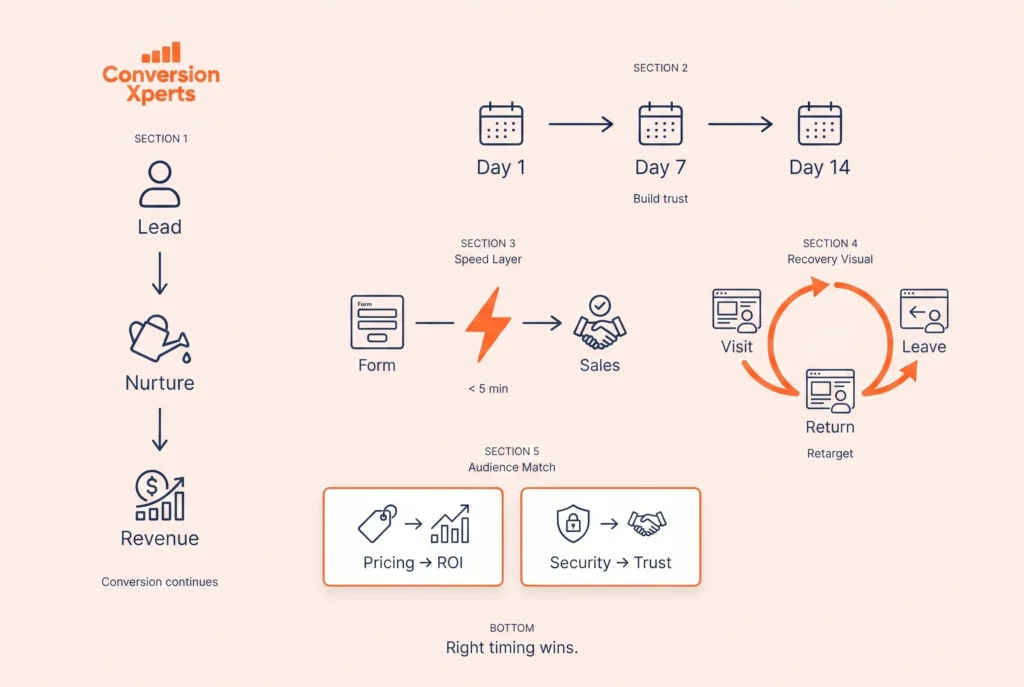
Converting a visitor to a lead is only the beginning. The real revenue impact of B2B CRO comes from optimizing the entire funnel from first touch to closed deal.
Email Nurture Sequence Optimization
The email sequence that follows a form submission is one of the most underleveraged conversion assets in B2B marketing. Most companies send a confirmation email and then wait for sales to follow up. Top performers use the first 14 days after a lead is created to deliver a structured sequence of high-value content that builds trust, addresses objections, and advances the prospect through their buying journey.
According to Marketo’s 2024 Engagement Benchmark Report, leads who receive five or more nurture touchpoints before a sales conversation close at 47 percent higher rates than those who receive only one. Optimizing the content, timing, subject lines, and CTAs of your nurture sequence using the same data-driven discipline you apply to your website is one of the highest-leverage activities in B2B CRO.
Sales and Marketing Handoff Optimization
A massive source of conversion loss in B2B is the handoff between marketing and sales. Marketing generates a lead, marks it as qualified, and passes it to sales. Sales takes days to follow up. The prospect has moved on mentally. According to a 2024 InsideSales study, leads contacted within five minutes of submitting a form are 100 times more likely to connect with a sales representative than leads contacted 30 minutes later.
Speed-to-lead optimization is a CRO initiative that does not touch your website at all but can have a larger impact on revenue than almost any on-page test. Implementing automated lead routing, instant calendar booking links in your confirmation emails, and sales notification triggers can dramatically compress the time between a lead being generated and a meaningful conversation happening.
Retargeting as a Conversion Recovery Tool
B2B buyers rarely convert on their first visit. They are researching, comparing, and building a business case. Retargeting campaigns that deliver highly relevant content to visitors based on the specific pages they viewed are an essential part of a complete B2B CRO strategy.
A visitor who read your pricing page gets retargeted with a customer ROI story. A visitor who read your security documentation gets retargeted with your compliance certifications and enterprise customer logos. This level of segmentation keeps your brand top of mind through the long B2B research cycle and brings high-intent prospects back at the moment they are ready to convert.