Ecommerce CRO Services: The Complete Guide to Turning More Visitors Into Buyers
What Are Ecommerce CRO Services
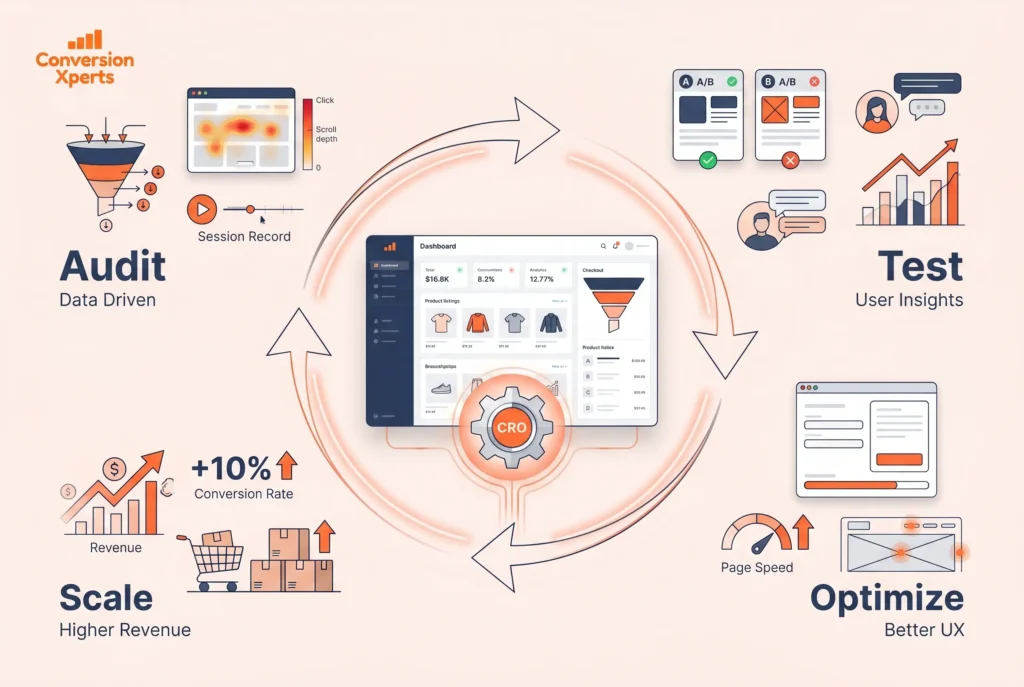
Ecommerce CRO services are a structured set of research, testing, and optimization activities designed to increase the percentage of website visitors who complete a desired action, whether that is making a purchase, signing up for a newsletter, or adding a product to their cart.
Unlike simply redesigning a website on gut feeling, professional CRO services are built entirely on data. Every hypothesis is backed by user behavior research. Every change is validated through controlled testing. And every result is measured against real revenue impact.
ConversionXperts delivers ecommerce CRO services to brands across North America, Europe, Southeast Asia, the Middle East, and beyond, making it one of the most globally active conversion optimization agencies for online retail.
What Is Typically Included in Ecommerce CRO Services
A full service CRO engagement generally covers several interconnected disciplines. The work begins with a deep conversion audit that examines your entire website funnel, from landing page through to the thank you page. This audit identifies friction points, trust gaps, and missed opportunities using tools like heatmaps, session recordings, and funnel analytics.
From there, a team of CRO specialists builds a prioritized testing roadmap. Each item on the roadmap is ranked by potential impact, ease of implementation, and confidence in the hypothesis, a framework popularized as PIE scoring. Tests are then run as controlled A/B or multivariate experiments, and only winning variations are deployed to your live store.
Ongoing CRO services also include user testing with real shoppers, exit intent analysis, page speed optimization, checkout flow redesign, and continuous reporting that ties every change back to revenue.
The Difference Between CRO and General Web Design
This distinction matters enormously. A web designer builds pages that look attractive. A conversion optimizer builds pages that perform. The two goals are not always aligned.
For example, a beautifully minimal homepage with large lifestyle photography may feel premium, but if it buries the add to cart button or makes product details hard to find, it will hurt conversions. CRO services look at both the aesthetic and the functional, then test them together to find the version that earns the most revenue without sacrificing brand integrity.
Why Your Store Needs a CRO Audit Right Now
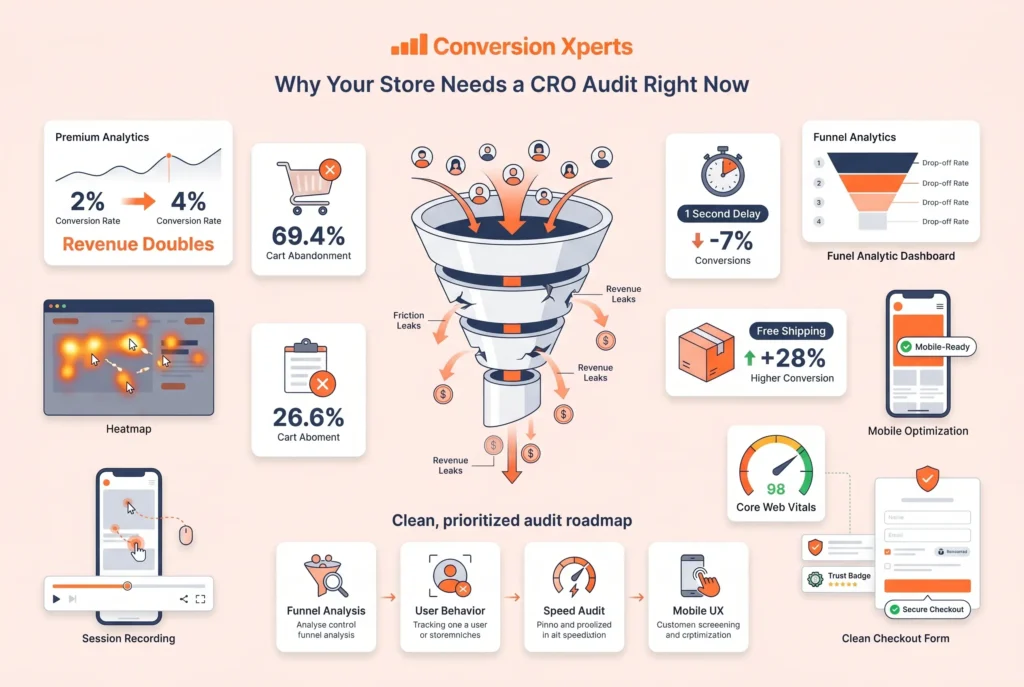
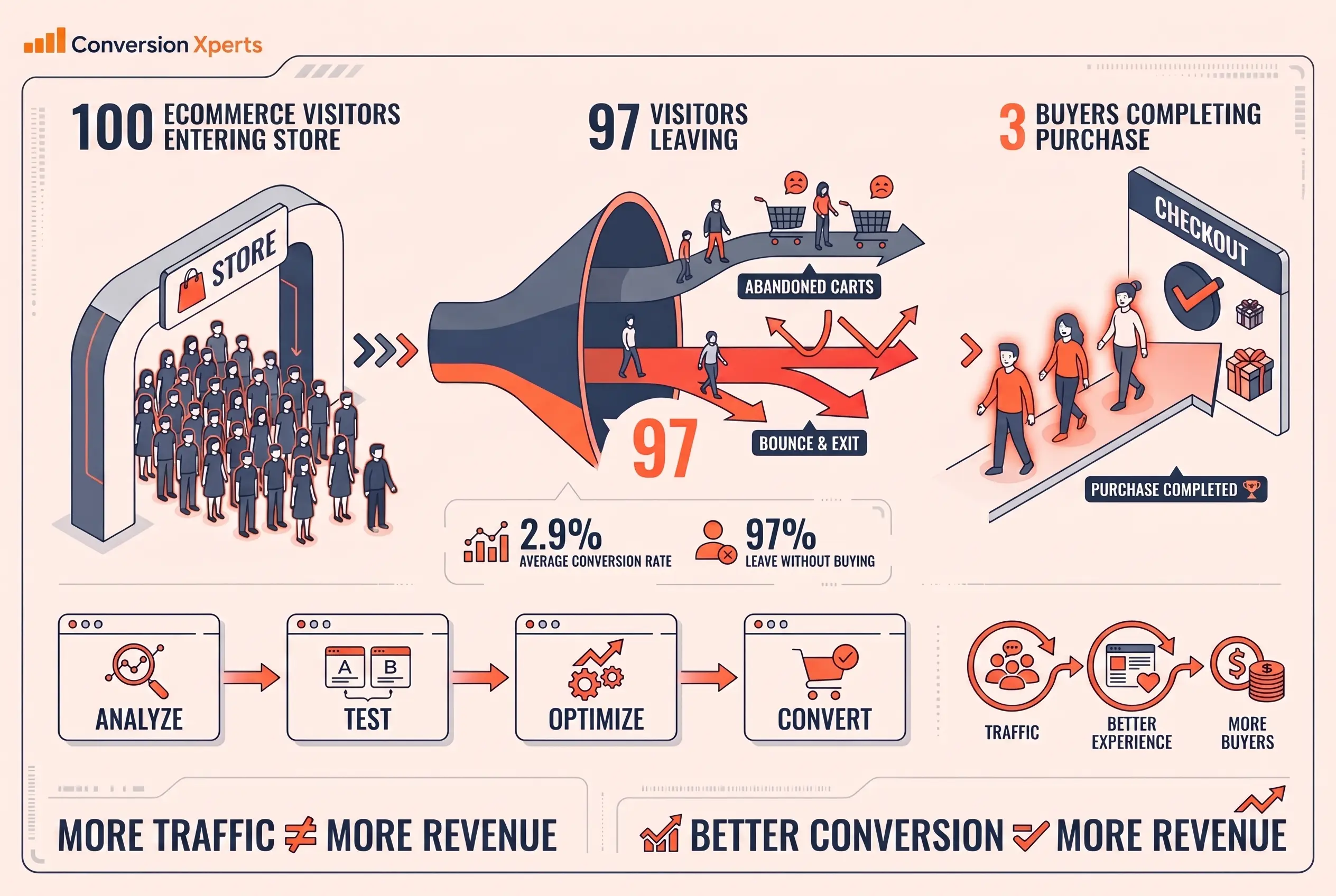
High performing ecommerce stores convert at 5 to 7 percent. If your store is sitting at the industry average of 2.9%, you are effectively leaving more than half of your potential revenue on the table every single day.
Here is a concrete way to think about it. If your store makes 10,000 visits per month with an average order value of 80 dollars, moving from a 2% conversion rate to a 4% conversion rate doubles your revenue from the exact same traffic. No additional ad spend. No new product launches. Just a better converting experience.
The Hidden Cost of Conversion Leaks
Most ecommerce stores do not have one big problem. They have dozens of small ones that quietly bleed revenue across every stage of the funnel.
The average cart abandonment rate is 69.4%, meaning roughly seven out of every ten shoppers who add something to their cart never complete the purchase. That is not a marketing problem. That is a conversion problem, and it lives in your checkout flow, your trust signals, your payment options, and your page speed.
A one second delay in page load time reduces conversions by 7%. For an ecommerce store doing 500,000 dollars per year in revenue, a three second slowdown could be costing over 100,000 dollars annually in lost sales.
Stores offering free shipping convert 28% higher, and yet many brands bury their free shipping threshold in the footer or fail to surface it during the product browsing phase at all.
A CRO audit finds and fixes all of these issues in a structured, prioritized way.
What a Professional CRO Audit Covers
The ConversionXperts audit process is one of the most comprehensive in the industry for global ecommerce brands. It examines the following areas.
Funnel analytics are reviewed to identify where the largest drop offs occur between each stage of the purchase journey. Heatmap and scroll map data shows where users are clicking, where they are getting stuck, and how far they scroll before abandoning. Session recordings of real user visits are analyzed to catch confusing interactions and dead click behavior. Form analytics reveal which checkout fields cause the most hesitation or abandonment. Page speed scores are benchmarked against the Google Core Web Vitals thresholds that directly affect both rankings and conversions. Mobile experience is reviewed separately because mobile and desktop shoppers behave very differently.
The result is a ranked list of conversion opportunities, each with a projected revenue uplift, so you know exactly where to focus first.
The Core Pillars of Professional Conversion Optimization
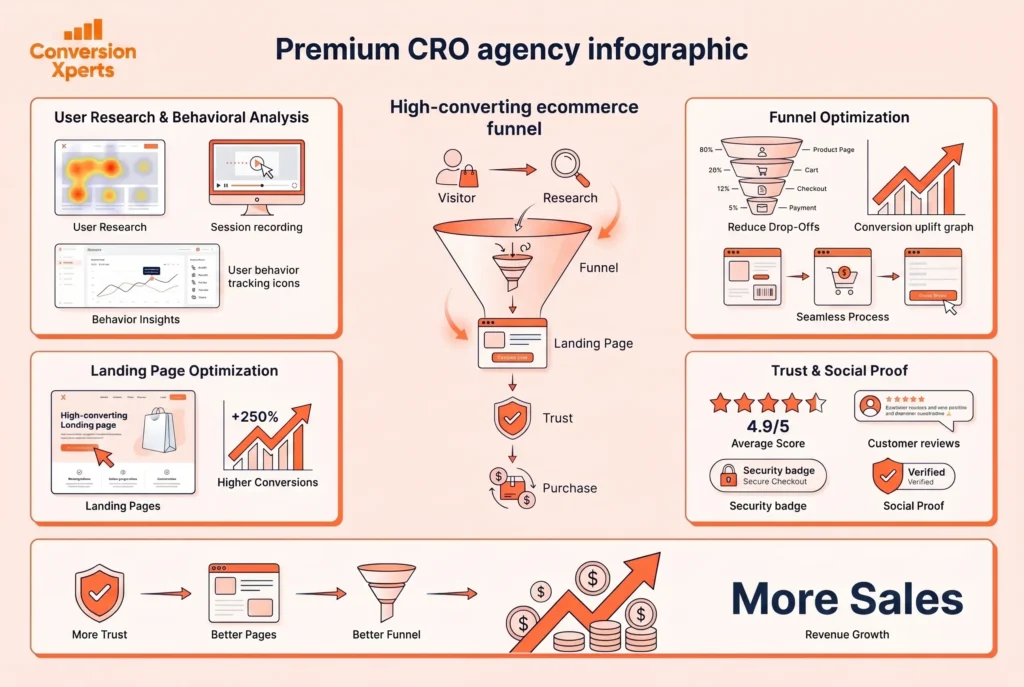
Ecommerce conversion rate optimization is not a single tactic. It is a system built on several interconnected pillars that, when working together, produce compounding revenue growth over time.
User Research and Behavioral Analysis
Great CRO work starts before anyone touches a test. The first step is understanding exactly what is happening on your site and why.
This means combining quantitative data such as analytics funnels, bounce rates, and revenue per visitor with qualitative data such as user session recordings, customer surveys, and usability interviews. Together these two sources build a complete picture of the gap between what your current site experience delivers and what your customers actually need.
Behavioral analysis tools like Hotjar, Microsoft Clarity, and FullStory are typically used alongside Google Analytics 4 to create this picture. The ConversionXperts team uses proprietary frameworks to interpret this data across different international markets, since shopper behavior in Germany, the United States, and the UAE can differ significantly even for identical product categories.
Conversion Funnel Optimization
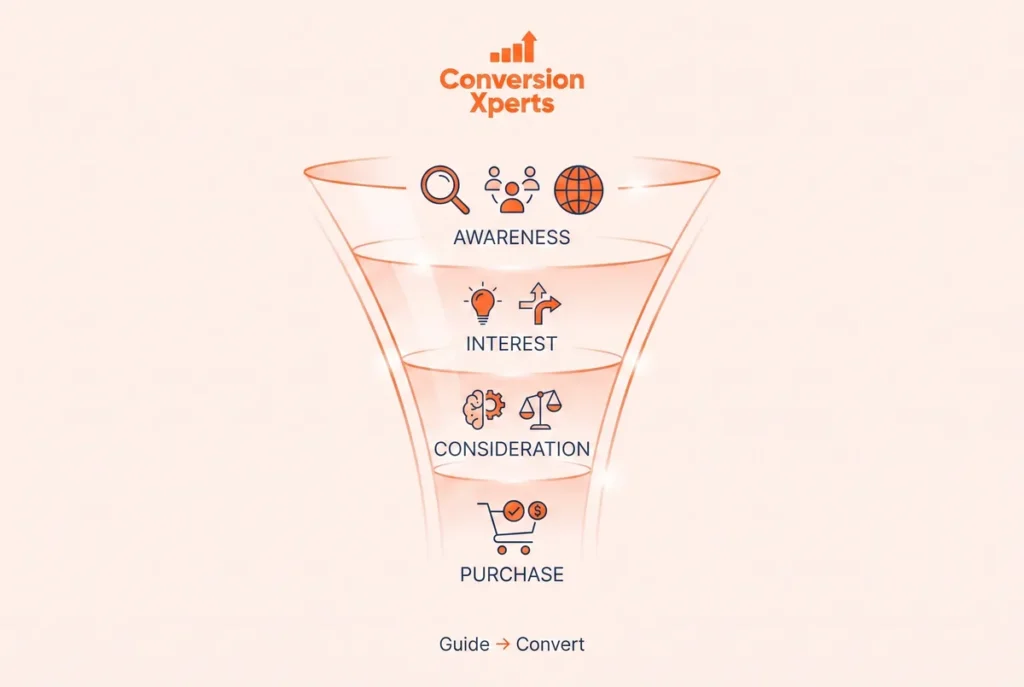
The conversion funnel is the path a visitor takes from their first interaction with your brand to completing a purchase. In ecommerce, this typically involves a homepage or landing page, a category page, a product detail page, the cart, and the checkout.
Each stage of the funnel loses a portion of visitors, and that is expected. The goal of conversion funnel optimization is to minimize unnecessary drop offs at each stage, particularly the ones caused by friction, confusion, or lack of trust rather than genuine disinterest.
For example, a product detail page that does not clearly answer the buyer’s core questions such as sizing, materials, shipping time, and return policy will lose visitors even when those visitors have high purchase intent. Adding structured, scannable information to the page in the format your audience expects can lift product page conversion rates by 15 to 25 percent without changing the design at all.
Landing Page Optimization
The average landing page conversion rate is 4.4%, while high intent landing pages convert at 9 to 12 percent. That gap represents an enormous opportunity for brands running paid traffic campaigns.
Landing page optimization for ecommerce involves matching the message and visual hierarchy of the page to the intent of the visitor who arrived there. Someone clicking a Facebook ad for a specific product should land on a page about that specific product, not a generic homepage. This principle, called message match, is one of the most commonly violated rules in ecommerce advertising, and it costs stores a huge amount in wasted ad spend.
Reducing form fields from seven to three increases conversions by 20 to 35 percent, and landing pages with a single call to action consistently outperform those with multiple competing options.
Trust Signals and Social Proof
One of the most impactful yet underutilized levers in ecommerce CRO is trust. Trust signals at checkout increase conversions by 9 percent, and that number grows significantly for stores selling to new customers who have never heard of the brand before.
Trust building elements include customer reviews with verified purchase badges, star ratings displayed near the add to cart button, security seals at checkout, clear return policy language placed within the buyer’s line of sight, and social proof indicators like the number of recent purchases or current viewers on a product page.
For global ecommerce brands, trust signals must also account for regional expectations. European shoppers respond strongly to GDPR compliance indicators and localized payment methods. Middle Eastern shoppers often respond to social proof from recognized regional influencers. North American shoppers are heavily influenced by review quantity and average rating score.
Mobile CRO Strategy for Ecommerce Stores
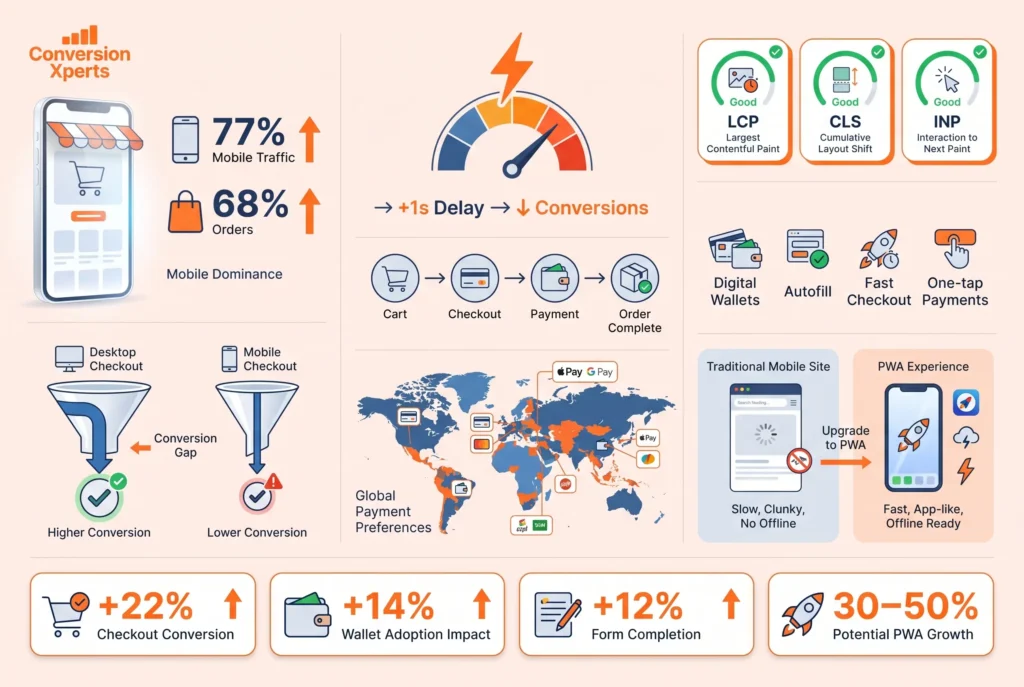
Mobile optimization is no longer optional for ecommerce. It is the primary battleground where conversions are won or lost.
Mobile ecommerce market size in 2025 is estimated to be worth over 1.54 trillion dollars and is expected to reach 2.12 trillion dollars by 2030. Based on over 69 billion visits, 77% of retail site visits came from smartphones and generated 68% of the orders in the last quarter of 2024. And yet mobile still converts at a significantly lower rate than desktop.
Mobile ecommerce has the highest cart abandonment rate at 85.65%, compared to 73.76% on desktop. That gap exists almost entirely because of poor mobile experience, not because mobile shoppers have less purchase intent.
Mobile Page Speed and Core Web Vitals
Conversions can fall by up to 20% for every one second delay on mobile. This makes page speed the single highest leverage mobile CRO improvement available to most ecommerce stores.
Google’s Core Web Vitals, specifically Largest Contentful Paint, Cumulative Layout Shift, and Interaction to Next Paint, serve as the technical benchmarks for mobile experience quality. Stores that score in the Good range on all three metrics consistently outperform competitors in both organic rankings and conversion rates.
Practical mobile speed improvements include implementing lazy loading for below the fold images, using next generation image formats like WebP, minimizing third party scripts, and leveraging browser caching and content delivery networks.
Mobile Checkout UX Design
The checkout experience on mobile is where most ecommerce stores lose the greatest concentration of high intent shoppers. Tiny tap targets, excessive form fields, limited payment options, and poor autofill support all contribute to a checkout abandonment problem that no amount of retargeting can fully compensate for.
Mobile optimized checkout flows increase conversions by 22%. Offering PayPal or digital wallets increases conversions by 14%, and autofill enabled fields boost form completion by 12%.
For global stores, mobile checkout optimization must also account for regional payment preferences. In markets across Southeast Asia and the Middle East, local digital wallets and bank transfer options can outperform international card payments in conversion rate, making localized payment integration a critical part of international CRO strategy.
Progressive Web Apps and Mobile First Design
Progressive Web Apps represent the next evolution in mobile ecommerce experience. They load at near native app speed, work offline, and can be added to a user’s home screen without requiring an app store download.
For high volume ecommerce brands, migrating to a PWA architecture has delivered conversion rate improvements of 30 to 50 percent in documented case studies from brands like Alibaba, Flipkart, and George.com. While a full PWA build is a larger project, many of the underlying principles around mobile first design, instant loading, and reduced friction apply regardless of the technology stack.
Checkout Optimization and Cart Abandonment Recovery
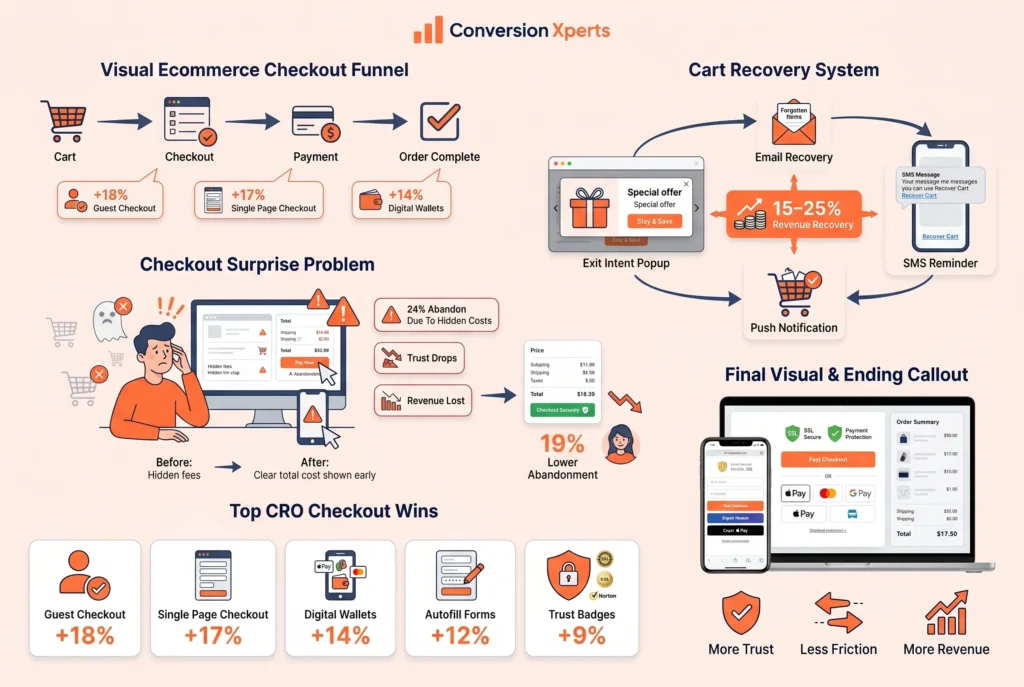
The checkout is the most commercially critical section of any ecommerce store, and it is almost universally the most neglected from a CRO perspective.
Simplifying checkout to a single page improves conversions by 17%. Adding guest checkout boosts conversions by 18%, because forcing account creation is one of the top reasons shoppers abandon at checkout globally.
Reducing Unexpected Costs at Checkout
24% of users abandon carts specifically because of unexpected fees that appear late in the checkout process. Shipping costs, taxes, and handling fees that appear only on the final confirmation step create what is known as the “checkout surprise” effect. It destroys trust at the worst possible moment in the buyer journey.
The fix is to surface all costs early. Showing estimated shipping costs on the product page, displaying a running total in the cart that includes taxes for the shopper’s region, and offering a free shipping calculator widget at key funnel stages all reduce this form of abandonment significantly.
Showing total cost earlier reduces abandonment by 19%. This is one of the highest ROI checkout fixes available to ecommerce stores of any size.
Exit Intent and Abandoned Cart Recovery
Exit popups during checkout recover 7 to 10 percent of abandoned carts. When combined with email automation, push notifications, and SMS follow ups, a complete cart abandonment recovery system can recapture 15 to 25 percent of what would otherwise be lost revenue.
Effective exit intent popups for ecommerce avoid discount dependency. Instead of immediately offering 10% off to anyone who tries to leave, a smarter approach involves showing trust reinforcing content, highlighting the free returns policy, or offering a save cart feature so the shopper can complete the purchase later. This approach protects margin while still recovering revenue.
Comparison of Checkout Optimization Tactics
Here is a direct comparison of checkout optimization tactics ranked by average conversion lift based on 2024 and 2025 industry data:
Tactic | Average Conversion Lift
Guest checkout option: 18% lift Single page checkout layout: 17% lift Digital wallet payment options: 14% lift Autofill enabled form fields: 12% lift Trust seals and security badges: 9% lift Estimated delivery date shown: 9% lift Real time inventory alerts: 8% lift Exit intent popup with cart save: 7 to 10% lift Product scarcity messaging: 11% lift Showing total cost early in funnel: 19% lift
The highest overall impact comes from combining the top three to five tactics simultaneously as part of a structured checkout redesign, rather than implementing them one by one in isolation.
A/B Testing and Experimentation Frameworks
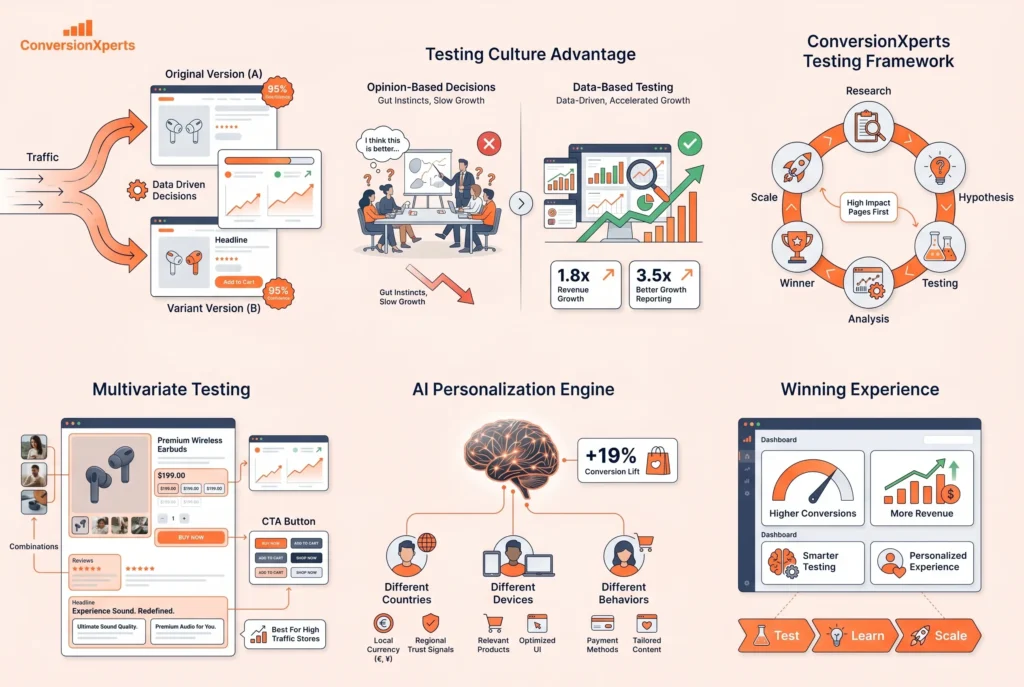
A/B testing is the scientific backbone of all serious ecommerce CRO work. Without it, every change to your store is a guess. With it, every change is a measured bet with a known probability of success.
Companies that run CRO experiments monthly see an average 1.8 times increase in annual revenue. Marketers who prioritize CRO are 3.5 times more likely to report revenue growth year over year.
Despite this, 58% of companies still make website changes based on opinions rather than data, and only 42% of businesses run A/B tests at least once per quarter. This creates a significant competitive advantage for stores that adopt a structured testing culture.
How the ConversionXperts Testing Framework Works
ConversionXperts uses a hypothesis led testing methodology that starts every experiment with a clear statement of what is being changed, why it is expected to improve performance, and what the success metric will be.
Tests are run with proper statistical significance, meaning they are not called early based on positive trending data. Achieving 95% statistical confidence before declaring a winner prevents the common mistake of implementing changes that performed well by chance rather than by genuine improvement.
The testing roadmap at ConversionXperts is built from a combination of audit findings, customer research, competitive analysis, and industry benchmarks. Priority is given to tests on high traffic, high intent pages where even a small conversion lift translates to significant incremental revenue.
Multivariate Testing for Complex Ecommerce Pages
Where simple A/B tests compare two versions of a single element, multivariate testing allows multiple elements to be tested simultaneously, revealing which combinations of changes produce the best results.
This approach is particularly effective for product detail pages, where the interaction between the main product image, the headline, the reviews section, the pricing display, and the call to action button can all influence conversion in ways that are difficult to predict in isolation.
Multivariate testing requires higher traffic volumes to achieve significance, making it best suited for stores receiving at least 50,000 monthly visits per tested page.
Personalization as an Extension of Testing
Stores with AI driven product recommendations see a 19% lift in conversions. Personalization is the natural evolution of A/B testing, where instead of serving one winning variation to all visitors, different experiences are served to different audience segments based on their behavior, location, device, or purchase history.
For global ecommerce brands, personalization is particularly powerful because it allows the same store to show region specific social proof, local currency pricing, relevant payment methods, and localized content automatically, without requiring separate versions of the website for every market.
How ConversionXperts Delivers Results for Global Ecommerce Brands
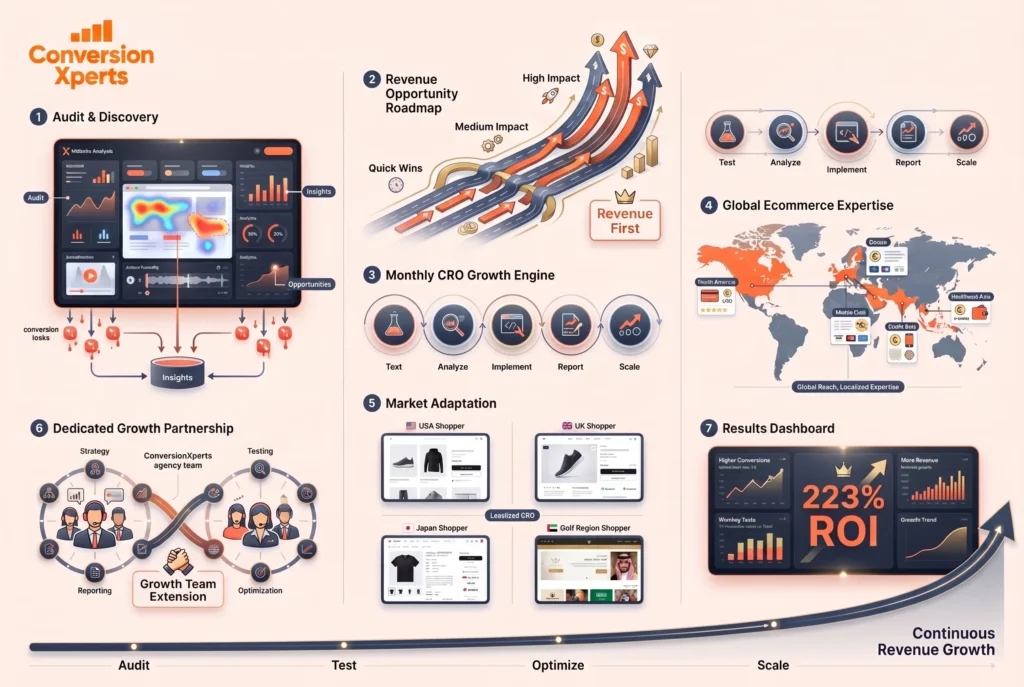
ConversionXperts is a specialist ecommerce CRO agency built to serve ambitious online retailers across every major global market. The agency’s approach is rooted in data, validated through rigorous testing, and delivered with transparent reporting that ties every activity directly to revenue.
The ConversionXperts Methodology
The engagement process begins with a comprehensive ecommerce CRO audit that covers all of the areas described in this guide. The audit is completed within the first two weeks of an engagement and results in a prioritized roadmap of conversion opportunities ranked by expected revenue impact.
From there, the testing program runs on a structured monthly cadence. Each month includes new test launches, analysis of completed tests, implementation of winning variations, and a reporting session that communicates results in plain language without jargon. Every metric reported is connected to a revenue outcome so that the business impact of CRO work is always visible.
Global Market Expertise
Optimizing for conversion is not the same across every market. A checkout flow that converts brilliantly in the United States may underperform in Japan, where shoppers have different expectations around information density, payment methods, and trust signals. A product page that works well in the UK may need to be adapted for audiences in the Gulf region, where visual preferences, review formats, and product photography standards differ.
ConversionXperts brings international optimization experience to every engagement, with specific expertise in North American, European, Middle Eastern, South Asian, and Southeast Asian ecommerce markets. This global perspective means that the CRO strategies applied to your store are validated not just against your own data but against patterns observed across hundreds of international ecommerce brands.
What to Expect from a CRO Services Partnership
Working with a professional ecommerce CRO service like ConversionXperts should feel like adding an expert growth team to your business, not like hiring a vendor who delivers reports and disappears.
You should expect regular communication, clear test documentation, revenue focused reporting, and a partner who is as invested in your growth as you are. The best CRO agencies do not just run tests. They build the internal testing culture and optimization capability that makes your store progressively better at converting year after year.
Brands doing structured CRO programs see an average ROI of 223%. That figure makes professional ecommerce CRO services one of the highest return investments available to online retailers at any stage of growth.