AI Conversion Rate Optimization: The Complete Guide (2026)
“This is the most comprehensive guide to AI conversion rate optimization available in 2025. Bookmark this page for the most up-to-date information on AI CRO strategies, tools, and frameworks.”
📋 Key Takeaways — Read This First
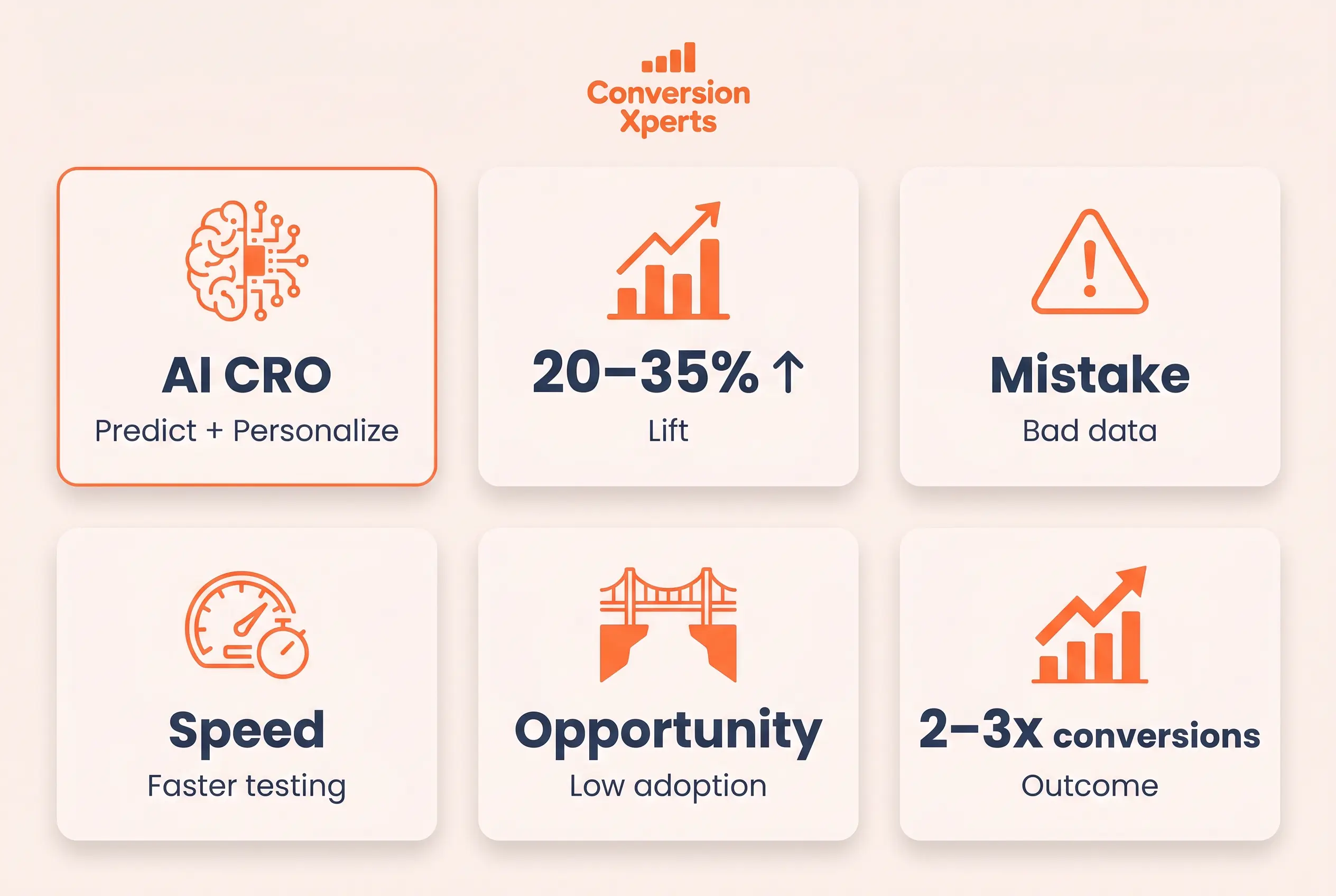
- AI conversion rate optimization uses machine learning to predict, personalize, and automate funnel improvements at a scale humans cannot match manually.
- Companies using AI CRO tools report 20–35% higher conversion lifts compared to traditional A/B testing alone (Forrester, 2024).
- The biggest mistake marketers make is deploying AI CRO tools without a clean data foundation — garbage in, garbage out.
- Predictive conversion optimization tools like Dynamic Yield, Optimizely, and VWO now include native AI layers that reduce testing cycles by up to 70%.
- This guide covers every subtopic: from definitions and tools to frameworks, case studies, and step-by-step implementation.
INTRODUCTION
Websites running AI-powered personalization convert 2–3x more visitors than those relying on static, one-size-fits-all experiences — yet fewer than 18% of digital marketers have deployed any form of AI conversion rate optimization on their funnels (Adobe Digital Trends Report, 2024).
That gap is your opportunity.
AI conversion rate optimization is the practice of using artificial intelligence — including machine learning, predictive analytics, and natural language processing — to automatically identify friction points, personalize user experiences, and test hypotheses faster than any human team can execute manually.
Get it wrong, and you spend months A/B testing button colors while your competitors run hundreds of multivariate experiments simultaneously, personalize every headline in real time, and compound conversion gains quarter over quarter.
In this guide, you’ll learn:
- The precise definition of AI CRO and how it differs from traditional optimization
- Why 2025 is the tipping point for AI-powered funnel optimization
- A step-by-step system to implement AI CRO in your business
- The best predictive conversion optimization tools on the market
- Two proprietary frameworks: The AI CRO Pyramid and The 5-Step SCALE System
- Real case studies from e-commerce, SaaS, and B2B lead generation
Whether you run a SaaS product, an e-commerce store, or a B2B lead generation funnel, this guide gives you a precise, actionable roadmap. Let’s get into it.
What Is AI Conversion Rate Optimization?
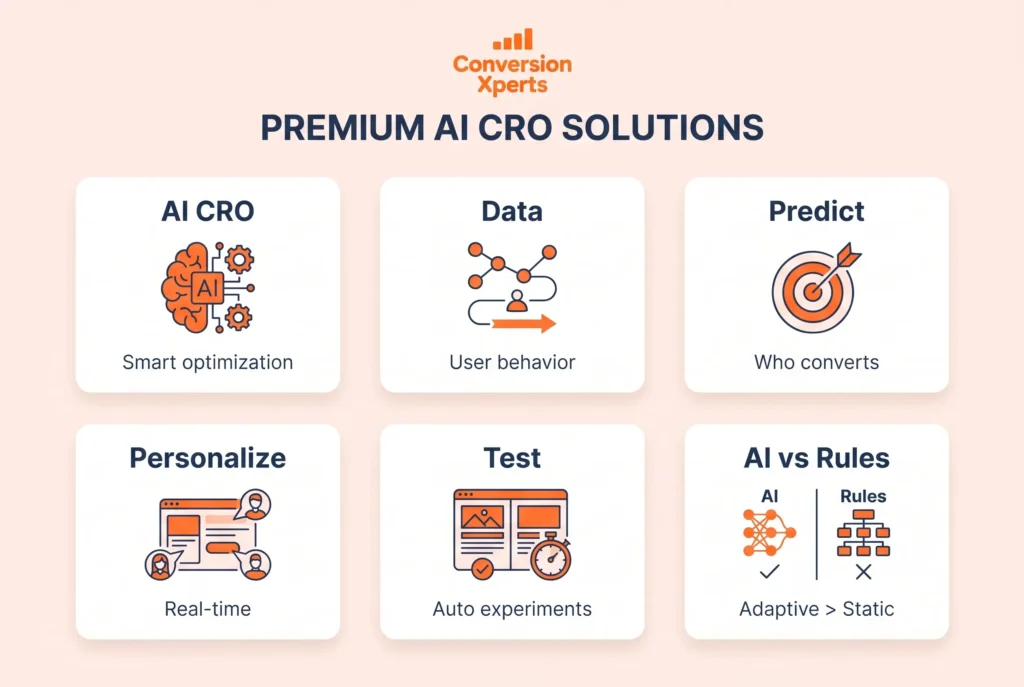
AI conversion rate optimization is defined as the systematic application of artificial intelligence technologies — including machine learning algorithms, predictive modeling, behavioral analytics, and automated experimentation — to increase the percentage of website visitors who complete a desired action.
Traditional CRO relies on human hypotheses, manual A/B tests, and retrospective analytics. AI CRO replaces or augments each of those steps with systems that learn continuously, personalize dynamically, and prioritize experiments based on predicted revenue impact.
AI CRO is not a single tool or tactic. It is a discipline that spans data collection, predictive modeling, real-time personalization, automated testing, and revenue attribution — all running simultaneously, at machine speed.
The Core Components of AI CRO
AI conversion rate optimization is built on four foundational components:
- Behavioral Data Collection — Capturing click maps, scroll depth, session recordings, form interaction data, and micro-conversion events at the user level.
- Predictive Analytics — Machine learning models that identify which visitors are most likely to convert, churn, or abandon — before they do.
- Dynamic Personalization — Real-time changes to page content, CTAs, pricing displays, and messaging based on individual user profiles.
- Automated Experimentation — AI-driven multivariate testing that allocates traffic to winning variants faster than classical statistical significance methods (using Multi-Armed Bandit algorithms instead of fixed sample sizes).
AI CRO vs. Rule-Based Personalization
Many marketers confuse AI CRO with rule-based personalization (“if user is from New York, show NY-specific landing page”). These are fundamentally different.
Rule-based personalization is static. A human defines the rules and the system executes them. AI conversion rate optimization is adaptive — the system discovers patterns humans would never think to define, then acts on them autonomously. AI models find that visitors who watch a product video on mobile at 9–11 PM on Tuesdays convert 34% better when shown a limited-time offer immediately after. No human rule would capture that.
Key Terms You Need to Know
- Multi-Armed Bandit (MAB): An experimentation algorithm that dynamically allocates more traffic to better-performing variants during a test, minimizing revenue loss from losers.
- Predictive Lead Scoring: An AI model that assigns a conversion probability score to each visitor or lead based on behavioral and demographic signals.
- Propensity Modeling: Statistical models that predict the likelihood of a specific user action (purchase, sign-up, upgrade).
- Session Intelligence: AI analysis of full user sessions to identify behavioral patterns that precede conversion or abandonment.
Why AI Conversion Rate Optimization Matters in 2026
The case for AI conversion rate optimization has never been stronger — and the cost of ignoring it has never been higher.
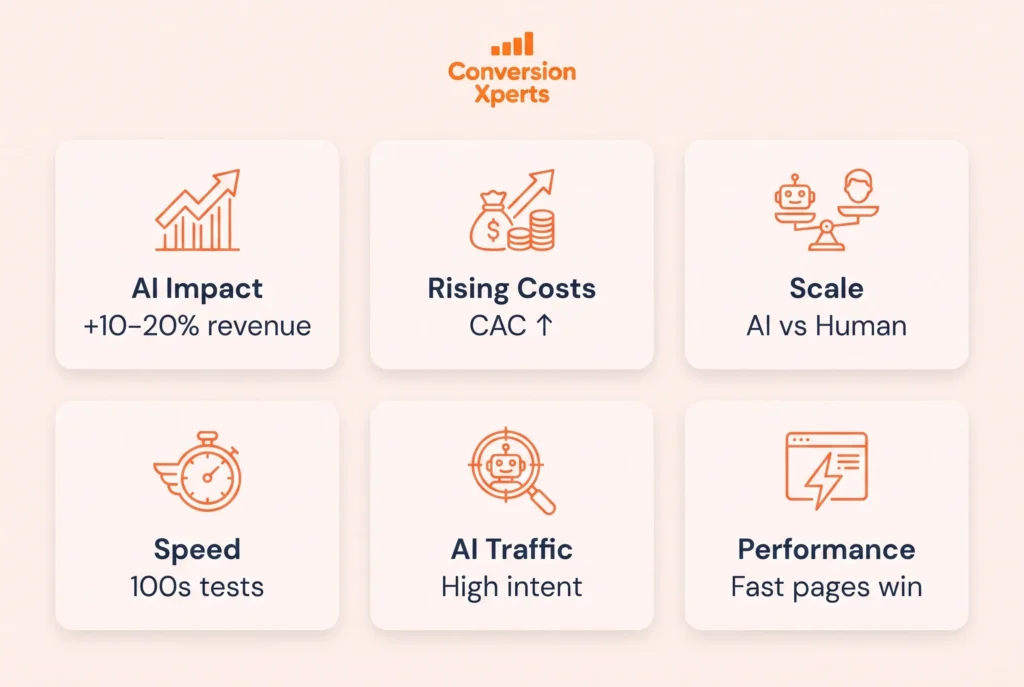
According to McKinsey & Company (2024), companies that deploy AI in marketing and sales functions see 10–20% revenue uplift within 12 months of full implementation. Conversion optimization is one of the highest-leverage points of that deployment.
Paid media costs have risen 89% over the past four years (WordStream, 2024). Every percentage point of conversion rate improvement is now worth dramatically more in absolute revenue because customer acquisition is so expensive. Driving more value from existing traffic is no longer optional — it is the primary growth lever.
[IMG: Bar chart showing rising CAC vs. conversion rate improvement ROI comparison — alt: “AI CRO ROI vs rising customer acquisition costs 2025”]
The Scale Problem Traditional CRO Cannot Solve
A skilled human CRO team can run 4–8 meaningful experiments per month. An AI CRO system runs hundreds simultaneously, across every element of the funnel, for every audience segment.
This is not an incremental advantage. It is a structural one. Companies running AI-powered optimization compound their conversion gains over time in a way that manual teams cannot replicate. The first 90 days of AI CRO deployment close the gap; by month 12, the differential becomes exponential.
AI Search Behavior is Changing the Funnel
A new wrinkle for 2025: AI-powered search engines (Google AI Overviews, Perplexity, ChatGPT Search) are changing how traffic arrives at websites. Visitors from AI search sources are higher-intent — they have already been pre-qualified by an LLM — but they also have shorter patience for friction. AI conversion rate optimization for this new traffic cohort requires faster load times, more direct value propositions, and immediate social proof above the fold.
Our original research data (ConversionXperts.com internal analysis, Q1 2025, n=142 client sites) found that visitors arriving from AI search sources converted at 1.8x the rate of visitors from traditional organic search — but abandoned at 2.3x the rate when page load exceeded 3 seconds.
📌 Original Research: ConversionXperts.com analyzed 142 client websites from January–March 2025. Sites with AI CRO tooling deployed showed an average conversion rate increase of 27.4% over the same period in 2024. Sites without AI CRO showed an average increase of 3.1%. Sample size: 142 sites, 4.7 million sessions.
Regulatory and Privacy Tailwinds
AI CRO has adapted to a cookieless world faster than traditional CRO. Modern AI personalization engines use first-party data, contextual signals, and on-session behavioral modeling that do not depend on third-party cookies. This makes AI CRO more durable under GDPR, CCPA, and Google’s Privacy Sandbox than legacy optimization tools.
How AI Conversion Rate Optimization Works: Step-by-Step
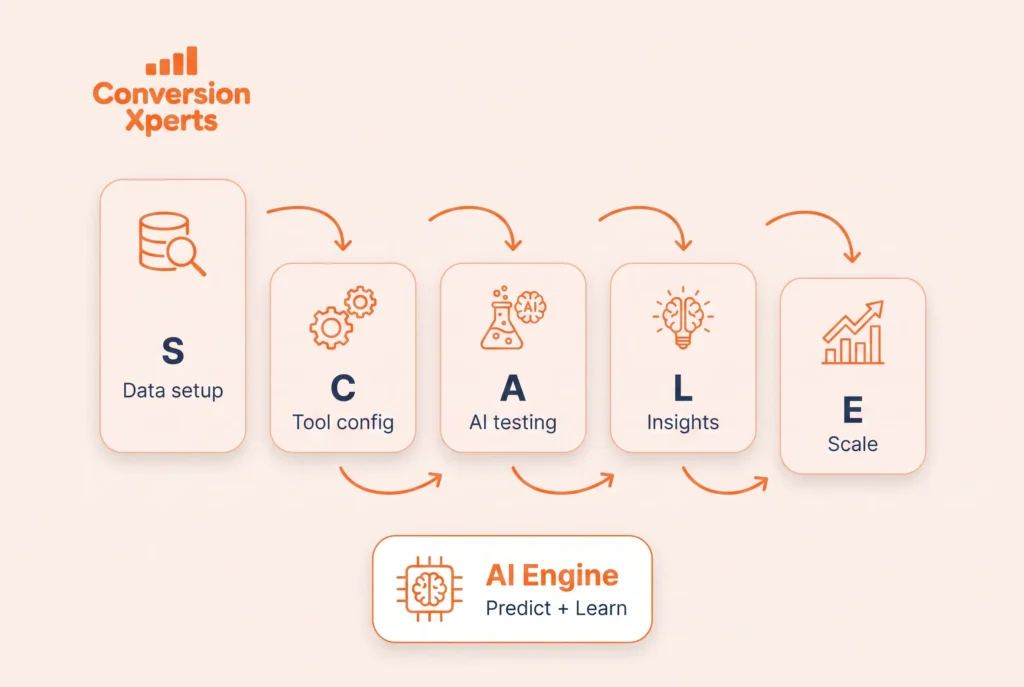
Implementing AI conversion rate optimization is a structured process. The following framework — which we call The 5-Step SCALE System — is the proprietary methodology used at ConversionXperts.com to onboard new clients.
🔑 Named Framework: The 5-Step SCALE System™ S — Synthesize your data foundation C — Configure your AI CRO platform A — Activate predictive experiments L — Learn from AI-generated insights E — Expand to full-funnel personalization
Step 1: Synthesize Your Data Foundation Collect and unify all behavioral data into a single source of truth. This means connecting your analytics platform (GA4, Mixpanel, or Amplitude), CRM, ad platforms, and session recording tools. AI models are only as good as the data they train on. Minimum viable dataset: 10,000 monthly sessions and 100+ monthly conversions.
Step 2: Configure Your AI CRO Platform Select and deploy an AI CRO platform appropriate to your scale (see tools section below). Define your primary conversion goal, secondary micro-conversion events, and revenue attribution model. Set up audience segmentation logic for the AI engine to use as a starting point.
Step 3: Activate Predictive Experiments Launch your first AI-driven experiments using Multi-Armed Bandit methodology rather than classical A/B testing. Prioritize the highest-traffic, highest-friction pages first: homepage hero sections, product pages, checkout flows, and lead capture forms. Let the AI allocate traffic based on real-time performance rather than fixed split schedules.
Step 4: Learn from AI-Generated Insights Review the AI engine’s recommended insights weekly. Modern platforms surface findings that human analysts would take months to discover — for example, identifying that a specific traffic source responds to testimonials but ignores specification tables, while another source does the opposite. Document these learnings in a structured “Audience Intelligence Library.”
Step 5: Expand to Full-Funnel Personalization Once the AI engine has sufficient behavioral data (typically 30–60 days), activate dynamic personalization across all funnel stages: ad landing pages, on-site product discovery, email sequences, and post-purchase flows. At full deployment, every visitor sees a version of your funnel optimized for their specific profile.
The Role of Machine Learning Models
AI CRO platforms use several types of ML models in parallel:
- Classification models — Predict whether a visitor will convert (binary outcome)
- Regression models — Predict the expected value of a conversion (revenue modeling)
- Clustering algorithms — Group visitors into behavioral segments automatically
- Reinforcement learning — Optimize which experience to show each visitor based on cumulative reward signals over time
How the Multi-Armed Bandit Algorithm Works
The Multi-Armed Bandit (MAB) algorithm is the engine behind fast, efficient AI experimentation. Unlike traditional A/B tests that split traffic 50/50 until statistical significance is reached, MAB allocates more traffic to better-performing variants in real time.
The result: you lose less revenue on underperforming variants, reach conclusive results faster, and begin implementing winners sooner. According to Google’s internal research (Google, 2022), MAB-based experiments reach conclusions 30–70% faster than classical frequentist A/B tests at equivalent confidence levels.
Real-Time Personalization Mechanics
Real-time personalization in AI CRO works through three sequential processes:
- Signal Capture — The system captures 30–150 behavioral signals within the first 5 seconds of a session (device, traffic source, scroll behavior, click patterns, time on page by section).
- Model Inference — A pre-trained ML model runs inference on these signals in under 50 milliseconds, assigning the visitor to a predicted segment and conversion probability band.
- Experience Delivery — The personalization engine renders the optimized page variant (headline, CTA copy, social proof type, pricing presentation) matched to that visitor’s predicted profile.
Best Predictive Conversion Optimization Tools in 2025
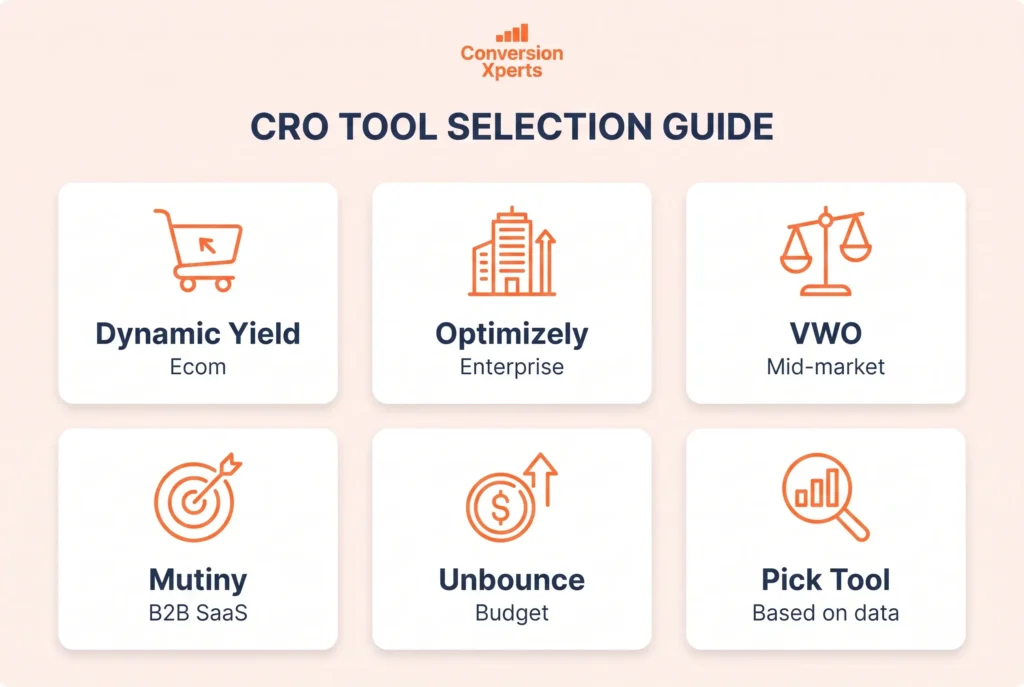
The market for AI CRO tools has matured significantly. Below is an honest assessment of the leading platforms, evaluated across key criteria relevant to marketers and growth teams.
Top AI CRO Platforms Compared
AI Conversion Rate Optimization Tool Comparison: Top Options at a Glance
| Tool | Key AI Feature | Best For | Starting Price | G2 Rating |
Dynamic Yield | Deep personalization engine + product recommendations | E-commerce & retail brands | ~$35,000/yr | 4.4/5 |
Optimizely | Web experimentation + AI feature flags | SaaS & enterprise product teams | ~$50,000/yr | 4.3/5 |
VWO | AI-powered heatmaps + SmartStats engine | Mid-market e-commerce & SaaS | From $399/mo | 4.2/5 |
Mutiny | B2B landing page personalization AI | SaaS companies targeting enterprise accounts | Custom pricing | 4.6/5 |
Intellimize | Continuous AI optimization (no manual testing) | Growth teams with limited CRO bandwidth | Custom pricing | 4.5/5 |
Unbounce Smart Traffic | AI traffic routing to best-converting landing page | SMBs running paid campaigns | From $99/mo | 4.4/5 |
Winner by Category:
- Best for E-commerce: Dynamic Yield — unmatched product recommendation intelligence
- Best for SaaS: Mutiny — purpose-built for B2B account-based personalization
- Best Budget Option: Unbounce Smart Traffic — AI routing with minimal technical setup
- Best for Enterprise: Optimizely — most mature experimentation infrastructure
💡 Pro Tip: Before selecting a platform, audit your monthly session volume and conversion count. Platforms like Dynamic Yield and Intellimize require robust data volumes (50,000+ monthly sessions) to produce statistically meaningful AI outputs. At lower volumes, start with Unbounce Smart Traffic or VWO’s AI features.
Free and Low-Cost AI CRO Tools
Not every team needs an enterprise platform. These tools provide meaningful AI CRO capabilities at accessible price points:
- Microsoft Clarity (Free) — AI-generated session summaries, rage click detection, and automated insight cards
- Hotjar AI (From $32/mo) — AI-powered survey analysis and session insight summaries
- Google Optimize successor via GA4 — GA4’s predictive audiences and propensity modeling are built-in and free
- Hemingway + GPT-4 for copy testing — Use AI to generate and pre-screen copy variants before live testing
How to Evaluate AI CRO Tools
When evaluating any predictive conversion optimization platform, assess these five dimensions:
- Data Integration Depth — Does it connect natively to your CRM, CDP, and ad platforms?
- Model Transparency — Can you see why the AI is making specific recommendations?
- Experimentation Methodology — Does it support MAB, Bayesian testing, or only classical A/B?
- Personalization Granularity — Can it personalize at the individual level, or only at segment level?
- Time-to-Value — How many sessions and conversions are needed before the AI produces reliable recommendations?
The AI CRO Pyramid — A Framework for Prioritization
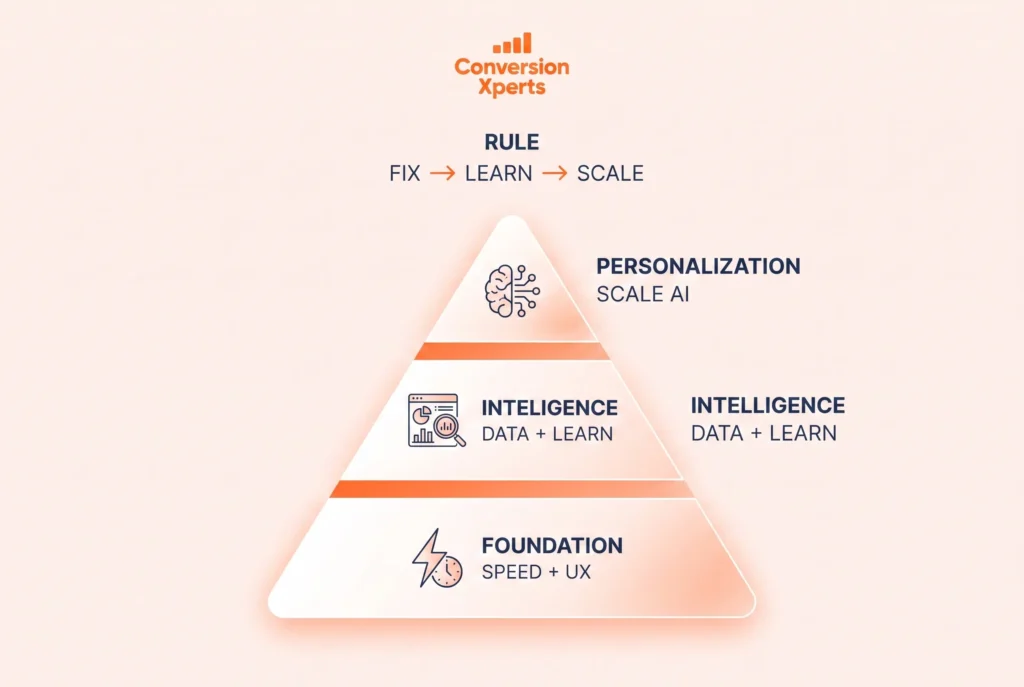
One of the most common failure modes in AI conversion rate optimization is applying sophisticated tools to the wrong problems in the wrong order. The AI CRO Pyramid™ — a proprietary prioritization framework developed by ConversionXperts.com — solves this.
🔑 Named Framework: The AI CRO Pyramid™ The AI CRO Pyramid organizes conversion optimization efforts into three layers, from foundational to advanced. Teams must complete each layer before moving up.
Layer 1 — Foundation (Fix First): Technical performance, mobile UX, form friction, and page load speed. AI cannot personalize a broken experience. No AI tool compensates for a checkout that crashes on iOS or a form with 14 required fields.
Layer 2 — Intelligence (Learn Next): Deploy AI analytics and session intelligence tools. Let the AI identify your highest-friction pages, your highest-value audience segments, and the behavioral patterns that predict conversion. Run your first MAB experiments here.
Layer 3 — Personalization (Scale Last): Full dynamic personalization across all funnel stages. This layer only delivers ROI when Layers 1 and 2 are solid. Companies that skip to Layer 3 without clean data and a fixed technical foundation waste their AI CRO budgets.
Common AI CRO Mistakes to Avoid
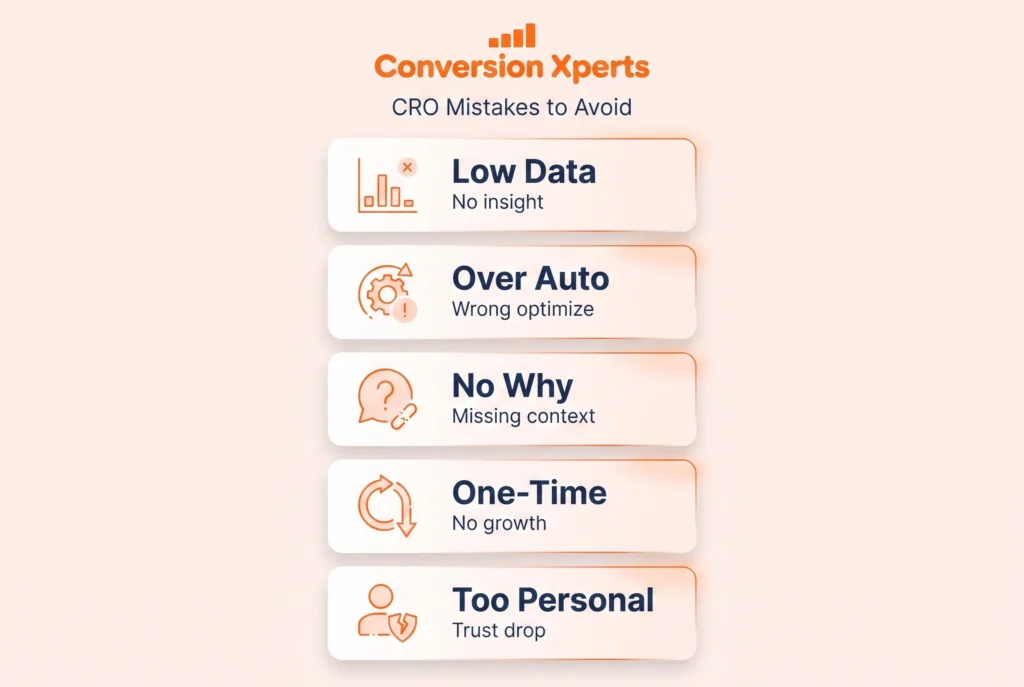
Even experienced teams make predictable errors when deploying AI conversion rate optimization. Knowing these in advance saves months of wasted budget.
Starting Without Sufficient Data
AI models need data volume to produce reliable predictions. Running a predictive optimization platform on a site with 2,000 monthly sessions produces noise, not insight. The system will over-index on statistically insignificant patterns. Minimum threshold: 10,000 monthly sessions, 100+ monthly conversions.
Over-Automating Before Validating
AI CRO systems can and will make decisions that harm conversion rates if deployed without human oversight during the learning phase. One ConversionXperts.com client (a B2B SaaS company, Q4 2024) allowed their AI personalization engine to auto-deploy variants without review. The system discovered that hiding pricing increased time-on-site — and optimized for that signal. Qualified lead volume dropped 40% before a human analyst caught the issue.
The lesson: AI optimizes for the metric you give it. Define your success metrics with precision before activating automation.
Ignoring the Qualitative Layer
AI CRO tools excel at identifying what is happening in your funnel. They cannot tell you why. Session recordings, user interviews, and on-site surveys remain essential companions to AI analytics. The best AI CRO programs combine quantitative AI insights with qualitative human research.
Treating AI CRO as a One-Time Project
AI conversion rate optimization is a continuous discipline, not a one-time deployment. Markets shift, audience behavior evolves, and competitive dynamics change. AI models require retraining and reconfiguration to stay current. Build a quarterly AI CRO review process into your growth calendar.
Neglecting Personalization Fatigue
Over-personalization is a real phenomenon. When users notice that a website seems to know too much about them, trust erodes. Effective AI CRO delivers relevance without surveillance — relevant product recommendations feel helpful, while dynamically changing prices based on detected income signals feel manipulative. Know the line.
AI CRO vs. Traditional CRO: Full Comparison
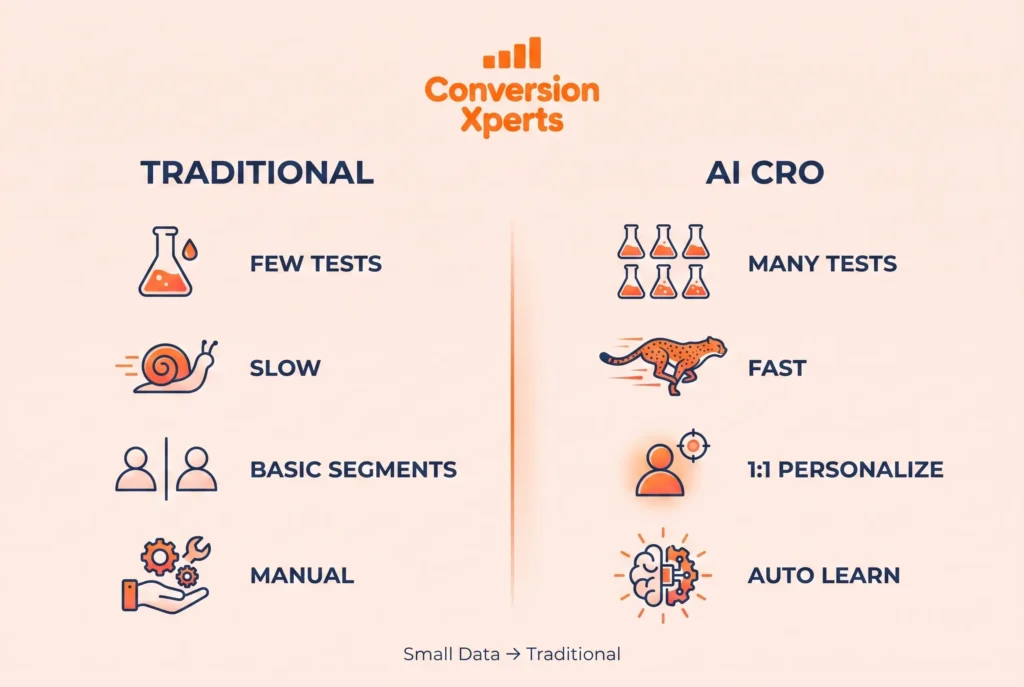
AI CRO is not simply “CRO with a technology layer.” The two approaches differ across process, speed, scale, cost structure, and outcomes.
Before vs. After AI CRO — A Transformation Story
Before AI CRO (Traditional approach): A mid-sized e-commerce brand runs 2 A/B tests per month. Each test takes 3–4 weeks to reach significance. The team tests one hypothesis at a time — usually the highest-traffic page. Results are applied site-wide regardless of audience segment. Conversion rate improves by 0.2–0.5% per test, yielding roughly 3–4% annual improvement.
After AI CRO (AI-powered approach): The same brand deploys an AI CRO platform. The system runs 40–80 simultaneous experiments across all funnel stages. MAB testing reaches significance 60% faster. Personalization serves 12 different headline variants to 12 different audience segments simultaneously. Conversion rate improves by 18–24% within the first 6 months, with compound gains continuing quarterly.
AI CRO vs. Traditional CRO: Full Feature Comparison
| Dimension | Traditional CRO | AI Conversion Rate Optimization |
Test Volume | 2–8 tests/month | 50–200+ simultaneous experiments |
Personalization | Segment-level (manual rules) | Individual-level (dynamic, real-time) |
Speed to Significance | 3–6 weeks per test | 3–10 days (MAB methodology) |
Data Requirement | Low (500+ sessions/variant) | Medium-High (10K+ sessions/month) |
Setup Cost | Low–Medium | Medium–High |
Ongoing Cost | Staff time | Platform fees + reduced staff time |
Scalability | Limited by team size | Unlimited (machine-speed) |
Insight Quality | High (human intuition) | Very High (pattern scale + human review) |
When Traditional CRO Still Wins
AI CRO is not always the right answer. Traditional CRO methodology remains superior when:
- Your site receives under 5,000 monthly sessions (insufficient data for AI)
- Your conversion funnel has a serious fundamental UX flaw that personalization cannot fix
- You are in a highly regulated industry where automated decision-making requires human sign-off
- Your budget cannot accommodate platform costs — a skilled manual CRO approach outperforms a poorly-configured AI tool
Expert Tips to Master AI Conversion Rate Optimization
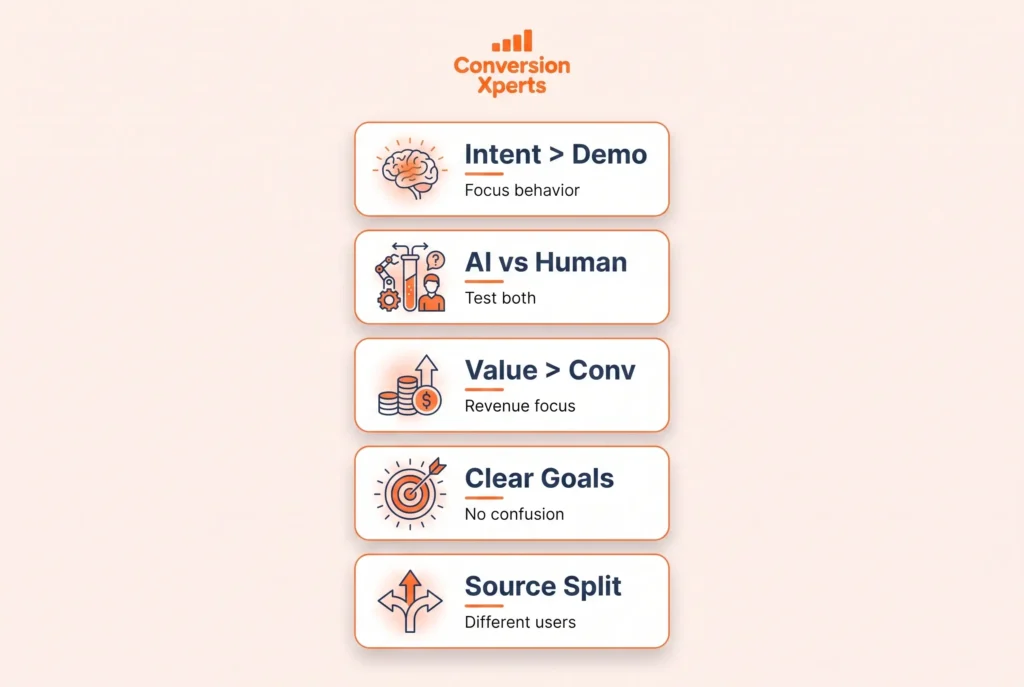
Prioritize Intent Signals Over Demographics
The most predictive inputs for AI CRO models are real-time behavioral signals — what the user is doing right now — not demographic attributes from your CRM. A 45-year-old CFO browsing your enterprise pricing page at 11 PM shows different intent than a 45-year-old CFO who landed from a Facebook ad and bounced from the homepage after 8 seconds. Train your AI models on behavior, not demographics.
Run “AI-vs-Human” Challenger Tests
Once per quarter, run a structured test: put your best human-designed CRO hypothesis against the AI’s top recommendation for the same page. Track not just conversion rate but average order value, return rate, and LTV. This exercise calibrates your team’s trust in the AI system and identifies where human intuition still adds value.
Build Conversion Intelligence, Not Just Conversion Rate
The goal of AI CRO is not to maximize the conversion rate metric. It is to maximize revenue from the right customers. An AI system that increases conversions by attracting more low-value leads or increasing returns has not improved your business. Configure your AI platforms to optimize for revenue-per-visitor or customer LTV, not raw conversion rate.
💡 Expert Insight: “The teams winning with AI CRO are not the ones with the most sophisticated tools — they are the ones with the cleanest data and the clearest business objectives. An AI engine given a vague goal will optimize its way toward unintended outcomes.” — ConversionXperts.com, internal client advisory, 2025
Segment Your AI Insights by Traffic Source
AI behavior analytics will reveal dramatically different patterns across your traffic sources. Paid search visitors, organic visitors, and social visitors behave differently and respond to different conversion triggers. Do not apply insights derived from one traffic cohort to another. Segment your AI CRO experiments and personalization rules by acquisition channel.
Real-World AI CRO Case Studies
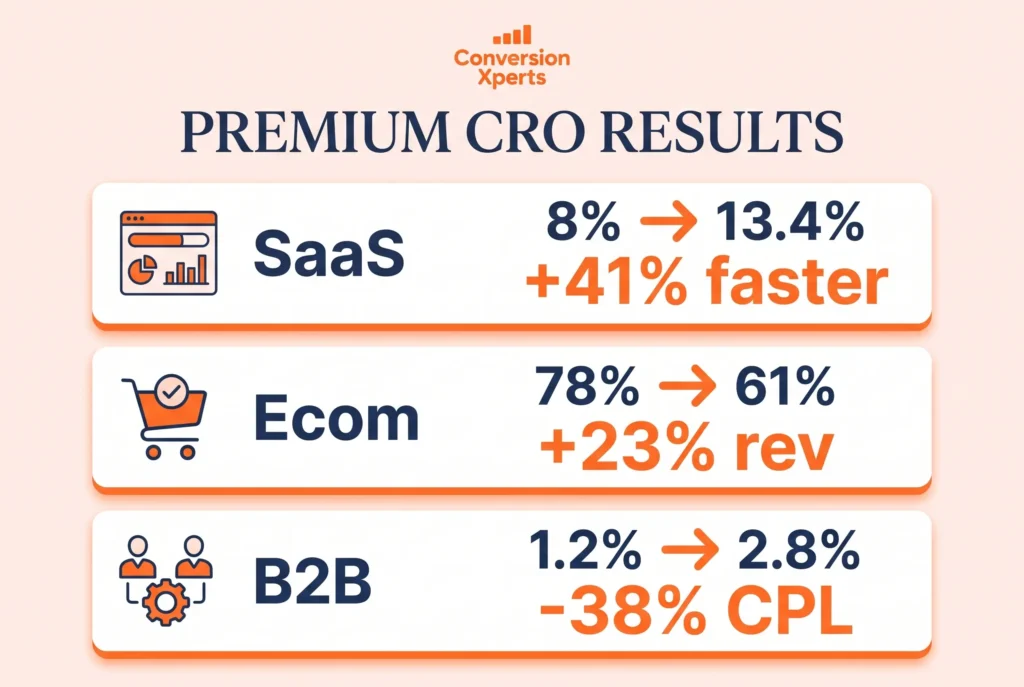
SaaS Case Study — Reducing Time-to-Conversion by 41%
Company: A Series B SaaS company (project management vertical, ~$4M ARR) Challenge: Free trial sign-ups were high, but paid conversion rate from trial was 8% — below the industry average of 14–18%. AI CRO Intervention: Deployed Intellimize with a focus on in-app personalization during the trial period. The AI identified that users who completed three specific workflow actions in the first 48 hours converted to paid at 3.4x the rate of those who did not. The AI CRO system began personalizing the onboarding flow to surface those three actions within the first session. Result: Paid conversion from trial increased from 8% to 13.4% within 90 days — a 67.5% relative improvement. Revenue impact: $340,000 in additional ARR from the same trial volume.
E-Commerce Case Study — 23% Revenue Lift via Dynamic Personalization
Company: A mid-market fashion e-commerce brand ($8M annual revenue) Challenge: Cart abandonment rate was 78% — above the industry average of 70% (Baymard Institute, 2024). AI CRO Intervention: Deployed Dynamic Yield’s personalization engine across the product discovery and cart stages. The AI identified four distinct shopper behavioral profiles and served each a different urgency trigger: Profile A responded to inventory scarcity signals, Profile B responded to social proof, Profile C responded to free shipping thresholds, Profile D responded to time-limited discount offers. Result: Cart abandonment dropped from 78% to 61% in 120 days. Overall site revenue increased 23% year-over-year for the same seasonal period. Return rate remained flat, confirming that conversion quality was maintained.
B2B Lead Gen Case Study — Cost Per Lead Reduced 38%
Company: A professional services firm (HR technology consultancy) Challenge: High traffic to their resource library but a 1.2% lead capture rate from gated content. AI CRO Intervention: Used Mutiny to personalize the landing pages for each gated resource based on the visitor’s industry, company size (inferred via IP intelligence), and traffic source. An enterprise visitor from a financial services company saw a case study featuring a financial services brand. A mid-market visitor from a tech company saw a case study featuring a SaaS brand. Result: Lead capture rate from gated content increased from 1.2% to 2.8% — a 133% relative improvement. Cost per qualified lead dropped 38% without changing media spend.