What Is a Good Website Conversion Rate? The Definitive Guide (2026)
What Is a Website Conversion Rate?
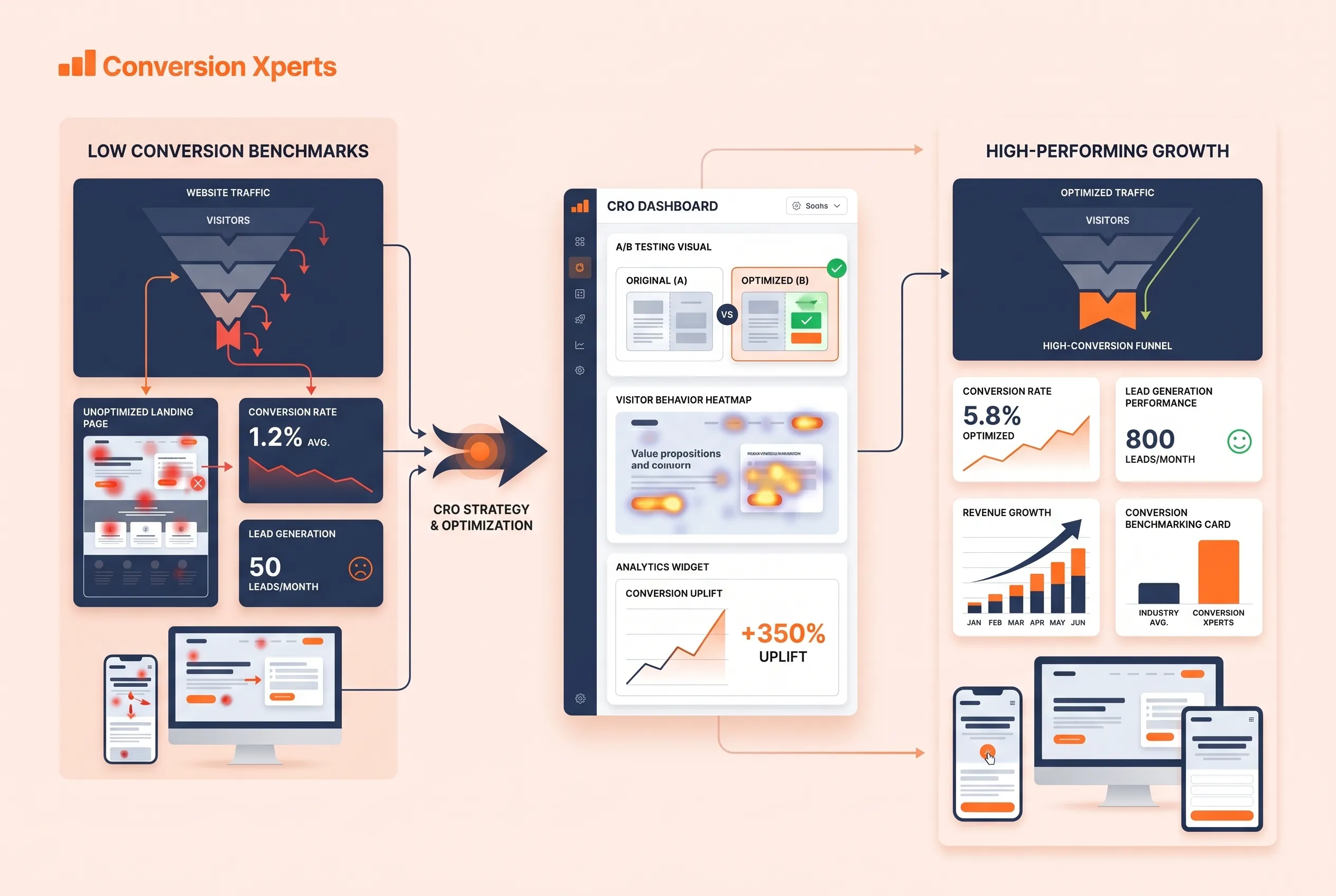
A website conversion rate is the percentage of your total visitors who complete a specific, desired action. That action changes depending on your business goal. For an ecommerce store, it is a completed purchase. For a SaaS company, it might be a free trial sign-up or a demo request. For a B2B services firm, it could be a contact form submission or a booked call.
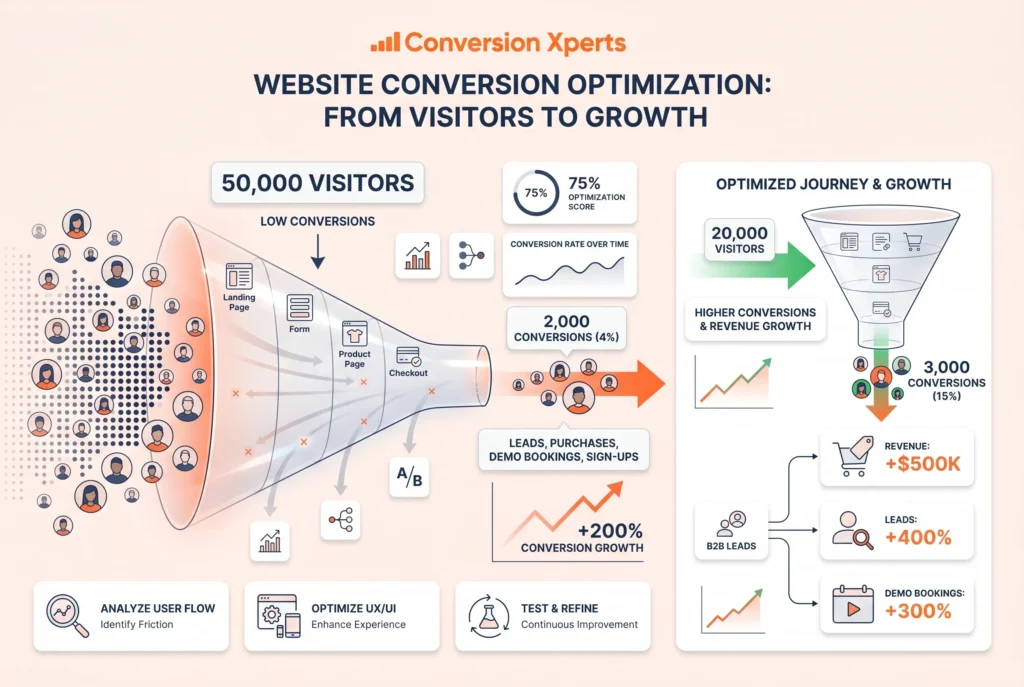
The conversion rate is arguably the single most important metric your website produces. It tells you not just how many people are visiting, but how many of them are actually doing something valuable when they arrive. A site with 50,000 monthly visitors and a 1% conversion rate is leaving serious money on the table compared to a site with 20,000 visitors converting at 5%.
Understanding your rate, benchmarking it against your industry, and improving it systematically is the difference between a website that is an asset and one that is just a cost centre.
How to Calculate Your Website Conversion Rate
Calculating your website conversion rate is straightforward. Here is the formula every marketer and growth team should know by heart:
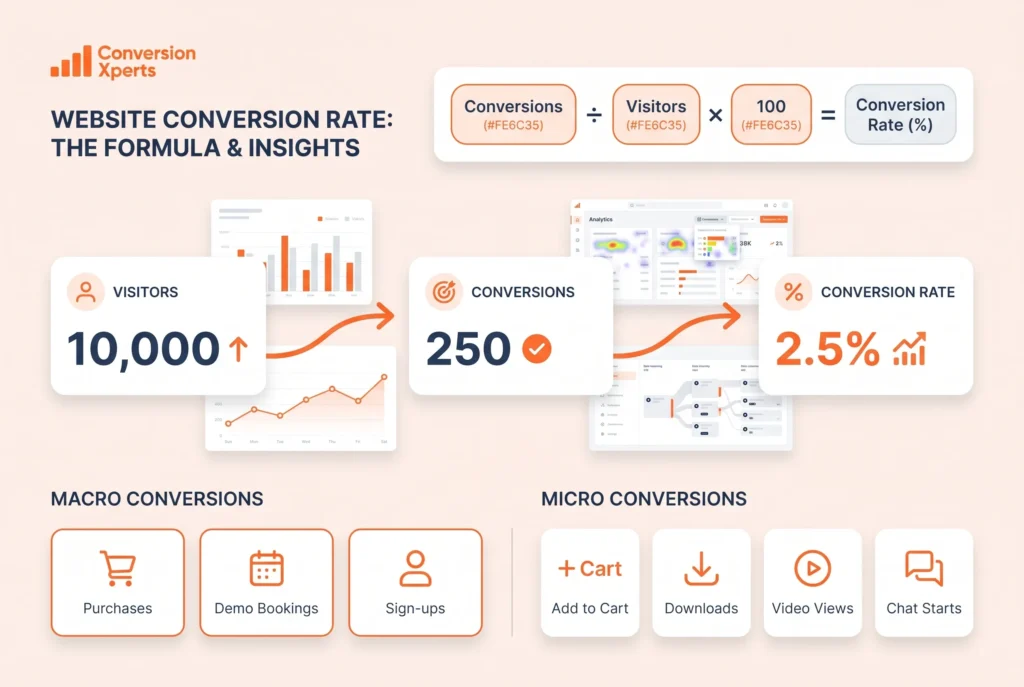
Conversion Rate (%) = (Number of Conversions ÷ Total Visitors) × 100
So if your website received 10,000 visitors in a month and 250 of them completed a purchase or filled out a form, your conversion rate is 2.5%.
What Counts as a Conversion?
This is where many businesses get confused. A conversion is any action that moves a visitor closer to becoming a customer or that directly delivers business value. Common conversions include:
- Completed purchases (ecommerce)
- Free trial or demo sign-ups (SaaS)
- Contact or lead form submissions (B2B services)
- Phone call clicks
- Email newsletter sign-ups
- Content downloads (whitepapers, case studies)
- Live chat initiations
- Add-to-cart actions (micro-conversion)
The key is to be specific about which conversion you are measuring. Lumping all of these together gives you a muddled number that is hard to act on. The best practice is to track your primary macro-conversion (the action most directly tied to revenue) and your secondary micro-conversions (the smaller steps that feed into it) separately.
Macro vs. Micro Conversions: Why Both Matter
Macro conversions are the big ones: the purchase, the demo, the signed contract. Micro conversions are the steps along the way, such as reading three blog posts, watching a product video, or downloading a case study. Micro conversions matter enormously in B2B and SaaS because the sales cycle is long. Someone who downloads your pricing guide today may not book a demo for another six weeks. If you only measure macro conversions, you miss the opportunity to nurture and accelerate that journey.
Where to Track Your Conversion Rate
Google Analytics 4 (GA4) is the standard tool for tracking conversion rates. You set up “events” or “goals” for each desired action and GA4 reports the percentage of sessions or users that trigger those events. Google Ads, Meta Ads Manager, and LinkedIn Campaign Manager all have built-in conversion tracking for paid traffic. Tools like HubSpot, Mixpanel, and Amplitude add additional depth, especially for SaaS companies that need to track in-product behaviour alongside website behaviour.
What Is a Good Website Conversion Rate? Benchmarks by Industry
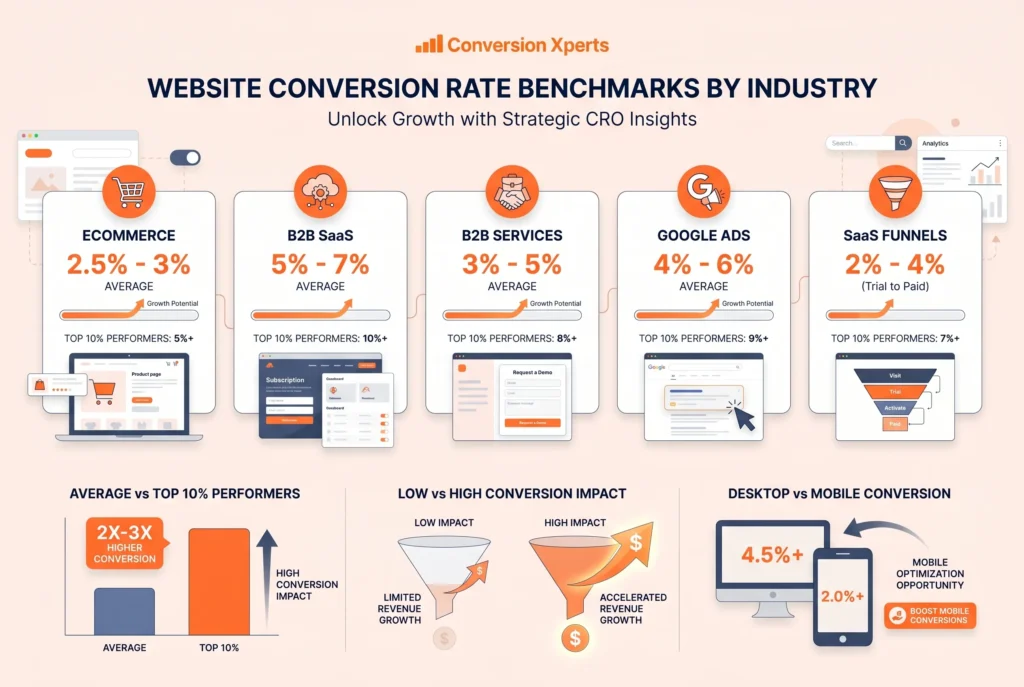
A good website conversion rate is one that beats your industry average. That sounds simple, but the benchmarks vary so widely — from under 1% to over 10% — that the answer only makes sense when you pin it to your specific context.
Here is the most important rule: do not compare your SaaS demo request rate to an ecommerce checkout rate. They are not the same kind of conversion. Compare apples to apples.
The Global Average Baseline
The global average website conversion rate sits at approximately 3.68% across all website types, according to data compiled by HigherVisibility in 2024. For ecommerce specifically, that number drops. IRP Commerce data for 2025 puts the ecommerce average at 1.8%, while Triple Whale found an average of 2.04% across the brands on their platform. For B2B SaaS landing pages, the average falls further still — to around 1.1% according to Grafit Agency’s 2025 analysis of over 200 SaaS companies.
If you are above these numbers, you are outperforming the average. If you are below 1%, there are almost certainly specific, fixable problems dragging your rate down.
Industry-by-Industry Conversion Rate Benchmarks (2025)
| Industry / Segment | Average Conversion Rate | Top 10% Conversion Rate |
Ecommerce (overall) | 1.8–2.1% | 4.7%+ |
B2B SaaS (visitor to lead) | 1.1–2.5% | 8–15% |
B2B Services (professional) | 4–6% | 10%+ |
Google Ads (all industries) | 6.96–7.52% | 11.45%+ |
SaaS Free Trial to Paid | 15–25% | 40–60% |
Legal Services (B2B) | 7.4% | — |
Food & Beverage | 3.7% | — |
Arts & Crafts | 5.11% | — |
Fashion & Apparel | 1.01–2.20% | — |
Health & Wellness | 1.87–4.20% | — |
Baby & Child Products | 0.70% | — |
Shopify (top 20% stores) | 3.2%+ | 4.7%+ |
Email Marketing | 1–5% | 10%+ (abandoned cart) |
Facebook Ads (organic) | 9.21% | — |
Sources: IRP Commerce, Lucky Orange, Triple Whale, HigherVisibility, Grafit Agency, WordStream, First Page Sage (2024–2025).
What “Good” Really Means for B2B vs. Ecommerce vs. SaaS
This is the nuance that most generic conversion rate articles miss — and it is critically important for B2B and SaaS businesses.
For an ecommerce store selling a $20 item with a frictionless checkout, a 3–4% conversion rate is solid. For a B2B SaaS company selling a $24,000 per year enterprise platform, a 1% visitor-to-demo-request rate might actually represent exceptional performance, because the quality of those leads and the revenue they generate per conversion is enormous. Context is everything.
The best B2B SaaS companies think about conversion in stages rather than a single rate. According to 2025 funnel benchmark data compiled from FirstPageSage, Marketjoy, and PoweredBySearch:
- Visitor to lead: 1.5–2.5% average, 8–15% for top performers
- Lead to MQL: 15–40% depending on nurture quality
- MQL to SQL: 15–21% is the average; this is typically the biggest bottleneck
- SQL to closed deal: 25–35%, with elite teams exceeding 40%
A 1-point lift in your B2B website conversion rate — say, from 2% to 3% — can reduce your customer acquisition cost (CAC) by 15–25%. That is one of the fastest and most capital-efficient levers available to any growth team.
Device-Based Conversion Rate Differences
Where your visitors are coming from — and what device they are using — changes your expected benchmark significantly. As of late 2024, mobile has taken over in terms of traffic share at 60.9%, yet desktop users historically convert at higher rates. For ecommerce:
- Desktop: approximately 2.8% conversion rate
- Tablet: approximately 3.1%
- Mobile: approximately 2.8% (improving rapidly due to better mobile UX)
If your mobile conversion rate is dramatically lower than your desktop rate, that is not a traffic problem. It is a user experience problem — and fixing it is one of the fastest ways to increase your overall website conversion rate.
How to Improve Your Website Conversion Rate: 10 Proven Strategies
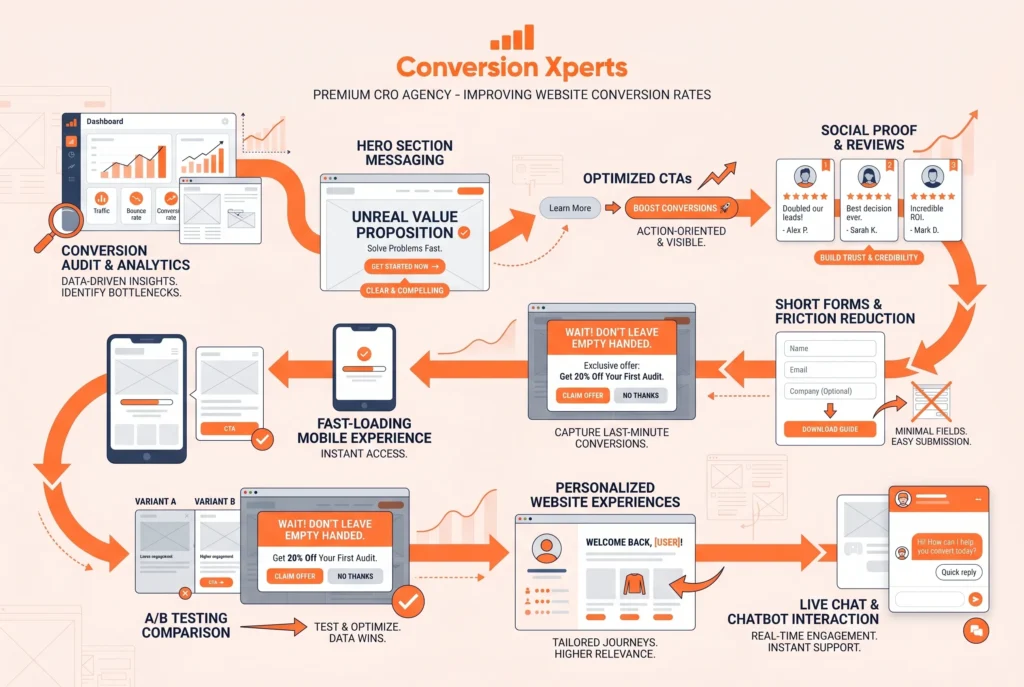
Improving your conversion rate is not about guessing. It is about understanding exactly where visitors are dropping off, forming hypotheses about why, testing changes, and measuring the results. Here are the ten strategies that consistently move the needle across industries.
4.1 Start With a Conversion Audit
Before you change a single thing on your website, you need to know what is actually broken. A conversion audit combines quantitative data (heatmaps, session recordings, funnel analytics, exit rate data) with qualitative data (user surveys, customer interviews, live chat transcripts) to pinpoint exactly where and why visitors are leaving without converting.
Tools like Hotjar, Microsoft Clarity, and Google Analytics 4 give you the quantitative picture. Surveys using tools like Typeform or Hotjar’s feedback widgets give you the qualitative why. Do not skip this step. Skipping the audit and jumping straight to “let us redesign the homepage” is how companies waste months and budgets on changes that do not actually address the real problem.
4.2 Nail Your Value Proposition in the First 5 Seconds
When a visitor lands on your website, they make a subconscious judgment within 50 milliseconds about whether to stay or leave. Your hero section — the first thing visible without scrolling — needs to answer three questions instantly: What do you do? Who is it for? Why should I care?
Vague, generic headlines like “Empowering Businesses to Succeed” convert poorly. Specific, benefit-driven headlines like “Double Your SaaS Demo Requests in 90 Days — Without Increasing Ad Spend” convert much better. The specificity creates relevance, and relevance is the engine of conversion.
4.3 Optimise Your Calls to Action
Your call to action (CTA) is the bridge between a visitor’s interest and your conversion goal. Weak CTAs are one of the most common — and most fixable — problems in CRO. “Submit” and “Click Here” are dead. “Get My Free Audit,” “Start My Free Trial,” and “Book a 15-Minute Strategy Call” are live.
Research from WordStream shows that personalised CTAs perform 202% better than generic ones. Single-goal landing pages with one focused CTA achieve 13.5% conversion rates on average, compared to 10.5% for pages with multiple competing CTAs, according to 2026 data from SaaS Hero. Every page should have one primary CTA. One job. One next step.
4.4 Build Trust Through Social Proof
People do not trust businesses. People trust other people. Social proof — the evidence that other real humans have bought from you, used your service, and had a good experience — is one of the most powerful conversion drivers available.
Effective social proof includes:
- Verified customer reviews and star ratings near your primary CTA
- Case studies with specific numbers (not “we improved conversions” but “we improved conversions by 247% in 60 days”)
- Logos of recognisable clients (especially important for B2B)
- Video testimonials from real customers
- Trust badges, certifications, and security seals near forms and checkout
- Social proof metrics like “Trusted by 500+ businesses globally”
Placing testimonials near your CTAs — not just on a testimonials page — creates the reassurance boost at exactly the right moment.
4.5 Reduce Friction on Forms
Long, complicated forms are one of the biggest killers of lead generation conversion rates. Research shows that reducing form fields from 10 to 6 can increase form completion rates by 15.65%. For SaaS companies, every extra field in your sign-up flow is a door that a percentage of users will not walk through.
The principle is progressive disclosure: ask for the minimum information you need to qualify the lead, then gather additional information post-engagement when you have already delivered some value. For B2B forms, first name, company name, work email, and a single qualification question is usually enough to get started.
Real-time validation — showing users instantly when they have made a formatting error rather than after they hit submit — also reduces abandonment significantly.
4.6 Optimise Your Page Speed
Page speed is both an SEO ranking factor and a direct conversion factor. Google’s data shows that as page load time goes from 1 second to 3 seconds, the probability of a bounce increases by 32%. At 5 seconds, that bounce probability increase reaches 90%.
For every 100 milliseconds of improvement in mobile page speed, ecommerce brands have seen up to 1% increases in conversion rates. Run your site through Google PageSpeed Insights and Core Web Vitals to identify specific issues. Common fixes include compressing images, enabling lazy loading, using a CDN, and eliminating render-blocking JavaScript.
4.7 Use A/B Testing to Make Data-Driven Decisions
A/B testing — also called split testing — means creating two versions of a page or element and splitting your traffic between them to see which one converts better. This removes opinion from the equation entirely. You are not guessing which headline is better; you are letting your users tell you.
For statistically significant A/B test results at a baseline conversion rate of 2%, you need approximately 50,000 visitors per variant. If your site does not have that level of traffic yet, focus on qualitative testing methods and higher-impact changes like entire page redesigns rather than minor tweaks to button colours.
The highest-impact tests for most businesses focus on: hero section messaging, pricing page layout, form length, CTA copy and placement, and social proof positioning.
4.8 Implement Exit-Intent Technology
Exit-intent technology detects when a visitor’s mouse movement suggests they are about to leave the page — and triggers a targeted popup offering a reason to stay or convert. A well-designed exit-intent overlay with a compelling offer (a free resource, a discount, a free consultation) can recover 10–15% of abandoning visitors.
For B2B and SaaS websites, exit-intent works especially well when you offer a high-value resource like a benchmark report, a free audit, or a case study pack in exchange for an email address. You convert the visitor to a lead even if they are not ready to buy today.
4.9 Personalise the Experience
Generic websites deliver generic conversion rates. Personalisation — showing different content, headlines, or offers to different visitor segments — consistently outperforms one-size-fits-all approaches. According to 2025–2026 data from SaaS Hero, AI-driven personalisation delivers roughly a 10% uplift in conversions across content, outreach, and in-app experiences.
Practical personalisation for most businesses includes: showing different CTAs to returning visitors vs. first-time visitors, customising landing page headlines based on ad source or keyword, and targeting visitors from specific industries or company sizes with relevant case studies and messaging.
4.10 Leverage Live Chat and Chatbots
Real-time conversation is one of the most underused conversion tools, particularly for B2B websites. A visitor who has a specific question and cannot find the answer will leave. A visitor who gets an instant answer to that question is much more likely to take the next step.
According to a 2024 Harvard Business Review study cited by HubSpot, responding to a lead within 5 minutes makes you 21 times more likely to qualify that lead than waiting 30 minutes. Live chat brings that responsiveness to your website 24/7, either through a human team or an AI-powered chatbot that handles common questions and routes complex ones.
How to Improve Conversion Rate on B2B and SaaS Websites Specifically
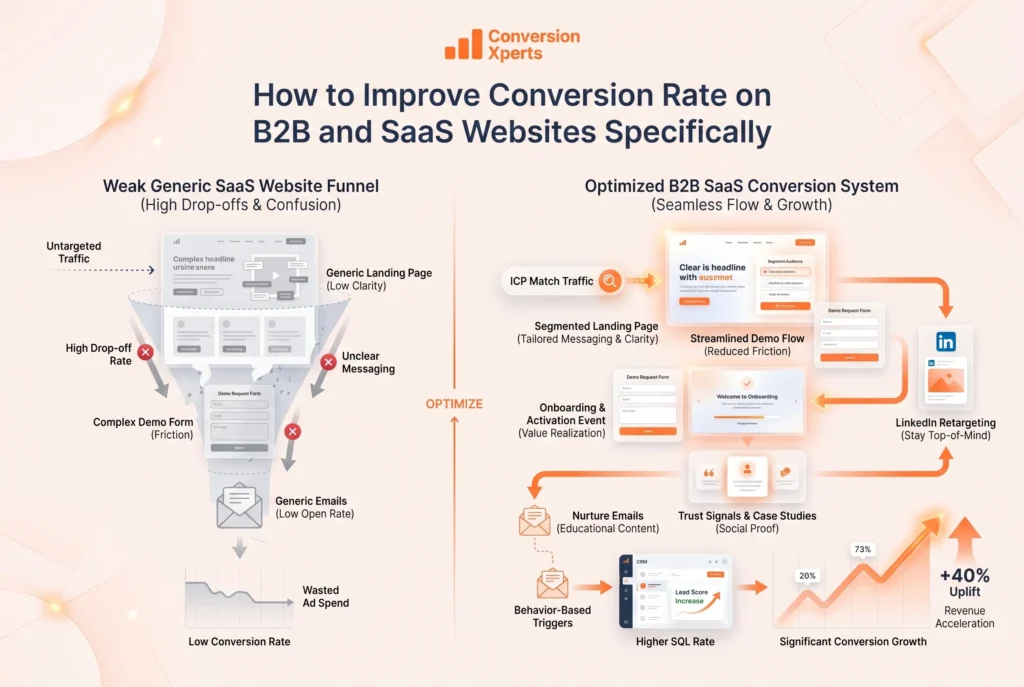
B2B and SaaS conversion optimisation is a fundamentally different discipline from ecommerce CRO. The sales cycle is longer. Multiple decision-makers are involved. Trust thresholds are much higher. And the cost of getting it wrong — a prospect who leaves your site and never comes back — is enormous given the high lifetime value of each customer.
According to Gartner’s 2024 B2B Buyer research, the average business purchase involves 6 to 10 people and takes anywhere from 3 to 18 months to complete. That means your website is not just converting one person — it needs to convert a committee, often through multiple visits over weeks or months.
5.1 Align Your Website With Your Ideal Customer Profile
The single most common reason B2B websites underperform on conversion is that they speak to everyone and resonate with no one. If your website could describe any company in your category, it is not specific enough. Your ICP (Ideal Customer Profile) should be so clearly defined that a visitor from that exact company segment reads your homepage and thinks, “This was written for us.”
Concretely, this means having separate landing pages or messaging tracks for different segments. If you serve mid-market SaaS companies and enterprise manufacturing firms, those are different buyers with different pain points, different vocabularies, and different objections. One homepage cannot serve both well.
5.2 Build a Demo and Trial Flow That Converts
For SaaS companies, the demo request or free trial sign-up is the critical macro conversion. The average B2B SaaS website converts 1.1% of visitors to this goal. The top 10% achieve 8–15%. What separates them?
First, they make the demo or trial offer incredibly low-friction. The sign-up form is short. There is no credit card required. The value is communicated clearly before the form. Second, they use social proof specific to the visitor’s use case — a CFO sees customer stories from finance teams; an HR director sees HR-specific case studies. Third, they follow up within minutes of a sign-up, not hours or days.
According to a 2024 report by Lenny Rachitsky, SaaS companies that define a specific “activation event” — the first moment where a user feels real value — and build their entire onboarding experience around getting new users to that moment as fast as possible see trial-to-paid conversion rates 2.5 times higher than those that do not. Slack defined their activation event as a team sending 2,000 messages together. Dropbox defined it as syncing at least one file to one device. What is yours?
5.3 Create Content That Accelerates the B2B Buying Journey
In B2B, your buyer typically spends significant time researching before they ever fill out a form. According to 2025 data from First Page Sage and PoweredBySearch, SEO-generated B2B leads convert at 2.1% from visitor to lead and achieve a 51% MQL-to-SQL conversion rate — the strongest of any channel. That is because organic search visitors arrive with specific intent and context.
Content that accelerates the buying journey includes:
- Comparison pages that honestly position you against competitors
- ROI calculators that show exactly what a prospect stands to gain
- Case studies with specific, verifiable numbers from similar companies
- Technical documentation that builds confidence in your product
- Pricing pages that are clear and transparent rather than requiring a sales call to discover basic information
Hidden pricing kills conversion. When someone has to book a call just to find out what something costs, a significant portion of them simply move on to a competitor who shows their pricing. Transparency builds trust, and trust drives conversion.
5.4 Use LinkedIn Retargeting and Nurture Sequences
Most B2B visitors will not convert on their first visit. That is normal. The job of your conversion strategy is to make sure those visitors do not forget you and that you keep showing up with relevant, useful content until they are ready to buy.
LinkedIn retargeting is particularly powerful for B2B because it lets you target visitors by job title, seniority, industry, and company size — so you can show a CFO at a 500-person tech company a different ad and landing page than you would show an operations manager at a 50-person retail brand. According to WordStream’s 2024 data, the average B2B Google Ads conversion rate is 3.04%, with top performers reaching 8–10%.
Email nurture sequences are equally important. A 2025 benchmark study found that email marketing leads achieve 43% lead-to-MQL conversion and 46% MQL-to-SQL conversion — among the strongest of any channel for mid-funnel nurturing.
The Biggest Mistakes That Kill Your Conversion Rate
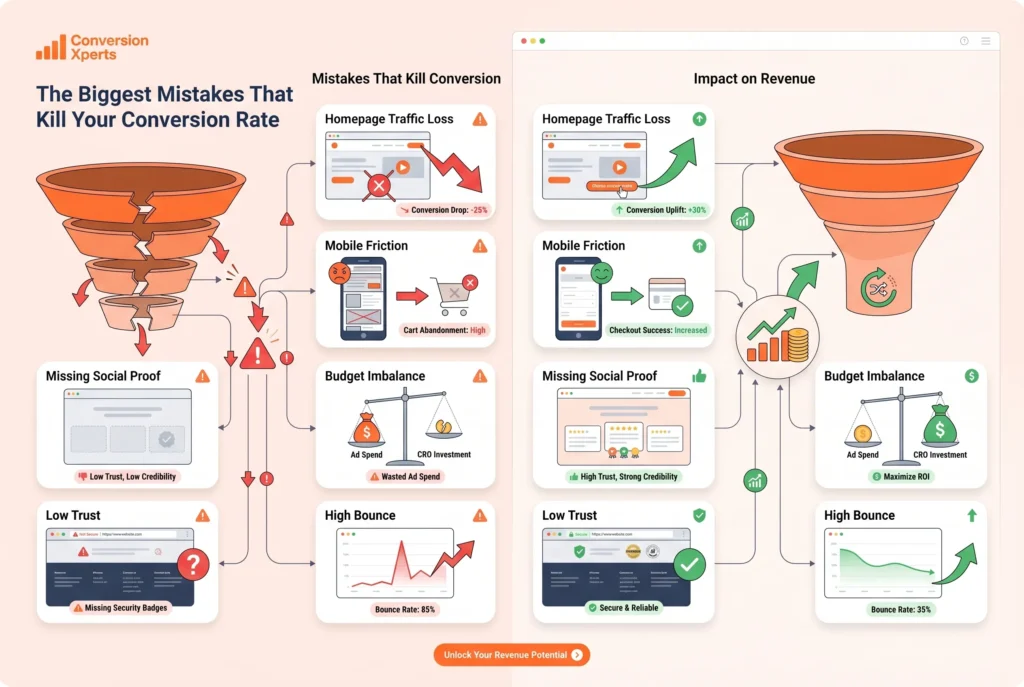
You can follow every best practice and still have a terrible conversion rate if you are making any of these fundamental mistakes. These are the conversion killers that come up again and again in professional CRO audits.
6.1 Sending Traffic to Your Homepage Instead of Dedicated Landing Pages
Your homepage is designed to serve multiple audiences with multiple goals. It is, by definition, a compromise. A dedicated landing page built for a specific audience, with a specific offer, and a single CTA, almost always outperforms homepage traffic for paid campaigns.
The top 10% of landing pages convert at 11.45% or higher, according to 2024 WordStream data. The average is 2.35%. That gap almost entirely comes down to relevance — how closely the page message matches what the visitor was searching for or what the ad promised.
6.2 Ignoring Mobile Experience
Over 60% of website traffic globally now comes from mobile devices. If your site is not genuinely optimised for mobile — not just “responsive” but actually designed for a mobile user’s behaviour, screen size, and attention span — you are throwing away a majority of your conversion opportunities. Mobile-specific issues include slow load times, forms that are hard to fill on a small screen, CTAs that are too small to tap, and pop-ups that cover the entire screen.
6.3 No Social Proof at the Right Moments
A 2024 joint study by Econsultancy and RedEye found that only 28% of companies are satisfied with their conversion rates, and 37% are actively dissatisfied. One of the leading causes is missing or misplaced social proof. Reviews and testimonials buried at the bottom of a page do very little. Social proof placed immediately next to your primary CTA — at the moment of decision — dramatically reduces the hesitation that prevents people from clicking.
6.4 Underinvesting in CRO Relative to Traffic Acquisition
This is the most systemic mistake in digital marketing today. According to data cited by Keywords Everywhere, companies spend $1 on conversion rate optimisation for every $92 they spend on acquiring traffic. That ratio is wildly out of balance. Every dollar you spend optimising conversion multiplies the return from every dollar you spend on traffic. If your conversion rate doubles, your traffic budget effectively doubles in value without spending another cent.
How ConversionXperts Helps B2B and SaaS Websites Convert More
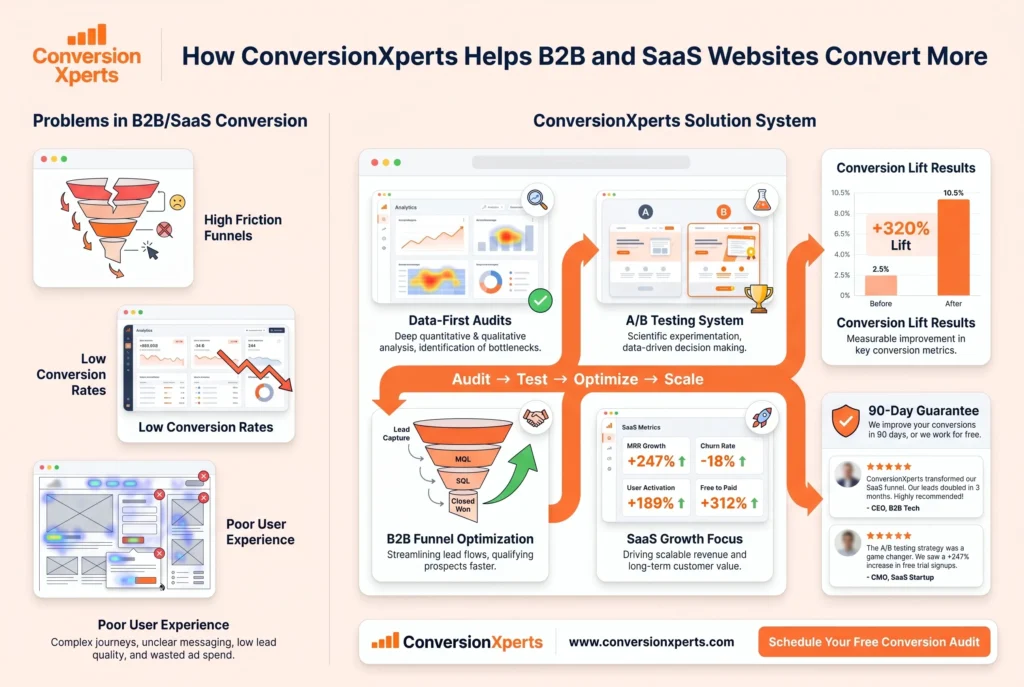
ConversionXperts is a specialist CRO agency with a specific focus on B2B commerce and SaaS websites, the most technically complex and highest-stakes conversion environments in digital marketing. With over 500 websites optimised globally and more than $5 million in additional revenue generated for clients, they operate with a methodology built around one principle: fix the website before you scale the traffic.
What Makes ConversionXperts Different
The agency is led by Kamran, a conversion rate specialist described by clients as having “expert-level CRO knowledge” who is “very thorough in his analysis” and lets “data drive the recommended tests.” What that translates to in practice is a process-first, opinion-last approach that larger agencies routinely pay lip service to but rarely deliver.
Here is what the work actually looks like:
Data-First Audits: Every engagement starts with a deep conversion audit combining quantitative data from tools like Google Analytics, Hotjar, Microsoft Clarity, and VWO with qualitative research. The goal is not to redesign the site. The goal is to find the specific pages, flows, and elements that are costing the most conversions and fix those first.
A/B Testing That Is Actually Statistically Valid: ConversionXperts runs structured A/B tests using validated methodology — correct sample sizes, minimum test durations that account for weekly business cycles, and proper statistical significance thresholds. Tests focus on high-impact areas: hero section messaging, pricing pages, free trial flows, form optimisation, and CTA placement.
B2B and SaaS Specialisation: The team understands that a B2B SaaS buying journey is not a single click but a multi-touch, multi-stakeholder process that can take 3–18 months. Their conversion work reflects that reality — optimising not just for the first-touch lead generation conversion but for the full funnel from visitor to activated user to paid customer.
90-Day Results Guarantee: ConversionXperts offers a money-back guarantee on results within 90 days — a confidence that only an agency with a proven track record can afford to make.
Real Client Results
These are real outcomes from ConversionXperts’ engagements:
- An ecommerce store in Los Angeles saw a 247% increase in checkout conversions within 60 days through a data-driven A/B tested checkout flow optimisation.
- A SaaS company in Austin achieved a 189% lift in free trial sign-ups through a landing page redesign and persuasive copywriting focused on reducing friction and increasing specificity of the value proposition.
- A real estate agency in Miami generated 312% more qualified leads through contact form optimisation and strategic placement of trust signals.
These are not outlier numbers. They reflect what happens when a specialist applies a structured CRO methodology to websites that have been optimised only cosmetically, if at all.
Client Reviews
“Kamran demonstrates expert-level CRO knowledge. He evaluates data to make appropriate decisions and provides great ideas for testing changes that will improve user experience, remove barriers, and ultimately improve conversions.” — Nikkie F., March 2026
“Kamran is great to work with. He’s communicative and diligent about running tests. I will be hiring him again.” — Paul A., May 2024
“His knowledge of conversion rate optimization was evident. He provided practical recommendations that improved our website’s performance. We experienced a positive impact on our conversion rates.” — Nico A., 2024
“I’ve worked with CROs quite a bit in my career, and I’d rate Kamran as top-notch in his knowledge. He was very thorough in his analysis and lets the data drive the recommended tests.” — Joseph H., 2024
ConversionXperts works with businesses globally, with a particular depth of experience in B2B SaaS platforms, ecommerce, and professional services. If you want to know exactly where your website is losing conversions and what to do about it, their free CRO audit is the logical first step. You can get yours at conversionxperts.com.