Lead Generation and Conversion: The Ultimate Proven Guide to Grow Your Business
What Is Lead Generation and Conversion?
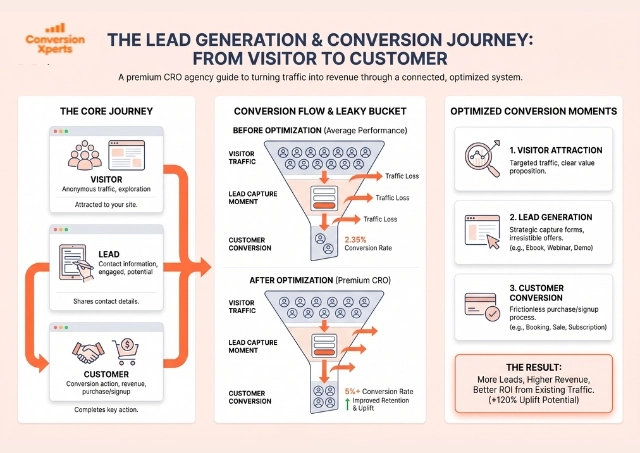
Lead generation is the process of attracting people who are interested in your product or service and encouraging them to give you their contact information so you can follow up with them. Conversion is the next step, where that interested person takes a specific action you want, like buying a product, booking a call, or signing up for a trial.
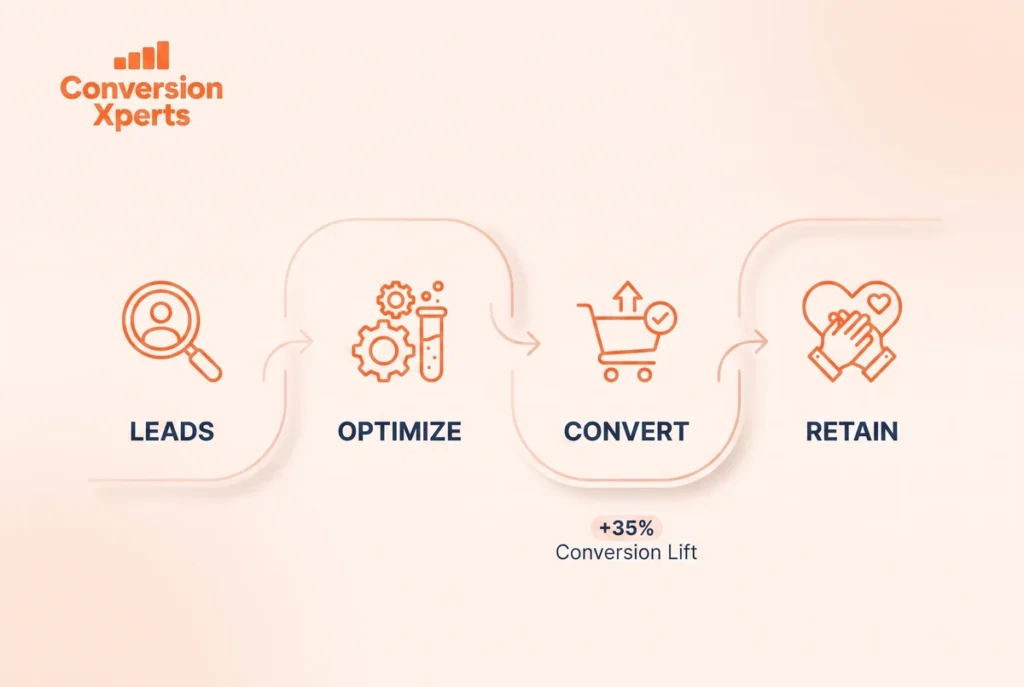
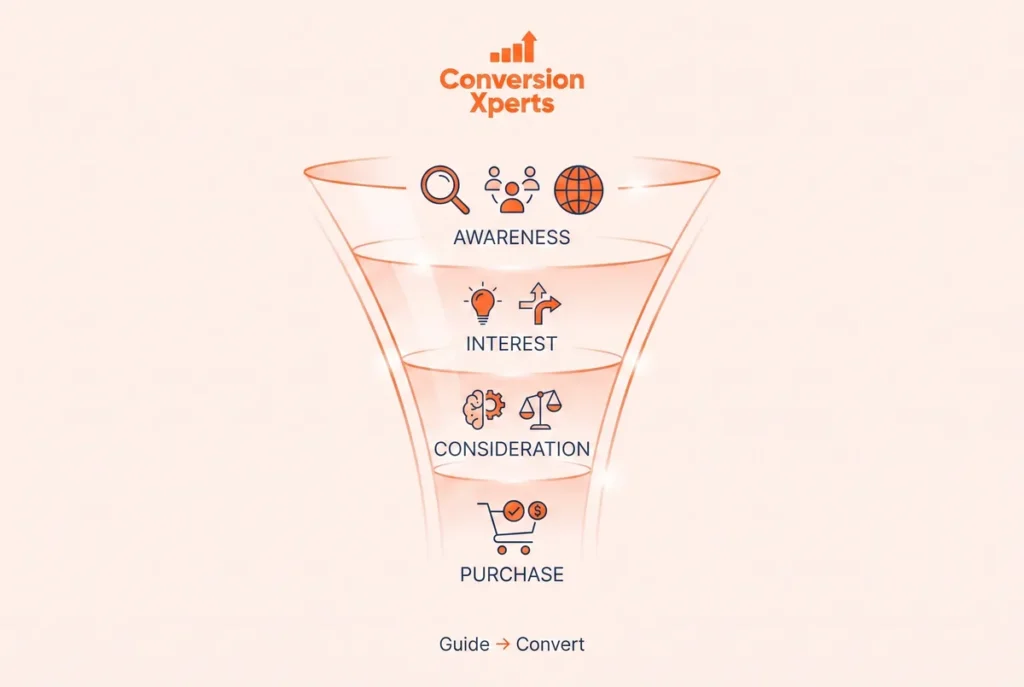
Think of it like a simple journey. A stranger finds your website. They read something valuable. They trust you enough to share their email. You send them helpful information. They eventually buy from you. That entire journey is lead generation and conversion working together.
The Difference Between a Lead and a Customer
A lead is someone who has shown interest but has not yet bought anything. A customer is someone who has completed a purchase. Your goal is to move as many leads as possible through to becoming customers, and doing that efficiently is what conversion optimization is all about.
Here is a simple way to understand the difference:
A visitor to your website is not yet a lead. A visitor who fills out your contact form is a lead. A lead who pays you money is a customer.
Why Both Generation and Conversion Must Work Together
Many businesses focus only on getting more traffic. They spend thousands of dollars on ads, social media, and content creation, but they never fix the leaky bucket. The leaky bucket is your website and your sales process. If your conversion rate is low, getting more traffic just means losing more visitors faster.
According to WordStream, the average landing page conversion rate across all industries is 2.35%, but the top 25% of landing pages convert at 5.31% or higher. That means the best businesses are converting more than twice as many visitors into leads compared to the average. The gap is not luck. It is strategy.
Why Your Conversion Rate Is the Most Important Number in Your Business
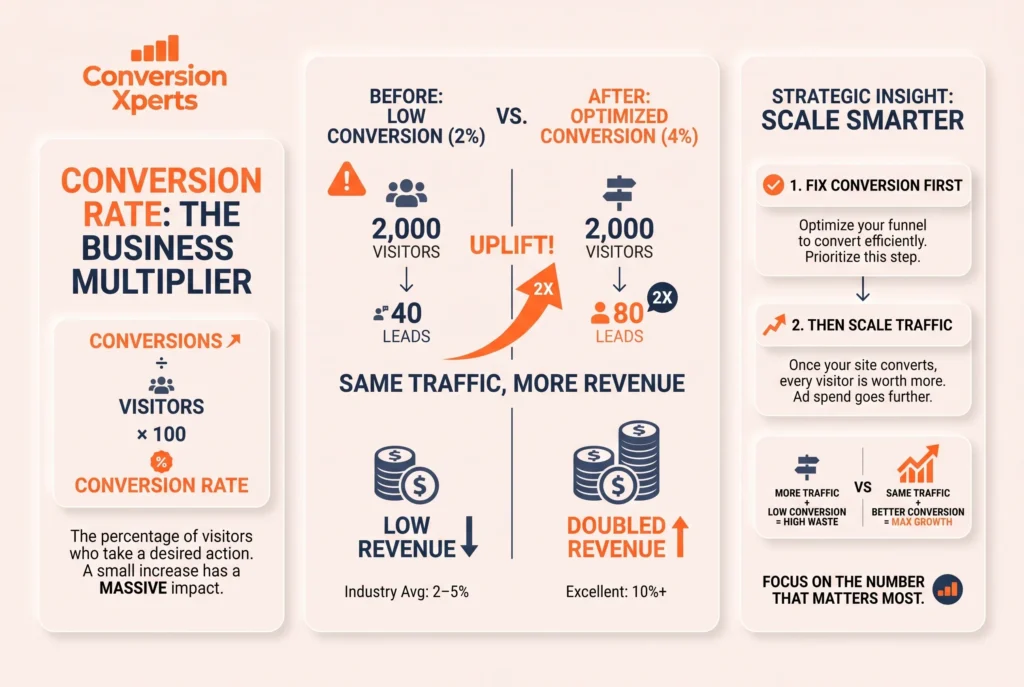
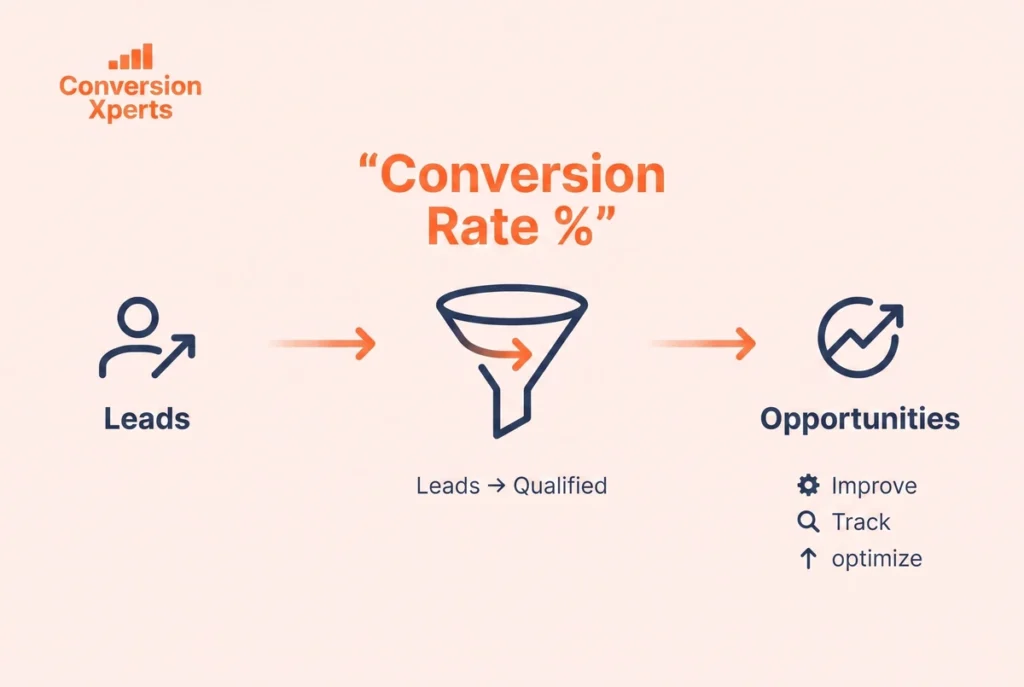
Your conversion rate tells you the percentage of people who take a desired action out of all the people who had the opportunity to do so. It is calculated simply: divide the number of conversions by the total number of visitors, then multiply by 100.
For example, if 1,000 people visit your landing page and 30 of them fill out the form, your conversion rate is 3%.
What a Good Conversion Rate Actually Looks Like
People often ask what a “good” conversion rate is. The honest answer is that it depends heavily on your industry, your offer, and your traffic source. However, here are general benchmarks that are widely accepted across the digital marketing industry:
Landing pages: 2% to 5% is average. Above 10% is excellent. Email opt-in pages: 20% to 50% is good if the traffic is targeted. E-commerce product pages: 1% to 3% is typical. Free trial sign-up pages: 15% to 30% is achievable with the right messaging.
If your conversion rate is below the average for your category, that is not bad news. That is good news. It means there is room to grow without spending a single extra dollar on advertising.
The Revenue Impact of Small Conversion Rate Improvements
Here is something that surprises most business owners. A small increase in your conversion rate creates a massive increase in revenue.
Imagine you are spending $5,000 a month on paid traffic and your current conversion rate is 2%. That means out of 2,000 visitors, you are getting 40 leads per month. If you improve your conversion rate to just 4%, you now get 80 leads for the same $5,000 budget. You doubled your leads without spending an extra cent.
That is the real power of conversion rate optimization. It is not just about tweaking a button color. It is about fundamentally improving how well your business communicates its value.
Conversion Rate vs. Traffic: Which Should You Focus On First?
Most beginners are told to get more traffic. But if your current conversion rate is 1% and you double your traffic, you still have a 1% conversion rate. You have just doubled your ad spend.
The smarter approach is to fix your conversion rate first, then scale traffic. This is a principle that every serious digital marketer understands, and it is why conversion rate optimization always comes before aggressive traffic scaling in a professional growth plan.
How to Do a Website Audit That Reveals Hidden Revenue
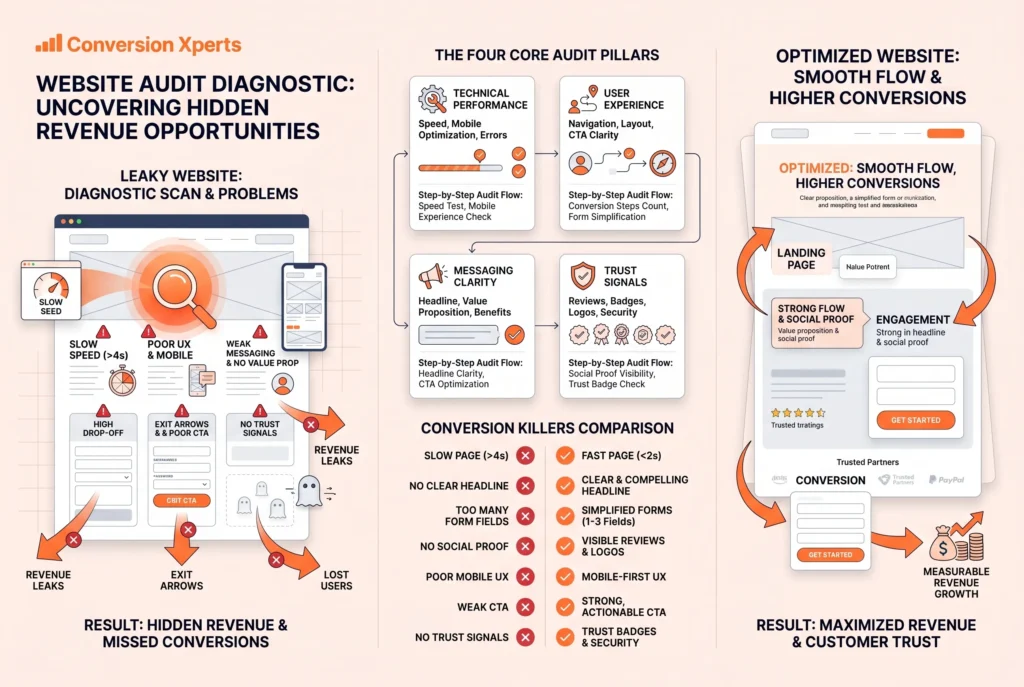
A website audit is a complete review of your website to identify problems that are hurting your ability to generate leads and convert visitors into customers. Think of it as a health checkup for your business online.
Most business owners are surprised by what a thorough website audit reveals. Small problems like a slow loading page, a confusing headline, or a form with too many fields can cut your conversion rate in half without you ever realizing it.
The Four Core Areas of a Conversion Focused Website Audit
A proper website audit for lead generation and conversion covers four main areas: technical performance, user experience, messaging clarity, and trust signals.
Technical performance includes your page load speed, mobile responsiveness, broken links, and crawl errors. According to Google, 53% of mobile users leave a page that takes longer than three seconds to load. That means if your site is slow, more than half your mobile visitors are already gone before they even read your headline.
User experience covers how easy it is for a visitor to find what they are looking for, navigate through your site, and take the action you want them to take. Poor navigation, cluttered layouts, and confusing calls to action all destroy your conversion rate silently.
Messaging clarity means your headline, subheadline, and body copy clearly tell the visitor what you do, who you do it for, and why they should care. If a visitor cannot figure out your value proposition within five seconds of landing on your page, they will leave.
Trust signals include testimonials, case studies, client logos, certifications, privacy policies, and secure payment badges. According to Edelman’s 2023 Trust Barometer, 81% of consumers say they need to trust a brand before they will buy from them.
Step by Step: How to Audit Your Own Website
Step one: Test your page speed using Google PageSpeed Insights. Your goal is a score above 80 on mobile.
Step two: Open your homepage on a mobile phone and ask yourself if it is easy to understand and navigate.
Step three: Read your main headline out loud. Does it clearly say what you offer and who it is for?
Step four: Count how many steps it takes for a visitor to become a lead. Every extra step loses conversions.
Step five: Look for social proof. Are there reviews, testimonials, or recognizable client logos visible without scrolling?
Step six: Check your forms. Remove every field that is not absolutely necessary.
Step seven: Review your calls to action. Are they specific and clear? “Get Your Free Quote” converts better than “Submit.”
Common Website Audit Findings That Kill Conversions
Here is a comparison of common problems found in website audits and their typical impact on conversion rate:
Problem | Typical Conversion Impact Page loads in more than 4 seconds | Up to 80% drop in conversions No clear value proposition in headline | 30% to 50% drop Form with more than 5 fields | 20% to 40% drop No social proof visible above fold | 15% to 30% drop No mobile-optimized layout | 40% to 60% drop on mobile Generic call to action like “Submit” | 10% to 25% drop No trust badges or security signals | 20% to 35% drop on transactional pages
If even two or three of these issues exist on your website right now, fixing them could dramatically improve your conversion rate before you ever change your marketing strategy.
Proven Lead Generation Strategies That Work in 2024
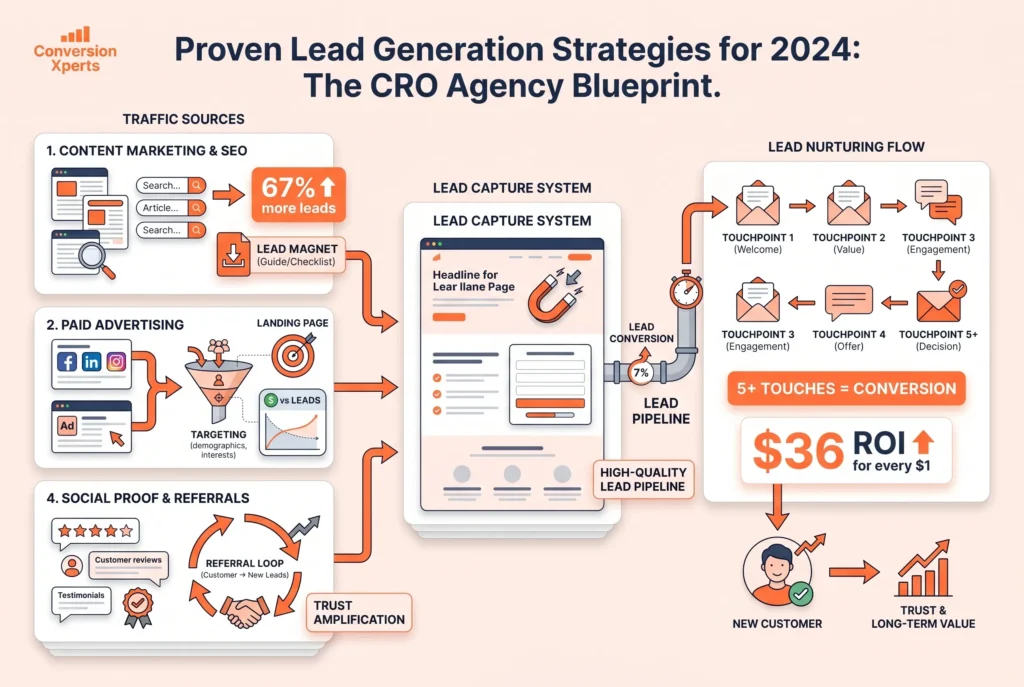
Lead generation is not one-size-fits-all. The best strategy depends on your industry, your audience, and your resources. But certain approaches consistently outperform others across nearly every business type.
Content Marketing and SEO for Organic Lead Generation
Content marketing is the practice of creating valuable, educational content that attracts your target audience through search engines and social media. When done correctly, it generates leads on autopilot, around the clock, without paying for every click.
According to HubSpot’s 2024 State of Marketing Report, businesses that blog consistently generate 67% more leads per month than businesses that do not. That is not a small edge. That is a transformational advantage that compounds over time.
The key to content marketing for lead generation is targeting keywords that your ideal customer is searching for, creating genuinely helpful content that answers their questions, and offering a lead magnet such as a free guide, checklist, or tool in exchange for their email.
Paid Advertising for Fast Lead Generation
Paid advertising on platforms like Google Ads, Meta (Facebook and Instagram), and LinkedIn allows you to put your message in front of your ideal customer almost immediately. When you combine strong paid traffic with a high-converting landing page, the results can be dramatic.
The important thing to understand about paid advertising is that traffic quality matters as much as traffic volume. Sending cheap, untargeted traffic to even a good landing page will produce disappointing results. The sweet spot is highly targeted traffic plus a well-optimized landing page.
According to WordStream’s 2024 Google Ads benchmarks, the average cost per lead across all industries is $53.52, but this varies widely. Legal services can pay over $100 per lead while e-commerce leads can cost under $10. Knowing your cost per lead and your customer lifetime value is essential before scaling any paid campaign.
Email Marketing: The Highest ROI Lead Nurturing Channel
Email marketing remains one of the highest return on investment channels in all of digital marketing. According to Litmus’s 2024 State of Email report, email marketing generates an average return of $36 for every $1 spent. No other marketing channel comes close to that ratio.
The key to email marketing for lead generation and conversion is the follow-up sequence. Most leads do not buy on the first contact. In fact, research from the National Sales Executive Association shows that 80% of sales require at least five follow-up touches. Most businesses give up after one or two.
A strong email sequence nurtures your leads with value, builds trust over time, and makes your offer at the right moment. This is called a lead nurturing sequence, and it is one of the most underused assets in small and medium business marketing.
Social Proof and Referral Programs
Word of mouth is still the most trusted form of marketing in the world. According to Nielsen’s 2023 Global Trust in Advertising study, 92% of consumers trust recommendations from people they know over all other forms of advertising.
A referral program converts your existing customers into a lead generation machine. By giving your customers an incentive to refer friends and colleagues, you create a system that generates warm, high-intent leads at a fraction of the cost of paid advertising.
Combining a referral program with strong social proof on your website, such as testimonials, star ratings, case studies, and before-and-after results, creates a powerful trust loop that accelerates both lead generation and conversion.
Conversion Rate Optimization: Step by Step for Beginners
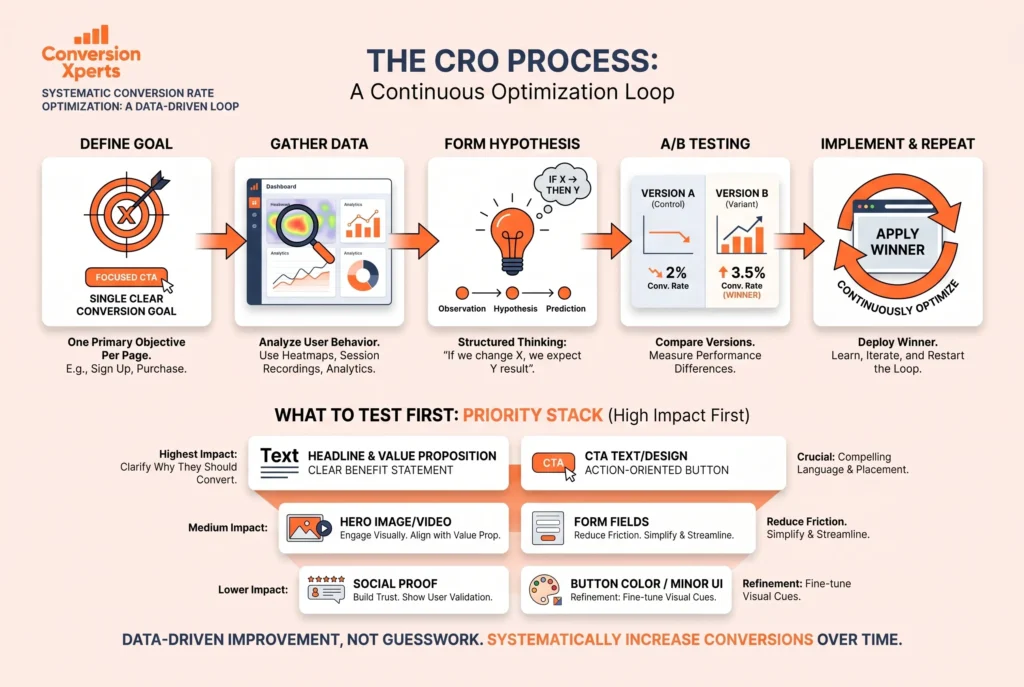
Conversion rate optimization, commonly called CRO, is the systematic process of increasing the percentage of website visitors who take a desired action. It combines data analysis, psychology, and design to remove friction and increase motivation throughout the buyer journey.
CRO is not guesswork. It is a structured, repeatable process. Here is how to do it as a beginner.
Step One: Define Your Conversion Goal
Before you can optimize anything, you need to know exactly what action you want visitors to take. This is called your conversion goal.
Common conversion goals include filling out a contact form, booking a call, downloading a free resource, starting a free trial, purchasing a product, or signing up for a newsletter.
You should have one primary conversion goal per page. Giving visitors too many choices is called “the paradox of choice,” and research by psychologist Barry Schwartz shows it reliably reduces the number of decisions made. One clear goal per page always outperforms multiple competing goals.
Step Two: Gather Data Before Changing Anything
The most common CRO mistake is changing things based on opinions rather than data. Before you touch a single element on your website, you need to understand what is actually happening right now.
Use Google Analytics 4 to see where visitors are dropping off. Use a heatmap tool like Hotjar or Microsoft Clarity to see where visitors click, scroll, and hesitate. Set up conversion tracking so you can see exactly which pages and traffic sources are generating leads.
This data gathering phase takes one to two weeks but it will save you from months of wasted testing. You want to identify your biggest problem areas, not guess at them.
Step Three: Form a Hypothesis
A hypothesis in CRO is a clear prediction about what change you think will improve results and why. A good hypothesis sounds like this: “If we change the headline from X to Y, we expect the conversion rate to increase because Y more clearly communicates the benefit to the visitor.”
Every test you run should start with a hypothesis. This keeps your testing structured and teachable, so you learn from every result whether the test wins or loses.
Step Four: Run A/B Tests
An A/B test shows two versions of a page to different segments of your visitors at the same time. Version A is your current page (the control). Version B is your changed page (the variation). After enough visitors have seen each version, you can determine with statistical confidence which one converts better.
You can run A/B tests using tools like Google Optimize, VWO, or Optimizely. Most of these tools have beginner-friendly interfaces and require no coding knowledge.
The key rule of A/B testing is to change only one element at a time. If you change the headline, the button color, and the image all at once, you will not know which change caused the improvement.
Step Five: Implement Winning Changes and Repeat
When a test produces a statistically significant winner, implement the winning version as your new control. Then start the process again with the next highest priority issue.
CRO is not a project you complete once. It is an ongoing process of continuous improvement. Businesses that build a CRO culture into their operations consistently outperform competitors who only run occasional tests.
What Elements Should You Test First?
Here is a priority order for CRO testing based on typical impact levels:
Priority | Element to Test | Typical Conversion Impact Highest | Headline and value proposition | 20% to 100% improvement High | Call to action text and design | 10% to 50% improvement High | Hero image or video | 10% to 40% improvement Medium | Form length and fields | 10% to 30% improvement Medium | Social proof placement | 10% to 25% improvement Lower | Button color | 1% to 10% improvement Lower | Font size and spacing | 1% to 5% improvement
Start with high-impact elements. Most businesses waste time testing button colors before they have even fixed their headline. Get the big things right first.
Key CRO Statistics Every Marketer Must Know
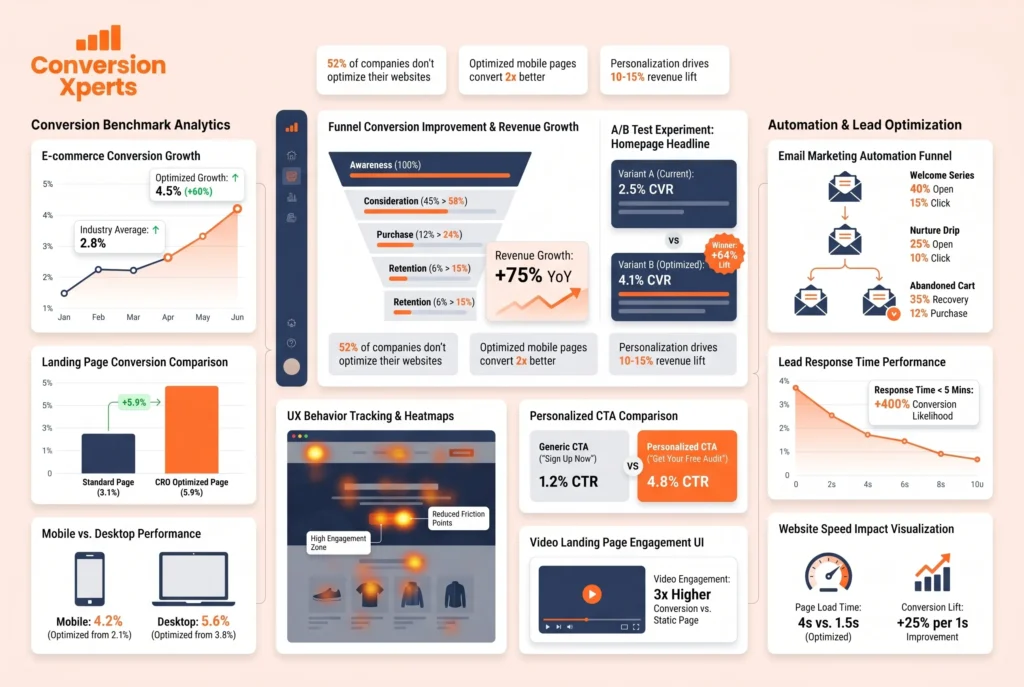
Understanding the data behind conversion rate optimization helps you set realistic expectations, make the case for investing in CRO, and identify where the biggest opportunities typically lie. Here are the most important CRO statistics from 2023 and 2024.
General Conversion Rate Benchmarks
The average website conversion rate across all industries is 2.35%, according to WordStream (2024). The top 10% of landing pages convert at 11.45% or higher. This means the gap between average and excellent is roughly five times, which represents a massive revenue opportunity for businesses willing to invest in optimization.
E-commerce conversion rates average between 1% and 4% globally, according to Statista (2024). However, top-performing e-commerce stores in niches like health, beauty, and fashion regularly achieve conversion rates between 5% and 8% through aggressive CRO programs.
B2B landing pages typically convert at 2.23% on average, according to Unbounce’s 2024 Conversion Benchmark Report. However, B2B companies in professional services, software, and consulting that use strong social proof and specific value propositions regularly achieve 5% or higher.
Lead Generation Specific Statistics
According to HubSpot’s 2024 State of Marketing Report, companies with 30 or more landing pages generate 7 times more leads than companies with fewer than 10 landing pages. This highlights how important content volume and landing page diversity is for lead generation at scale.
Personalized calls to action convert 202% better than generic calls to action, according to HubSpot (2023). This single statistic alone is reason enough to invest in basic personalization on your website.
Video on landing pages can increase conversions by up to 86%, according to Eyeview Digital (2023). This is particularly powerful for products or services that benefit from a visual demonstration or emotional storytelling.
Website Speed and Mobile CRO Statistics
Google’s research from 2023 shows that a one-second delay in page load time can reduce conversions by up to 7%. For a business doing $100,000 per month in revenue, that is $7,000 per month lost to a one-second loading problem.
53% of mobile users abandon a website that takes longer than three seconds to load, according to Google (2023). Given that mobile now accounts for over 60% of all web traffic globally, mobile performance is no longer optional.
According to Adobe’s 2023 Digital Trends report, 38% of people will stop engaging with a website if the content or layout is unattractive. This confirms that design quality directly impacts conversion rate, not just aesthetics.
Email and Follow Up Conversion Statistics
The average email open rate across all industries is 21.33%, according to Mailchimp (2024). However, highly segmented, personalized email campaigns regularly achieve open rates of 35% to 50%.
Welcome emails generate 4x the open rate and 10x the click-through rate of standard marketing emails, according to Experian (2023). Sending a strong welcome email immediately when someone opts in is one of the highest-leverage actions in lead nurturing.
Businesses that respond to a web lead within 5 minutes are 9 times more likely to convert that lead compared to businesses that wait 10 minutes or more, according to Harvard Business Review research cited by InsideSales.com. Speed of response is a massively underestimated conversion lever.
How ConversionXperts.com Can Help You Grow Faster
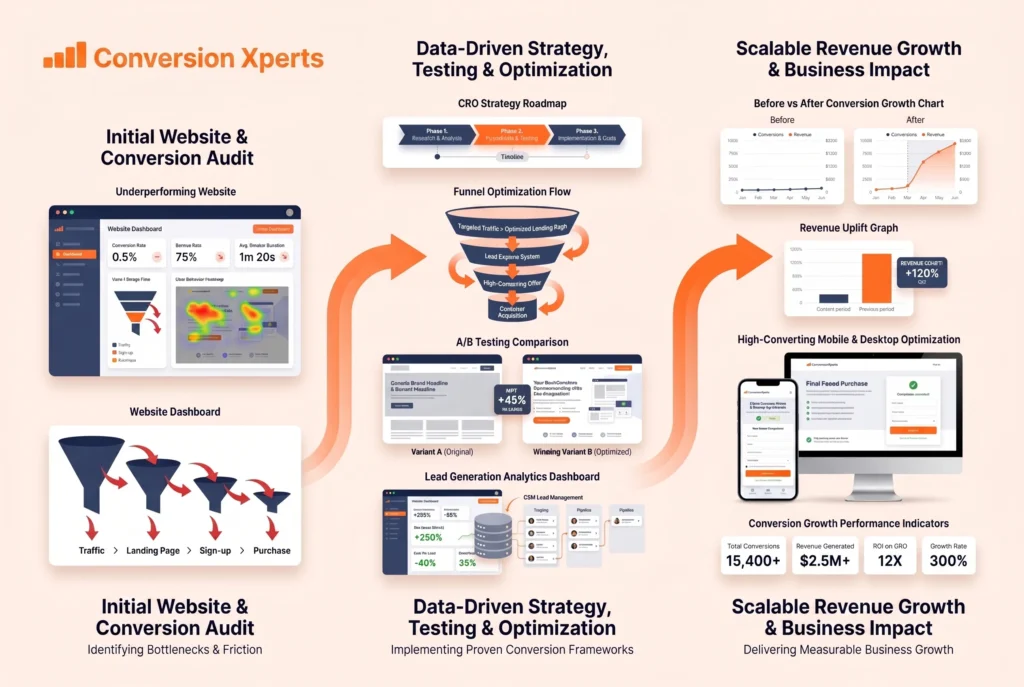
ConversionXperts.com is a specialist conversion rate optimization and lead generation agency built to help businesses globally stop losing leads and start converting more of their existing traffic into paying customers.
If everything you have read in this guide makes sense but feels overwhelming to do on your own, that is exactly what ConversionXperts.com is for. Their team handles the full process: website audit, conversion strategy, A/B testing, landing page optimization, and lead generation system setup.
You can visit ConversionXperts.com to learn more about their services, see case studies from clients across multiple industries, and request a free website audit to find out exactly where your biggest conversion opportunities are hiding.
Working with a specialist team like ConversionXperts.com compresses the learning curve dramatically. Instead of spending months testing and learning, you get strategies that have already been proven across hundreds of websites, implemented by people who do this every single day.
Whether you are a startup looking to build your first lead generation system or an established business looking to squeeze more revenue out of your existing traffic, ConversionXperts.com offers tailored solutions designed to deliver measurable results.
Visit ConversionXperts.com to start your growth journey today.