SaaS Conversion Rate Benchmarks: What the Best Companies Actually Hit in 2026
What Is a SaaS Conversion Rate and Why It Matters for Large Businesses
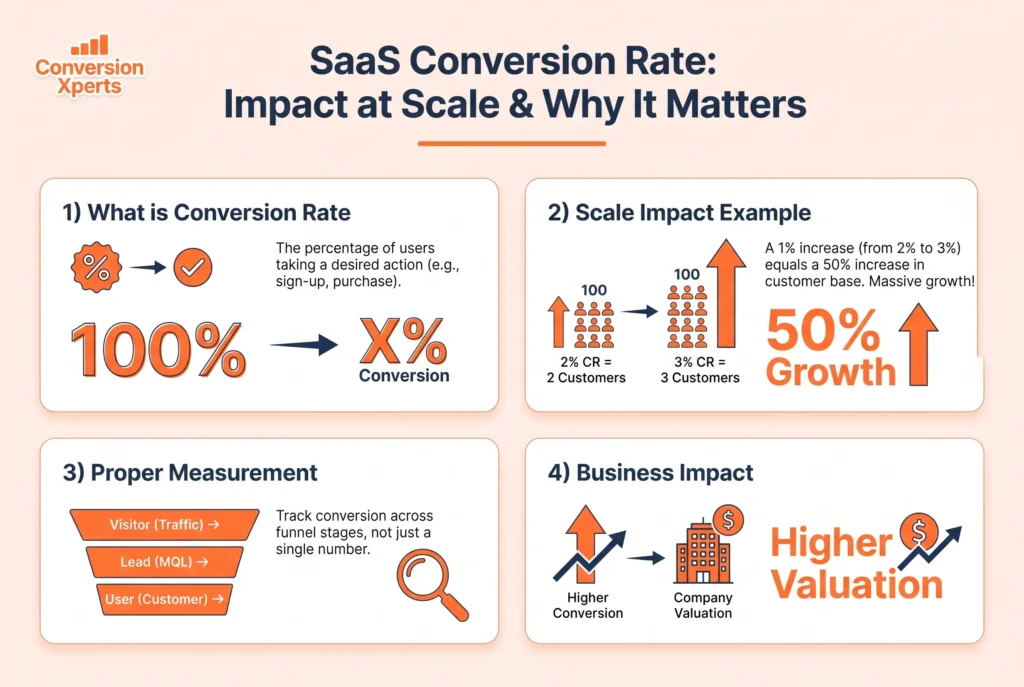
A SaaS conversion rate is the percentage of people who complete a specific desired action at any point in your funnel. That action could be submitting a demo request, starting a free trial, activating a core feature, upgrading from a free plan to a paid one, or signing a multi-year enterprise contract.
For small SaaS companies, a weak conversion rate is painful. For large, enterprise-grade SaaS businesses managing hundreds of thousands or millions of monthly visitors, a weak conversion rate is catastrophic in ways that compound every single quarter.
Here is why this matters at scale. If your platform receives 500,000 monthly visitors and your visitor-to-trial rate is 2%, you are generating 10,000 trials per month. If you move that rate to just 3%, you are generating 15,000 trials from the same traffic. That is 5,000 extra trials per month without increasing your ad spend by a single dollar. At an average contract value of $5,000 per year and a trial-to-paid rate of 5%, that one percentage point improvement generates $1.25 million in additional annual recurring revenue every single month you sustain it.
That is the compounding power of conversion rate optimization for large SaaS businesses, and it is why the most sophisticated growth teams in the world treat CRO optimization as their highest-leverage channel.
Why Most Enterprise SaaS Teams Measure Conversion Rate Incorrectly
The single biggest measurement mistake large SaaS teams make is tracking one aggregate conversion number across the entire site. This blends together high-intent bottom-of-funnel visitors with cold top-of-funnel traffic, making the number almost meaningless for decision-making.
The correct approach is to break your funnel into discrete transition stages and track each conversion rate independently. According to a 2026 report by Gainsight and Pendo, companies that instrument their funnel at five or more distinct conversion points identify improvement opportunities 3.2 times faster than those measuring a single overall rate.
The stages you should be measuring separately are:
Organic and paid visitor to lead or trial signup. Trial signup to product activation, which means reaching the core value moment. Activated user to paid subscription. Paid subscriber to annual or multi-year commitment. Annual customer to expansion, upsell, or additional seat purchase.
Each of these rates has its own benchmark, its own set of optimization levers, and its own business impact. When you treat them separately, you stop guessing and start engineering.
How Conversion Rate Affects SaaS Valuation in 2026
This connection between conversion rate and company valuation is something even many CFOs underestimate. According to a 2026 SaaS benchmark report by OpenView Partners, SaaS companies with trial-to-paid conversion rates in the top quartile of their peer group command revenue multiples that are 2.7 times higher than bottom-quartile performers, even when annual recurring revenue figures are comparable.
The reason is efficiency. A high conversion rate signals to investors that your go-to-market motion is predictable, your product delivers on its promise quickly, and your revenue will scale without requiring proportional increases in sales and marketing spend. If you are a growth-stage or pre-IPO SaaS company, improving your conversion rate is not just a growth activity. It is a direct input into your valuation story.
SaaS Conversion Rate Benchmarks by Funnel Stage in 2026
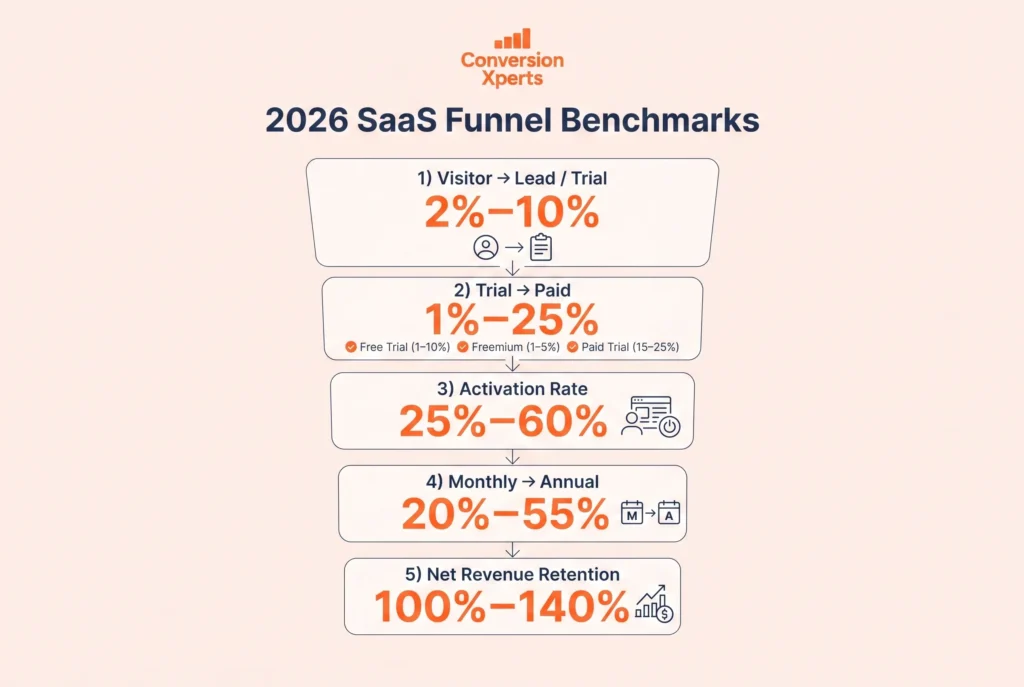
These SaaS conversion rate benchmarks are drawn from multiple 2026 industry studies including reports by ChartMogul, OpenView Partners, Bessemer Venture Partners, Gainsight, Pendo, and Forrester Research. Where ranges appear, they reflect differences across company size, business model, and market segment.
Visitor to Free Trial or Lead: 2% to 10%
The first major conversion event in most SaaS funnels is the moment a website visitor takes a meaningful step toward becoming a customer, whether that is signing up for a free trial, requesting a demo, downloading a high-value resource, or entering an email to access a product.
According to the 2026 FirstPageSage B2B SaaS Conversion Benchmark Report, the median visitor-to-lead conversion rate for B2B SaaS companies sits at 2.4%. Companies in the top quartile hit 6% to 10%, while the bottom quartile struggles below 1%.
The spread between median and top performers at this stage comes down almost entirely to three things. First is message clarity, meaning whether your headline communicates a specific, tangible outcome for a specific type of buyer within the first few seconds. Second is page load performance, since Google’s 2026 Core Web Vitals data shows that every additional second of load time reduces conversion probability by 4.5% on average for B2B SaaS landing pages. Third is social proof density, meaning the volume, specificity, and placement of customer logos, case study snippets, and G2 or Gartner Peer Insights ratings above the fold.
As Peep Laja, founder of CXL Institute and one of the most respected voices in CRO, said in a 2025 interview: “The homepage is not a brochure. It is a conversion machine or it is a money pit. There is no middle ground in competitive SaaS markets.”
Free Trial to Paid Conversion Rate: 1% to 25%
This is the most debated benchmark in all of SaaS because the range is enormous and the factors that drive it vary dramatically by business model. Here is what the 2026 data actually shows.
According to the 2026 ChartMogul SaaS Benchmarks Report, the median free-to-paid conversion rate across all SaaS business models globally is 3.8%. However, when you segment by trial model, the picture becomes far more useful.
Companies using an opt-out free trial, meaning they require a credit card upfront, see median conversion rates of 5% to 8% with top performers reaching 15% to 25%. Companies using an opt-in free trial without a credit card see median rates of 1.5% to 2.5%, with top performers reaching 5% to 9%. Freemium models show a wide range of 1% to 6%, with the outliers like Slack, Notion, and Figma historically achieving rates above 15% through exceptional product experience and virality. Demo-led models, which are common in enterprise SaaS, see the highest conversion rates of all: 18% to 40% from demo completed to closed deal, according to the 2026 Forrester B2B Sales Benchmark Study.
| Trial Model | Median Conversion Rate | Top Quartile | Bottom Quartile |
Opt-out trial (card required) | 5% to 8% | 15% to 25% | Below 3% |
Opt-in trial (no card) | 1.5% to 2.5% | 5% to 9% | Below 0.8% |
Freemium | 2% to 5% | 8% to 15% | Below 1% |
Demo-led (enterprise) | 18% to 30% | 35% to 40% | Below 10% |
Reverse trial (full access, then downgrade) | 6% to 12% | 18% to 22% | Below 4% |
The most important insight buried in this data is that free-to-paid conversion rate is primarily a product activation problem, not a marketing problem. According to a 2026 Pendo State of Product-Led Growth Report, users who reach their product’s core activation moment within 72 hours of signup convert to paid at a rate 4.1 times higher than users who do not reach activation in that window.
The question you should be asking is not “how do we get more signups?” It is “how do we get more signups to experience the value of our product before they lose interest?”
Activation Rate: 25% to 60%
Activation rate is the percentage of new trial users who reach the predefined core value moment of your product. This benchmark is often overlooked but it is arguably the most important conversion metric in all of SaaS.
According to the 2026 Amplitude Product Intelligence Report, the median activation rate across B2B SaaS companies is 34%. Top-quartile companies hit 55% to 65%. Bottom-quartile companies sit below 18%.
The companies that achieve top-quartile activation rates almost always share four characteristics. They have a precisely defined activation milestone that correlates with long-term retention. They have an onboarding flow built specifically to reach that milestone in the shortest possible time. They use behavioral email and in-app messaging triggered by user actions rather than time delays. And they have a dedicated team, whether that is a growth team, a product team, or a customer success team, whose primary metric is activation rate rather than signups.
Paid Customer to Annual Plan: 20% to 55%
This conversion event is one of the highest-value and most underleveraged in enterprise SaaS. Converting a monthly subscriber to an annual plan increases their lifetime value immediately, reduces churn probability significantly, and improves your cash flow position.
According to the 2026 Bessemer Venture Partners State of the Cloud Report, the median monthly-to-annual conversion rate for B2B SaaS companies is 28%. Top-quartile companies hit 45% to 55%.
The primary lever at this stage is timing and incentive design. Companies that offer annual plan conversion options at the moment of maximum engagement, typically 14 to 21 days into the subscription when the user has just experienced their first major success with the product, convert at rates 2.3 times higher than those who present the offer at billing renewal only.
Net Revenue Retention and Expansion Rate: 100% to 140%
While technically not a standalone conversion rate, Net Revenue Retention (NRR) is the ultimate downstream output of all your conversion work, and in 2026 it has become one of the most scrutinized metrics by enterprise SaaS investors globally.
According to a 2026 KeyBanc Capital Markets SaaS Survey, the median NRR for enterprise SaaS companies is 108%. Top-quartile performers hit 120% to 140%, meaning they grow revenue from existing customers faster than they lose it from churn. A select group of category leaders including Snowflake, Datadog, and Veeva have historically sustained NRR above 150%.
Companies with NRR above 120% are effectively building a compounding revenue engine inside their existing customer base. For large SaaS businesses with significant customer portfolios, optimizing the expansion conversion rate, meaning the percentage of customers who purchase additional seats, modules, or features, is often a faster path to revenue growth than acquiring new customers.
B2B Sales Funnel Conversion Rates: What Enterprise Numbers Look Like
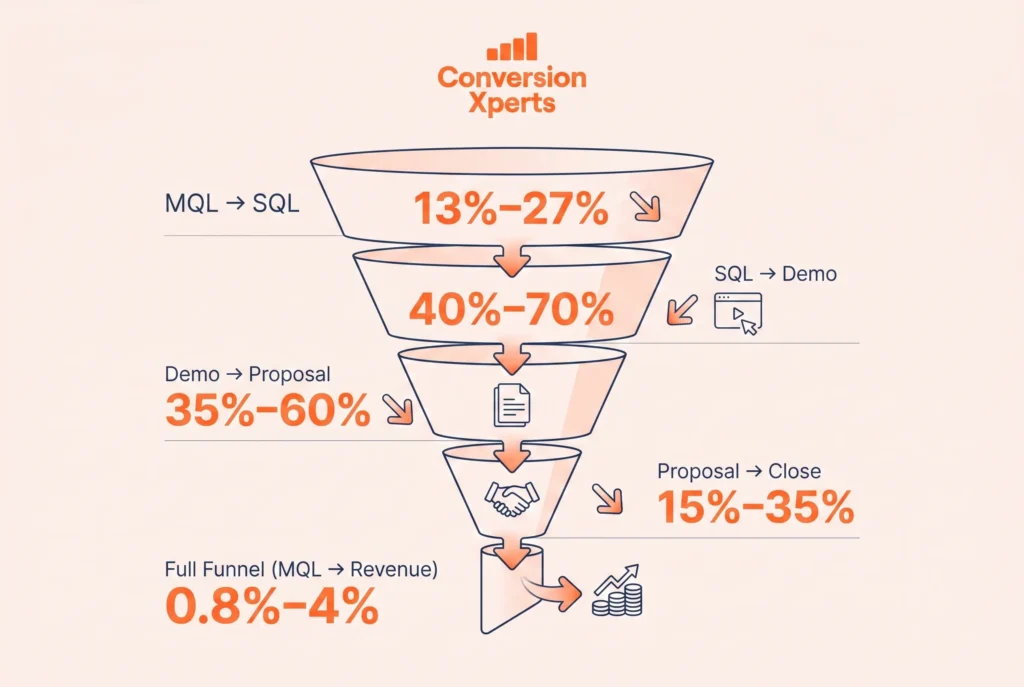
B2B sales funnel conversion rates operate on a fundamentally different set of benchmarks compared to self-serve or product-led SaaS. Enterprise deals involve longer sales cycles, multiple decision-makers, procurement processes, and legal review. Understanding these benchmarks is critical for any large B2B SaaS company optimizing its revenue engine.
Marketing Qualified Lead to Sales Qualified Lead: 13% to 27%
According to the 2026 Forrester B2B Revenue Waterfall Benchmark Study, the median conversion rate from Marketing Qualified Lead (MQL) to Sales Qualified Lead (SQL) in enterprise SaaS is 18%. Top-performing companies, defined as those in the top quartile of their peer group by revenue growth rate, hit 25% to 30%.
The gap between median and top performers at this stage is explained by lead quality, not volume. Companies that use intent data, firmographic targeting, and behavioral scoring to define their MQL criteria generate SQLs that close at dramatically higher rates than companies using simple demographic criteria alone.
According to a 2026 Gartner B2B Sales Technology Report, enterprise SaaS companies that incorporate third-party intent data into their lead scoring models improve their MQL-to-SQL conversion rate by an average of 34% within two quarters of implementation.
Sales Qualified Lead to Demo Completed: 40% to 70%
Once a lead is classified as sales-qualified, the next conversion event is getting them into a discovery call or product demonstration. According to the 2026 SalesLoft State of Sales Engagement Report, the median rate at which SQLs complete a scheduled demo is 52%. Top-performing enterprise sales teams hit 65% to 72%.
The primary drivers of above-average rates at this stage are outbound sequence quality, the specificity of meeting invitation personalization, and the credibility signals visible to the prospect before the meeting. Enterprise buyers in 2026 conduct an average of 8.3 pieces of independent research before agreeing to a vendor demo, according to Gartner. This means your content, review site presence, and peer recommendations are actively influencing demo show rates even before your sales team sends a single email.
Demo to Proposal: 35% to 60%
Not every demo leads to a formal proposal. The median conversion rate from completed demo to proposal sent is 42% for enterprise B2B SaaS, according to the 2026 Pavilion Go-to-Market Benchmark Report. Top-quartile teams hit 55% to 63%.
The biggest driver of improvement at this stage is discovery quality. Sales teams that run structured discovery processes and document the specific business pain, quantified impact, and decision-making criteria before building a proposal convert at 1.8 times the rate of teams that move straight from demo to generic proposal.
Proposal to Closed Won: 15% to 35%
This is the final and most scrutinized stage of the B2B sales funnel. According to the 2026 Pavilion and Winning by Design joint benchmark study, the median proposal-to-close rate for enterprise SaaS deals above $50,000 in ACV is 21%. Top performers hit 30% to 38%.
The factors that most reliably predict above-average close rates at this stage are executive sponsor engagement on the buyer side, competitive differentiation clarity, the strength of the business case in the proposal, and the speed of procurement navigation. Enterprise SaaS companies that provide dedicated deal desk support for procurement and legal review cycles see close rates 26% higher than those that leave that process entirely to the prospect.
| B2B Funnel Stage | Median Rate | Top Quartile | Key Driver |
Visitor to MQL | 2% to 4% | 7% to 10% | Content quality and targeting |
MQL to SQL | 18% | 25% to 30% | Lead scoring model sophistication |
SQL to Demo Completed | 52% | 65% to 72% | Sequence quality and social proof |
Demo to Proposal | 42% | 55% to 63% | Discovery process structure |
Proposal to Closed Won | 21% | 30% to 38% | Business case and champion strength |
Overall MQL to Revenue | 0.8% to 1.5% | 2.5% to 4% | Full-funnel alignment |
SaaS Conversion Rate Benchmarks by Category and Business Model
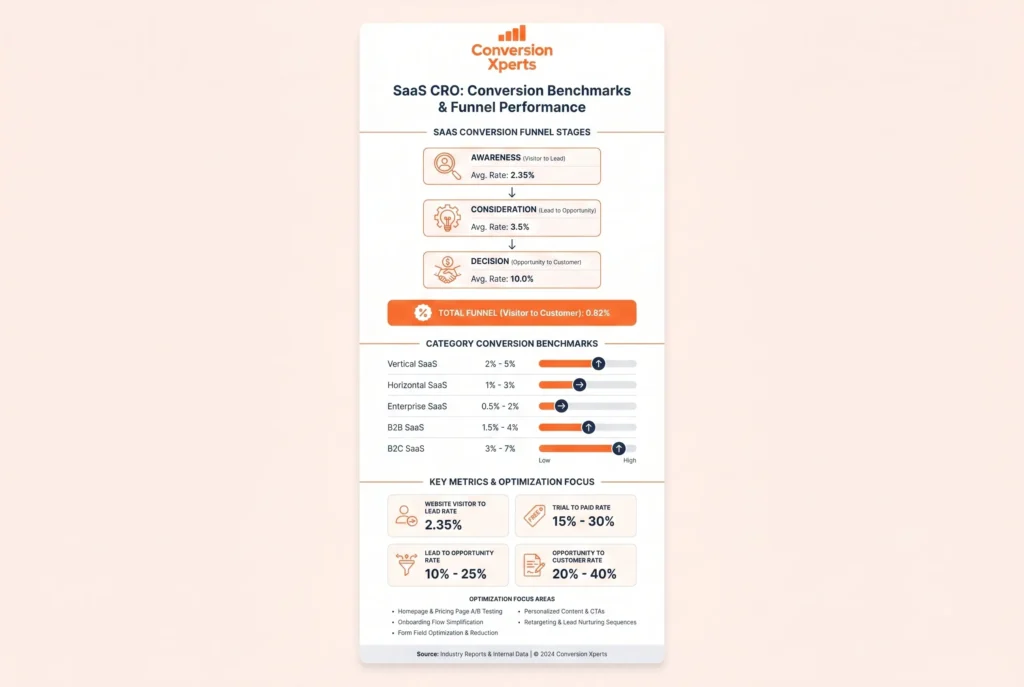
Not all SaaS categories are created equal. Conversion rates vary significantly by vertical, deal size, buyer type, and whether the product is horizontal or vertical in its application. Here is what 2026 data shows across major SaaS categories.
Horizontal SaaS (CRM, HRIS, Project Management, Marketing Automation)
Horizontal SaaS platforms serve a broad audience across industries. Because the audience is wide, top-of-funnel conversion rates tend to be more competitive but mid-funnel differentiation is harder to achieve. According to the 2026 G2 Market Benchmarks Report, horizontal SaaS products see average free-to-paid conversion rates of 3.2%, with visitor-to-trial rates of 2.8% for platforms in the CRM, project management, and collaboration categories.
The challenge for horizontal SaaS is that competitors are plentiful and buyer education is high. Prospects in this category compare more vendors, read more reviews, and take longer to convert. The companies winning in horizontal SaaS are those investing heavily in use-case-specific landing pages, persona-level messaging, and segment-specific onboarding tracks.
Vertical SaaS (Healthcare IT, LegalTech, FinTech, PropTech)
Vertical SaaS companies serve a specific industry with tailored solutions. Because they face less direct competition and serve buyers with more acute, specific pain points, their conversion rates tend to be higher at the mid and bottom funnel even when top-of-funnel volumes are lower.
According to the 2026 Battery Ventures Vertical SaaS Report, vertical SaaS companies see demo-to-close rates of 28% to 42%, meaningfully above the enterprise horizontal average. Visitor-to-lead rates are also higher, averaging 4.1% versus 2.4% for horizontal, because intent signals from vertical search traffic are stronger.
Vertical SaaS companies that embed compliance, workflow, and integration depth into their core product story see the strongest conversion performance because these are features that horizontal competitors cannot easily replicate.
Developer Tools and API-First SaaS
This category operates on entirely different conversion logic. Developer tool companies, including API platforms, infrastructure SaaS, and data infrastructure companies, typically use a bottom-up adoption model where individual developers or engineers adopt the product before a purchase decision is made at the organizational level.
According to the 2026 Redpoint Ventures Infrastructure and Developer Tools Benchmark, the median free-to-paid conversion for API-first and developer tool companies is 4.8%, with top performers like Stripe, Twilio, and comparable infrastructure platforms historically achieving rates of 10% to 18% from active free tier users to paid accounts.
The key metric for developer SaaS is not trial-to-paid but rather “active API user to paid plan” since many developer tools have an indefinitely free tier with usage-based pricing that kicks in at scale.
Security, Compliance, and Risk SaaS
This category sees some of the highest enterprise deal conversion rates because purchases are often driven by regulatory requirement, audit findings, or board-level mandate rather than discretionary budget. According to the 2026 Crunchbase and G2 joint SaaS analysis, security SaaS companies see proposal-to-close rates averaging 31%, significantly above the 21% overall enterprise median.
However, sales cycles in this category are long. The median enterprise security SaaS sales cycle length in 2026 is 118 days, according to the 2026 SalesLoft Benchmark Report, compared to 74 days for horizontal SaaS. The higher conversion rate at close compensates for the longer cycle, but it means pipeline management and velocity metrics are critical.
How to Optimize Your SaaS Website for Higher Conversion in 2026
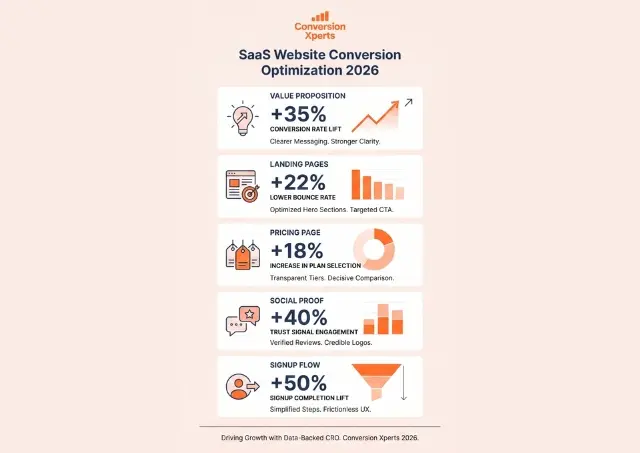
Learning how to optimize your SaaS website for conversion is the most direct way to improve your top-of-funnel numbers without increasing acquisition spend. Here is what the data and expert consensus says about what actually works in 2026.
Nail Your Above-the-Fold Value Proposition
Your homepage headline has approximately 3.2 seconds to communicate what you do, who it is for, and what makes it different. According to Nielsen Norman Group’s 2026 B2B Website UX Report, 79% of enterprise SaaS visitors leave a page without scrolling if the above-the-fold content does not immediately match their expectation.
The formula that consistently outperforms in A/B testing across large SaaS websites is: Specific Outcome + Specific Audience + Specific Differentiator. An example of a weak headline is “The platform for modern teams.” An example of a strong headline is “Reduce your enterprise procurement cycle by 40% without replacing your ERP.”
The specificity is what drives conversion. Vague headlines feel like they are for everyone, which means they resonate with no one.
Build Persona-Specific Landing Pages
One of the highest-ROI investments in SaaS website CRO is creating dedicated landing pages for each major buyer persona and use case. According to HubSpot’s 2026 State of Marketing Report, companies with 40 or more landing pages generate 12 times more leads than companies with fewer than 5.
For enterprise SaaS companies with multiple buyer personas, such as a CFO, a VP of Engineering, and a Chief Information Security Officer all evaluating the same platform, the homepage cannot serve all three audiences equally. A dedicated landing page for each persona that speaks to their specific priorities, uses their specific language, and shows case studies from peers in their role converts at 2.4 times the rate of a generic homepage, according to the 2026 Unbounce Conversion Benchmark Report.
Optimize Your Pricing Page for Conversion
The pricing page is the highest-intent page on any SaaS website, and it is also one of the most poorly optimized. According to a 2026 analysis of 500 enterprise SaaS pricing pages by Price Intelligently and ProfitWell, companies that redesigned their pricing page with clear tier differentiation, visible annual discount framing, and a prominent comparison table saw an average 23% improvement in trial or demo request conversion from that page alone.
Three pricing page elements that consistently improve conversion in 2026 are:
A recommended plan badge or highlight that reduces decision paralysis. Annual billing as the default toggle, not monthly, which increases annual plan uptake by an average of 18%. A clear “Talk to Sales” option for enterprise buyers who are ready to buy but need a custom quote, which captures high-value leads that would otherwise leave without converting.
Use Social Proof Strategically, Not Decoratoratively
Most SaaS websites scatter logos and testimonials across their pages without strategic intent. The companies with the highest visitor-to-trial conversion rates in 2026 use social proof as a conversion instrument, placing the right proof element at the exact moment of maximum hesitation.
According to a 2026 Baymard Institute UX Research Study, the three highest-converting placements for social proof on SaaS websites are immediately adjacent to the primary CTA button, directly above the pricing section, and within the sign-up flow itself after the user has entered their email but before they have completed registration.
Specificity also matters enormously. A testimonial that says “Great product, highly recommend” converts at a fraction of the rate of one that says “We reduced onboarding time by 60% in the first quarter. Our team of 200 now spends 3 fewer hours per week on manual reporting.” Real numbers from real companies in recognizable industries are infinitely more persuasive than generic praise.
Reduce Friction in Your Sign-Up Flow
Every field you ask a user to complete during signup reduces your conversion rate. According to a 2026 analysis by Formisimo and Hotjar, every additional field in a SaaS signup form beyond the first three reduces completion rate by an average of 11%.
For enterprise SaaS, the tension here is real because you genuinely need qualification data. The resolution is progressive profiling: collect only an email and maybe a company name at signup, then gather additional qualification data through the onboarding flow, product behavior, and enrichment tools like Clearbit or Apollo that automatically append firmographic data to new signups without requiring the user to provide it.
CRO Optimization Strategies That Actually Move the Needle
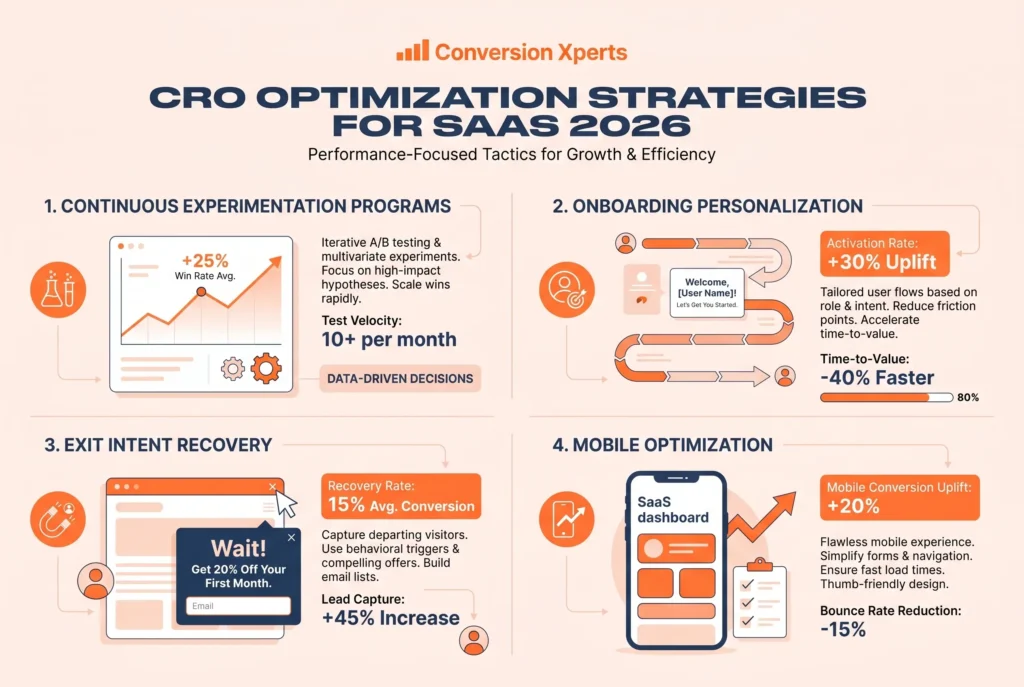
CRO optimization is not a set of tactics you apply once and forget. It is a continuous, systematic discipline. Here is what the most sophisticated SaaS growth teams are doing in 2026 to drive sustained conversion improvement.
Build a Continuous Experimentation Program
The most important structural difference between SaaS companies with consistently improving conversion rates and those that plateau is the presence of a formal experimentation program. According to the 2026 Optimizely State of Experimentation Report, enterprise companies running 50 or more A/B tests per year see 3.1 times higher conversion rate growth than those running fewer than 10.
A well-functioning experimentation program requires four things: a clear prioritization framework to decide what to test first, statistical rigor to ensure results are trustworthy, minimum sample sizes respected before calling a winner, and a shared log of all tests, including losers, so institutional knowledge accumulates over time.
The ICE framework, standing for Impact, Confidence, and Ease, is the most widely used prioritization methodology in SaaS CRO teams in 2026. You score each test idea on all three dimensions, multiply the scores, and run the highest-scoring experiments first. This ensures you are testing ideas with the biggest expected impact on conversion rather than whatever happens to be on the roadmap.
Implement Behavioral Segmentation in Your Onboarding
Generic onboarding flows are one of the biggest destroyers of free-to-paid conversion rates. According to the 2026 Appcues SaaS Onboarding Benchmark Report, companies that personalize their onboarding flow based on user role, company size, or stated use case see 38% higher activation rates than those showing the same onboarding to all users.
The implementation is simpler than most teams assume. A single onboarding survey question asking “What is your primary goal with our product?” allows you to route users into different onboarding tracks without building a complex conditional flow. Each track focuses on the shortest path to value for that specific user type, removing irrelevant steps and highlighting the features most relevant to their stated goal.
Use Exit Intent and Behavioral Triggers to Recover Abandonment
Most SaaS websites lose between 60% and 80% of visitors who reach the pricing page without converting. Exit intent overlays, triggered when a visitor’s mouse movement signals they are about to leave, recover a meaningful percentage of these abandoning visitors.
According to a 2026 Sumo Group analysis, well-designed exit intent overlays on SaaS pricing pages convert abandoning visitors at rates of 3% to 7%. For a website with 100,000 monthly pricing page visitors and a 70% abandonment rate, a 5% exit-intent recovery rate means 3,500 additional captured leads per month that would otherwise have been lost forever.
The most effective exit-intent offers in 2026 for enterprise SaaS are extended trial periods, access to a relevant case study from a comparable company, or a one-click option to schedule a 15-minute call with a product expert rather than a full sales demo.
Optimize for Mobile Even in B2B
Many B2B SaaS marketing teams deprioritize mobile optimization because they assume enterprise buyers are desktop users. This assumption is increasingly wrong. According to Google’s 2026 B2B Mobile Research Study, 56% of B2B SaaS research journeys now involve at least one mobile touchpoint, and 28% of initial demo requests are submitted from a mobile device.
Companies that have mobile-optimized their trial signup flows and demo request forms see an average 19% improvement in overall conversion rate because they stop losing a segment of high-intent visitors who experience friction on mobile that does not exist on desktop.
How ConversionXperts Helps Enterprise SaaS Companies Scale Revenue
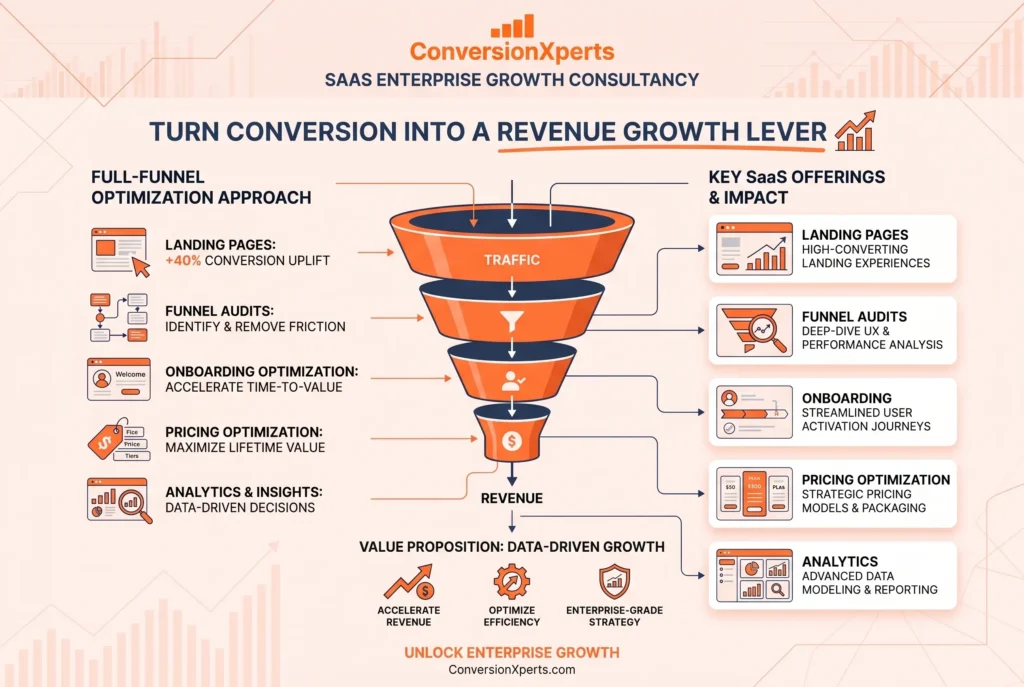
If you have read this far, you already understand that conversion rate optimization is not a simple checklist. It is a data-driven, continuously evolving discipline that requires deep expertise, sophisticated tooling, and a systematic approach to testing and iteration. For large SaaS companies managing complex funnels across multiple geographies and buyer personas, getting this right internally is genuinely hard.
That is exactly where ConversionXperts comes in.
ConversionXperts is a specialized CRO and growth consultancy built specifically for enterprise and growth-stage SaaS businesses that are ready to move beyond guesswork and start treating conversion rate as the strategic revenue lever it actually is. We work with SaaS companies generating $10 million or more in ARR who are serious about making their entire acquisition and conversion funnel as efficient as possible.
Our work starts where most agencies stop: at the intersection of data, buyer psychology, and technical implementation. We do not run a handful of headline tests and call it a win. We build end-to-end conversion systems, meaning we audit every stage of your funnel from organic visitor to paid customer to expansion, identify the highest-impact opportunities using a proprietary diagnostic framework, and then execute a structured testing roadmap that compounds over time.
Our services cover full-funnel CRO strategy and execution, SaaS website conversion optimization including landing page design, messaging architecture, and sign-up flow redesign, B2B sales funnel conversion rate analysis and optimization, pricing page strategy and A/B testing, onboarding flow optimization to improve free-to-paid conversion, and behavioral analytics implementation so your team can see exactly what users are doing and why they are or are not converting.
What makes ConversionXperts different from a generalist digital marketing agency is that every team member who works on your account has direct experience working inside or with SaaS companies. We understand that your buying committee has six people. We understand that your enterprise sales cycle is 90 days long. We understand that your pricing page is not just a pricing page but a negotiation document for a VP of Finance who has never spoken to your sales team. That context shapes everything we do.
Companies that partner with ConversionXperts typically see measurable improvements in their key funnel conversion rates within the first 90 days of engagement. The long-term impact of sustained, compounding conversion improvement at scale is transformational for revenue growth, customer acquisition efficiency, and ultimately, company valuation.
If you are a SaaS company serious about turning your conversion funnel into a competitive advantage, ConversionXperts is the partner built for exactly that challenge.