













Google Optimize Alternative Services – Seamless Testing After Google Optimize Sunset

We help you migrate, set up, and optimize testing on modern platforms like Convert, VWO, or AB Tasty.

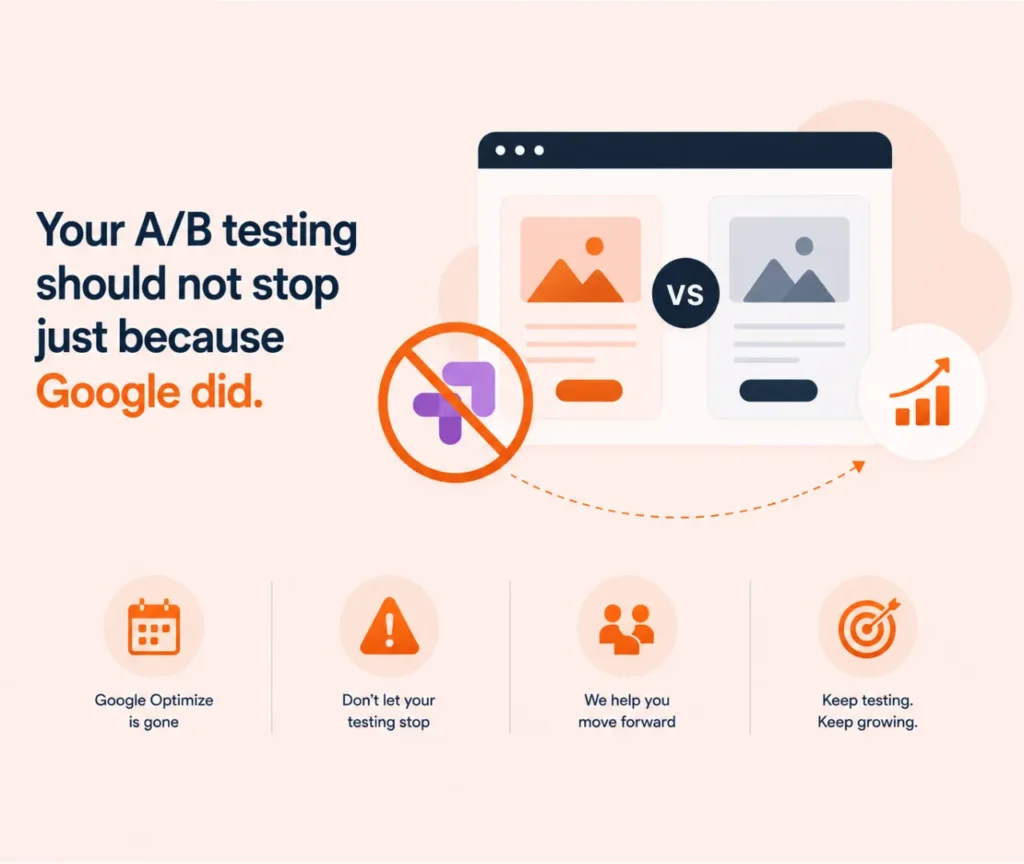
Your A/B testing should not stop just because Google did.

On September 30, 2023, Google shut down Google Optimize permanently. No warning period extension. No free replacement. No successor product. For thousands of businesses that had built their entire experimentation workflow around it, that date felt like the floor dropping out from under a running program.
If you are still dealing with the aftermath, whether that means you paused testing altogether, have been running experiments inconsistently, or simply never made the switch to a proper replacement, this page is for you.
At ConversionXperts, we help businesses move from Google Optimize to modern, professional-grade A/B testing platforms without losing momentum, data context, or revenue. We handle the migration, the setup, the strategy, and the training, so you can get back to running experiments that actually improve your conversion rate.

Why Google Optimize's Shutdown Still Matters

Most businesses treated Google Optimize's sunset as an inconvenience. The ones paying close attention realized it was actually a warning about how much they had been underinvesting in experimentation infrastructure.
Google Optimize was free. That was its biggest selling point and ultimately the biggest problem with relying on it. Free tools do not get priority development. They do not get advanced statistical engines. They do not get the kind of segmentation, personalization, and integrations that serious conversion rate optimization requires. When Google shut it down, they explicitly stated that it did not have many of the features and services that customers request and need for experimentation testing. That was a rare moment of corporate honesty about a product's limitations.
Here is the real cost of the shutdown that most businesses have not fully calculated. Every month you spend without a proper A/B testing platform is a month where your pages are not improving. Your competitors who made the switch quickly have now been running structured experiments for well over a year longer than you. Every test they ran during that time, every headline they validated, every checkout step they simplified, every CTA they refined, compounded into a conversion rate advantage that will take you real effort to close.
The businesses that feel the gap most acutely tend to be ecommerce brands losing revenue on high-traffic product and checkout pages, SaaS companies watching trial-to-paid conversion rates stall, lead generation businesses running paid traffic to pages that have not been tested in over twelve months, and marketing agencies that lost the ability to run experiments for their clients and have been explaining why ever since.
If any of those sound familiar, the right move is not to keep waiting. It is to choose the right platform, implement it properly, and get back to building a testing culture that drives results.

What's our Clients Say

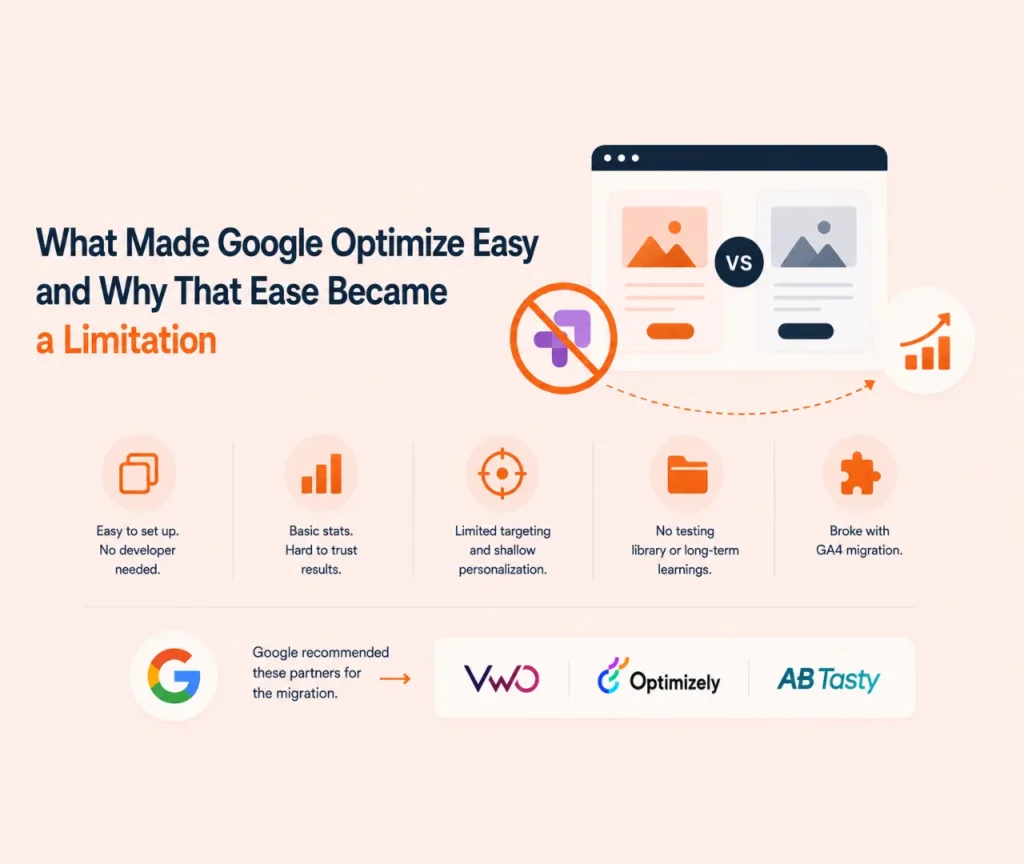
What Made Google Optimize Easy and Why That Ease Became a Limitation

Before we talk about what comes next, it is worth understanding what Google Optimize actually was and why so many businesses ended up depending on it.
Google Optimize launched in 2017 as a free A/B testing tool tightly integrated with Google Analytics. The pitch was simple: if you already have Analytics installed, you can start running experiments in minutes. And for many businesses, that was genuinely true. The visual editor was straightforward. Setting up a basic A/B test on a landing page required no developer involvement. You could see results alongside the Analytics data you were already looking at every day.
The problem was that it was built like a starter tool, not a serious experimentation platform. You could only run a limited number of tests simultaneously. The statistical engine was basic, which meant you were often making decisions based on data that had not reached proper significance. The targeting capabilities were limited. Personalization features were shallow. There was no proper way to build an institutional testing library that your team could learn from over time. And when your GA4 migration happened, the integration that made Optimize useful essentially broke.
Google's own partners for the migration, the companies they specifically recommended as replacements, were VWO, Optimizely, and AB Tasty. That endorsement tells you something important: even Google acknowledged that serious experimentation required tools built specifically for that purpose.

The Right Google Optimize Alternative Depends on Your Business

There is no single answer to which platform you should move to. The right choice depends on your traffic volume, your team's technical comfort level, your testing ambitions, the integrations you need, and your budget. Here is an honest breakdown of the three platforms we recommend most often and the specific situations where each one makes the most sense.

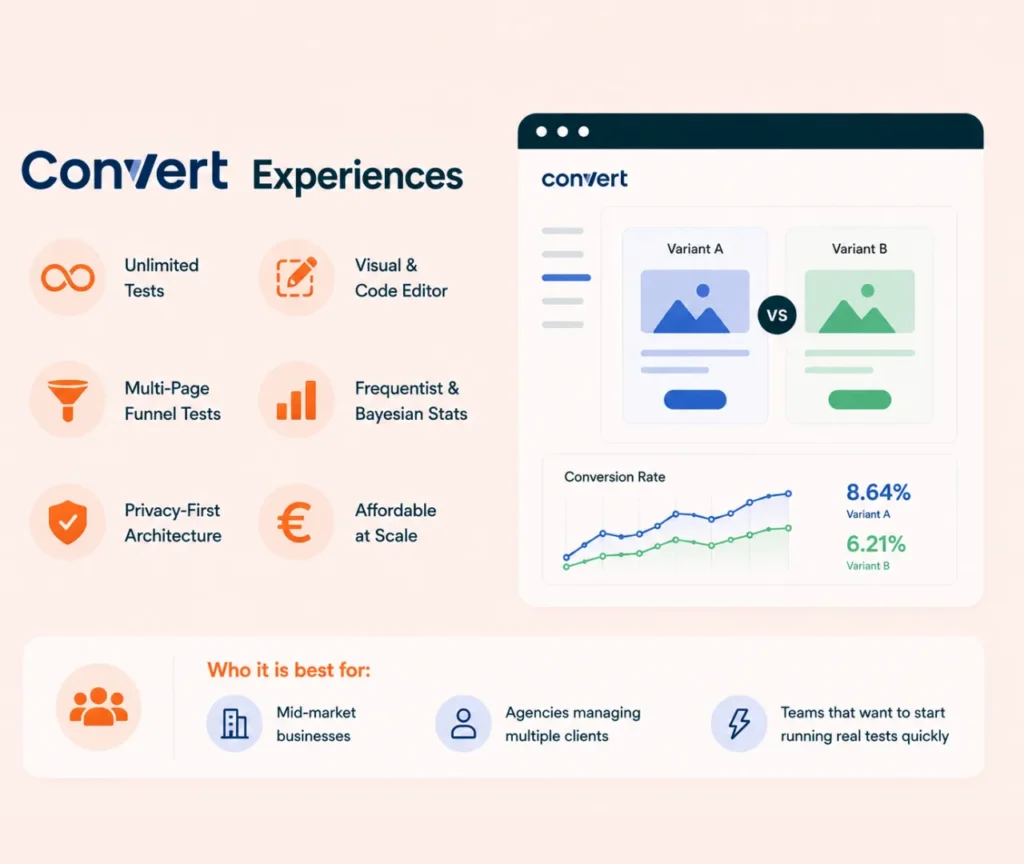
Convert Experiences

Convert is the platform we recommend most often to businesses that want a genuinely professional A/B testing environment without enterprise-level complexity or pricing. It sits in a sweet spot that Google Optimize could never reach: powerful enough to run sophisticated tests, approachable enough that marketers can manage it without a developer on call for every experiment.
Convert offers unlimited tests, a clean visual editor, a solid code editor for more advanced modifications, multi-page funnel experiments, and statistical engines based on both frequentist and Bayesian approaches, which means you can actually trust your results rather than guessing whether you have hit significance. Its privacy-first architecture also makes it a strong choice for businesses serving European audiences under GDPR requirements.
Convert is often described by practitioners as the most affordable serious tool in the market. For mid-sized businesses that were using Google Optimize because it was free, Convert tends to be the most natural upgrade path because it does not require you to completely rethink how your testing program operates.
Who it is best for: Mid-market businesses, agencies managing multiple client accounts, teams that want to start running real tests quickly without enterprise-level implementation overhead.

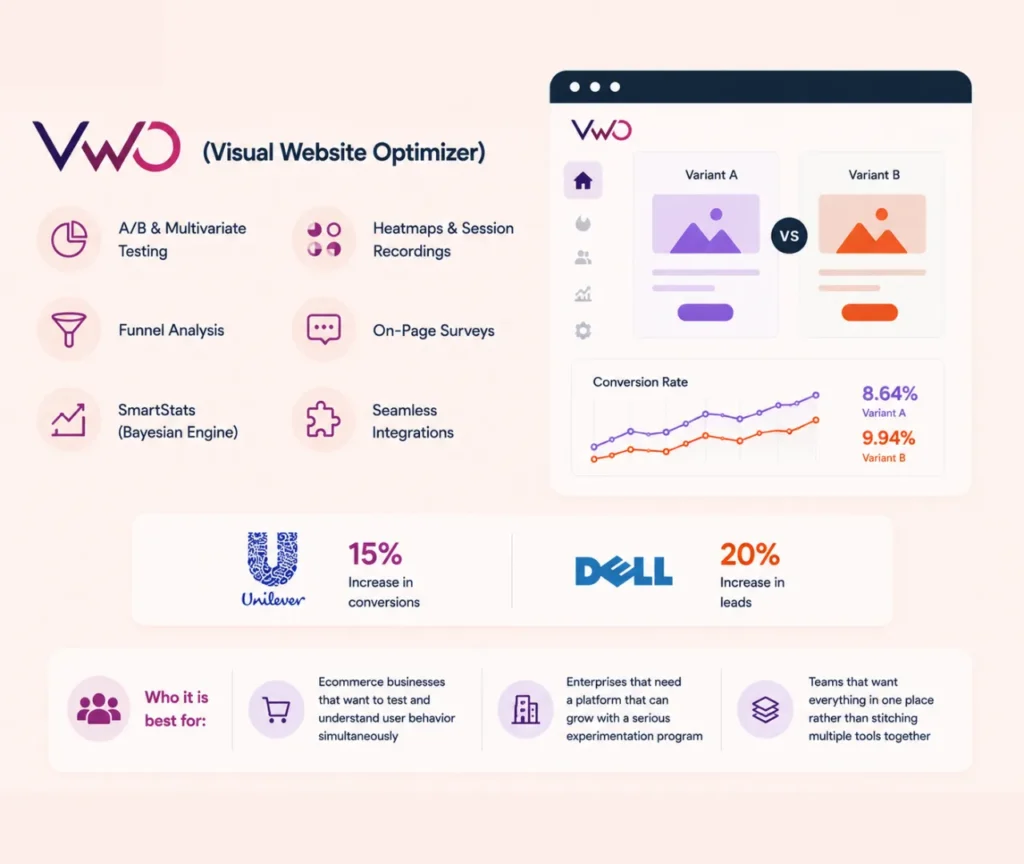
VWO (Visual Website Optimizer)

VWO is the most complete all-in-one experimentation platform in this tier of the market. Where Convert focuses primarily on testing, VWO extends into heatmaps, session recordings, on-page surveys, funnel analysis, and a full behavioral analytics suite. It is the platform you choose when you want to not just run tests but understand why visitors behave the way they do and build your testing hypotheses from behavioral evidence rather than intuition.
VWO's SmartStats engine is one of its most underappreciated features. Traditional A/B testing requires you to commit to a minimum sample size before you can trust results, which means slower decisions. SmartStats uses a Bayesian continuous monitoring approach that gives you reliable guidance on experiments in progress without the same exposure to false positives that comes with peeking at frequentist results. For high-traffic businesses that want to move fast, this matters.
VWO has WordPress and Shopify plugins that make installation clean and straightforward, along with integrations for Google Analytics 4, Segment, Salesforce, Heap, Contentsquare, and FullStory. If you already have a behavior analytics stack, VWO connects into it rather than forcing you to replace it. Unilever used VWO to run A/B tests on product pages and achieved a 15% improvement in conversions. Dell used VWO's personalization capabilities to increase leads by 20%. These are not small improvements at scale.
Who it is best for: Ecommerce businesses that want to test and understand user behavior simultaneously, enterprises that need a platform that can grow with a serious experimentation program, and teams that want everything in one place rather than stitching multiple tools together.

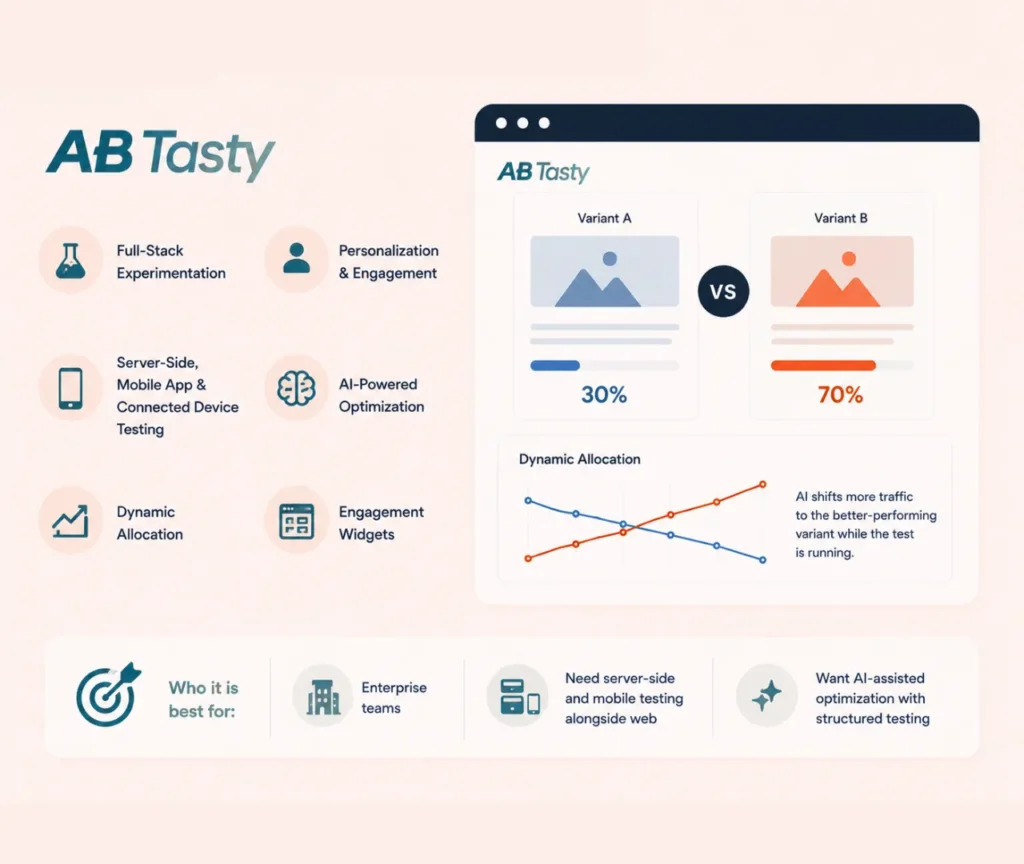
AB Tasty

AB Tasty positions itself as a customer experience optimization platform, which is a meaningful distinction from a pure A/B testing tool. Where Convert and VWO emphasize experimentation, AB Tasty extends further into personalization, engagement widgets, and AI-powered optimization features. Its Flagship product is a full-stack experimentation platform that supports server-side testing, mobile app testing, and even connected device testing, which is genuinely unusual in this market.
AB Tasty's dynamic allocation feature is worth calling out specifically. Rather than running a standard A/B test where traffic is split evenly until you declare a winner, AB Tasty's AI can progressively shift more traffic toward the better-performing variant while the test is still running. This reduces revenue lost to the losing variant during the test period, which is a meaningful benefit for high-traffic pages.
Who it is best for: Enterprise teams, organizations that need server-side and mobile testing in addition to front-end web testing, and businesses that want AI-assisted optimization alongside traditional structured testing.

Platform Comparison at a Glance

Platform Best For Standout Feature Pricing Model Convert Mid-market, agencies Affordable, privacy-first, unlimited tests Traffic-based, transparent VWO Ecommerce, enterprises Heatmaps, session recordings, SmartStats Traffic-based, modular AB Tasty Enterprise, AI-driven programs Dynamic traffic allocation, full-stack Custom enterprise pricing Optimizely Large enterprise Most advanced statistical engine $65,000 plus annually

What Happens When Businesses Try to Handle This Migration Themselves

The instinct to self-manage a platform migration is understandable. You know your website. Your team knows how to install a JavaScript snippet. How complicated can it really be?
In practice, businesses that manage their own Google Optimize migrations tend to run into a predictable set of problems. The first is that they install the new platform but do not configure it properly for their specific analytics setup, which means their test results do not match what they expect to see in GA4 or whatever analytics platform they are using. The second is that they try to recreate old experiments without updating them first, which means they are essentially repeating tests they already ran rather than building on those learnings. The third, and most costly, is that they start making changes to their website based on early test data that has not reached statistical significance, which means they are essentially making random changes to their conversion flow and calling it optimization.
A poorly managed migration does not just fail to improve your conversion rate. It can actively hurt it by creating a false sense that you are testing when you are actually just guessing with extra steps.

What Our Google Optimize Alternative Service Actually Covers

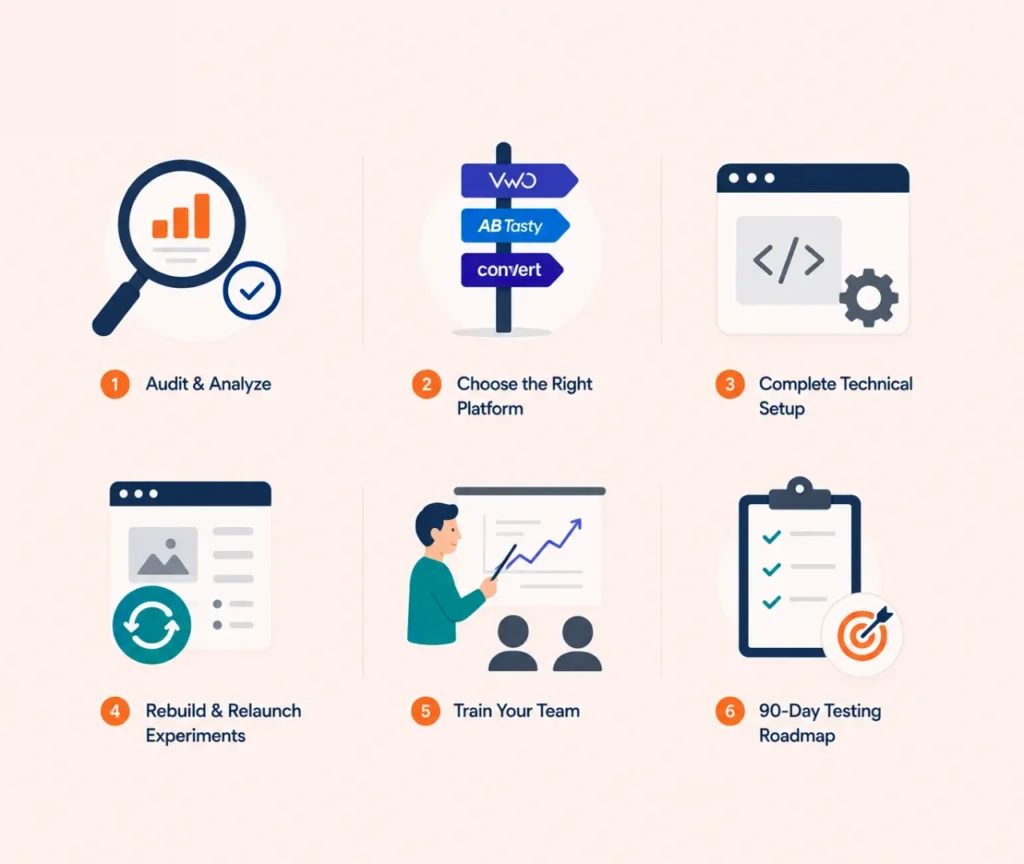
When ConversionXperts manages your migration to a new A/B testing platform, we treat it as a full program rebuild rather than a technical task. Here is exactly what that looks like in practice.
The first thing we do is audit where your testing program currently stands. This means looking at what experiments you ran in Google Optimize, what results you got, what decisions were made based on those results, and whether those decisions actually held up. Many businesses discover during this audit that they made permanent page changes based on undercooked data from Optimize, and that some of those changes are quietly dragging down conversion rates right now.
From there we work with you to choose the right platform based on your actual situation, not which one has the best marketing copy. We look at your traffic volume, your team structure, your existing analytics stack, your testing ambitions over the next twelve months, and your budget. Then we give you a clear recommendation with honest tradeoffs rather than defaulting to whatever is easiest for us to implement.
Once the platform is chosen, we handle the complete technical setup. This includes installing the testing snippet correctly to minimize impact on page speed, which matters because poorly installed A/B testing code is one of the most common but least-discussed causes of slow page load times. We configure the platform to integrate with your analytics environment so results are consistent and trustworthy. We set up your conversion goals precisely so you are measuring what actually matters to your business rather than tracking proxy metrics that feel good but do not correlate with revenue.
We then rebuild or recreate your most important experiments in the new platform, updated with everything you learned from the previous testing program. We do not simply copy old tests across. We review them, assess whether the hypothesis was sound, update the variants based on current best practices, and relaunch them with proper statistical rigor.
After setup, we train your team on the new platform so that ongoing testing is not dependent on our involvement. Our goal is to build your internal capability, not to create dependency on an external agency. The businesses that see the most sustained improvement from CRO investment are the ones where the testing mindset becomes embedded in the team, not outsourced forever.
Finally, we establish a testing roadmap for the first 90 days after migration. This is a structured prioritization of experiments ranked by their potential impact on conversion rate, their implementation complexity, and the confidence level of the hypothesis behind them. You launch your new platform not by picking a random page to test but by running the highest-value experiment your data suggests you should run.

The Cost of Not Testing Right Now

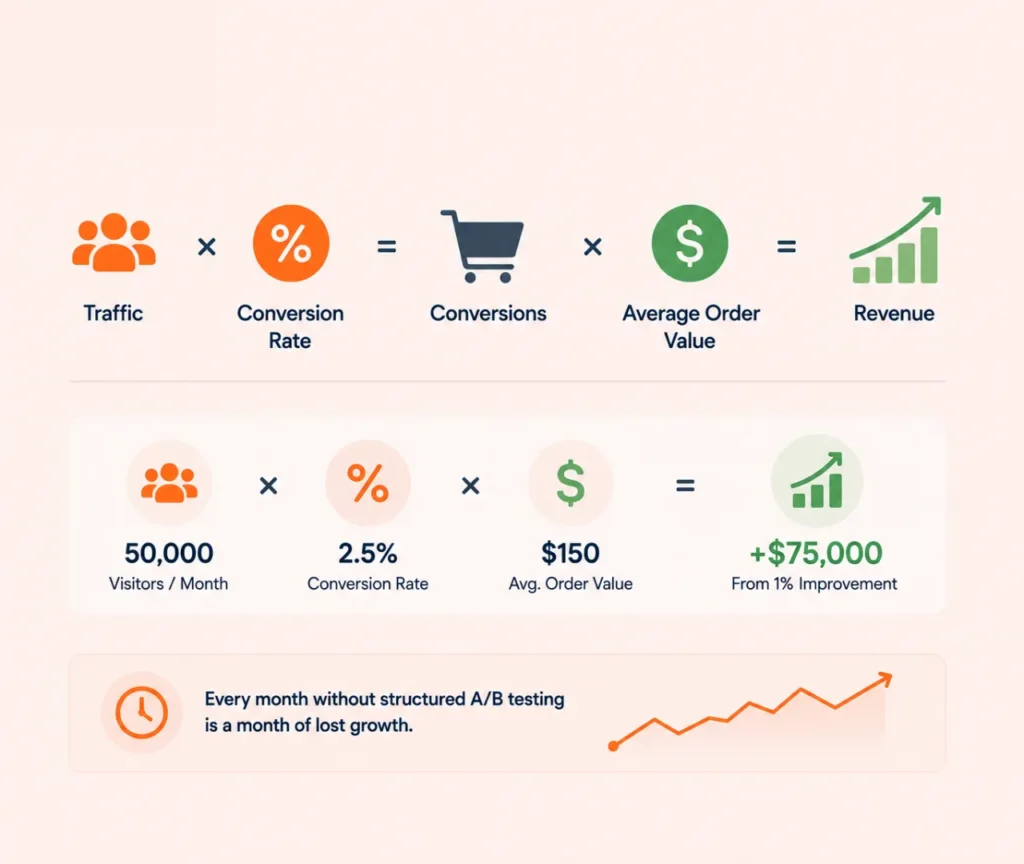
There is a simple way to think about what your current situation is costing you. Take your monthly traffic number and multiply it by your current conversion rate. That gives you your monthly conversions. Now ask yourself what your revenue would look like if your conversion rate were 20% higher. Or 30% higher. Or doubled.
For a business receiving 50,000 visitors per month with a 2.5% conversion rate and an average order value of $150, a one percentage point improvement in conversion rate is worth $75,000 in additional monthly revenue. That number does not require new traffic. It does not require new products. It requires a better page.
Every month without structured A/B testing is a month that improvement is not happening. Every month your competitor's testing program is running while yours is not, they are moving toward that number and you are not.

Why ConversionXperts

ConversionXperts exists for one reason: to help businesses turn the traffic they already have into more revenue without spending more to acquire it.
We are not a generalist digital marketing agency that offers CRO as one line item among twenty services. Conversion rate optimization is what we do, every day, for every client. That focus means our team has real depth in behavioral psychology, statistical analysis, user experience research, copywriting for conversion, and the technical implementation that makes testing programs actually work.
We have worked with ecommerce brands trying to move a 3% checkout conversion rate toward what their category's top performers achieve. We have helped SaaS companies build testing programs that systematically improve trial-to-paid conversion over months rather than hoping a single redesign fixes the problem. We have helped professional services firms convert more of their organic search traffic into consultation requests by building tightly matched landing page experiences around each service they offer.
The Google Optimize migration is not just a technical task for us. It is the beginning of a proper experimentation partnership. The businesses we work with do not just get a new platform. They get a testing strategy, a roadmap, expert interpretation of results, and a team that genuinely cares about whether the numbers move.
If your testing program stalled when Google Optimize shut down and you are ready to rebuild it on a foundation that will actually perform, we are ready to help you do that.

Common Questions We Hear Before Getting Started

What if we never ran many experiments in Google Optimize?

This is actually one of the best reasons to work with us. A managed migration is easier without a complex history of experiments to audit, and starting fresh on a modern platform with a proper strategy from day one is better than trying to piece together a program built on an outdated foundation.

Technically, yes. The snippet installation itself is not complex. What tends to go wrong is everything around the installation: goal configuration, integration with analytics, statistical setup, and most importantly, the testing strategy. The platform is just a tool. What matters is how you use it.

For most businesses, the core technical migration takes one to two weeks. Rebuilding your first experiments and launching a proper testing roadmap typically takes three to four weeks from the start of the engagement. You will be running tests on a professional platform within a month.

For most standard migrations, no. The ConversionXperts team handles the implementation. If your website has a complex custom tech stack or you want to pursue server-side testing, we will be upfront about whether developer involvement is needed and what that looks like.

Both Convert and VWO offer free trials. We can help you set up a trial on the platform we recommend for your situation so you can experience it firsthand before making any financial commitment.

Yes. Many of our clients engage us for ongoing CRO management after the initial migration, which means we run their testing program continuously, handle the analysis of results, and build the roadmap month by month. Others prefer to bring the program fully in-house after the initial setup, in which case we provide comprehensive training and documentation so their team can operate independently.


What Happens When You Get in Touch

From that audit we give you a clear picture of which platform is the right fit, what your first three months of testing should look like, what a realistic improvement in conversion rate looks like for your specific business, and what the full scope of the migration engagement involves.
There is no pressure to commit after the audit. If what we show you makes sense and the fit is right, we move forward together. If it does not, you leave with a clearer picture of your situation than you had before, which is worth something on its own.
The first step is a free audit. Before we recommend anything, we want to understand your current situation. That means looking at your existing analytics data, understanding your traffic sources and volumes, reviewing what testing you have done in the past, and identifying the highest-value conversion opportunities on your website.

Real Clients. Real Results. Real Revenue Growth.

We let the numbers do the talking. Watch real business owners from e-commerce, and SaaS share how Conversion Xperts turned their underperforming websites into predictable revenue machines.
Chris Sheridan talking about my CRO services which improve Conversion Rates & Sales
Mark talking about my Hotjar, Google Analytics 4, Looker Studio Services

Ready to Double Your Conversions in the Next 90 Days?

Fill out the contact form and our optimization team will review your website and respond within 24–48 business hours.
Want to Increase Your Conversions? Let’s Talk
⚠️ 3 Spots remaining for May 2026