




















Multivariate Testing Services – Optimize Every Element to Maximize Conversions

Test multiple variables, implement data-backed changes, and see measurable improvements in conversions and revenue.

You Are Getting Traffic. So Why Aren't You Getting More Conversions?

Most businesses invest heavily in driving traffic to their website — through SEO, paid ads, social media, and content marketing. But here is the uncomfortable truth: if your pages are not optimized, you are paying for traffic that never converts.
A compelling headline can be undermined by a weak call-to-action. A beautiful hero image can work against a confusing layout. A trust badge in the wrong position can actually raise doubts instead of removing them. The problem is that page elements do not operate in isolation — they interact with each other constantly, and the combination matters just as much as the individual parts.
This is exactly the problem Multivariate Testing was built to solve.
What is multivariate testing for conversion optimization

What Is Multivariate Testing?

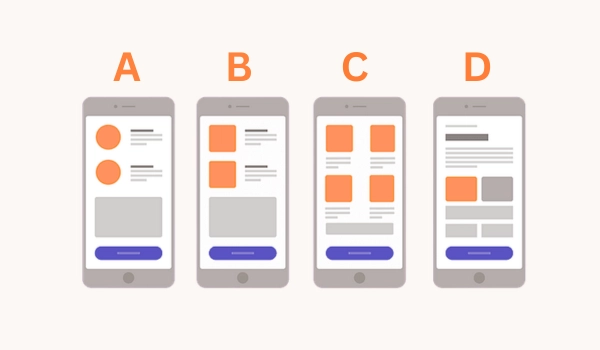
Multivariate Testing (MVT) is a structured method of experimentation that simultaneously tests multiple page elements and their combinations to determine which configuration produces the highest conversion rate.
Unlike A/B testing — which isolates one change at a time and compares two versions of a single element — Multivariate Testing goes several layers deeper. Instead of asking "does Headline A or Headline B perform better?", MVT asks "which combination of headline, image, subheadline, CTA button text, and form placement produces the best outcome together?"
In a typical MVT setup, you might test:
That gives you 3 × 2 × 2 × 2 = 24 unique combinations to evaluate — all running simultaneously, all measured against the same success metrics. The result is a level of insight that simply cannot be achieved by running A/B tests one at a time over many months.
The goal of MVT is not just to find a winner. It is to understand the relationship between your page elements — which ones have the highest individual impact, which ones work best in combination, and which ones actually hurt performance when paired together. This depth of understanding makes every future optimization decision smarter and faster.

What's our Clients Say

Multivariate Testing vs. A/B Testing — Which One Is Right for You?

This is one of the most common questions we hear, and the honest answer is: it depends on your situation. Both approaches have legitimate use cases, and the best CRO programs use both strategically.
A/B Testing is the right choice when:
A/B testing when to use it for optimization
Multivariate testing when to use it for optimization
Multivariate Testing is the right choice when:
Both methods are grounded in the same fundamental principle: stop guessing, and start testing. The difference is the complexity of the questions being answered.
Multivariate testing importance for conversion optimization

Why Multivariate Testing Is Essential for Serious Conversion Optimization

Here is a reality that most businesses discover too late: your intuition about what works on your website is likely wrong — or at best, incomplete.
User behavior is shaped by dozens of psychological, contextual, and design factors that interact in non-obvious ways. What you think looks clean and compelling, your visitors may experience as confusing or untrustworthy. What you assume is a minor detail — a button color, a headline word choice, the presence or absence of a product image — may be the single biggest driver of your conversion rate.
Multivariate Testing removes assumption from the equation entirely. It replaces "I think this will work" with "the data proves this works."
Specifically, MVT gives you the ability to:
Optimize multiple page sections at once. Rather than running a single test per month, you can evaluate dozens of combinations in the same testing window, dramatically accelerating your optimization velocity.
Understand element interactions. Sometimes two elements that perform adequately on their own create a powerful effect when combined. MVT reveals these synergies — and reveals conflicts you would never discover through sequential A/B testing.
Maximize the value of existing traffic. MVT does not require more visitors — it makes every existing visitor count more. You are converting traffic you are already paying for more effectively.
Reduce risk in design decisions. Before rolling out a significant page redesign, MVT allows you to validate individual component changes at scale, so you are never relying on guesswork for high-stakes decisions.
Build a cumulative knowledge base. Every test you run teaches you something specific about your audience. Over time, this creates a proprietary understanding of your users that your competitors simply do not have.

Our Multivariate Testing Process — From Hypothesis to Revenue Impact

We follow a rigorous, end-to-end process that is designed to produce results you can act on with confidence. Here is exactly how we work:
Step 1 — Discovery and Page Audit
Before we test anything, we need to understand where your biggest opportunities lie. We conduct a comprehensive audit of your target pages using a combination of quantitative data (Google Analytics, heatmaps, session recordings, funnel drop-off analysis) and qualitative research (user surveys, on-site polls, customer interviews). This tells us which elements are likely causing friction, which are already performing well, and where user attention is being lost.
Step 2 — Hypothesis Development
Every test we run is grounded in a specific, evidence-based hypothesis. We do not test for the sake of testing. Each hypothesis follows the structure: "If we change [element] in this [specific way], we expect [this outcome] because [this is what the data suggests about user behavior]." This rigor ensures that every test, whether it wins or loses, teaches us something valuable.
Multivariate testing process from hypothesis to revenue impact
Step 3 — Test Design and Variation Creation
We design your multivariate test with statistical precision, ensuring that the number of combinations is manageable relative to your traffic volume, and that the test will reach statistical significance within a reasonable timeframe. We create all variation assets — copy, design elements, layouts — and implement the test using industry-leading platforms such as VWO, Optimizely, Google Optimize, or Convert, depending on your technology stack.
Step 4 — Traffic Allocation and Test Launch
We configure the test to distribute traffic fairly and randomly across all combinations, with proper controls in place to prevent data contamination. We monitor the early stages of the test closely to catch any technical issues, ensure even distribution, and verify that tracking is capturing the right events.
Step 5 — Data Analysis and Statistical Interpretation
Once the test reaches statistical significance — typically a 95% confidence threshold or higher — we conduct a deep analysis of the results. This goes beyond identifying the winning combination. We analyze the performance of each individual element, the interaction effects between elements, and what the results tell us about your users' preferences and psychology. We separate true wins from statistical noise so you never make decisions based on misleading data.
Step 6 — Implementation and Iteration
We translate the findings into a clear implementation plan and work with your development team (or handle implementation ourselves) to roll out the winning configuration. We then use the learnings from this test to inform the next round of hypotheses, creating a continuous optimization cycle that keeps improving your results over time.
What we test elements that improve conversion rates

What We Test — Elements That Move the Needle

Not all page elements have the same impact on conversions. Through hundreds of tests across multiple industries, we have identified the highest-leverage elements to test through MVT:
Headlines and Subheadlines — Your headline is the first thing a visitor reads and the primary determinant of whether they stay or leave. We test value proposition framing, emotional tone, specificity, length, and format to find the language that resonates most strongly with your audience.
Call-to-Action Buttons The text, color, size, shape, placement, and surrounding whitespace of your CTA all influence click-through rates. Small changes here can produce outsized results.
Hero Images and Media — The visual content above the fold significantly shapes first impressions. We test product shots versus lifestyle images, video versus static imagery, illustration versus photography, and the presence or absence of people to determine what builds the most trust and engagement.
Form Design and Placement — For lead generation pages, form length, field labels, input types, and CTA text are all testable variables with significant conversion impact. We also test single-column versus multi-column layouts and progressive disclosure approaches.
Trust Signals — Testimonials, client logos, review counts, guarantees, security badges, and certifications all reduce perceived risk. We test their placement, format, and prominence to find where they have maximum impact.
Pricing and Offer Presentation — How you frame your pricing, what order you present packages in, and how you highlight your most valuable tier all influence purchase decisions. MVT allows us to optimize these interactions systematically.
Navigation and Page Layout — The overall structure of your page — section order, whitespace usage, content hierarchy, and navigation elements — shapes how users process information and where their attention flows.

Who Benefits Most from Multivariate Testing?

Multivariate Testing delivers the greatest impact for businesses that combine meaningful traffic volume with high-value conversion actions. The industries and business types that benefit most include:
E-commerce brands that want to increase add-to-cart rates, reduce checkout abandonment, and improve product page performance. For e-commerce, even a 1% improvement in conversion rate can translate to hundreds of thousands in additional annual revenue.
SaaS companies optimizing free trial signups, demo requests, and paid upgrade flows. MVT is particularly powerful for SaaS landing pages, where the combination of headline, feature highlights, social proof, and CTA must work together seamlessly to convert skeptical buyers.
Service businesses and agencies that rely on lead generation forms, consultation bookings, or quote requests. These businesses often have high-value leads but low conversion rates, making page optimization extremely high-ROI.
Financial services and insurance companies where trust, clarity, and compliance all influence user decisions simultaneously.
Who benefits from multivariate testing in CRO
Healthcare and wellness brands that need to balance urgency with sensitivity, and clinical credibility with approachability.
Media and content publishers seeking to increase newsletter signups, paid subscription conversions, or content upgrade downloads.
If your website generates meaningful traffic but your conversion rate feels stuck, Multivariate Testing is almost certainly the fastest path to improvement.

The Business Case for Multivariate Testing — Real Numbers

Let us put this in concrete terms. Suppose your website generates 50,000 visitors per month with a current conversion rate of 2.5%, producing 1,250 conversions. Your average order value is $120.
A 20% improvement in conversion rate — from 2.5% to 3.0% — adds 250 conversions per month. At a $120 AOV, that is $30,000 in additional monthly revenue, or $360,000 per year, from the exact same traffic you are already paying for.
This is not a hypothetical. It is the kind of outcome that rigorous, data-driven Multivariate Testing produces for businesses that commit to continuous optimization. The return on investment from MVT is among the highest of any marketing activity precisely because it improves the performance of every other channel you invest in simultaneously.

Why Work with Conversion Xperts for Multivariate Testing?

There are many agencies that offer testing services. Here is what makes our approach different:
We are strategists first, technologists second. We use data and testing tools in service of a clear optimization strategy, not as a box-ticking exercise. Every test we design is connected to a business objective.
We bring cross-industry expertise. We have run hundreds of experiments across e-commerce, SaaS, services, and lead generation, which means we bring pattern recognition and benchmarking knowledge that accelerates your results.
We are transparent about what the data says. When a test is inconclusive, we tell you. When a hypothesis is wrong, we tell you why, and we use that learning to build a better next hypothesis. We never cherry-pick results or spin ambiguous data to look good.
We think beyond individual tests. Our goal is not to run one successful experiment — it is to build a systematic optimization capability for your business that compounds over time. We help you develop a testing roadmap, a research infrastructure, and a culture of experimentation that keeps improving your results for years.
We work within your existing stack. Whether you use VWO, Optimizely, Convert, Adobe Target, or another platform, we integrate with your existing tools and processes without requiring a complete overhaul of your technology.

Frequently Asked Questions About Multivariate Testing

How much traffic do I need for Multivariate Testing?

MVT requires more traffic than A/B testing because you are splitting visitors across many more combinations. As a general guideline, we recommend a minimum of 20,000 to 30,000 monthly visitors to the page being tested, though the precise requirement depends on your current conversion rate and the number of combinations being tested. We will always calculate the required sample size before recommending MVT for a specific page.

Test duration depends on your traffic volume, the number of combinations, and your current conversion rate. Most MVT experiments run for two to six weeks to reach statistical significance. We never call a test early, as premature conclusions are one of the most common sources of bad optimization decisions.

When implemented correctly using asynchronous loading methods and quality testing platforms, MVT adds no perceptible impact to page load speed. We always implement tests following performance best practices and will flag any concerns before launch.

We deliver a comprehensive results report with clear recommendations, implement the winning variation, and use the learnings to develop the next round of hypotheses. Optimization is a continuous process, not a one-time project.

Absolutely. We can either hand off a complete implementation specification to your developers, collaborate directly within your development workflow, or handle implementation ourselves — whichever approach works best for your team.


Real Clients. Real Results. Real Revenue Growth.

We let the numbers do the talking. Watch real business owners from e-commerce, and SaaS share how Conversion Xperts turned their underperforming websites into predictable revenue machines.
Chris Sheridan talking about my CRO services which improve Conversion Rates & Sales
Mark talking about my Hotjar, Google Analytics 4, Looker Studio Services

Ready to Double Your Conversions in the Next 90 Days?

Fill out the contact form and our optimization team will review your website and respond within 24–48 business hours.
Want to Increase Your Conversions? Let’s Talk
⚠️ 3 Spots remaining for May 2026