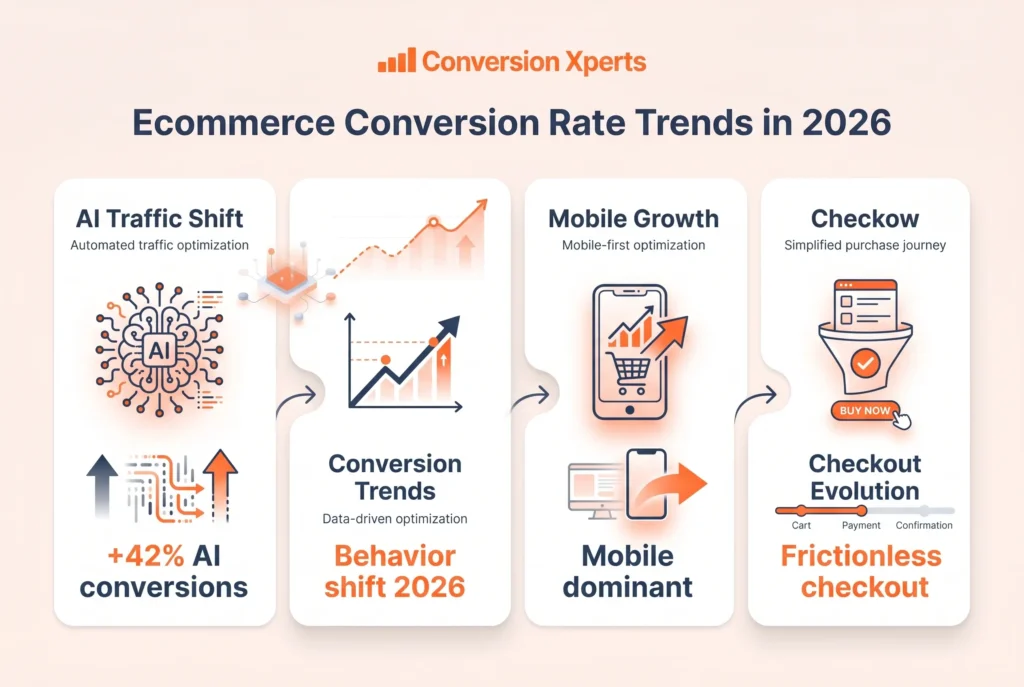
Sales Conversion: The Complete Guide to Boosting Your Conversion Rate
Key Sales Conversion Statistics 2026
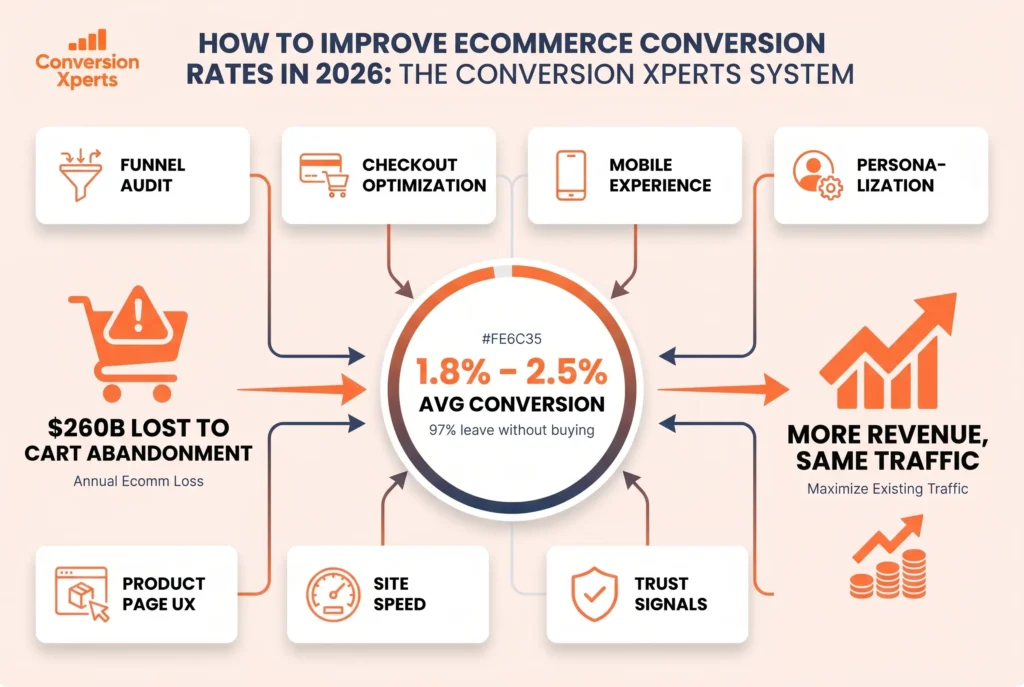
Did you know that the average website converts only 2.35% of its visitors into customers? That means for every 100 people who land on your page, roughly 97 leave without buying anything. If you are running a business in Pakistan or anywhere globally, those numbers represent real lost revenue every single day.
Sales conversion is the process of turning a visitor, lead, or prospect into a paying customer. It sounds simple, but getting it right takes more than just good products. You need the right message, the right timing, and a website experience that builds trust fast.
In this guide, you will learn:
- What sales conversion actually means and why it matters
- What a good sales conversion rate looks like by industry
- The key sales conversion statistics you need to benchmark your performance
- What CRO (conversion rate optimization) is and how it works
- Practical steps to improve your conversion rate starting today
Whether you are a small business owner, a marketing manager, or someone exploring professional CRO services, this guide gives you a clear, honest picture of where to focus your energy.
What Is Sales Conversion?
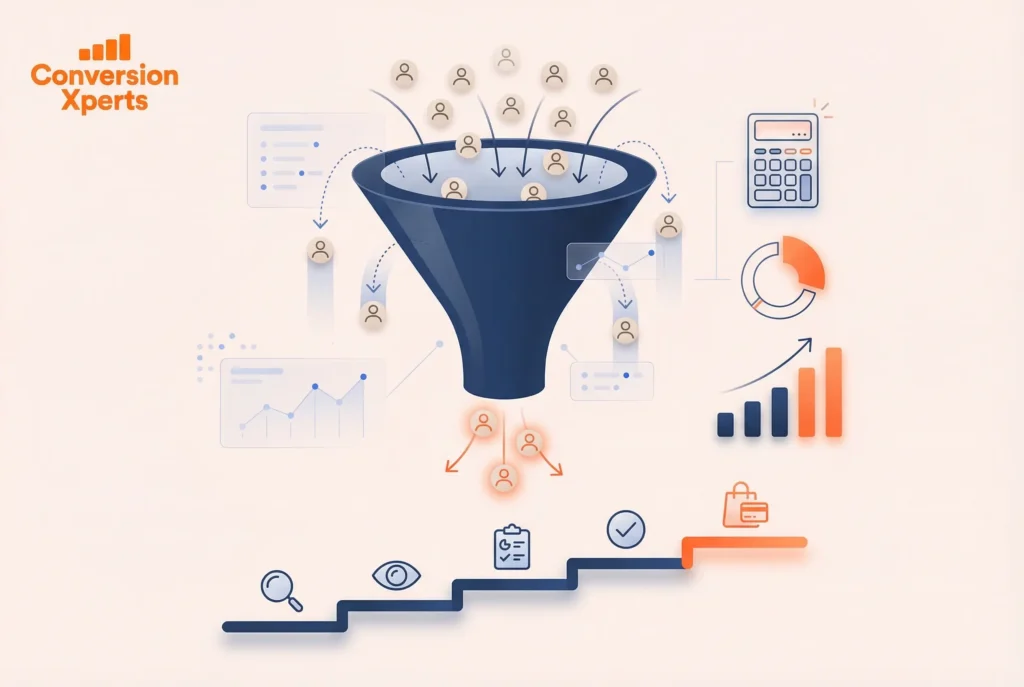
Sales conversion is the act of moving a person from one stage of your sales funnel to the next, ultimately resulting in a purchase or a desired action.
The word “conversion” does not always mean a sale. Depending on your business, a conversion might be:
- A visitor filling out a contact form
- A user signing up for a free trial
- A prospect booking a discovery call
- A shopper completing a checkout
The sales conversion rate measures how often this happens. You calculate it with a straightforward formula:
Conversion Rate = (Total Conversions ÷ Total Visitors) × 100
So if 50 people out of 1,000 visitors complete a purchase, your conversion rate is 5%.
Why Sales Conversion Matters More Than Traffic
Most businesses pour their budget into getting more traffic. But here is the problem: more traffic without better conversion is like pouring water into a leaking bucket.
A business with 10,000 monthly visitors and a 1% conversion rate gets 100 customers. That same business, with zero extra traffic but a 3% conversion rate, suddenly has 300 customers. The math is compelling.
Focusing on sales conversion means you grow revenue without necessarily spending more on ads or content. That is why conversion rate optimization has become one of the highest-ROI activities in modern marketing.
The Sales Conversion Funnel
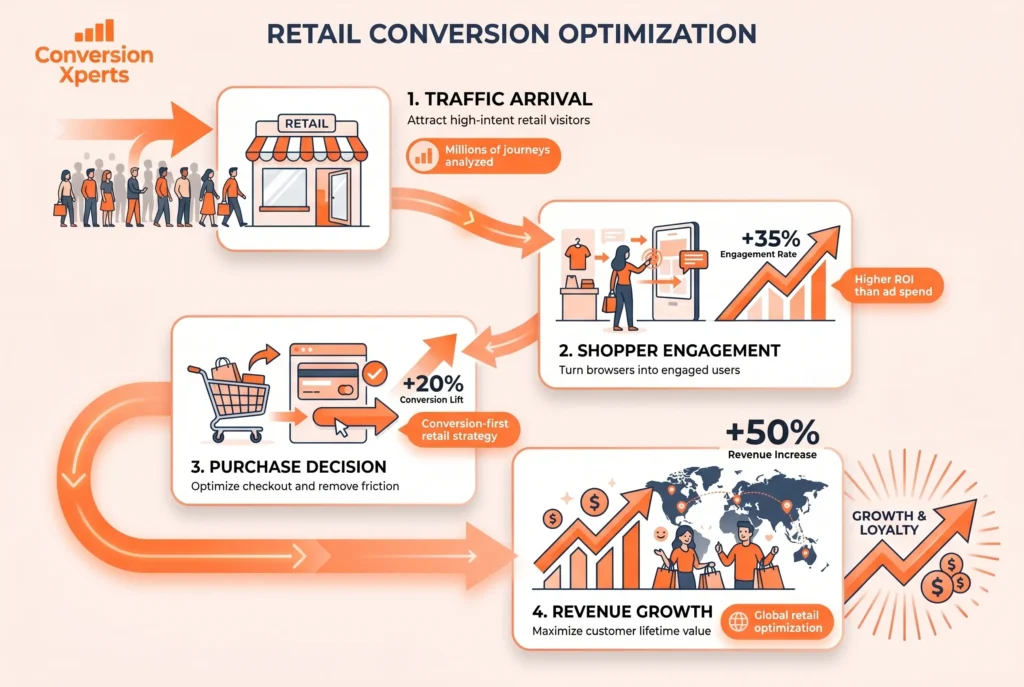
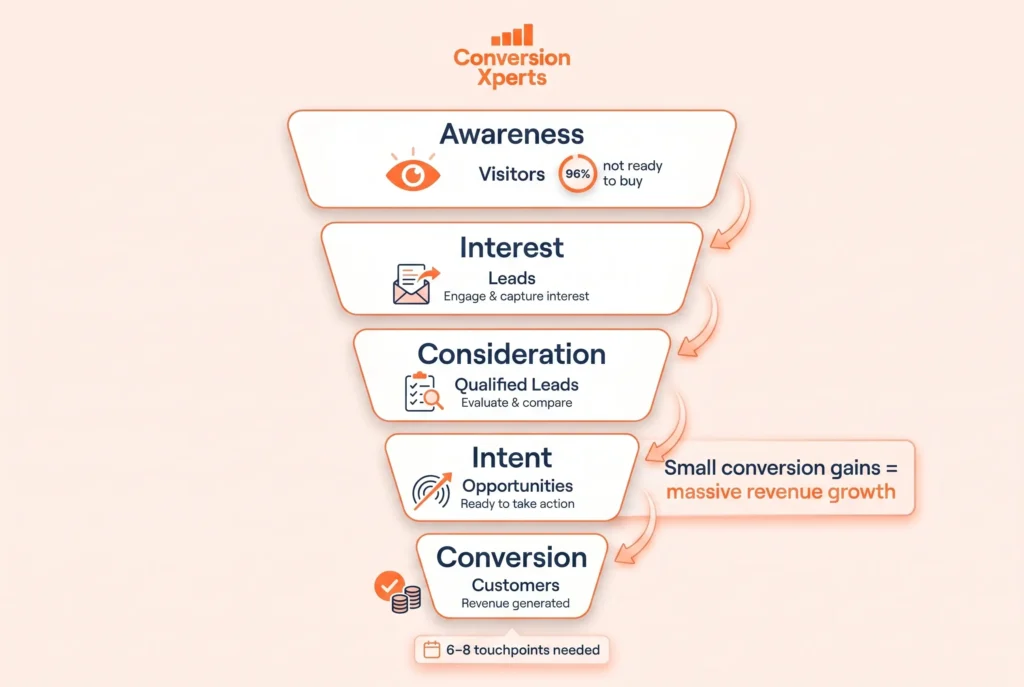
Your sales funnel is the journey a stranger takes to become a customer. Each stage has its own conversion moment:
| Funnel Stage | Conversion Action | Typical Drop-Off |
Awareness | Clicks your ad or finds your content | 90%+ leave |
Interest | Browses your website or product pages | 70–80% leave |
Consideration | Adds to cart or requests a quote | 60–70% leave |
Decision | Starts checkout or fills out a form | 20–30% leave |
Purchase | Completes the transaction | Final conversion |
Understanding where people drop off is the first step in improving your overall sales conversion rate.
What Is a Good Sales Conversion Rate?
A good sales conversion rate depends on your industry, your traffic source, and the complexity of your product. For most websites, anything between 2% and 4% is considered average. Top-performing businesses convert at 5% or higher.
Here is a breakdown by industry, based on current benchmarks:
Conversion Rate Benchmarks by Industry (2024–2025)
| Industry | Average Conversion Rate |
Arts and Crafts | 5.11% |
Personal Care / Beauty | 6.8% |
Food and Beverages | 4.9% |
Professional Services | 4.6% |
Healthcare | 3.0% |
Finance | 3.1% |
Electronics | 3.6% |
B2C eCommerce | 2.1% |
B2B eCommerce | 1.8% |
Travel | 2.4% |
Higher Education | 2.8% |
Real Estate | 2.91% |
Sources: Keywords Everywhere, VWO, Speed Commerce, 2024–2025
If your numbers are below your industry average, you have an optimization opportunity. If you are above it, the goal becomes staying ahead through ongoing testing.
B2B vs. B2C: A Different Benchmark Game
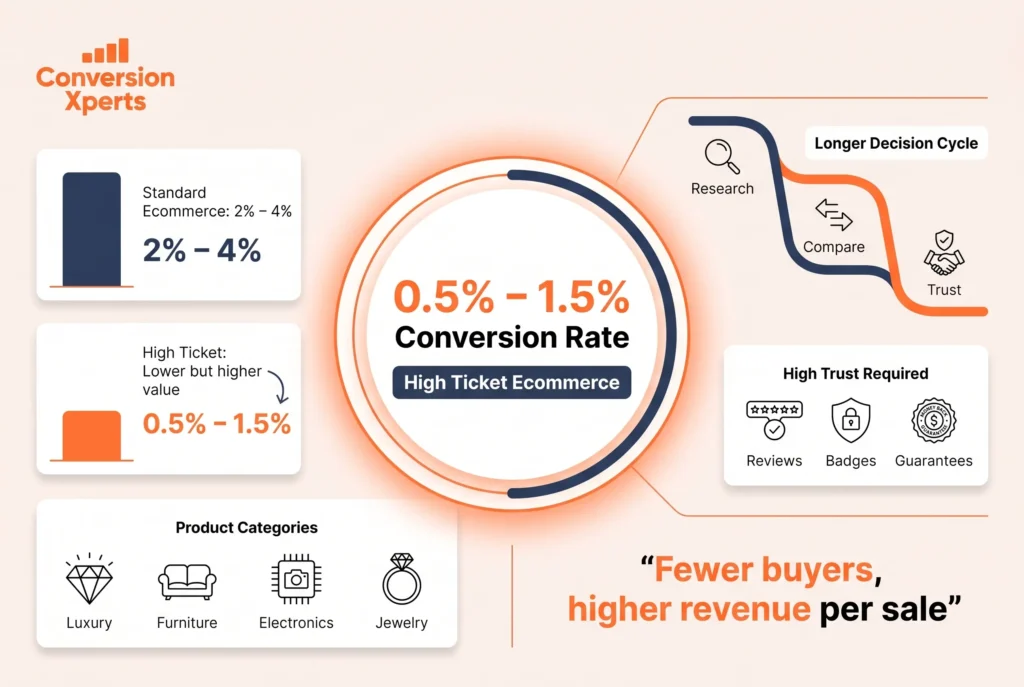
B2B sales conversion works very differently from B2C. Business buyers go through longer decision cycles, involve multiple stakeholders, and require more trust before committing. As a result, the average B2B eCommerce conversion rate sits around 1.8%, compared to 2.1% for B2C.
However, in B2B, a single conversion might be worth thousands of dollars. So a lower conversion rate can still mean excellent revenue, as long as the lead quality is high.
The key takeaway is this: never benchmark yourself against a different business model. A B2B software company comparing its conversion rate to a B2C fashion retailer will reach the wrong conclusions.
Key Sales Conversion Statistics 2026
Numbers help you make better decisions. Here are the most important sales conversion statistics that should shape your strategy right now.
General Conversion Benchmarks
- The average website conversion rate is 2.35% across industries. Top-performing sites convert at 11% or higher (Keywords Everywhere, 2024).
- According to the HubSpot 2024 Sales Trends Report, the average sales win rate is 21%, meaning 79% of leads never convert into customers.
- Direct marketing has the highest conversion rate of any channel at 3.13%, compared to organic social at 1.05% and paid social at just 0.61% (ContentSquare 2024 Digital Experience Benchmark Report).
Speed and Technical Performance
- A one-second improvement in page load speed can increase conversions by 7% (Shopify, 2024).
- Sites that load in one second convert at 3x the rate of sites that take five seconds to load (Landbase, 2025).
- 53% of users abandon a page that takes longer than 3 seconds to load (Marketing LTB, 2025).
- On mobile, every extra second of load time reduces conversions by up to 20% (Shopify, 2024).
Mobile vs. Desktop
- Desktop users convert at approximately 4.8%, while mobile users convert at around 2.9% (Landbase, 2025).
- Mobile accounts for 73% of web traffic, but still lags behind desktop in conversion performance.
- Mobile eCommerce cart abandonment reaches 85.65%, compared to 73.76% on desktop (Shopify, 2024).
- People who have a bad mobile experience are 62% less likely to purchase from that brand in the future (Google).
Personalization and Testing
- Personalized messaging results in 50% better customer re-engagement and 21% more sales conversions (Shopify, 2024).
- Companies that run 10 or more A/B tests per month grow 2.1 times faster than those who test infrequently (Marketing LTB, 2025).
- AI-powered personalization tools can lift conversions by 30% or more for eCommerce brands (Shopify, 2024).
- Adding a product video before the CTA has been shown to increase conversion rates by 144% in specific brand case studies (KhrisDigital, 2025).
Email and Retargeting
- Email marketing leads all channels with an average conversion rate of around 15% (Landbase, 2025).
- Retargeting ads increase conversions by 26%, with high-intent campaigns converting at 12–18% (Marketing LTB, 2025).
- 70% of retargeted visitors are more likely to convert compared to cold traffic (Keywords Everywhere, 2024).
- Abandoned cart emails recover 10–14% of lost sales (Marketing LTB, 2025).
What Is CRO? A Plain-English Explanation
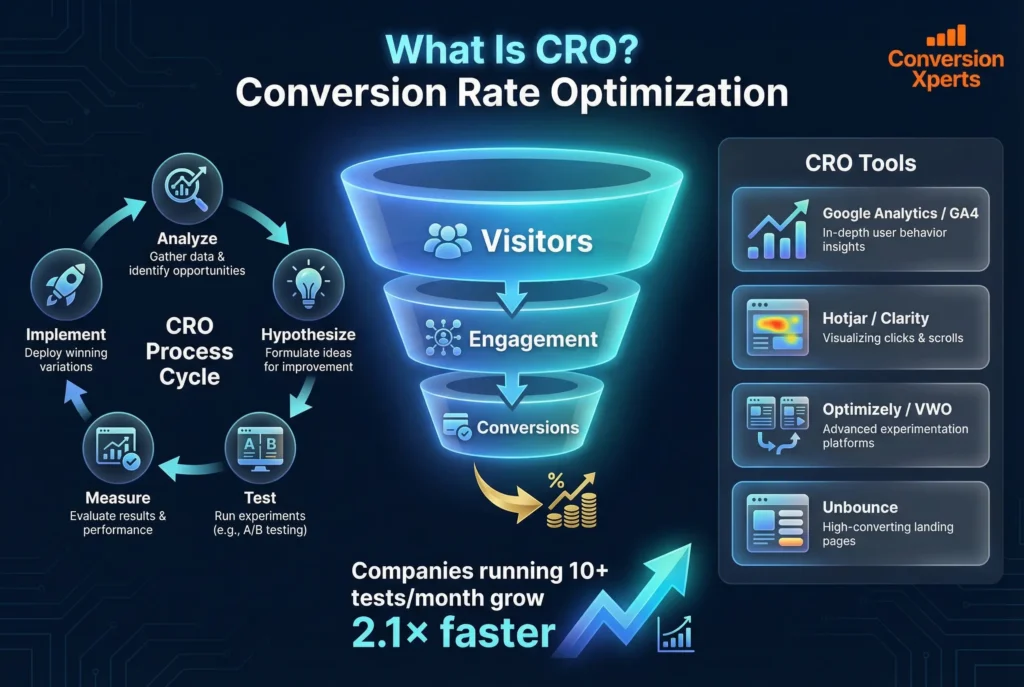
CRO (Conversion Rate Optimization) is the systematic process of increasing the percentage of visitors who take a desired action on your website, without increasing your traffic budget.
Think of CRO as improving the efficiency of your existing funnel. Instead of spending more to bring new people in, you focus on getting more value from the people already visiting.
The Core CRO Process
CRO is not guesswork. It follows a structured cycle:
- Analyze: Use analytics tools to identify where users drop off in your funnel.
- Hypothesize: Form a theory about why that drop-off happens.
- Test: Run an A/B test or multivariate test to compare your original version against a new one.
- Measure: Determine which version performs better using statistical significance.
- Implement: Roll out the winner and repeat the cycle.
This is why businesses that run more tests grow faster. The data confirms it: companies running 10 or more tests per month grow at more than double the rate of those running fewer tests.
CRO Tools You Should Know About
Several reliable tools help businesses implement conversion rate optimization:
- Google Analytics / GA4: The starting point for understanding user behavior and drop-off points.
- Hotjar or Microsoft Clarity: Heatmaps and session recordings that show where users click, scroll, and get confused.
- Optimizely or VWO: Platforms built specifically for running A/B tests on your website.
- Unbounce: A landing page builder with built-in testing and AI traffic optimization features.
You do not need all of these from day one. Start with analytics and a heatmap tool, then move into testing once you have identified specific problem areas.
What CRO Is Not
CRO is often misunderstood. It is not:
- Just changing button colors and hoping for the best
- A one-time project that you finish and forget
- Only relevant to large eCommerce brands
CRO applies to any business that has a website and wants visitors to take action. That includes service businesses, SaaS companies, local businesses with contact forms, and B2B companies seeking leads.
The important insight here is that companies spend $92 acquiring new customers for every $1 they invest in CRO (Keywords Everywhere, 2024). That imbalance is exactly why so many businesses leave revenue on the table.
How to Improve Your Sales Conversion Rate
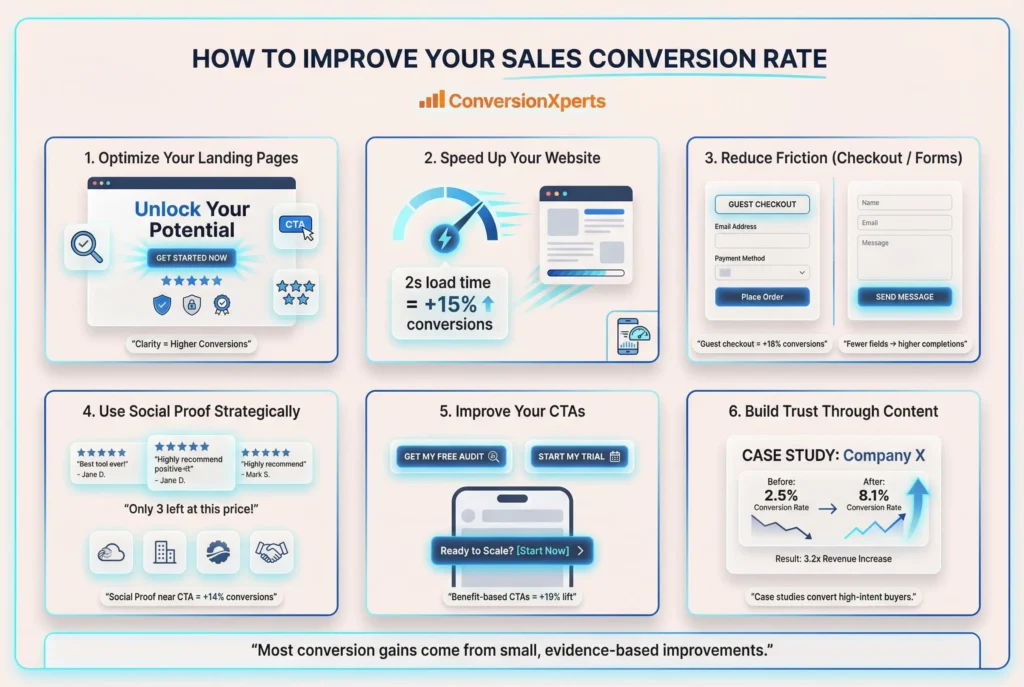
Improving your sales conversion rate does not require a complete website redesign. Most meaningful gains come from targeted, evidence-based changes. Here are the proven tactics that move the needle.
1. Optimize Your Landing Pages
Landing pages are often the first impression your brand makes after an ad click or email link. They live or die by one thing: clarity.
What works:
- A single, clear headline that states the benefit directly (not the feature)
- One primary call-to-action per page
- Social proof elements near the CTA: customer reviews, case study snippets, trust badges
- Removing navigation menus so visitors focus on one action
Long-form landing pages convert 18% higher for high-ticket services. Short-form pages outperform for low-priced products. Match the length to the level of trust required to buy (Marketing LTB, 2025).
Adding an FAQ section to your landing page increases conversions by 9%. This is because it answers objections before they become reasons to leave.
2. Speed Up Your Website
Page speed is not a technical nice-to-have. It directly affects your sales conversion rate.
A two-second load time or faster increases conversions by 15%. Every second you add on top of that costs you customers. For mobile users, the stakes are even higher since a one-second delay can cut conversions by up to 20%.
Start with Google PageSpeed Insights to get a free audit of your current performance. Common quick wins include compressing images, enabling browser caching, and switching to a faster hosting provider.
3. Reduce Friction in Your Checkout or Contact Process
Friction is anything that makes it harder for a visitor to say yes. The more steps, the more fields, the more confusion, the lower your sales conversion rate will be.
For eCommerce:
- Offer guest checkout. Adding it has been shown to boost conversions by 18% (Marketing LTB, 2025).
- Show the total cost (including shipping and fees) as early as possible. 24% of cart abandonments happen because of unexpected fees at checkout.
- Add digital payment options like PayPal or Google Pay. These increase conversions by 14%.
For service businesses and lead generation:
- Reduce the number of fields in your contact form. Fewer fields consistently produce more completions.
- Add a clear expectation below the submit button: “We will respond within 24 hours” or “No spam, ever.”
4. Use Social Proof Strategically
People trust other people more than they trust brands. Social proof reduces the perceived risk of buying and is one of the most cost-effective CRO tools available.
Effective social proof includes:
- Customer reviews and star ratings on product pages
- Case studies showing specific results (“Our client grew revenue 37% in 90 days”)
- Real-time trust signals: “230 people viewed this page today” or “Only 3 left in stock”
- Logos of well-known clients or media features
Featuring social proof near your CTA specifically lifts conversions by 14% (Marketing LTB, 2025). Placement matters as much as content.
5. Improve Your Calls-to-Action
Your CTA is the final ask. It should be specific, benefit-driven, and easy to find.
- Benefit-driven CTA buttons outperform generic ones by 19% (Marketing LTB, 2025). “Get My Free Audit” beats “Submit” every time.
- CTA copy tests produce an average 9–12% lift when improved.
- Sticky CTAs (buttons that stay visible as the user scrolls) improve mobile conversions by 12%.
Test your CTAs regularly. Sometimes a single word change produces a meaningful conversion gain.
6. Build Trust Through Content
Case studies are one of the most effective content types for attracting high-intent buyers. According to the Content Marketing Institute’s 2023 Content Marketing for Demand Generation Survey, 40% of marketers identified case studies as the most effective tool for converting research-phase prospects.
If you are a service business, document two or three clear client success stories. Show the problem, the approach, and the measurable result. This type of content answers the question every buyer has: “Will this actually work for me?”
Conversion Rate Optimization by Channel
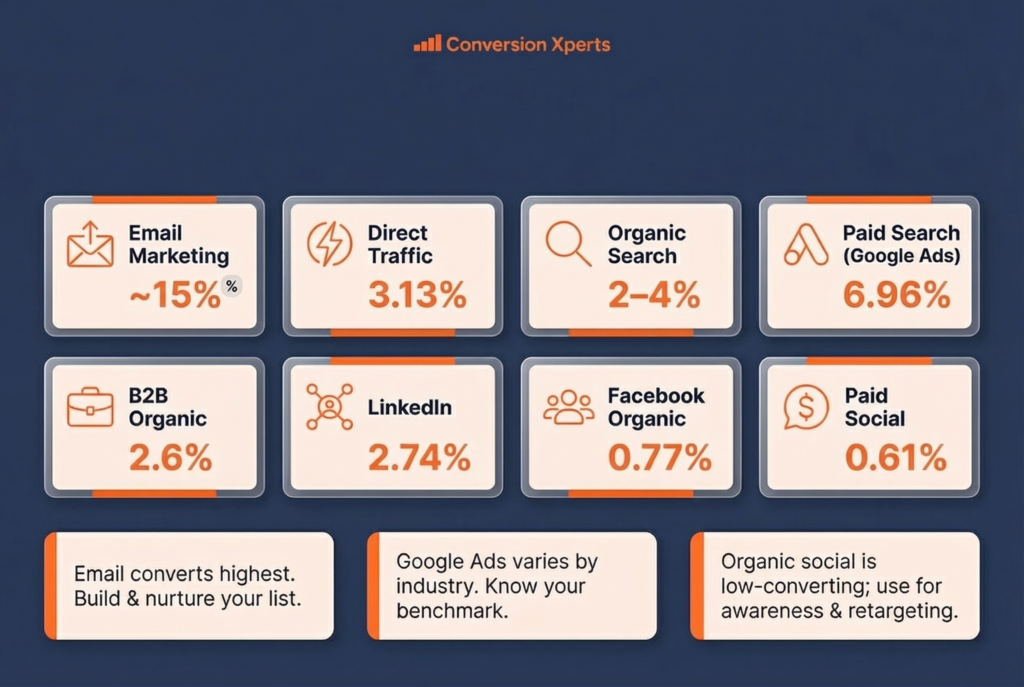
Different traffic channels convert at very different rates. Knowing where your best-converting visitors come from helps you invest your budget wisely.
Channel Comparison: Conversion Rates at a Glance
| Traffic Channel | Average Conversion Rate |
Email Marketing | ~15% |
Direct Traffic | 3.13% |
Organic Search | 2–4% |
Paid Search (Google Ads) | 6.96% average |
B2B Organic Search | 2.6% |
2.74% (visitor to lead) | |
Facebook (organic social) | 0.77% |
Twitter / X (organic) | 0.69% |
Paid Social | 0.61% |
Sources: Landbase, ContentSquare, Keywords Everywhere, 2024–2025
What This Data Means for Your Strategy
Email marketing produces the highest conversion rates of any channel. If you are not building an email list and sending regular, personalized messages, you are leaving significant revenue behind.
Google Ads averages a 6.96% conversion rate across industries, which sounds strong, but this varies widely. Automotive repair leads at 12.96%, while furniture sits at 2.53% (Keywords Everywhere, 2024). Know your industry before setting performance expectations.
Organic social media has the lowest conversion rates in the group. It still plays a role in brand awareness and retargeting audiences, but it should not be your primary conversion channel.
LinkedIn is the clear winner for B2B lead generation, converting visitors to leads at nearly 3x the rate of Twitter and Facebook. If you sell business services, LinkedIn deserves dedicated investment.
Common Conversion Mistakes Businesses Make
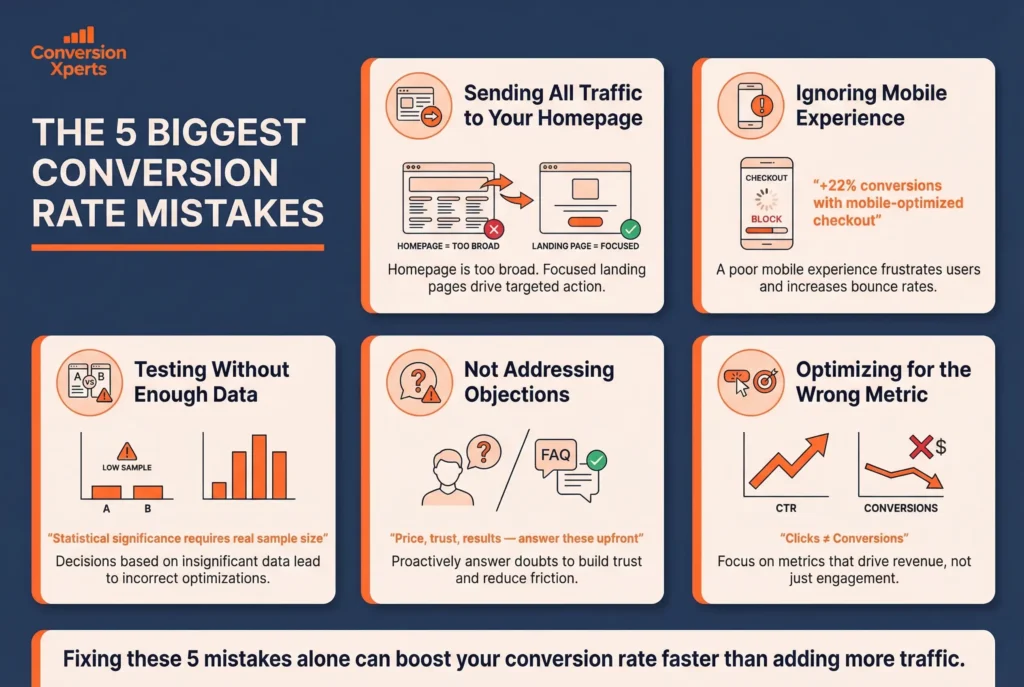
Most businesses sabotage their own sales conversion rate without realizing it. Here are the most common mistakes and how to avoid them.
Sending All Traffic to Your Homepage
Your homepage serves many audiences at once. It cannot be optimized for a single conversion goal. Sending ad traffic or email clicks to a dedicated landing page almost always outperforms sending them to a generic homepage.
Ignoring Mobile Experience
Mobile drives the majority of global web traffic, yet conversion rates on mobile lag far behind desktop. Businesses that treat mobile as a secondary experience lose potential customers at checkout, on contact forms, and on landing pages daily.
Mobile-optimized checkout flows specifically increase conversions by 22% (Marketing LTB, 2025). This is not optional anymore.
Testing Without Enough Data
Many businesses run A/B tests for a few days, see a slight improvement, and declare a winner. This is statistically unreliable. You need enough traffic and enough conversions to reach statistical significance, usually meaning a minimum of a few hundred conversions per variation.
Tools like Google Optimize’s successor or VWO help you determine when you have reached a valid sample size.
Not Addressing Objections
Every visitor who leaves without converting had a reason. Often, they had an unanswered question or an unresolved concern. The most common objections are about price, trust, and whether your product will work for their specific situation.
Addressing these directly in your copy, your FAQ section, or your chat support dramatically reduces doubt and improves your sales conversion rate.
Optimizing for the Wrong Metric
Chasing clicks instead of conversions is one of the most common mistakes in digital marketing. A high click-through rate on your ad means nothing if those clicks do not convert. Always trace the full journey from click to conversion when evaluating campaign performance.