Easiest Content Conversions for B2B: Proven Guide
- Published by: Kamran
- Last Updated: May 2026
Introduction
Did you know the average B2B website converts just 1.5% of its visitors into leads, while top performers hit 8 to 15%? That gap is not a technology problem or a traffic problem. It is almost always a content problem.
If you are a B2B marketer, demand generation manager, or growth-focused founder, the easiest content conversions for B2B are not the ones that require the biggest budget or the longest production timeline. They are the ones that align precisely with how your buyers actually make decisions, which involves multiple stakeholders, months of research, and a strong need for trust before any form gets submitted.
In this guide you will learn which B2B content formats deliver the highest conversion rate with the least friction, what the latest CRO statistics say about each format, how a proper website audit helps you find hidden conversion wins, how to optimize B2B sites without rebuilding from scratch, and how ConversionXperts.com can help you put all of this into action systematically.
Table of Contents
Why B2B Content Conversions Work Differently Than B2C
B2B conversion is not a single moment. It is a series of smaller trust-building actions spread across a buying journey that, according to Gartner’s 2024 B2B Buyer research, involves 6 to 10 stakeholders and can take anywhere from 3 to 18 months to complete. That fundamental reality changes everything about which content formats actually work.
In B2C, you can run a flash sale, trigger an impulse, and close a transaction in minutes. In B2B, the person reading your blog post today may not have budget authority. The person approving the contract may never read your content at all. The content you create must serve multiple roles simultaneously: building awareness at the top of the funnel, generating qualified leads in the middle, and reinforcing the decision at the bottom.
This is why the easiest content conversions for B2B are not necessarily the most complex to produce. They are the ones that remove friction at a specific stage of the buyer journey and give the right person the right reason to take the next step.
Why Most B2B Content Fails to Convert
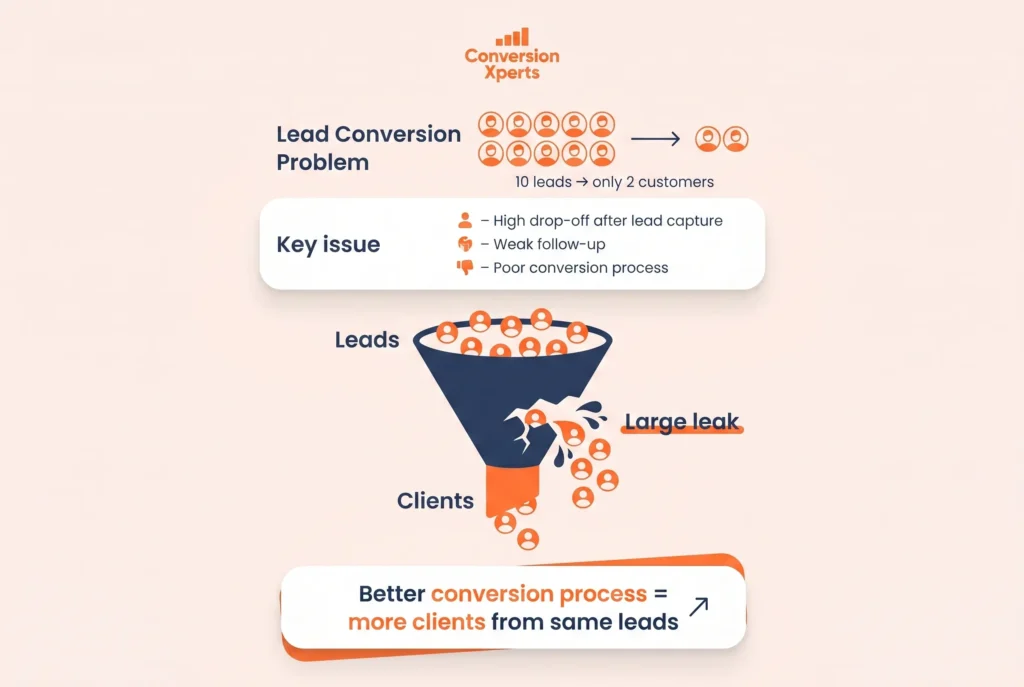
Most B2B content is created to perform well in traffic reports, not in revenue reports. Brands publish blog posts that attract thousands of visitors but include no meaningful call to action. They create whitepapers with no follow-up sequence. They run webinars with no post-event nurture.
According to a 2025 HubSpot State of Marketing Report, website, blog, and SEO efforts ranked as the top channel driving ROI for B2B brands. But ROI only materializes when content is intentionally connected to a conversion path. Traffic without conversion architecture is just noise.
The Conversion Rate Reality in B2B
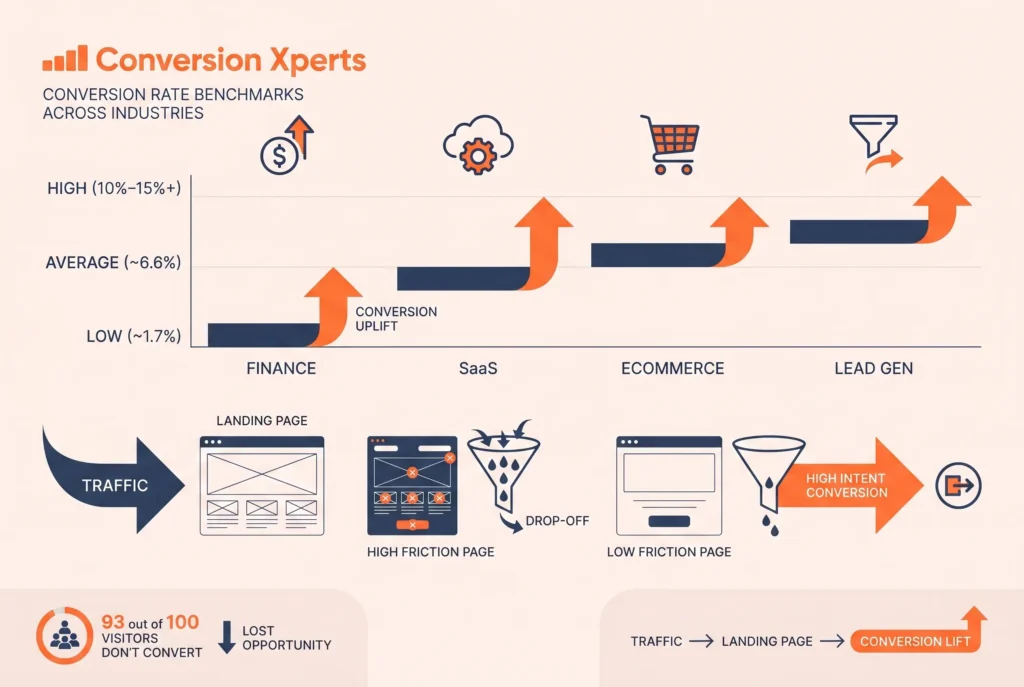
B2B websites average a conversion rate of around 1.8%, compared to 2.1 to 2.5% for B2C sites, with the lower B2B figure reflecting longer sales cycles and multiple decision makers. That number sounds discouraging until you realize that even moving from 1.8% to 3% on a site receiving 20,000 monthly visitors adds 240 additional leads per month. At a reasonable close rate, that is a significant revenue impact with no increase in ad spend.
The Easiest Content Conversions for B2B Ranked by Impact
The formats below are ranked not by how impressive they look in a portfolio but by how reliably they drive measurable conversion rate improvements across different funnel stages. Each has been validated by industry data and real-world performance.
Case Studies: The Highest Trust Asset in the B2B Arsenal
A case study is a structured narrative showing how a real client solved a real problem using your product or service. It is the closest thing B2B has to a peer recommendation. According to the Content Marketing Institute, case studies or customer stories are among the top content types used by 75% of B2B marketers.
The reason case studies convert so well is that they collapse skepticism. A prospective buyer reading about a company in their industry that faced the same problem and achieved a measurable result is essentially reading a pre-written justification for their own purchase decision. That is incredibly powerful, and it is why case studies convert at a disproportionately high rate for their production cost.
To maximize case study conversions, build them around a specific job title, industry, or pain point rather than a generic success story. A case study titled “How a 45-Person SaaS Company Cut Sales Cycle Length by 30%” will outperform “Customer Success Story” every time.
Gated Whitepapers and Research Reports: Lead Magnets That Actually Work
A gated whitepaper or original research report sits at the top of the funnel and trades detailed, credible insight for contact information. This format works exceptionally well in B2B because decision makers are information hungry, especially when you are offering proprietary data they cannot find elsewhere.
Whitepapers help build trust, showcase authority, and generate leads at the top of the funnel. The key word there is trust. In B2B, trust is the conversion. Everything else is mechanics.
The most effective gated reports in 2025 are original, meaning they contain survey data, proprietary analysis, or benchmark findings that cannot be Googled. Repurposing publicly available information into a PDF does not qualify. Original research is what justifies the form fill.
Demo Requests and Free Trial Pages: The Highest Intent Conversion
If someone arrives on your demo request page, they are already close to buying. The demo page is the last piece of content they encounter before entering a sales conversation, which makes its conversion rate optimization the highest leverage activity on most B2B sites.
According to a 2025 First Page Sage study, B2B companies with strong SEO programs averaged a 2.4% conversion rate from organic traffic, and those leads also closed at higher rates because they found the company through research rather than an ad.
For SaaS businesses specifically, the B2B SaaS free trial to paid conversion rate sits at roughly 15 to 25% for opt-in trials requiring no credit card, and 40 to 60% for opt-out trials requiring a card at signup. These numbers confirm that the architecture of your free trial offer matters as much as the content surrounding it.
Webinars: Live Conversion Events
A survey including 115 marketing practitioners concluded webinars were the most effective top-of-funnel demand generation tactic. The reason is simple. A webinar requires active commitment from the attendee. Someone who registers, shows up live, and watches for 45 minutes has demonstrated serious intent. Their conversion probability is dramatically higher than someone who downloaded a PDF and never opened it.
Webinars also give B2B brands something rare: a two-way conversation at scale. Live questions, polls, and follow-up Q&A sessions produce the kind of engagement that accelerates trust far faster than passive content consumption.
Email Sequences: The Highest Performing Conversion Channel Per Dollar
A 2024 Litmus report found that email delivers an average return of $36 for every $1 spent in B2B, making it the most cost-efficient conversion channel available. The average B2B email campaign converts at 2.4%, according to FirstPageSage’s 2025 data.
The critical insight here is that email sequences must be connected to behavior, not just time. A nurture sequence triggered by a whitepaper download should deliver content relevant to whatever problem that whitepaper addressed. Generic email blasts do not convert because they are not relevant. Behavior-triggered, personalized sequences do convert because they feel like a continuation of a conversation.
Blog Posts With Embedded CTAs: The Compound Asset
A well-optimized blog post is not just a traffic vehicle. It is a conversion asset that keeps working for months or years after publication. When Drift overhauled their blog, they found that 76% of their traffic came from only 20% of their posts, which is a powerful reminder to focus optimization efforts on the posts already generating traffic rather than publishing more content.
The blog posts that convert in B2B are not general educational pieces. They are posts that map directly to a specific problem in the buyer’s journey, end with a contextually relevant CTA, and use social proof or data to build credibility throughout.
How a Website Audit Unlocks Your Fastest Wins
A website audit is the diagnostic step that most B2B companies skip, and skipping it is why so many conversion optimization efforts fail. You cannot fix what you cannot see.
What a B2B Website Audit Actually Covers
A proper website audit for B2B conversion optimization examines several interconnected layers. It looks at technical performance including page speed, mobile responsiveness, and Core Web Vitals. It examines behavioral data including heatmaps, scroll depth, and session recordings to understand where visitors are dropping off. It analyzes the messaging architecture to determine whether value propositions are clear and whether CTAs are placed at moments of high intent. And it reviews the conversion funnel to identify stages where qualified leads are leaking out before they reach sales.
More than three-fourths of B2B eCommerce buyers consider site design the number one factor in deciding to make a purchase, which means a website audit is not a cosmetic exercise. It is a revenue exercise.
The Audit as a Conversion Roadmap
The output of a strong website audit is a prioritized list of specific changes ranked by potential impact and ease of implementation. This is not a 200-page report full of generic recommendations. It is an actionable roadmap that tells you exactly which pages to fix first, what to change on each one, and what result to test for.
According to Econsultancy and RedEye research cited in multiple 2025 studies, only 28% of companies are satisfied with their conversion rates, while 37% reported being either quite dissatisfied or very dissatisfied. The difference between the satisfied minority and the dissatisfied majority almost always comes down to whether they have done the diagnostic work of understanding what is actually breaking in their funnel.
Quick Wins a Website Audit Commonly Reveals
The most common high-impact, low-effort fixes that emerge from B2B website audits include simplifying the primary navigation so users reach high-intent pages faster, rewriting above-the-fold copy to lead with outcomes rather than features, reducing the number of form fields on lead generation pages, adding social proof in the form of logos, statistics, or brief testimonials near CTA buttons, and improving page load speed which directly affects conversion rate. Studies consistently show that a one-second delay in page load can reduce conversions by 7% or more.
Key CRO Statistics Every B2B Marketer Should Know in 2025
CRO statistics are most valuable when they are specific, current, and connected to a decision you can actually make. Here are the numbers that matter most right now.
Conversion Rate Benchmarks by Channel
Organic search traffic from SEO converts at an average of 2.6% for B2B, making it the highest performing inbound channel by conversion quality. Referral and partner site traffic shows an average conversion rate of around 2.9% across industries, which explains why strategic partnerships and review site presence matter so much in B2B. Social media traffic typically converts below 1% for B2B, around 0.9%, making it far more effective as an awareness and engagement channel than a direct conversion driver.
Paid search conversion rates average around 3.04% for B2B Google Ads, with top performers reaching 8 to 10%, according to WordStream’s 2024 benchmark report. That variance is explained almost entirely by landing page quality and message match, not bid strategy.
The Email Advantage
Email marketing conversion rates for B2B average 2.4%, according to FirstPageSage 2025 data, with personalized and segmented campaigns consistently outperforming generic sends by a factor of two or more. The most effective B2B email sequences are behavior-triggered, meaning they are sent in response to specific actions a prospect has taken on your website rather than on a fixed calendar schedule.
Nearly 56% of marketers say it is much easier to improve conversion rates now than it was ten years ago, according to the HubSpot State of Marketing Report 2026, largely because of advances in personalization technology, behavior tracking tools, and AI-driven testing platforms.
Landing Page Simplicity Wins Every Time
Landing pages with fewer than 10 elements convert at roughly twice the rate of pages with 40 or more elements, which directly contradicts the assumption that more information equals more persuasion. In B2B, cognitive overload is a conversion killer. The most effective landing pages make one clear offer, support it with one or two compelling proof points, and ask for one specific action.
How to Optimize B2B Sites Using Content Without Burning Your Budget
Learning how to optimize B2B sites for conversion does not require a complete redesign or a six-figure agency retainer. The most impactful optimization work is usually targeted, iterative, and grounded in behavioral data.
Start With Your Highest-Traffic Pages, Not Your Homepage
Most B2B companies begin optimization with their homepage, which is often not where qualified buyers spend their most meaningful time. Run your analytics and identify which three to five pages receive the most traffic from organic search and paid campaigns. Those are your priority conversion assets. Even small improvements on high-traffic pages multiply across your entire acquisition investment.
Match Content to Buyer Stage With Precision
The most common reason B2B content fails to convert is a mismatch between the content and where the reader is in their decision journey. A visitor searching for a problem-awareness term like “why is my sales cycle so long” is not ready for a demo request form. They need an educational piece that introduces your framework and ends with an offer for a relevant, low-friction next step like a related guide or a diagnostic tool.
The rule is simple: every piece of content should have one job, and that job should match the buyer’s readiness to act. Top of funnel content should invite a small commitment. Middle of funnel content should invite a meaningful one. Bottom of funnel content should make the case for action today.
Use Social Proof Strategically, Not Decoratively
Most B2B sites scatter logos and testimonials across the page without connecting them to the specific doubt or objection a buyer has at that moment. Strategic social proof places the right evidence in the right place. A testimonial about your customer support quality belongs near your pricing page, not your homepage hero. A case study about enterprise implementation belongs on your solutions page, not in your footer.
Dynamic content that customizes the user experience based on visitor behavior or demographic information enhances engagement and leads to higher conversion rates. If you have the data infrastructure to show a visitor a case study from their specific industry, that level of relevance pays dividends that no static page can match.
Run A/B Tests on the Elements That Matter
Not all A/B tests are created equal. Testing button colors and stock photos rarely moves the needle meaningfully in B2B. The elements worth testing are headline copy, value proposition framing, form length and field selection, CTA placement and language, and the offer itself. A shift from “Schedule a Demo” to “See How Much You Could Save” is a value proposition reframe, not a cosmetic change, and it often produces significant conversion rate lifts because it speaks to outcomes rather than process.
ConversionXperts.com: Who They Are and What They Do
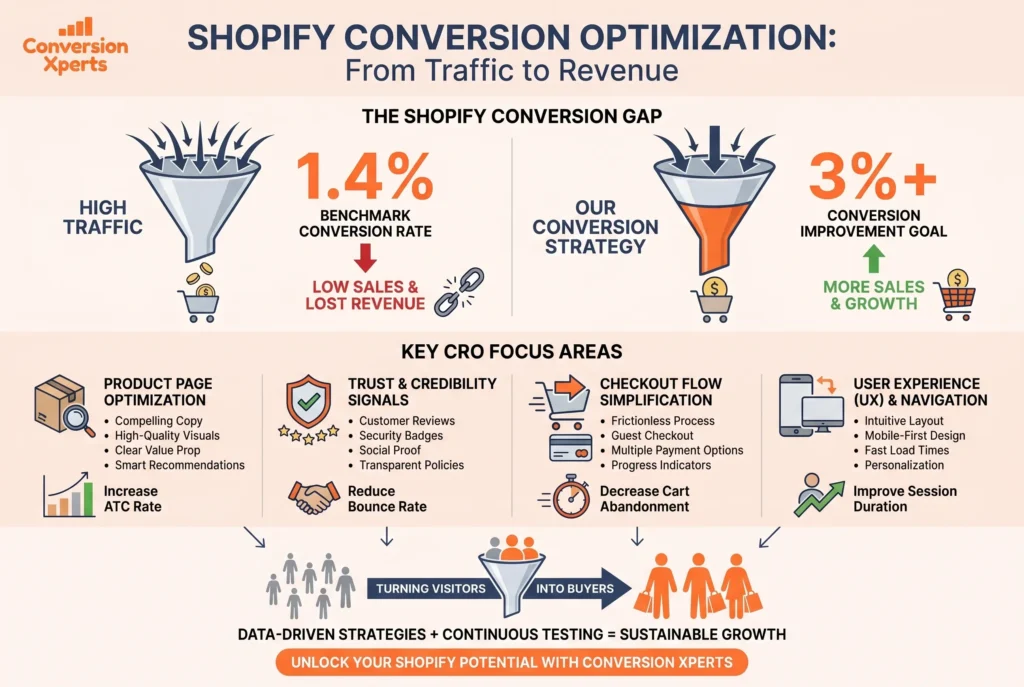
ConversionXperts.com is a conversion rate optimization agency with a focused mandate: help businesses make more revenue from the traffic they already have. Their philosophy is that paid media is expensive and SEO takes time, but the traffic arriving on your website today is an untapped asset that most businesses are systematically underusing.
The team operates globally and takes a data-driven, assumption-free approach to CRO. Every recommendation they make is backed by analytics and structured experimentation, not gut feel or design trends. Their work is grounded in the principle that a 1% improvement in conversion rate translates into measurable revenue without any additional spend on traffic acquisition.
Services Offered by ConversionXperts.com
ConversionXperts provides a comprehensive set of conversion optimization services built for businesses that are serious about turning their website into a revenue engine.
Website Audit and Conversion Analysis: Their audit process is a 360-degree review of the customer journey on your site. It identifies technical performance gaps, UX friction points, messaging weaknesses, and missed conversion opportunities across desktop and mobile. The output is a prioritized action plan in plain language, not a generic checklist.
Conversion Rate Optimization (CRO): Their core service focuses on systematically improving the percentage of visitors who take a desired action. This covers everything from landing page architecture to form optimization to post-click experience design. Every change is tested and measured.
A/B Testing and Experimentation: ConversionXperts designs, runs, and analyzes split tests with proper statistical rigor. They test headlines, CTA copy, page layouts, form structures, and offer framing. The goal is compounding improvement over time, not one-off wins.
Landing Page Optimization: They specialize in building and improving landing pages for paid campaigns, organic traffic, and account-based marketing. This includes both the design and the copy, with a focus on message-to-market match and removing conversion friction.
UX Improvements and User Experience Research: Beyond testing, ConversionXperts analyzes qualitative behavioral data including heatmaps, session recordings, and user research to understand the real reasons visitors are not converting. This insight drives hypothesis generation that tests more likely to succeed.
Data-Driven Growth Strategy: For clients seeking a longer-term partnership, ConversionXperts builds and manages an ongoing optimization program that compounds learning over multiple testing cycles. This is especially valuable for B2B companies with complex funnels and multiple audience segments.
Who ConversionXperts Works With
ConversionXperts serves businesses globally and offers remote optimization services. Their work is particularly relevant for B2B companies, SaaS platforms, and lead generation websites where improving funnel performance has a direct, measurable impact on pipeline and revenue. They respond to all inquiries within 24 to 48 business hours and offer a free initial CRO audit consultation for qualified businesses.
If your website is receiving traffic but underperforming on conversions, ConversionXperts is built exactly for that problem. You can start with their free CRO audit at ConversionXperts.com
Comparison Table: B2B Content Formats and Their Conversion Potential
The table below compares the most common B2B content formats across the metrics that matter most to marketers making prioritization decisions.
Content Format | Funnel Stage | Typical Conversion Rate | Production Effort | Time to Value | Best For
Case Studies | Mid to Bottom | High (drives demo requests) | Medium | Fast | Building trust with near-ready buyers
Gated Whitepapers | Top to Mid | Medium (lead capture) | Medium to High | Medium | List building and authority
Webinars | Top to Mid | High (engaged attendees) | Medium | Fast | Demand generation and relationship building
Demo Request Pages | Bottom | Highest (high intent) | Low (optimization) | Immediate | Converting research-stage buyers
Blog Posts with CTAs | Top | Low to Medium (volume) | Low | Slow (compound) | Organic traffic and top-of-funnel capture
Email Nurture Sequences | All Stages | Medium to High (2.4% avg) | Medium | Medium | Moving leads through the funnel
Free Tools or Calculators | Mid | High (interactive engagement) | High | Medium | Capturing problem-aware buyers
Video Demos or Explainers | Mid to Bottom | Medium to High | Medium | Fast | Simplifying complex offers
FAQ: People Also Ask About B2B Content Conversions
What is a good conversion rate for B2B content marketing?
A good B2B conversion rate is context-dependent, but the industry benchmark sits around 1.8 to 2.4% for website visitors to leads. Top performers reach 5 to 15% on optimized landing pages. Rather than chasing a universal number, measure your current rate and focus on consistent improvement above your own baseline.
Which content format converts best in B2B?
Case studies and webinars consistently deliver the highest conversion rates in B2B because they build trust through specificity and engagement. Case studies show real outcomes for real buyers. Webinars create a live commitment and two-way interaction that passive content cannot replicate. Both work best when they are targeted to a specific industry or pain point.
How do I calculate my B2B conversion rate?
Your B2B conversion rate equals the number of desired actions divided by total opportunities, multiplied by 100. If 5,000 people visited your landing page and 90 submitted a form, your conversion rate is 1.8%. Track this separately for each funnel stage: visitor to lead, lead to SQL, and SQL to closed customer. Each stage reveals a different optimization lever.
What does a B2B website audit actually include?
A B2B website audit examines technical performance including page speed and mobile experience, user behavior data from analytics and heatmaps, messaging and value proposition clarity, CTA placement and copy, form friction, and funnel drop-off points. A good audit produces a prioritized list of specific changes ranked by potential revenue impact, not a generic checklist.
Why is my B2B content getting traffic but not converting?
The most common cause is a mismatch between content intent and conversion offer. If a visitor arrives on an awareness-stage blog post and the only CTA is a demo request, the jump in commitment is too large. Match your CTAs to buyer readiness: offer a related guide or checklist to awareness-stage readers, and reserve demo requests for bottom-of-funnel pages where intent is already established.
How long does it take to see results from B2B CRO?
Most CRO programs produce measurable improvements within 60 to 90 days when testing is run rigorously and prioritized correctly. Significant compounding results typically emerge over 6 to 12 months of systematic experimentation. Quick wins from fixing obvious friction points, such as simplifying forms or improving page speed, can show results within days.
What is the easiest B2B content conversion to start with?
The easiest starting point is optimizing a high-traffic blog post you already have. Add a contextually relevant, low-friction CTA like a related guide download or a short checklist. This requires no new content production, improves a page that already has traffic, and gives you a fast read on your audience’s conversion behavior with minimal investment.
How does email marketing fit into B2B content conversions?
Email is the highest ROI channel in B2B, delivering an average of $36 for every $1 spent according to a 2024 Litmus report. It works best when behavior-triggered rather than calendar-based, meaning emails are sent in response to specific actions a lead has taken. A well-structured nurture sequence connected to your content downloads can convert cold leads into sales conversations over weeks or months.
Conclusion
The easiest content conversions for B2B are not the most glamorous ones. They are the ones that do one job well, speak to a specific buyer at a specific stage, and remove every unnecessary obstacle between interest and action.
Three things to take away from this guide: first, case studies, webinars, and behavior-triggered email sequences consistently deliver the highest conversion rates in B2B because they earn trust rather than demand it. Second, a proper website audit is not optional. It is the fastest path to finding the specific friction points costing you leads right now. Third, optimizing the B2B conversion rate is a compounding discipline. Each test, each fix, and each insight builds on the one before it.
If you are ready to stop guessing and start converting, the team at ConversionXperts.com offers a free CRO audit to help you identify exactly where your funnel is leaking and what to do about it. Your traffic is already there. Now it is time to make it work.
Sources Referenced:
Gartner 2024 B2B Buyer Survey Report (gartner.com)
HubSpot State of Marketing Report 2025 and 2026 (hubspot.com)
FirstPageSage B2B Conversion Rate Benchmarks 2025 (firstpagesage.com)
Litmus Email Marketing ROI Report 2024 (litmus.com)
WordStream Google Ads Benchmark Report 2024 (wordstream.com)