Landing Page Conversion Rates by Industry: The Complete 2026 Guide
What Is a Landing Page Conversion Rate and How Is It Calculated
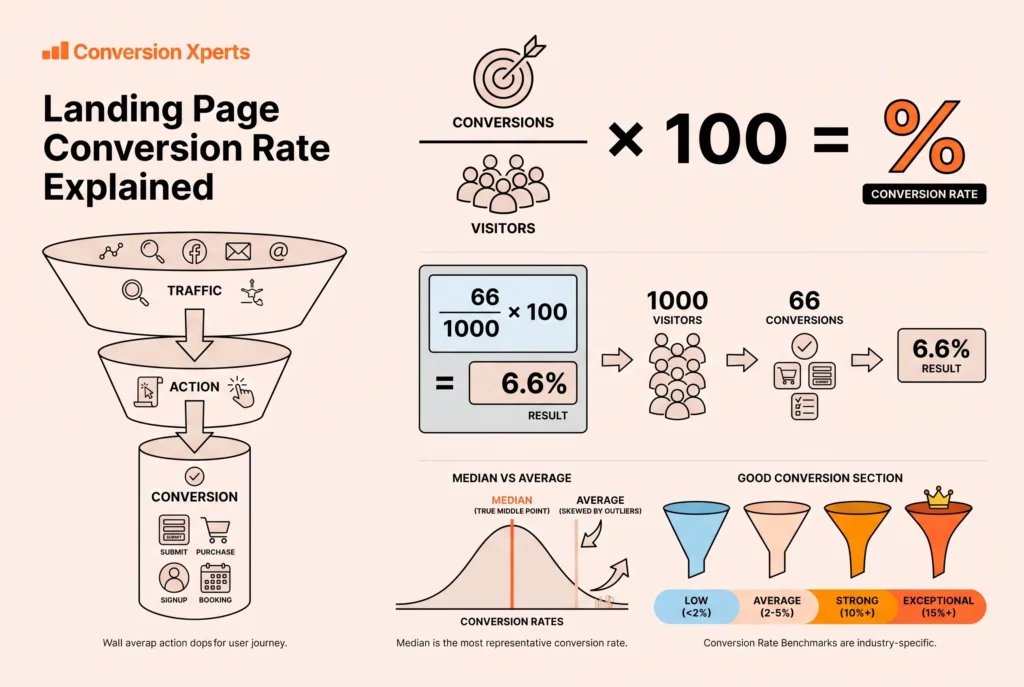
A landing page conversion rate is the percentage of visitors who complete a desired action on your page, whether that is filling out a form, booking a call, making a purchase, or signing up for a free trial. The formula is straightforward: divide the number of conversions by the total number of visitors and multiply by 100.
For example, if 1,000 people visit your page and 66 of them submit a form, your conversion rate is 6.6%.
What counts as a conversion depends entirely on what you define as your goal. A lead generation page might count form submissions. An ecommerce page counts completed purchases. A SaaS page might count demo sign-ups. This distinction matters enormously when you are comparing your numbers to any benchmark, because different conversion goals carry very different baseline expectations.
Why the Median Matters More Than the Average
Most published conversion rate data uses the word “average,” but the number that actually gives you a fair picture is the median. Averages are pulled upward by outliers. A handful of landing pages converting at 40% or 50% can make an entire dataset look far healthier than it really is.
According to Unbounce’s Q4 2024 analysis of 41,000 landing pages and 464 million visitors, the median conversion rate across all industries is 6.6%. That is the number that represents the true middle of the market, and it is the figure you should be using as your baseline.
What Is Considered a Good Conversion Rate
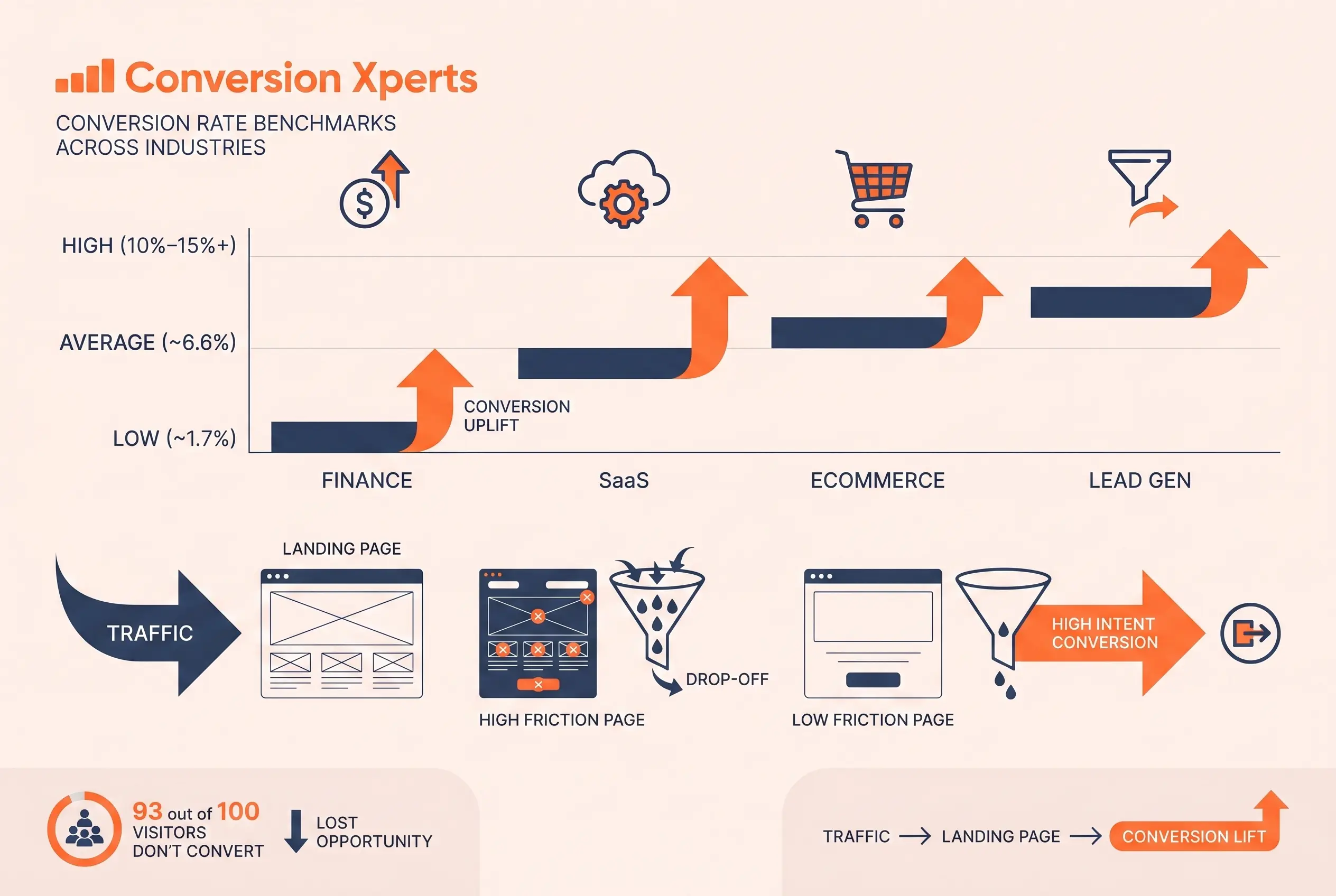
A conversion rate of 10% or above is broadly considered strong performance. Landing pages converting at 15% or higher are genuinely exceptional and typically reflect a combination of high-intent traffic, tight message-to-audience matching, and well-tested design. The top 25% of landing pages in any given industry convert at roughly three times the industry median, which means the gap between average and great is not a small one.
Landing Page Conversion Rates by Industry: 2026 Benchmarks
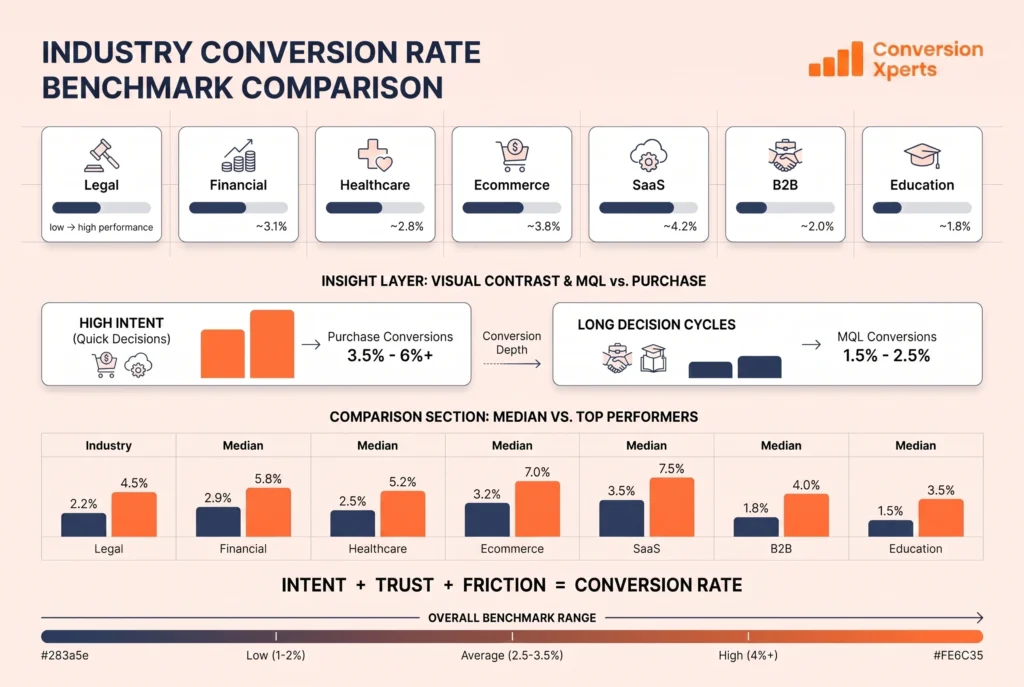
Landing page conversion rates by industry reveal a striking range of performance, and understanding why each sector sits where it does is just as important as knowing the numbers themselves. Below is a comprehensive breakdown based on data from Unbounce, First Page Sage, and independent research covering 2024 and 2025.
Financial Services and Insurance
The financial services sector shows a wide range depending on the data source and how conversions are defined. Unbounce’s analysis places financial services among the higher performers with a median around 8.4%, reflecting the high consumer intent that drives people to these pages. However, First Page Sage’s 2026 report, which focuses specifically on MQL-generating actions like contact form fills and appointment bookings, puts insurance and financial services at 1.7% to 2.3%, reflecting the complexity of long decision cycles and regulatory compliance requirements.
The takeaway here is that the type of conversion matters. If you are measuring newsletter signups, your number will look very different from a page designed to get someone to book a financial consultation.
Legal Services
Legal services consistently performs well on landing page conversion, with First Page Sage reporting a benchmark of around 7.4% for lead generation goals. The reason is buyer psychology: people searching for a lawyer are almost always experiencing a pressing problem. The urgency is built in. That high intent, combined with short decision timelines relative to other professional services, means a well-built legal landing page can perform significantly above the cross-industry median.
Healthcare
Healthcare landing pages present a more complex picture. First Page Sage places the average in a range of 3.0% to 4.2%, with top performers reaching 8% to 10%. The primary drag on conversion in this space is trust. Before a person books an appointment or submits their information to a healthcare provider, they need to feel confident in both the provider’s credibility and the safety of their personal data. Pages that invest heavily in social proof, provider credentials, and visible privacy assurances consistently outperform those that do not.
Ecommerce
The ecommerce conversion rate landscape is particularly nuanced. According to First Page Sage, the broader ecommerce average sits at around 4.3% for meaningful purchase actions. However, this varies enormously by product price point, niche, and traffic source. A page selling a $15 impulse buy from a warm email list will convert at a fundamentally different rate than a page selling a $2,000 appliance to cold paid traffic. According to Keywords Everywhere’s analysis, email traffic converts at a rate nearly 3.2 times higher than paid social in some commercial categories.
SaaS and Technology
SaaS landing pages are among the more challenging to convert. Unbounce data suggests the industry median hovers around 3.8%, partly because SaaS purchases involve longer evaluation cycles, require organizational buy-in in B2B contexts, and ask visitors to trust a product they cannot immediately hold or experience. The highest-performing SaaS pages almost always pair a clear free trial or freemium offer with strong social proof and a headline that speaks directly to a specific job-to-be-done.
B2B Services
According to Wishpond, B2B landing pages average a conversion rate of 13.28%, which at first glance seems surprisingly strong. The reason this number holds up is that B2B landing pages tend to attract highly targeted traffic with specific intent, and their conversion goals often include low-friction actions like downloading a report or requesting more information rather than high-commitment purchases. When the goal shifts to booking a sales call or requesting a custom quote, the numbers move significantly lower.
Education and Vocational Training
Education pages tend to see strong conversion rates, particularly when they are tied to specific outcomes like career advancement or professional certification. The promise of a concrete, transformational result drives higher engagement and lower hesitation than more abstract product offers.
Industry Conversion Rate Comparison Table
| Industry | Median Conversion Rate (2024/2025) | Top Performer Range |
| Legal Services | 7.4% | 12% to 15%+ |
| Financial Services (broad) | 8.4% (Unbounce median) | 12% to 18% |
| Financial Services (MQLs) | 1.7% to 2.3% (First Page Sage) | 5% to 8% |
| B2B Services | 13.28% | 20%+ |
| Healthcare | 3.0% to 4.2% | 8% to 10% |
| Ecommerce | 4.3% | 8% to 12% |
| SaaS / Technology | 3.8% | 7% to 10% |
| All Industries (Overall) | 6.6% | 10% to 15%+ |
Sources: Unbounce Q4 2024 Conversion Benchmark Report, First Page Sage 2026 Report, Wishpond
Why Conversion Rates Differ So Dramatically Across Industries
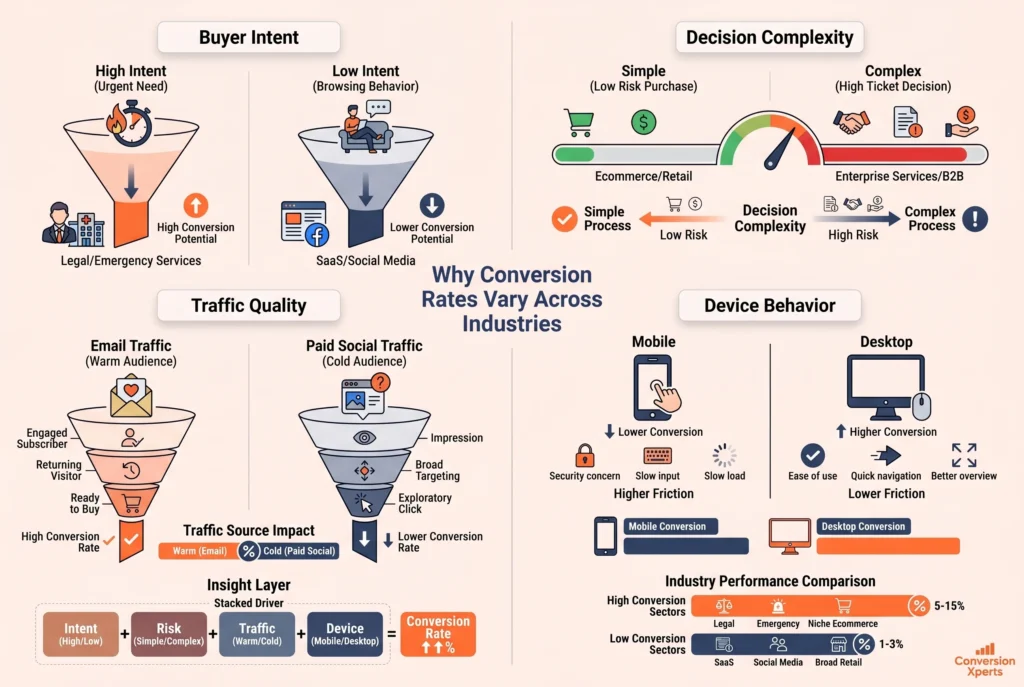
Understanding the numbers is one thing. Understanding why those numbers exist is what gives you the leverage to change them. The gap between a 2% converter and a 12% converter rarely comes down to luck. It almost always traces back to a handful of structural differences.
Buyer Intent and Urgency
The single biggest driver of conversion rate is how urgently a visitor needs what you are offering. A person who just had a car accident searching for a personal injury lawyer has near-maximum intent. A person passively browsing for project management software does not. Industries where pain is acute and the need for a solution is immediate will always carry structural conversion advantages over industries where the buyer is in exploration mode.
This is why legal services, emergency healthcare, and financial problem-solving pages can punch well above the cross-industry average without doing anything particularly extraordinary with their design or copy. The intent does some of the work for them.
Decision Complexity and Purchase Risk
The higher the perceived risk of a decision, the more evidence, reassurance, and time a person needs before they convert. This is why ecommerce pages selling low-cost consumables convert at higher rates than pages selling enterprise software or high-ticket professional services. A $20 purchase is a low-risk experiment. A $50,000 annual software subscription is not.
Conversion rate optimization for high-risk purchases is not about removing friction at any cost. It is about providing the right kind of evidence at the right moment to help someone feel confident enough to take the next step.
Traffic Quality and Source
The source of your traffic has a profound impact on your conversion rate, often more so than anything on the page itself. According to data from the commercial and professional services industry, email traffic converts at a rate 3.18 times higher than paid social. Visitors arriving from email already trust you enough to be on your list. Visitors arriving from a social media ad are meeting you for the first time.
This is one of the most important CRO statistics to internalize: before you start testing button colors and headline copy, make sure you understand whether you have a page problem or a traffic quality problem.
Mobile vs. Desktop Behavior
Mobile devices now account for over 54% of global web traffic as of late 2025, according to Statista. Despite that majority, mobile consistently converts at lower rates than desktop. The gap exists because of a combination of factors: smaller screens create more friction in form completion, mobile users are more likely to be in early research mode rather than ready-to-buy mode, and page load speed issues hit mobile users harder.
Among the top-performing landing pages analyzed across major studies, 86% have been specifically optimized for mobile. The brands closing the mobile conversion gap are not just making their pages responsive. They are rethinking the entire experience for a smaller screen and a shorter attention window.
How to Optimize Your Landing Page: Proven CRO Strategies That Work
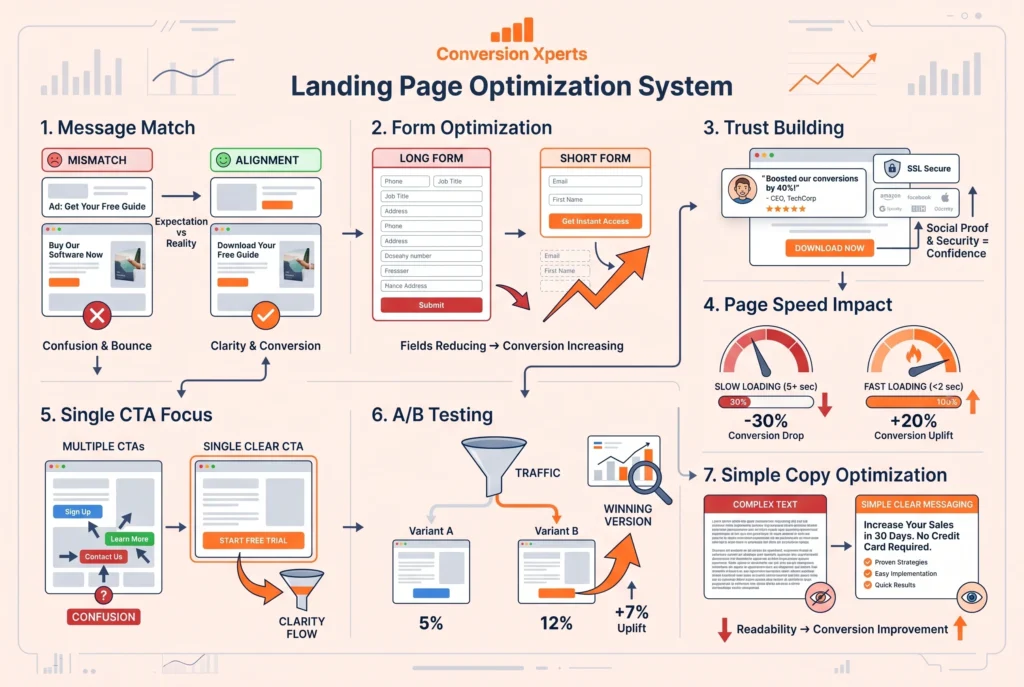
Conversion rate optimization is the discipline of systematically increasing the percentage of visitors who take a desired action on your page. It is not guesswork, and it is not a single fix. It is an ongoing process of hypothesis, testing, and iteration grounded in behavioral data.
Match Your Message to Your Traffic Source
Every visitor arrives at your landing page with a set of expectations shaped by what they just clicked. If someone clicks a Google ad promising “free SEO audit for local businesses” and lands on a generic digital marketing homepage, the mismatch destroys trust instantly and they leave. Message match is the alignment between what brought someone to your page and what they find when they get there.
Tight message match is one of the highest-leverage changes you can make. In many tests, simply aligning the headline and subheadline language directly with the ad or organic search query that drove the click produces double-digit conversion lifts without changing anything else.
Simplify Your Form Fields Aggressively
According to research compiled by Omnisend, forms asking only for email and phone number performed with a conversion rate of 10.15%, while forms that added fields for birth date or gender saw rates drop to 5% to 6%. Every additional field you ask someone to complete adds friction. Ask only for what you genuinely need to follow up, and collect everything else after you have started the relationship.
Reducing form fields to five or fewer doubles completion rates in most industry contexts, according to multiple studies across landing page platforms. The moment a form looks like work, most people stop.
Build Trust Visually and Verbally
Trust is the conversion killer that most pages underinvest in. People do not hand over their contact information, their money, or their time to brands they do not trust. Trust is built through a combination of elements working together: testimonials from real, named customers with recognizable photos; case study results with specific numbers rather than vague claims; security badges and privacy statements near form fields; and the use of real human faces, which appear in 73% of top-converting landing pages according to a detailed analysis of high-performing pages.
Social proof is not decoration. It is one of the primary psychological mechanisms through which people resolve uncertainty about a decision they are about to make.
Speed Matters More Than You Think
Every additional second of page load time costs you approximately 7% of your conversions. Research on core web vitals shows that improving the Largest Contentful Paint metric alone can drive conversion lifts of over 61%, based on Rakuten’s case study data. If your page takes more than three seconds to load on mobile, a substantial portion of your potential conversions never even see your offer.
Page speed optimization is not a glamorous CRO tactic. It does not show up in before-and-after screenshots. But the data consistently shows it is one of the highest-return improvements available to almost any landing page.
Use a Single, Clear Call to Action
Pages with multiple offers reduce conversion rates by up to 266%, according to research cited across multiple marketing publications. This is counterintuitive to many marketers, who assume that giving people more options serves more of them. In reality, choice creates confusion and confusion creates inaction. Every additional path you offer is an opportunity for someone to choose none of them.
The most effective landing pages are built around one goal, one audience, and one call to action. The CTA text matters too: specific action phrases like “Get My Free Strategy Call” outperform generic phrases like “Submit” or “Contact Us” in virtually every test.
Run Structured A/B Tests
Only about one in eight A/B tests produces a statistically significant result, which means you need to be running tests continuously rather than hoping for a single breakthrough. The most productive elements to test are headlines, the primary CTA text and button color, the above-the-fold layout, form length, and the framing of your value proposition.
The rule that separates effective testing from wasted effort is to change one element at a time and run the test until you have reached statistical significance. Testing two things simultaneously makes it impossible to know which change drove the result.
Write Copy at the Right Reading Level
One of the most surprising CRO statistics: landing pages written at a fifth to seventh grade reading level convert at 11.1%, while pages written at a college reading level convert at just 5.3%, according to analysis cited in Backlinko’s research. That is more than a doubling of the conversion rate from simplifying your language.
A simpler copy does not mean less intelligent copy. It means cleaner, more direct sentences that make your value proposition immediately accessible to anyone who lands on your page, regardless of their familiarity with your industry vocabulary.
SEO Conversion Rate Optimization: Where Search and CRO Meet
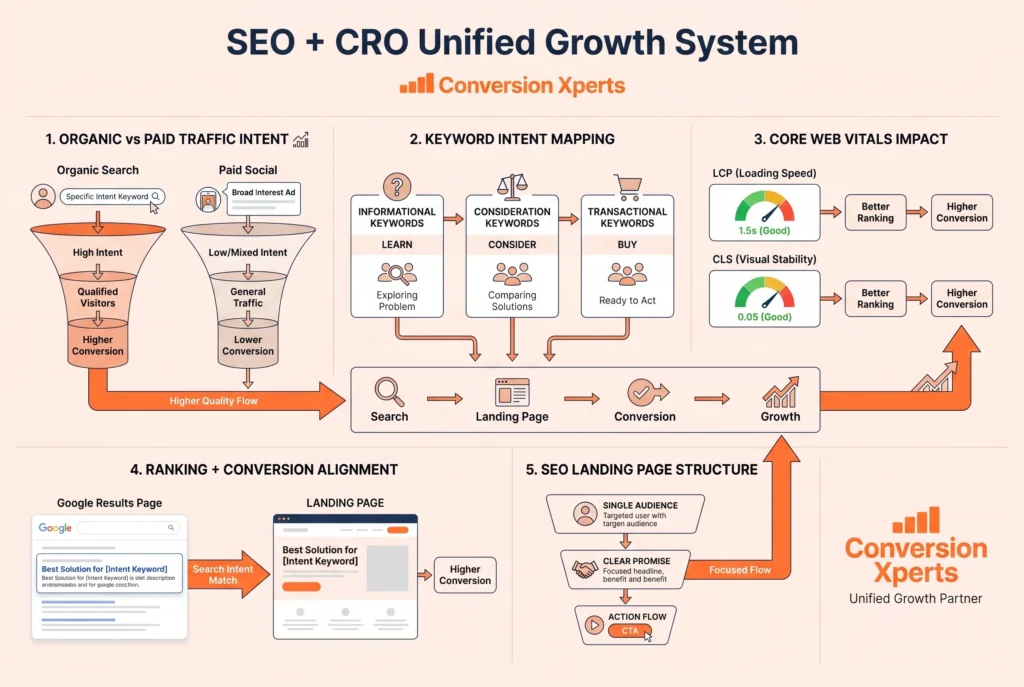
SEO conversion rate optimization treats search engine optimization and conversion design not as separate disciplines but as two halves of the same performance challenge. Ranking is meaningless if the traffic you earn does not convert. Converting is limited if you cannot scale the volume of qualified visitors arriving at your page.
Why Organic Traffic Often Converts Differently
Visitors arriving through organic search are in a fundamentally different mental state than paid traffic visitors. They went looking for something, found your page through their own search behavior, and chose to click. That self-selected quality tends to produce higher engagement and, in many cases, better conversion rates than cold paid traffic.
According to research on email versus social traffic, the quality of intent embedded in the traffic source routinely matters more than the optimization of the page itself. Organic search visitors who find exactly what they were looking for tend to be among the most qualified visitors you can attract.
Aligning SEO Keywords with Conversion Intent
The keywords you target in your SEO strategy should reflect where in the buying journey your ideal visitor is. Informational keywords like “what is a landing page” bring people who are learning. Transactional keywords like “landing page optimization service” bring people who are ready to act. The landing page you build for each type of visitor must be calibrated to meet them at their level of intent.
Targeting high-intent keywords and building landing pages that speak directly to the decision someone is ready to make is one of the most powerful forms of SEO conversion rate optimization available. It simultaneously improves your organic rankings and your conversion rates by creating a tightly matched experience from search result to page.
Page Speed, Core Web Vitals, and Dual Impact
Google’s ranking algorithm incorporates Core Web Vitals, which means the same technical improvements that make your page load faster for users also improve your position in search results. Improving your Largest Contentful Paint, reducing Cumulative Layout Shift, and shortening Interaction to Next Paint all feed into both better rankings and better conversion rates simultaneously.
This is one of the clearest examples of where SEO and CRO genuinely reinforce each other rather than existing in tension.
Building Landing Pages That Rank and Convert
A landing page that ranks in Google must satisfy search intent. A landing page that converts must satisfy visitor intent. In many cases these are the same thing: a person searching for “CRO agency for SaaS companies” wants to find a page that convincingly demonstrates expertise in that specific problem. A page that is generic, slow, or unconvincing will neither rank well nor convert the traffic it does receive.
The most effective SEO landing pages are built around a single clear audience segment, a specific promise, and a structured flow from awareness through belief to action. They earn their rankings by being genuinely the best answer to the question someone typed into Google.
What ConversionXperts Can Do for Your Business
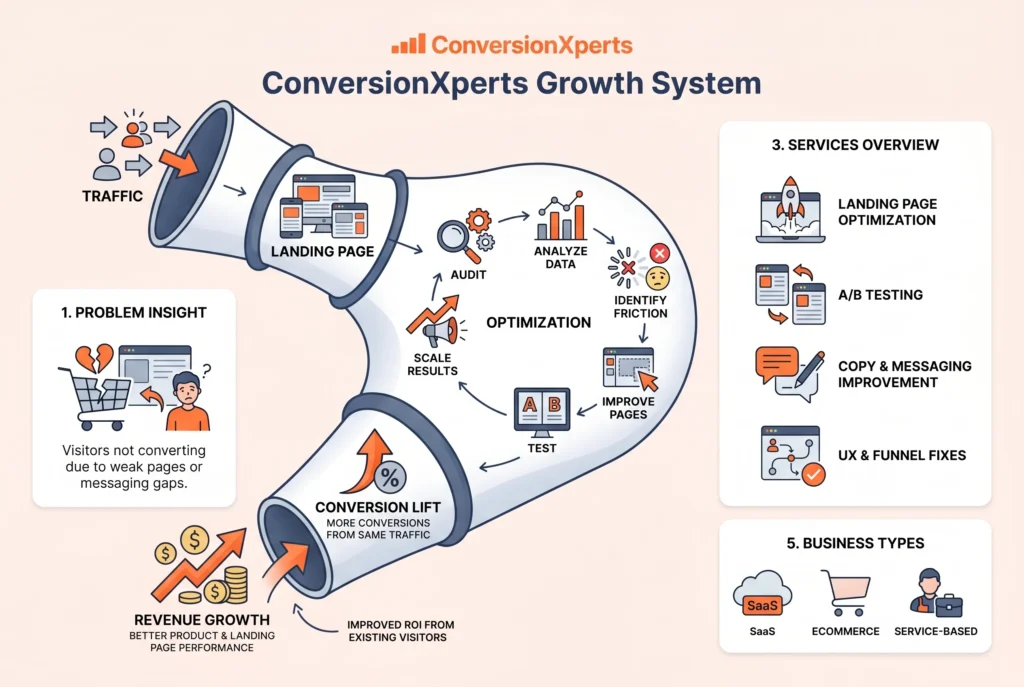
If you have read this far, you already understand that landing page conversion rates are not fixed. They are a reflection of decisions, and most of those decisions can be improved with the right expertise.
ConversionXperts is a specialized conversion rate optimization agency built around one core belief: that most businesses are leaving a significant percentage of their revenue on the table not because they lack traffic, but because their pages, messaging, and funnels are not working hard enough for the visitors they already have.
The team at ConversionXperts works with businesses across industries to audit, redesign, and systematically test landing pages using a methodology grounded in behavioral psychology, data analytics, and deep knowledge of what actually moves conversion needles in specific industries. This is not template-based work. Every engagement begins with a thorough analysis of your traffic sources, your current conversion data, your audience’s decision-making patterns, and the specific friction points keeping visitors from taking action.
ConversionXperts brings together expertise in landing page design, CRO testing strategy, copywriting, SEO conversion rate optimization, and user experience research into a single integrated service. The result is landing pages that do not just look good but that measurably perform better across every stage of the funnel.
Whether you are a SaaS company trying to close the gap between your 3.8% industry median and the 10% your category’s top performers achieve, a professional services firm looking to convert more of your hard-earned organic traffic into consultation requests, or an ecommerce brand trying to turn more product page visitors into buyers, ConversionXperts has the process, the tools, and the track record to help you get there.
You can learn more about how ConversionXperts approaches conversion optimization and what a partnership looks like at conversionxperts.com.