B2B Marketing Conversion Rates: The Guide You Should Know About In 2026
What Is a B2B Marketing Conversion Rate?
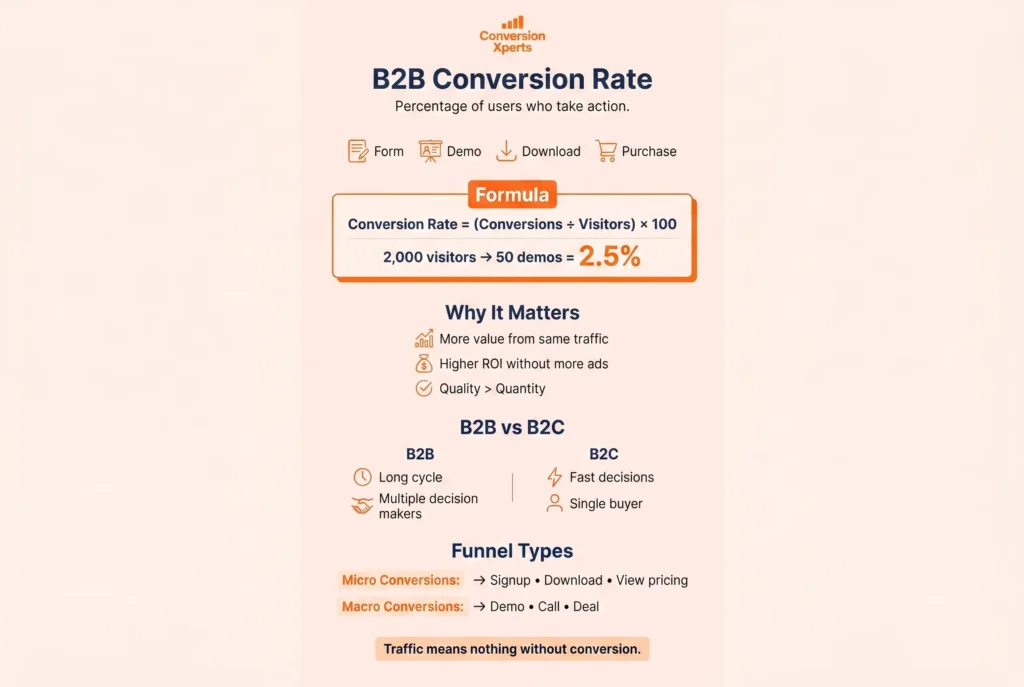
A B2B marketing conversion rate is the percentage of visitors, leads, or prospects who complete a desired action at any given stage of your sales funnel. That action could be filling out a contact form, booking a demo, downloading a white paper, or ultimately signing a contract.
The formula is simple:
Conversion Rate = (Number of Conversions / Total Number of Visitors or Leads) x 100
For example, if 2,000 businesses visit your pricing page in a month and 50 of them request a demo, your conversion rate is 2.5%.
What makes B2B conversion rates fundamentally different from B2C is complexity. In B2B, you are not dealing with a quick impulse buy. You are navigating high stakes, lengthy timelines, and decision-making by committee. In fact, 77% of B2B buyers describe their last purchase as complex or difficult.
This complexity is not a reason to accept low numbers. It is a reason to build smarter systems, and that is exactly what this guide shows you how to do.
Why Conversion Rate Matters More Than Traffic
Most B2B companies obsess over traffic volume. They celebrate when organic sessions climb, when ad impressions grow, when LinkedIn followers multiply. But traffic without conversion is just noise.
Consider two companies. Company A gets 50,000 monthly visitors and converts at 1%. Company B gets 20,000 monthly visitors and converts at 3.5%. Company B generates 33% more leads on less than half the traffic. That gap compounds over time into dramatically different revenue outcomes.
B2B conversion rate optimization is about squeezing the most value from the audience you are already reaching, before you spend another dollar on acquisition.
The Difference Between Micro and Macro Conversions
Not every conversion means a closed deal. Savvy B2B marketers track two levels:
Macro conversions are the big ones. A demo request, a sales call booking, a completed purchase, a signed contract. These feed pipeline directly.
Micro conversions are smaller behavioral signals. A content download, a pricing page view, a webinar registration, a newsletter signup. These map your buyer’s journey and reveal where the funnel is leaking before leads ever reach sales.
Tracking both levels gives you far higher resolution visibility into what is working and what is not.
B2B Conversion Rate Benchmarks by Industry in 2026
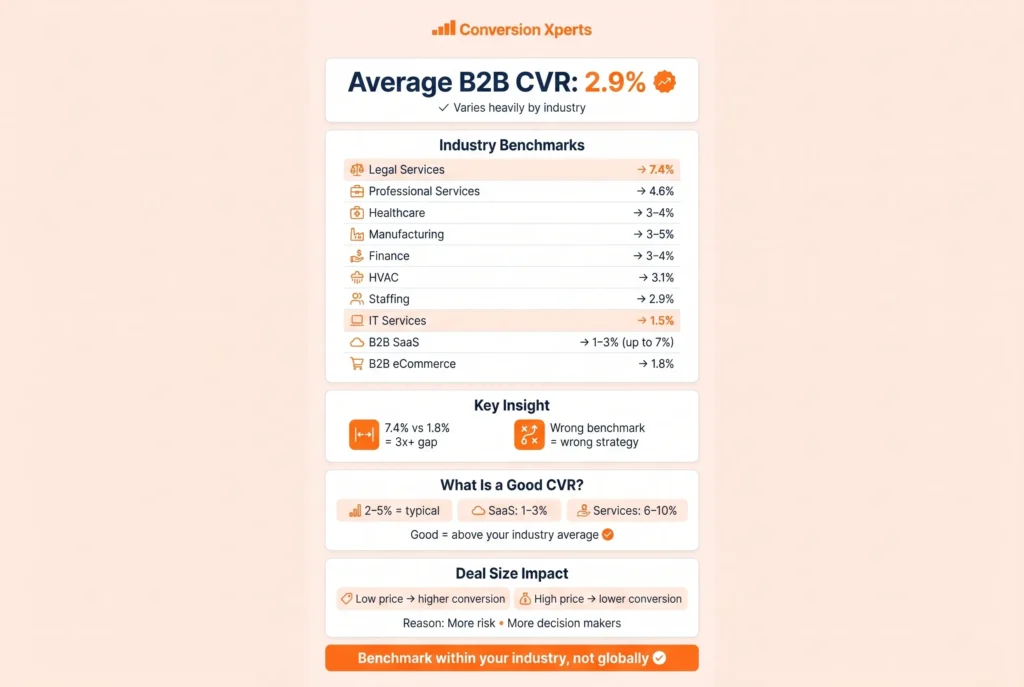
The single most important thing to know about B2B conversion rates by industry is that they vary enormously depending on your industry, product complexity, sales cycle length, and average deal size. Benchmarking against the wrong industry will send you chasing the wrong target.
The median B2B conversion rate across all industries is 2.9%, based on Ruler Analytics’ analysis of 100 million data points published in August 2025. But that headline number hides a wide range.
Top Performing B2B Industries
Legal services lead all B2B sectors with a 7.4% average conversion rate, while B2B SaaS and software development struggle at 1.1%. The overall average conversion rate is 2.9%.
Here is how major B2B industries stack up in 2025:
| Industry | Average Conversion Rate | Why It Performs This Way |
Legal Services | 7.4% | High buyer urgency, short decision window |
Professional Services | 4.6% | Trust driven, relationship led buying |
Healthcare Consulting | 3 to 4% | Regulatory urgency drives faster decisions |
Manufacturing | 3 to 5% | Strong referral networks, high intent traffic |
Finance and Insurance | 3 to 4% | Compliance needs create urgency |
HVAC Services | 3.1% | Service urgency compresses cycles |
Staffing and Recruiting | 2.9% | Direct outcome driven buying |
IT Services | 1.5% | Longer evaluation cycles, high competition |
B2B SaaS | 1.1 to 7% | Varies widely by deal size and product complexity |
B2B eCommerce | 1.8% | Lowest due to catalog complexity and high competition |
Sources: First Page Sage, Predictable Profits, SERPsculpt 2025 Reports
The spread between legal services (7.4%) and B2B eCommerce (1.8%) represents a 311% difference. This is why benchmarking within your specific vertical matters so much.
What Counts as a “Good” B2B Conversion Rate?
Across industries, a 2 to 5% sales conversion rate is typical for B2B. SaaS and tech usually see 1 to 3%, while consulting and professional services average 6 to 10%. Anything above your industry’s median typically signals strong conversion rate optimization systems and a high-fit ideal customer profile.
A good B2B conversion rate is one that beats your specific industry median. Chasing a 5% rate when your industry averages 1.2% is a reasonable goal. Feeling satisfied with 3% when your industry averages 6% is a problem.
How Deal Size Affects Conversion Rate Expectations
One often overlooked factor is average contract value. A company selling a $500 monthly SaaS tool should expect higher top-of-funnel conversion rates than one selling a $500,000 enterprise software license. Higher stakes mean more stakeholders, longer deliberation, and more due diligence. Lower conversion rates in high ACV categories are not failures. They are structural realities that require different nurturing approaches.
How the B2B Funnel Works and Where It Leaks
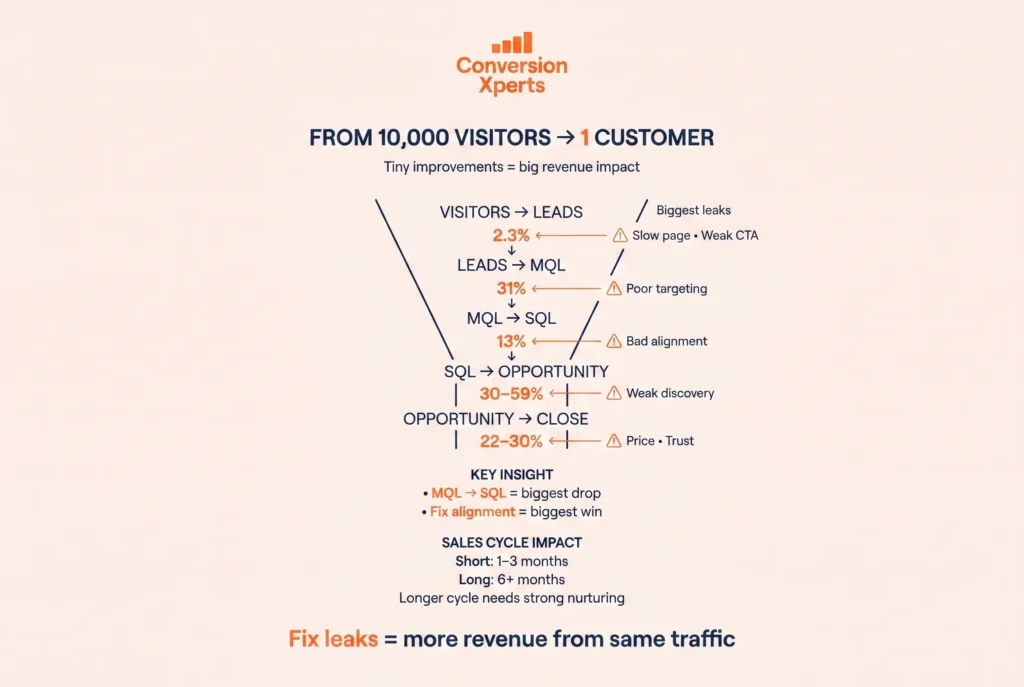
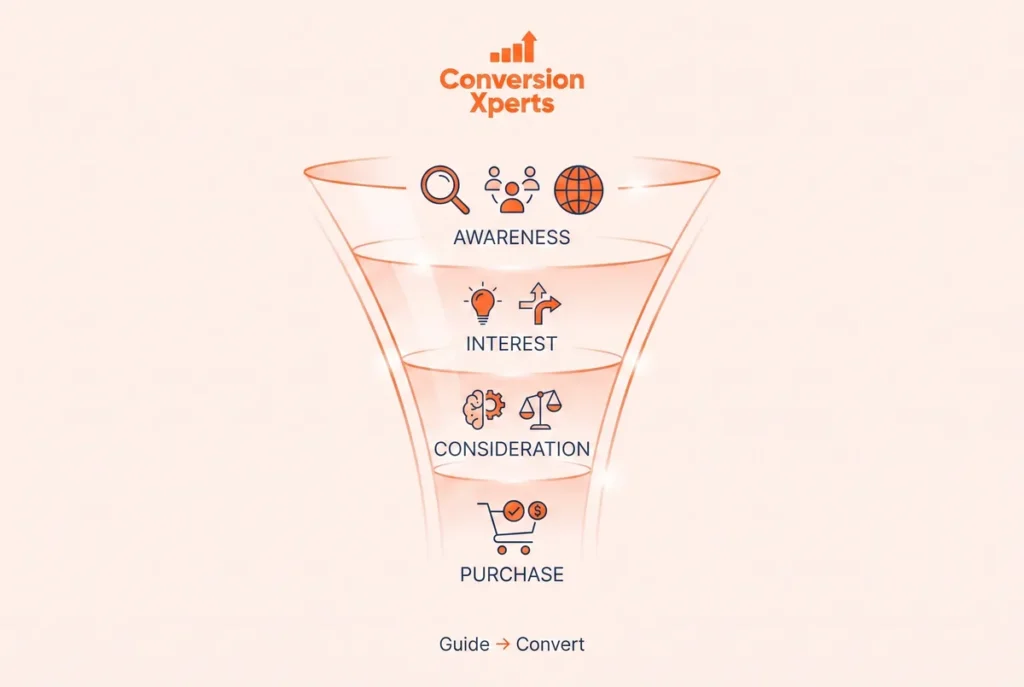
The B2B funnel is not a single gate. It is a series of handoffs, each with its own conversion rate, and each one representing an opportunity to either accelerate or lose a deal.
The Full Funnel Breakdown
About 2.3% of visitors become leads, 31% of leads become marketing qualified leads (MQLs), 13% of MQLs become sales qualified leads (SQLs), 30 to 59% of SQLs become opportunities, and 22 to 30% of opportunities close as won deals.
Here is the math that should keep every B2B revenue leader up at night. Start with 10,000 website visitors:
10,000 visitors at 2.3% conversion produces 230 leads. 230 leads at 31% MQL rate produces 71 MQLs. 71 MQLs at 13% SQL rate produces 9 SQLs. 9 SQLs at 45% opportunity rate produces 4 opportunities. 4 opportunities at 26% close rate produces 1 closed deal.
That is a full funnel that converts 0.01% of visitors into customers. This is why even small percentage improvements at the top and middle of your B2B funnel produce disproportionately large revenue gains at the bottom.
Where B2B Funnels Lose the Most Leads
The biggest leaks happen in predictable places. Understanding each one helps you apply targeted fixes rather than making guesses.
Visitor to Lead: Poor landing page clarity, mismatched messaging between ad and page, slow load speeds, or weak calls to action. Pages taking more than 3 seconds to load convert at half the rate of fast pages.
Lead to MQL: Weak lead scoring, too many unqualified contacts entering the funnel from broad targeting, no behavioral data informing qualification criteria.
MQL to SQL: The most consistently underperforming handoff in B2B. The MQL to SQL average sits around 13%, but high performers hit 20 to 25%, and some teams using strong behavioral scoring report up to 40%. The gap is almost always caused by poor alignment between marketing and sales on what a qualified lead actually looks like.
SQL to Opportunity: Weak discovery calls, solutions that do not map clearly to the prospect’s specific pain, or premature pitches before trust is built.
Opportunity to Close: Competitive displacement, budget objections, extended procurement processes, and failure to address all buying committee members.
The Role of Sales Cycle Length
B2B sales cycles are getting longer. In 2024, the average cycle was 25% longer than it was just five years earlier. For simpler products, you might close in 1 to 3 months, but for more intricate solutions, expect 6 months or more.
A longer cycle does not mean a lower close rate. It means your nurturing system needs to sustain relevance, trust, and momentum across many more touchpoints. Companies that build this system consistently outconvert those that treat every prospect as ready to buy today.
How to Optimize Your B2B Conversion Rate at Every Stage
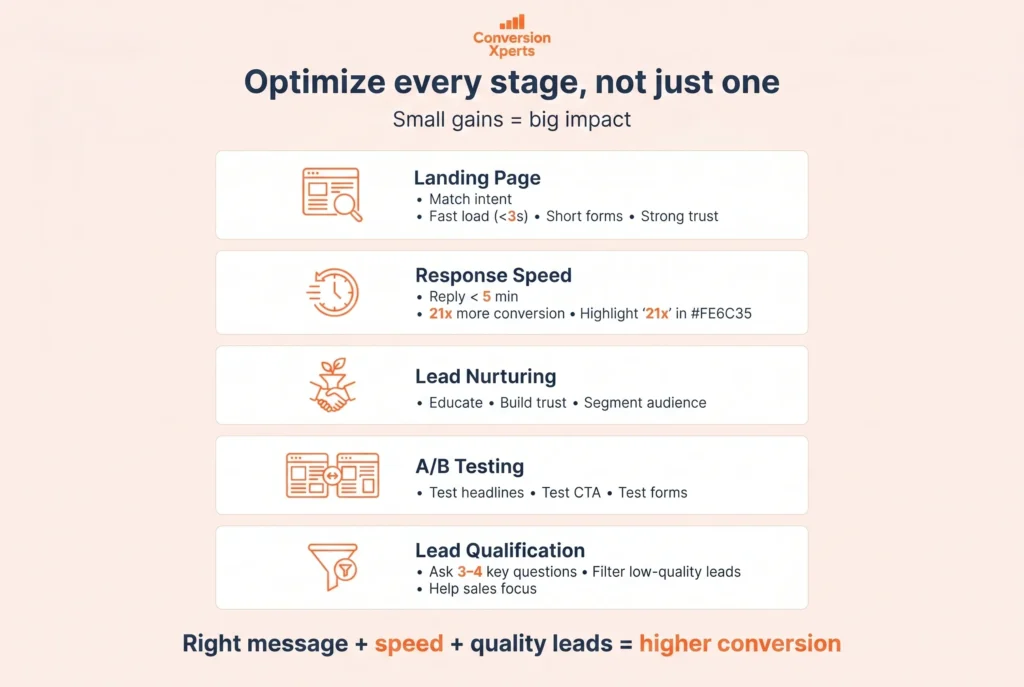
B2B lead conversion rate optimization is not about randomly tweaking button colors or swapping headlines. It is a systematic discipline applied across every stage of your funnel. Here is how the highest performing B2B organizations approach it.
Optimize Your Landing Pages for Clarity and Intent Alignment
Your landing page is often the first real test of whether your message matches what your prospect was looking for. Most B2B landing pages fail this test at the headline level.
Intent alignment means that the visitor who clicked a paid search ad for “B2B CRM software for manufacturing” arrives on a page that specifically addresses B2B CRM for manufacturing companies, not a generic homepage.
Pages that load in under 3 seconds convert twice as well as those taking 5 seconds or more. Additionally, 70% of B2B research now involves mobile devices, making mobile-optimized design non-negotiable.
Practical steps to improve landing page conversion:
Remove navigation menus from dedicated lead generation pages. Every navigation link is an exit ramp. If you are asking for a demo, make that the only action on the page. Use a single, specific headline that names the exact outcome your prospect wants. Place your most important trust signal, whether that is a client logo, a case study result, or a specific testimonial, directly above the fold. Keep form fields to a minimum at the top of the funnel. More form fields mean more friction and fewer completions.
Speed Up Your Response Time Dramatically
This is perhaps the single highest leverage conversion improvement available to any B2B team, and it costs almost nothing to implement.
Contacting a lead within 5 minutes makes you 21 times more likely to qualify that lead compared to waiting 30 minutes. Most B2B companies respond within hours or days, not minutes. That alone explains why so many well-qualified leads go cold.
Automation solves this problem entirely. Set up instant email acknowledgments, calendar booking links in your confirmation sequence, and alert systems that notify your sales team the moment a high-value lead submits a form. The economics of speed are among the best in all of B2B conversion rate optimization.
Build a Lead Nurturing System That Sustains Interest
The majority of B2B leads are not ready to buy at the moment they first convert. They need education, proof, and repeated value delivery before they trust you with a significant contract.
A well-built nurture sequence does three things. First, it delivers relevant content that maps to where the lead is in their decision process. Second, it surfaces your unique expertise through case studies, data, frameworks, and demonstrations. Third, it creates natural reasons to re-engage without feeling like harassment.
B2B companies with mature lead generation processes experience 133% more revenue than companies without, demonstrating the substantial impact of well-developed lead generation strategies.
Segmentation is critical here. A CMO from a 500-person manufacturing company needs entirely different content from a founder at a 10-person SaaS startup, even if both downloaded the same initial asset.
Run Continuous A/B Testing
Top B2B teams never stop testing. The specific elements worth testing include call to action copy, hero headlines, form length and structure, proof placement (case study above versus below the form), pricing page layout, and demo scheduling flows.
Top-performing B2B marketing teams run 4 to 8 experiments per quarter. That cadence of testing compounds over time, producing pages and sequences that reflect real user behavior rather than internal assumptions.
The key rule is to test one variable at a time with statistically significant sample sizes. For a baseline 3% conversion rate, you need approximately 10,000 visitors per variation to detect a 20% lift with confidence.
Score and Qualify Leads Before They Reach Sales
Sending unqualified leads to your sales team is one of the most expensive mistakes in B2B. It wastes sales capacity, inflates cost per acquisition, and creates misalignment between marketing and revenue.
High-performing teams ask 3 to 4 qualification questions directly in the form. This filters out unqualified leads at the point of capture and arms sales with the context needed to prioritize and personalize outreach.
Questions worth including at the qualification stage are company size, primary challenge or use case, budget range, and timeline for decision. These answers transform anonymous leads into profiled prospects your sales team can approach with relevance from the first conversation.
Channel by Channel B2B Conversion Rates
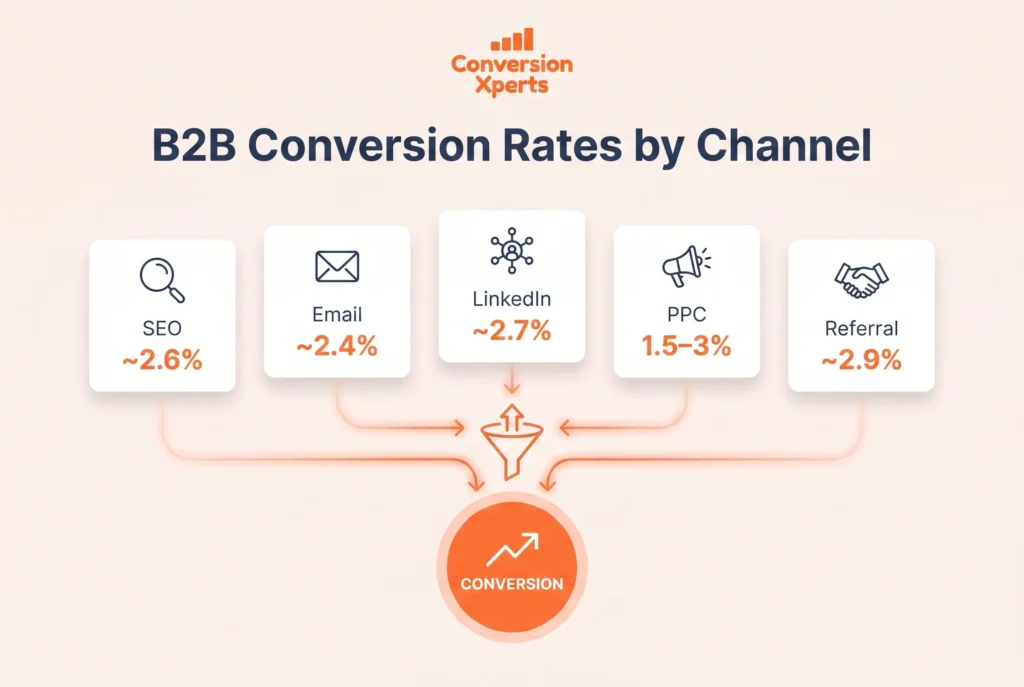
Different marketing channels produce dramatically different conversion rates in B2B. Knowing where each channel sits helps you allocate budget intelligently and set realistic targets for each source of pipeline.
Organic Search and SEO
According to First Page Sage’s 2025 report, average B2B conversion rates by channel show SEO around 2.6%, PPC around 1.5%, and email around 2.4%.
Organic search tends to produce higher quality leads because visitors arrive with explicit intent. Someone searching for “B2B conversion rate optimization agency” is much further along in their buyer journey than someone who sees a display ad while scrolling a news site.
Content and SEO generate 3 times more leads than traditional outbound at approximately 62% lower cost. This is why long-term investment in organic content is one of the most defensible and high-returning moves any B2B marketing team can make.
Email Marketing
Email consistently delivers strong results in B2B because it allows for personalization, sequencing, and timing control that no other channel matches.
Half of marketers rank email as the most effective tool for ROI. But B2B email is not about blasting generic newsletters. It is about cultivating relationships over long sales cycles.
Segmented, behavior-triggered email sequences consistently outperform broadcast emails by 3 to 5 times in both open rates and downstream conversion. The best-performing B2B email programs connect email actions directly to CRM data, so every send is informed by what the prospect has already done on your website.
LinkedIn and Paid Social
LinkedIn is the platform of choice for 89% of B2B marketers, and 65% report acquiring clients through LinkedIn ads.
HubSpot found that LinkedIn generated the highest visitor-to-lead conversion rate at 2.74%, significantly outperforming Twitter and Facebook.
LinkedIn works in B2B because the audience is already in a professional mindset when using the platform. Sponsored content, lead generation forms, and direct message campaigns all perform best when targeted tightly by job title, company size, and industry rather than broad interest categories.
Referral Traffic
Referral traffic consistently converts at among the highest rates of any channel in B2B, often 2.9% or above. This makes intuitive sense. A referral arrives with a layer of trust that paid traffic simply cannot replicate. A prospect who lands on your site because a trusted colleague recommended you is already partially sold before reading a single headline.
Building referral systems, partner networks, and integration marketplace listings are all legitimate long-term strategies to increase the volume of high-converting referral traffic.
Comparison of B2B Marketing Channel Conversion Rates
| Channel | Average Conversion Rate | Best Used For |
Referral Traffic | 2.9% | High trust, late-stage prospects |
Organic Search (SEO) | 2.6 to 2.7% | Intent-driven top and mid-funnel leads |
Email Marketing | 2.4% | Nurturing, reactivation, mid-funnel |
LinkedIn Ads | 2.74% | Targeted ICP outreach, awareness to demo |
Paid Search (PPC) | 1.5 to 3.2% | High-intent bottom of funnel keywords |
Display Advertising | Under 1% | Brand awareness, retargeting only |
Sources: First Page Sage, HubSpot State of Marketing 2025, Ruler Analytics 2025
Common B2B Conversion Killers and How to Fix Them
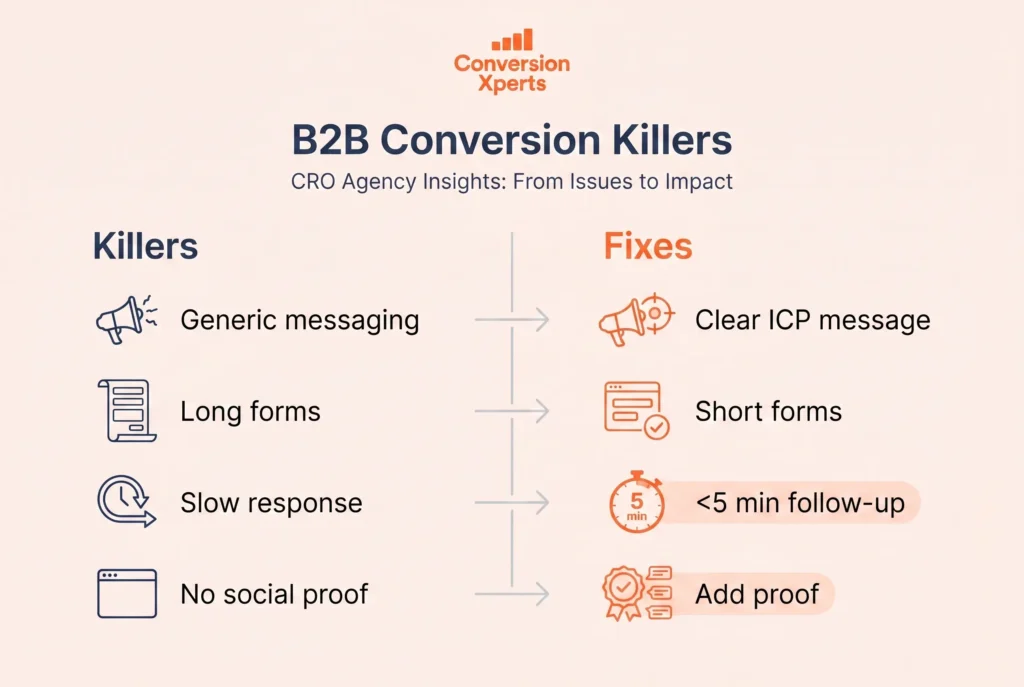
Many B2B companies are unknowingly sabotaging their own conversion rates through predictable and fixable mistakes. Here are the most common ones and what to do about each.
Generic Messaging That Speaks to No One
The most common conversion killer in B2B is messaging so broad that it fails to resonate with anyone specific. “We help businesses grow” is not a value proposition. It is a placeholder.
The fix is specificity. Name your target buyer, name their exact problem, and name the specific outcome you deliver. “We help B2B SaaS companies with 50 to 500 employees double their MQL to SQL conversion rate in 90 days” speaks to a specific person with a specific problem in a specific timeframe.
Friction-Heavy Forms and Sign-Up Processes
According to the Baymard Institute, 22% of customers report abandoning their purchase because the checkout or signup process was too long or complicated.
Multi-step forms, excessive required fields, and processes that demand information you do not actually need at the initial stage all destroy conversion rates. Progressive profiling, which collects information across multiple interactions rather than all at once, is a proven technique to reduce friction while still building a complete lead profile over time.
Slow Follow-Up from Sales
As noted earlier, responding to leads within 5 minutes produces dramatically better qualification outcomes than waiting even 30 minutes. Most B2B teams respond within business hours at best, and often the next day. That alone is costing your business meaningful revenue every month.
Ignoring the Buying Committee
B2B purchases typically involve 3 to 7 decision-makers, meaning your content must address different roles such as end users, technical evaluators, and budget holders.
If your content only speaks to the end user and ignores the CFO’s ROI concerns or the IT director’s security requirements, you will win the champion and lose the deal. Great B2B conversion rate optimization accounts for every stakeholder in the buying process.
No Social Proof at the Conversion Moment
Trust is the currency of B2B. Buyers want proof before they commit. If your most important conversion pages, demo request, pricing, contact, lack testimonials, case study results, client logos, or third-party review ratings, you are asking prospects to trust you on faith alone.
Place your strongest proof directly adjacent to your primary call to action. A specific result such as “82% of our clients see qualified pipeline growth within 60 days” outperforms a generic testimonial by a wide margin.
How ConversionXperts.com Solves Your B2B Conversion Problem
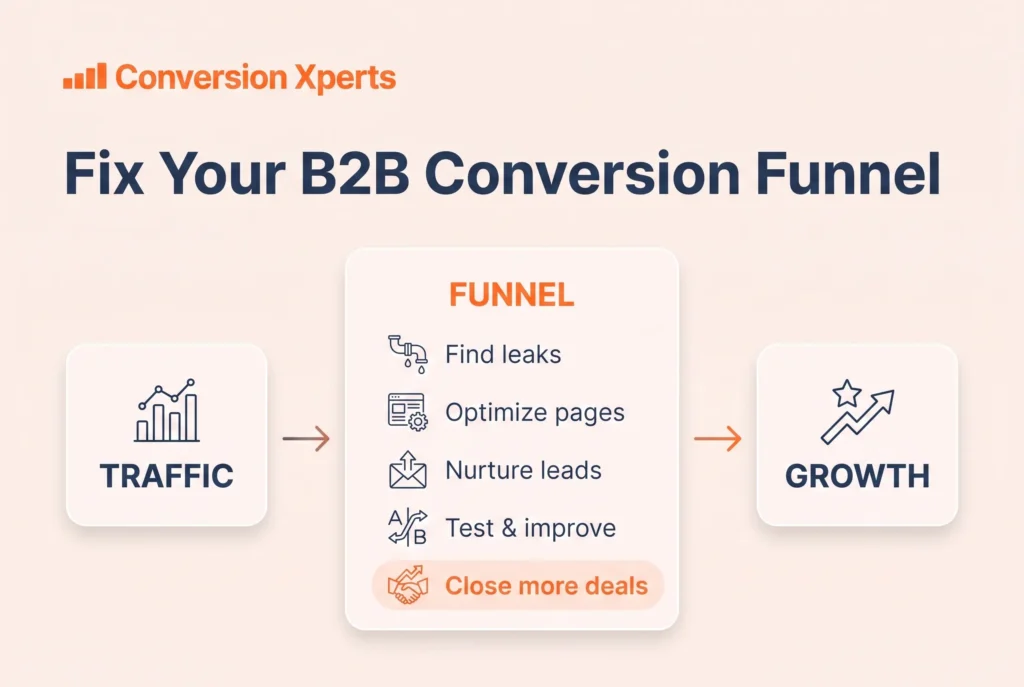
Understanding B2B conversion rate benchmarks is one thing. Building the systems that consistently outperform them is another. That is where ConversionXperts.com comes in.
ConversionXperts is a specialist conversion rate optimization agency built specifically for B2B companies. While most agencies help you generate more traffic, ConversionXperts focuses on what happens after that traffic arrives, making sure that every dollar of marketing spend works harder and produces more qualified pipeline.
What ConversionXperts.com Does
The ConversionXperts approach is built on a full-funnel audit and optimization framework that covers every stage of your B2B funnel, from the moment a visitor lands on your page to the moment a deal closes in your CRM.
Funnel Diagnostics: ConversionXperts begins with a comprehensive audit of your existing funnel, identifying exactly where leads are dropping off and quantifying the revenue impact of each leak. This creates a prioritized roadmap that focuses effort where it will move the needle most.
Landing Page Optimization: Using conversion copywriting, UX best practices, and industry-specific messaging frameworks, ConversionXperts rebuilds your most important pages to align precisely with buyer intent and drive action.
Lead Nurturing Architecture: ConversionXperts designs and builds segmented email nurturing sequences that sustain lead engagement across long B2B sales cycles, delivering the right content to the right buyer at the right stage.
A/B Testing Programs: Rather than one-off tests, ConversionXperts runs structured, ongoing experimentation programs that compound improvements quarter over quarter, continuously raising your baseline conversion rate.
Sales and Marketing Alignment: ConversionXperts bridges the gap between marketing and sales teams by building shared lead scoring frameworks, handoff processes, and feedback loops that ensure high-quality leads receive high-quality follow-up.
Who ConversionXperts.com Serves
ConversionXperts works with B2B companies globally across industries including SaaS, professional services, technology, manufacturing, healthcare, and financial services. Whether you are a growth-stage startup building your first systematic funnel or an enterprise organization optimizing a complex multi-channel pipeline, the ConversionXperts team brings the expertise to move your numbers.
The Business Case for Working with ConversionXperts
Companies using conversion rate optimization tools report a 223% ROI, but only 39.6% have a documented CRO strategy. That gap represents an enormous competitive opportunity for companies willing to invest in conversion systematically rather than hoping traffic eventually converts on its own.
If you are currently converting at the industry average of 2.9%, a ConversionXperts engagement targeting a 4.5% conversion rate on 10,000 monthly visitors produces 160 additional leads per month. At a 13% MQL rate, a 45% SQL rate, and a 25% close rate, that translates to more than 2 additional closed deals per month from the same traffic you already have.
That is the power of B2B lead conversion rate optimization done systematically, and it is what ConversionXperts delivers for its clients.
Visit ConversionXperts.com to request a free funnel audit and discover exactly where your conversion rate is leaking revenue.