Boost Your SEO Conversion Rate: The Ultimate CRO Guide
What Is SEO Conversion Rate and Why Does It Matter
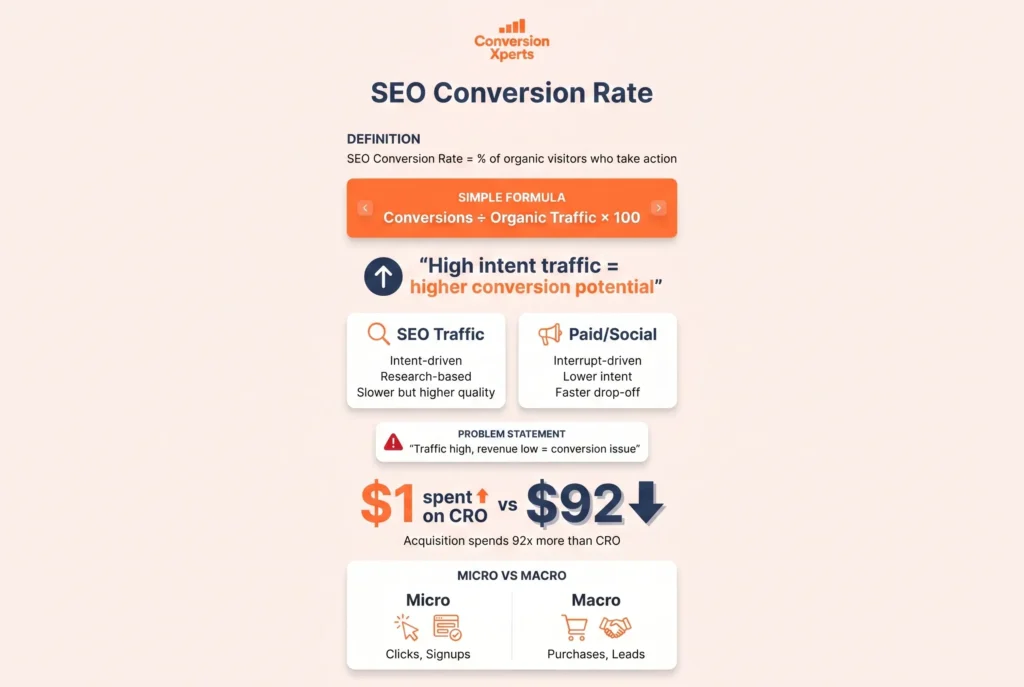
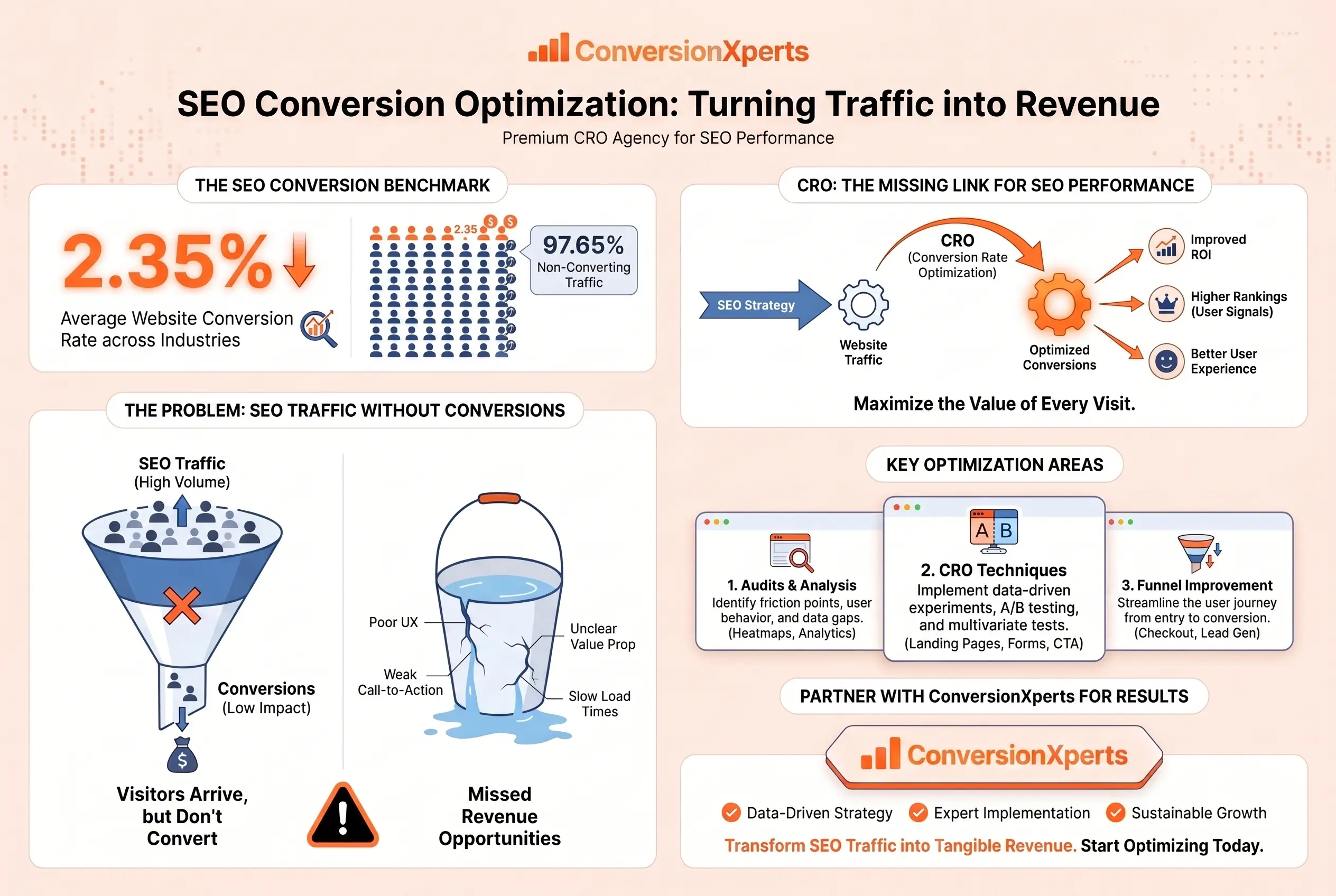
Your SEO conversion rate is the percentage of visitors who arrive through organic search and then complete a desired action on your site. That action could be buying a product, filling out a contact form, booking a call, downloading a resource, or signing up for a newsletter.
The formula is simple. Divide the number of conversions by the total number of organic visitors, then multiply by 100. So if 5,000 people found your site through Google last month and 150 of them filled out your contact form, your SEO conversion rate is 3%.
This number matters more than most people realize. Here is why.
SEO Traffic Is High Intent Traffic
People who find you through organic search are already looking for what you offer. They typed a question or searched for a solution, and Google showed them your page. That is very different from someone who sees a random ad on Instagram. Organic visitors are warmer, more curious, and more likely to convert if your page gives them what they came for.
In financial services, SEO converts customers at 7.3 times the rate of PPC. In real estate, that multiplier is 3.5 times. In legal services, it is 3.4 times. These numbers show that organic search visitors are not just cheaper to acquire, they are fundamentally more likely to take action when they land on a well-optimized page.
The Gap Between Traffic and Revenue Is a Conversion Problem
Most businesses that come to us have done good SEO work. They rank for the right keywords. They get decent traffic. But their revenue from organic search does not match their rankings. That gap is almost always a conversion problem, not an SEO problem.
Companies spend just one dollar on conversion rate optimization for every 92 dollars they spend on customer acquisition. That imbalance is exactly why so many businesses feel like their marketing is not working. They keep pouring money into the top of the funnel while the bottom leaks.
Fixing your SEO conversion rate is not about getting more visitors. It is about making better use of the visitors you already have.
SEO Conversion Rate vs. Overall Conversion Rate
These two things are related but not the same. Your overall conversion rate includes all traffic sources: paid ads, social media, email, direct visits, and referrals. Your SEO conversion rate is specifically the percentage of organic search visitors who convert.
Tracking them separately is important because organic traffic and paid traffic behave differently. Organic visitors often take longer to convert because they are in research mode. They may visit two or three times before making a decision. Your CRO strategy needs to account for that.
What Is a Good SEO Conversion Rate by Industry
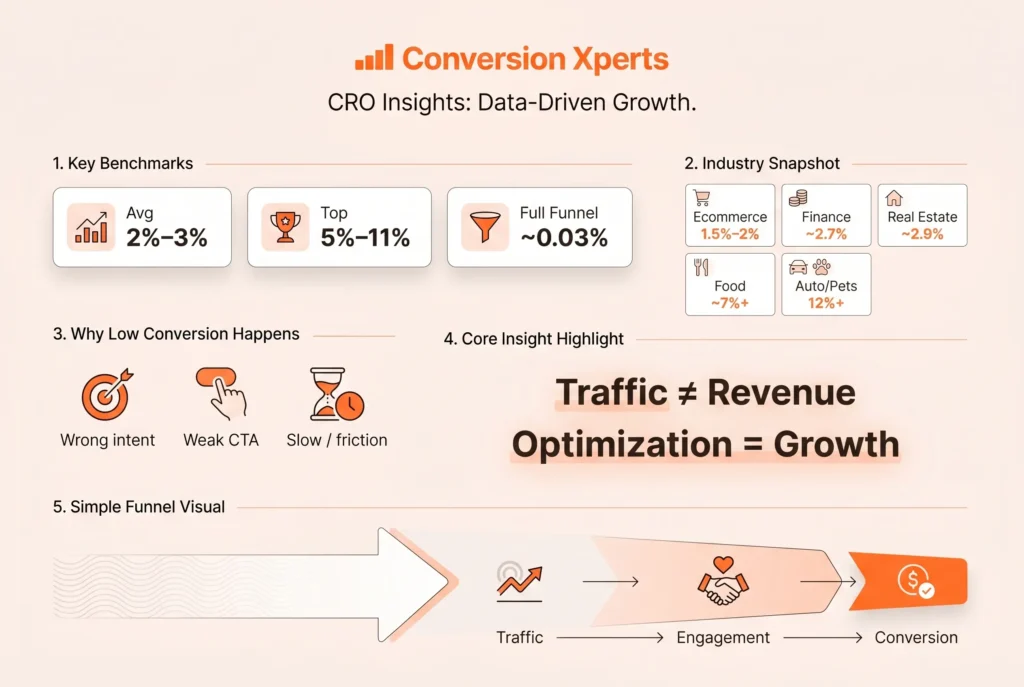
There is no single number that works as a universal benchmark. A 3% conversion rate might be outstanding in one industry and below average in another. Knowing where you stand in your specific vertical is the starting point for any serious optimization effort.
Average Conversion Rate Benchmarks
On average, websites convert about 2.35% of their visitors into customers. However, top performing websites convert at 11% or higher.
The global average website conversion rate sits at 3.68%. For paid search landing pages, the average across all industries is 2.35%, and the top 10% of landing pages convert at 11.45% or above.
Here is a breakdown by industry to give you a realistic target:
Industry | Average Conversion Rate | Top Performer Benchmark Automotive Repair | 12.96% | 20%+ Animals and Pets | 12.03% | 18%+ Food and Beverage | 7.9% | 14%+ Personal Care Products | 3.17% | 8%+ eCommerce (General) | 1.5% to 2% | 5%+ Real Estate | 2.91% | 7%+ Finance and Insurance | 2.78% | 6%+ Furniture | 2.53% | 5%+ Legal Services | Varies | 10%+
Source: Keywords Everywhere, Invesp, and First Page Sage data compiled 2024 to 2025.
Why Your Number Might Be Lower Than the Benchmark
If your conversion rate is sitting below the industry average, it almost never means your product is the problem. In most cases it comes down to one or more of these issues: your page does not match the search intent of the people landing on it, your call to action is weak or buried, your site loads too slowly, or you are driving the right traffic to the wrong page.
Each of these is fixable. And fixing them is exactly what a proper CRO audit is designed to do.
The Full Funnel Perspective on SEO Conversion
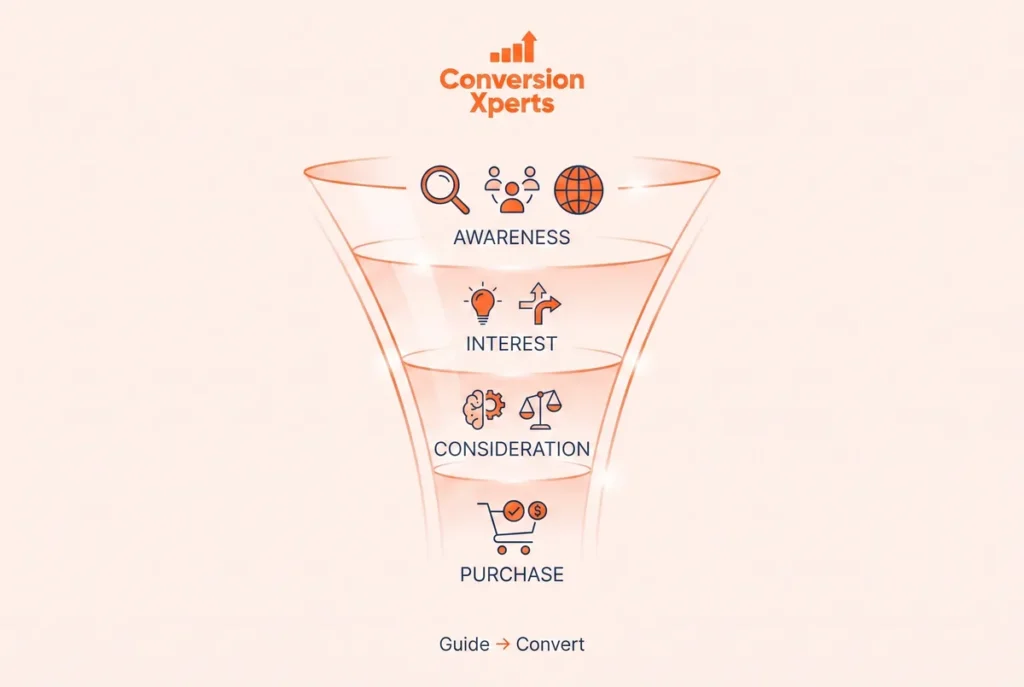
The full funnel conversion rate for SEO across the entire visitor journey, from first click to closed customer, averages around 0.032%, or roughly 1 in 3,100 visitors. This sounds low, but it reflects the complete path from a first search to a signed contract or completed purchase. Understanding this helps you set realistic expectations at each stage of your funnel and identify where the biggest leaks are happening.
How to Run a Full CRO Audit on Your Website
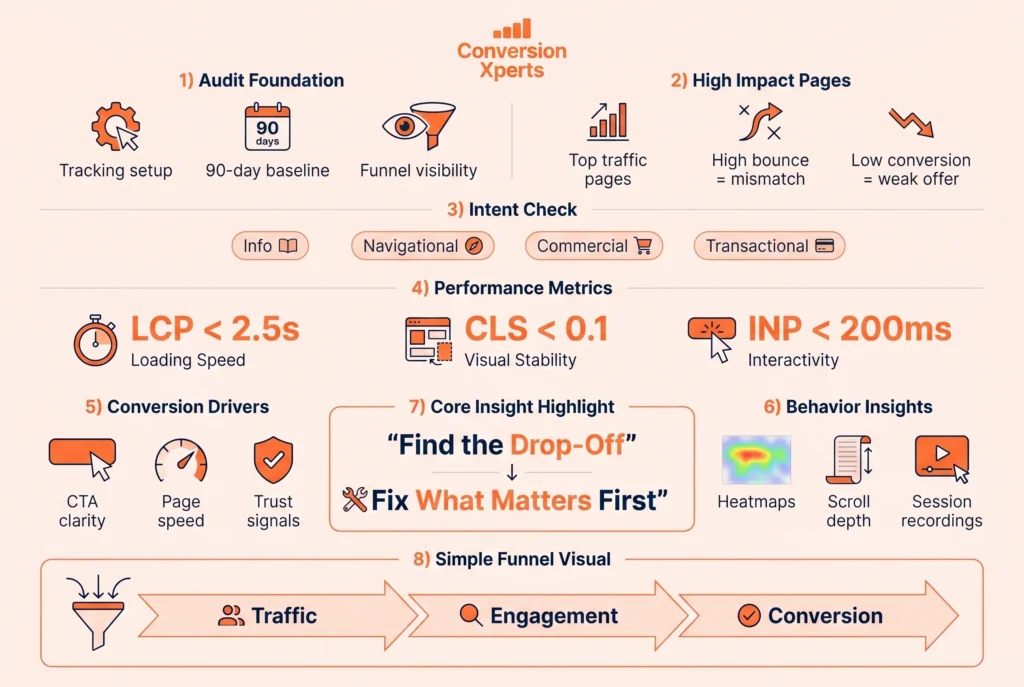
A CRO audit is a structured review of your website that identifies exactly where visitors are dropping off and why. Think of it as a health check for your conversion funnel. A good website audit does not just tell you that something is broken. It tells you what to fix first and what impact that fix will have.
Here is how to do it properly.
Step 1: Set Up Your Tracking and Baselines
You cannot optimize what you cannot measure. Before touching a single page, make sure Google Analytics 4 is set up correctly and that you have defined conversion events. These should include form submissions, button clicks, phone calls, purchases, and any other action that represents a real lead or sale.
Set up funnel tracking so you can see where in your process people are abandoning. If you run an eCommerce site, track cart additions, checkout starts, and completed purchases as separate events. If you run a services business, track contact form views, form starts, and form completions separately.
Once your tracking is clean, pull a 90 day baseline. This gives you enough data to see patterns without being too old to be relevant.
Step 2: Analyze Your Highest Traffic Organic Landing Pages
Open Google Search Console and sort your pages by organic impressions and clicks. The pages getting the most organic traffic are your highest leverage opportunities. A 1% improvement on a page getting 10,000 organic visits per month is worth far more than a 5% improvement on a page getting 200 visits.
For each of your top 10 organic landing pages, look at three things: bounce rate, average time on page, and conversion rate. If bounce rate is high and time on page is low, visitors are not finding what they expected. If time on page is decent but conversion rate is low, the content is engaging but the call to action or the offer is not landing.
This combination of signals tells you exactly what kind of problem you are dealing with.
Step 3: Check for Search Intent Mismatches
This is one of the most common issues we find in website audits and one of the most damaging. If your page ranks for a keyword but the content does not deliver what the searcher actually wants, they will leave immediately regardless of how well the page is designed.
Search intent falls into four categories: informational (looking to learn), navigational (looking for a specific site), commercial (comparing options before buying), and transactional (ready to buy now). Your page needs to match the dominant intent behind the keyword driving traffic to it.
For example, if you rank for “how to improve website conversion rate,” visitors expect educational content with practical steps. If you send them straight to a sales page with no context, they will bounce. But if you educate them well and then present a clear next step, the same traffic converts at a much higher rate.
Step 4: Review Page Speed and Core Web Vitals
A one second delay in your site loading time can reduce conversions by up to 7%. That is not a small number. A site that loads in 4 seconds instead of 3 is silently costing you a meaningful percentage of your revenue every single day.
Run your top landing pages through Google PageSpeed Insights. Pay particular attention to Largest Contentful Paint (LCP), which should be under 2.5 seconds, Cumulative Layout Shift (CLS), which should be below 0.1, and First Input Delay (FID) or Interaction to Next Paint (INP), which should be under 200 milliseconds.
These are not just SEO ranking signals. They are direct conversion factors. A page that shifts around while loading, takes forever to display its main content, or feels laggy when you click something will bleed conversions no matter how good the copy is.
Step 5: Evaluate Your CTA Placement and Copy
Your call to action is the bridge between a visitor who is interested and a visitor who converts. Most sites get this wrong in one of three ways: the CTA comes too late on the page, the copy is vague, or there is only one CTA and it is easy to miss.
A proper CRO audit reviews every page for CTA visibility, placement above the fold, specificity of the offer, and button copy. “Submit” and “Learn More” are weak. “Get My Free SEO Audit” or “Start Converting More Traffic Today” are strong because they tell the visitor exactly what happens when they click and what they get.
Changing internal link colors alone has been shown to improve clicks by meaningful margins. VWO found that simply changing the color of text links increased internal link clicks by 22.8% for one client. These small details compound.
Step 6: Run Heatmaps and Session Recordings
Tools like Hotjar, Microsoft Clarity, and Lucky Orange let you see exactly where visitors click, how far they scroll, and where they stop engaging. This qualitative data is invaluable because it shows you the real behavior of real visitors, not just aggregated numbers.
Look for rage clicks, which are rapid repeated clicks on non-clickable elements, indicating frustrated visitors. Look for scroll depth patterns to see if your key messaging is even being seen. Look at session recordings for patterns of confusion or hesitation.
What you see in these recordings will often surprise you. The things you think are clear are sometimes the things visitors find confusing.
The Top SEO Optimization Techniques That Improve Conversion Rate
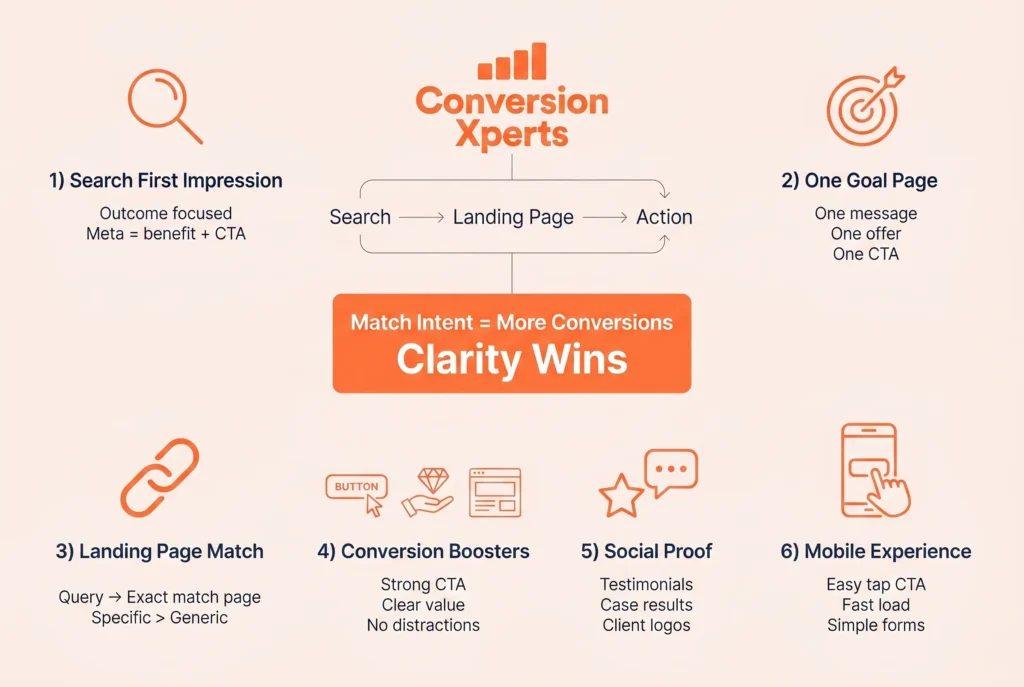
SEO optimization and conversion rate optimization are not opposites. When done right, they reinforce each other. Here are the techniques that move both metrics simultaneously.
Align Your Title Tags and Meta Descriptions With Conversion Intent
Your title tag and meta description are your first conversion moment. They appear in search results before someone even reaches your site. If they do not create a reason to click, no SEO in the world will help your conversion rate.
Write title tags that speak to the outcome the searcher wants, not just the keyword they typed. Instead of “CRO Services | ConversionXperts.com,” try “Turn Your Traffic Into Customers | CRO Services.” One describes what you do. The other describes what the visitor gets.
Meta descriptions should include a clear benefit and a soft call to action. “Learn how to improve your SEO conversion rate and start turning organic traffic into real revenue. Free audit available.”
Optimize Your Landing Pages for One Goal
A high converting page sticks to the Rule of One: made for one reader, built around one big idea, offering one solution, and directing toward one call to action. The more choices you give a visitor, the less likely they are to make any choice at all. This is called decision paralysis and it silently kills conversion rates on pages that try to do too much.
If you are running a dedicated landing page for an SEO service, that page should have one job: get the visitor to request a consultation or an audit. Every element on the page, the headline, the subheadlines, the images, the testimonials, and the button, should push toward that one action.
Removing navigation from landing pages is one of the simplest and most effective CRO moves available. VWO tested this by removing the navigation bar from a landing page and saw signups double from 3% to 6%.
Create More Targeted Landing Pages
Increasing your number of landing pages from 10 to 15 can boost leads by 55%. More landing pages mean more opportunities to match specific search queries with highly relevant content. A visitor who searches “CRO audit for eCommerce sites” should land on a page specifically about CRO audits for eCommerce, not a generic services page.
The specificity of the match between what someone searches and what they see when they land is one of the strongest predictors of whether they convert.
Use Social Proof Strategically
People trust other people more than they trust brands. Testimonials, case studies, client logos, review counts, and star ratings all reduce the psychological risk of taking action.
The placement of social proof matters as much as having it. Put your strongest testimonial directly adjacent to your main call to action. If someone is hesitating before clicking, a well-placed quote from a happy client at that exact moment can be the thing that tips them over.
Case studies are especially powerful for service businesses because they show the transformation, not just the result. “We increased their organic conversion rate from 1.8% to 4.6% in 90 days” is far more compelling than a five star review that says “great service.”
Optimize for Mobile Experience Separately
Mobile devices account for roughly 63% of organic search visits in the US. Yet most businesses still design and optimize primarily for desktop. Your mobile experience is not a smaller version of your desktop site. It is its own conversion environment with its own friction points and its own best practices.
Check that your CTAs are large enough to tap comfortably. Check that forms do not require excessive typing. Check that pop-ups do not block the entire screen on mobile. Check that your page does not require horizontal scrolling.
Mobile visitors are often in a different mindset than desktop visitors. They want faster answers and simpler actions. Design for that.
How to Optimize Your Site for Both SEO and Conversions at the Same Time
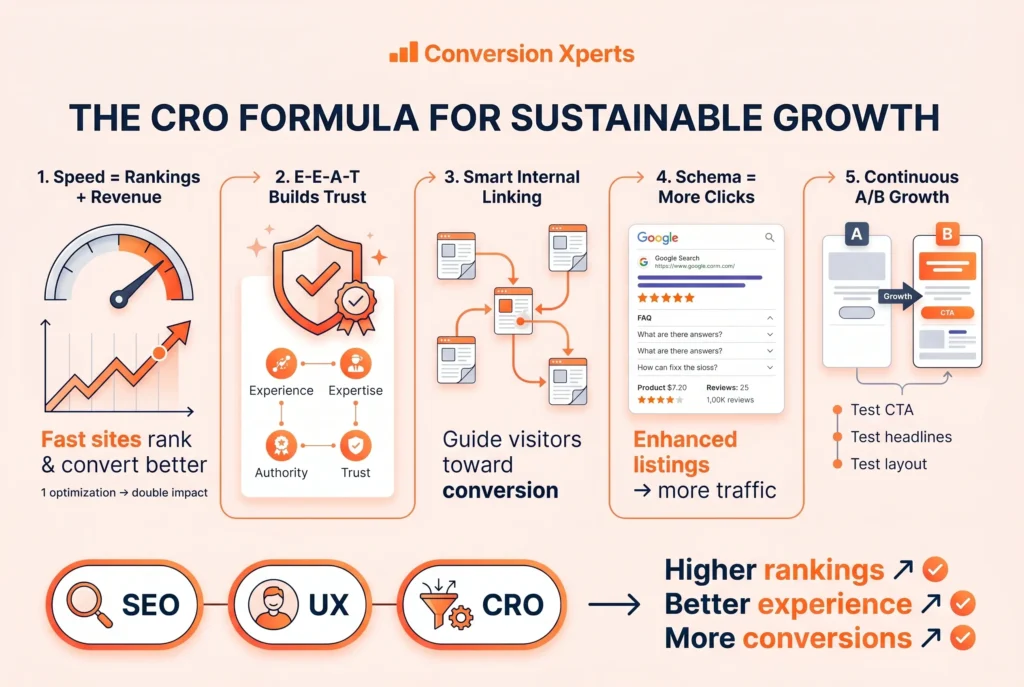
The best SEO optimization is the kind that also improves user experience, which in turn improves conversion rate. These two disciplines used to be treated as separate things. They are not.
Page Speed Is Both an SEO Signal and a Conversion Factor
Google uses Core Web Vitals as a ranking signal. But a fast loading site also converts better. Improving your site speed helps you rank higher and convert more from that higher ranking. That is a compounding return on a single investment.
Compress images, eliminate render-blocking scripts, use a content delivery network, and enable browser caching. These technical fixes serve both SEO and CRO simultaneously.
Content Quality Signals Trust to Both Google and Your Visitors
Google’s ranking algorithms increasingly reward content that demonstrates real expertise, genuine authority, and trustworthiness. This is the E-E-A-T framework: Experience, Expertise, Authoritativeness, and Trustworthiness. The same qualities that make Google trust your content are the same qualities that make visitors trust you enough to hand over their contact details or their credit card.
Write content that actually answers questions in depth. Cite real data with sources. Include specific examples from real situations. Show that you know what you are talking about because you have actually done it, not just read about it.
Internal Linking Serves Both Rankings and Conversion Paths
A well-structured internal link strategy helps Google understand the hierarchy and relationships between your pages. It also creates natural pathways that move visitors from informational content toward conversion pages.
If someone reads your blog post on “how to improve SEO conversion rate,” they should find a natural next step that leads them toward your service page or your free audit offer. The internal link is both a ranking signal and a conversion funnel tool.
Schema Markup Improves Click Rates From Search Results
Adding structured data markup to your pages helps search engines display enhanced results, including star ratings, FAQs, how-to steps, and pricing, directly in the search results. These enhanced results have higher click-through rates. More clicks mean more visitors to convert.
This is SEO optimization that directly improves the top of your conversion funnel before anyone even reaches your site.
A/B Testing for Continuous Improvement
Simple on-page fixes like improving a CTA, removing a form field, or adding social proof can show measurable results within days. A/B tests typically need two to four weeks to reach statistical significance. A structured CRO program with regular testing cycles produces compounding results over three to six months.
The key word here is compounding. Each test teaches you something about your specific audience. Over time, the insights stack up and your conversion rate climbs in a way that is genuinely sustainable.
Do not test random things. Test based on data from your heatmaps, session recordings, and analytics. Start with your highest traffic pages and your highest impact elements: headlines, CTA copy, form length, page layout, and social proof placement.
Tools That Make CRO Auditing and SEO Optimization Easier
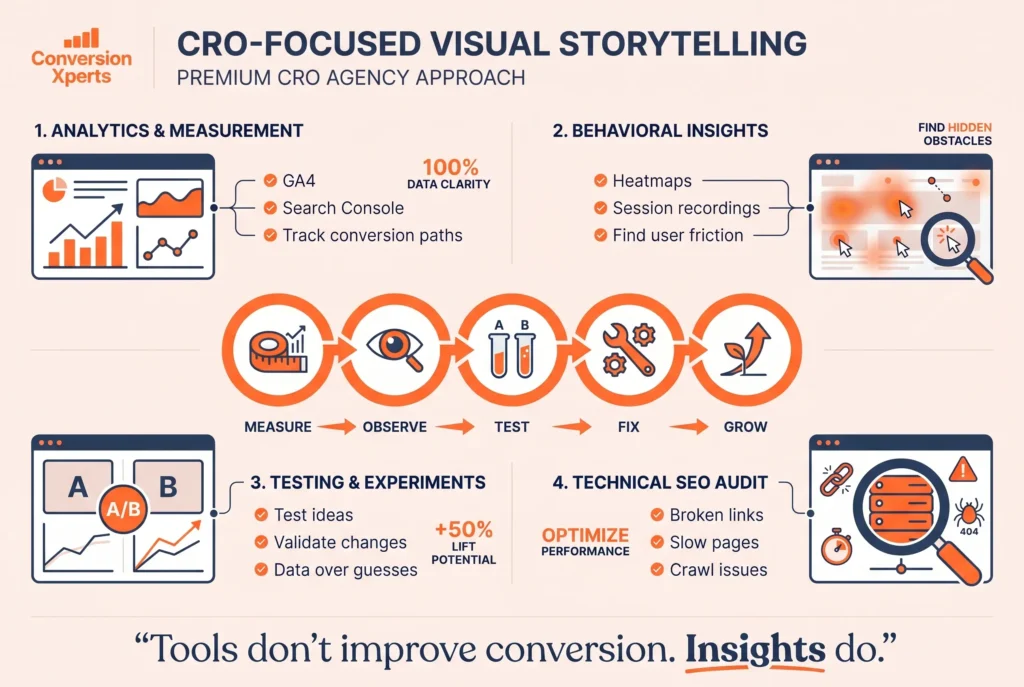
You do not need to use every tool on this list. But you do need at least one from each category to run a complete and informed optimization program.
Analytics and Measurement
Google Analytics 4 is non-negotiable. It is free, powerful, and integrates with everything. Set up conversion events properly from day one. Google Search Console shows you exactly which organic queries are bringing visitors to which pages, and what your average position and click-through rate are. This is your first stop for identifying where SEO and conversion issues overlap.
Behavioral Analytics
Hotjar and Microsoft Clarity both offer heatmaps, session recordings, and user feedback tools. Clarity is free. Hotjar has a free tier with limits. Either one gives you the qualitative insight you need to understand why people are not converting, not just that they are not.
Lucky Orange adds live chat capability and conversion funnels on top of heatmaps and recordings, making it particularly useful for eCommerce sites.
Testing and Experimentation
VWO, Optimizely, and Google Optimize (or its successors) let you run A/B tests and multivariate tests without developer support. These are essential for validating your CRO hypotheses before rolling out changes site-wide.
Most optimizers aim for a confidence level of around 90 to 95% before declaring a test winner. If your site does not get much traffic, A/B testing can be difficult because you need enough data to reach statistical significance. If traffic is low, focus on qualitative research first and make changes based on best practice principles before investing in formal testing infrastructure.
Technical SEO and Site Audit
Screaming Frog, Ahrefs Site Audit, and Semrush Site Audit all crawl your site and identify technical issues: broken links, missing meta data, duplicate content, slow pages, crawl errors, and more. Running a full technical audit is always the first step in any comprehensive website audit process.
These technical issues do not just hurt your rankings. Broken links frustrate visitors. Missing meta descriptions reduce click-through rates from search results. Duplicate content confuses both search engines and users.
How ConversionXperts.com Can Help You Grow
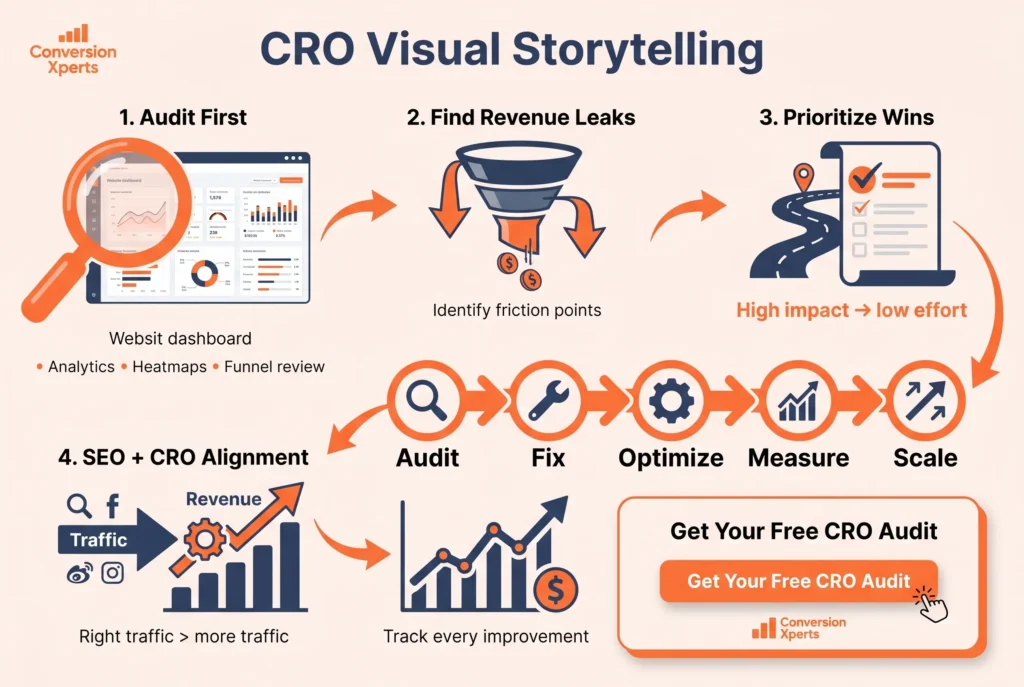
Here is the truth about what we do at ConversionXperts.com. We are not an agency that runs generic traffic campaigns and calls it done. We are a team of conversion specialists who believe that more traffic means nothing if your site is not set up to capture it.
We work with businesses that already have some SEO traction but feel like their results do not match their effort. You are getting visitors but not enough of them are becoming leads. You have a decent ranking but your revenue from organic search is frustrating. You have run some CRO experiments but nothing has moved the needle the way you hoped.
That is exactly where we come in.
Our process starts with a deep website audit. We look at your analytics, your heatmaps, your technical SEO, your content, your calls to action, and your page speed. We map your actual conversion funnel and identify every point where visitors are dropping off and why.
Then we build a prioritized action plan. Not a list of 200 things to fix eventually. A clear sequence of the changes that will have the biggest impact on your conversion rate in the shortest time. We know from experience which levers move the needle most and which ones are just busywork.
We also help you align your SEO strategy with your conversion goals. That means making sure the keywords you rank for attract the right kind of visitors, not just the most visitors. High traffic from the wrong audience is just expensive noise.
What makes us different is that we measure everything. Every change we make is tracked against your baseline. You see exactly what moved and by how much. No vague claims about “increased brand awareness.” Real numbers tied to real revenue.
If you are serious about turning your organic traffic into a predictable source of leads and sales, we would love to show you what is possible. Get your free CRO audit at ConversionXperts.com and let us show you exactly where your biggest opportunities are hiding.