

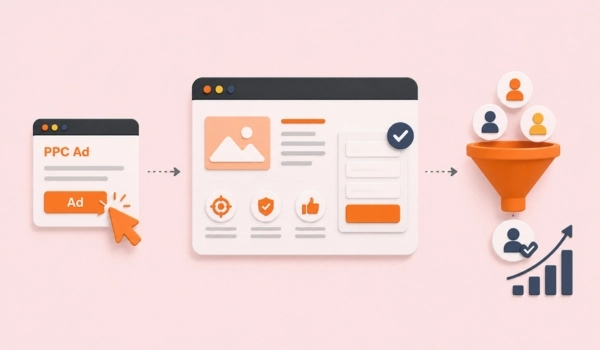
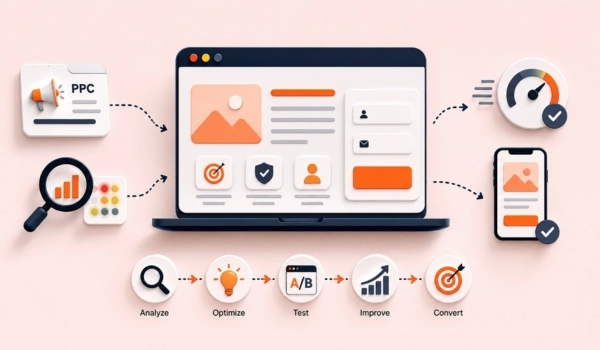
| Element | Why It Matters |
| Headline & Message Match | Confirms visitors landed in the right place and reinforces ad intent |
| Above-the-fold content | Determines whether a visitor stays or bounces within the first few seconds |
| Call-to-Action (CTA) | Directs visitor behavior toward the desired conversion action |
| Form design | Reduces friction while maintaining lead quality |
| Page load speed | Directly affects bounce rate, Quality Score, and mobile performance |
| Trust signals | Builds credibility with visitors who have no prior brand relationship |
| Mobile experience | The majority of paid traffic now arrives on mobile devices |
| Visual hierarchy | Guides attention toward the conversion goal without distraction |
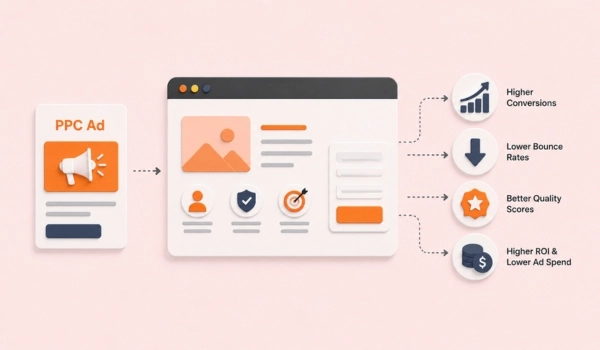

PPC landing page optimization is the process of improving a paid-ad landing page’s messaging, design, speed, and calls-to-action to increase the percentage of paid visitors who convert into leads or customers.
General CRO applies to all traffic sources, while PPC landing page optimization specifically accounts for the behavior of paid visitors, who tend to be colder, more price-sensitive, and quicker to bounce, and it factors in ad platform metrics like Quality Score and cost-per-click.
Most clients begin seeing measurable improvements within the first testing cycle, typically 2–4 weeks, depending on traffic volume. Statistically significant A/B test results require sufficient sample size, so higher-traffic pages tend to show conclusive results faster.
Yes. Google Ads Quality Score factors in landing page experience, including relevance, load speed, and mobile usability. Improving these elements typically leads to a stronger Quality Score and a lower cost-per-click.
Both. We can optimize your existing PPC landing pages through iterative, tested improvements, or design new landing pages built specifically for a campaign’s ad messaging and audience.
We optimize landing pages for traffic from Google Ads, Microsoft Ads, Meta Ads (Facebook and Instagram), and LinkedIn Ads, as well as multi-channel paid campaigns.
Success is measured against the specific conversion goal of the campaign, whether that’s form submissions, purchases, sign-ups, or calls, and validated through statistically significant A/B testing rather than assumptions.