AI Conversion Rate Optimization: The Complete 2026 Guide That Actually Works
-
By: Henry
- Mar 4
- Comments (0)
Introduction
Did you know that most websites are wasting over 97% of their traffic right now?
That is the reality. The average website converts only 2.35% of visitors. That means for every 100 people who land on your site, about 97 of them leave without doing anything. No purchase. No form. No call. Nothing.
AI conversion rate optimization is changing that completely.
Businesses using AI CRO tools are doubling and even tripling their conversion rates without spending more on ads. According to a 2025 McKinsey report, companies using AI in their marketing see 10 to 20% more revenue. And most of that growth comes from converting the traffic they already have.
In this guide, you will learn what AI conversion rate optimization is, how it works, which AI tools for lead to lease conversion rate and sales actually deliver results, how AI chatbots boost conversions around the clock, and a simple step-by-step framework you can follow starting today.
This guide is written for US businesses that want to learn about CRO and want real results fast. Let us get into it
Table of Contents
What Is AI Conversion Rate Optimization?
AI conversion rate optimization means using artificial intelligence to figure out why visitors are not converting and then fixing it automatically.
Instead of guessing what is wrong with your website, AI looks at the data, finds the problems, and helps you fix them faster than any human team ever could.
A conversion can be anything. A phone call. A form submission. A booked appointment. A product purchase. A signed lease. AI CRO helps you get more of those actions from the same amount of traffic you are already getting.
Why AI CRO Is Different From Regular CRO
Regular conversion rate optimization is slow. A human analyst has to review recordings, build a hypothesis, design a new page version, wait for a developer, launch a test, and then wait weeks for enough data. By the time they get results, weeks or even months have passed.
AI conversion rate optimization does all of that in hours.
AI reads thousands of data points about your visitors at the same time. It spots patterns no human would ever notice. Then it acts on those patterns instantly by changing headlines, showing different offers, triggering a chatbot, or routing high-value visitors to your sales team right away.
That speed is why AI CRO is one of the biggest opportunities in digital marketing right now.
The Three Things AI CRO Does For Your Business
The first thing AI CRO does is predict who will convert. AI looks at how visitors behave on your site and gives each one a score. A high score means they are likely to buy or sign up. Low score means they need more nurturing. This helps you focus your energy on the right people at the right time.
The second thing AI CRO does is personalize the experience. Instead of showing everyone the same page, AI shows each visitor the version that is most likely to convert them. Different headlines. Different offers. Different CTAs. All based on who that person is and where they came from.
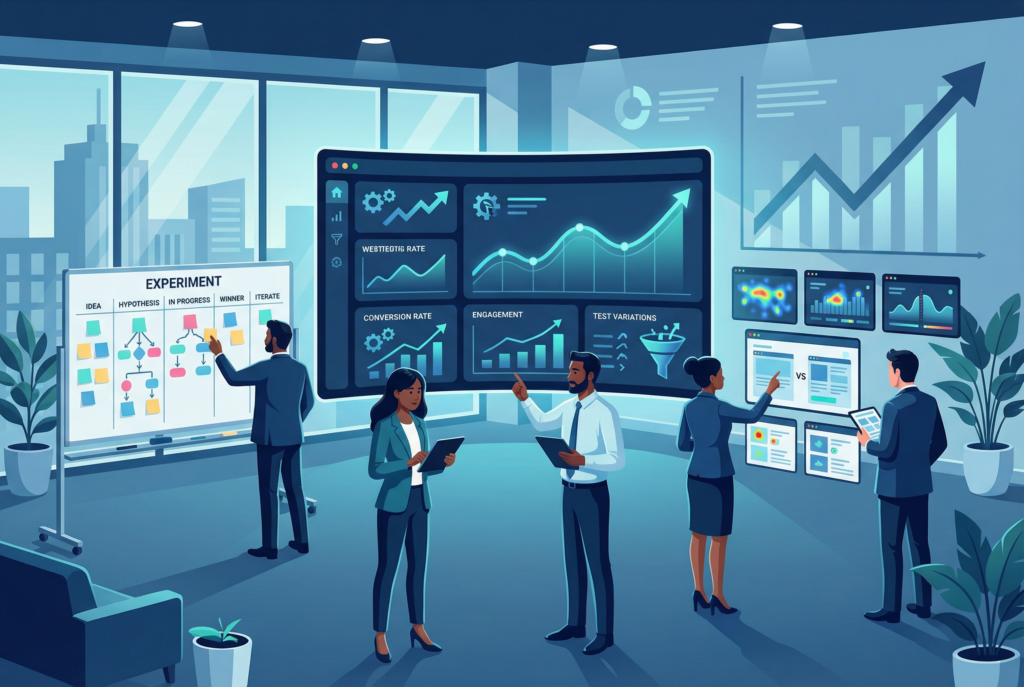
The third thing AI CRO does is test and improve constantly. AI runs dozens of tests at the same time and automatically moves traffic toward whatever is working best. No waiting around. No manual analysis. Just continuous improvement running in the background while you focus on your business.
What Does AI CRO Look Like in Real Life?
Imagine someone lands on your pricing page. They scroll through it slowly. They hover over the most expensive plan. Then they move their mouse toward the back button.
Without AI CRO, they leave, and you never see them again.
With AI CRO, a chatbot pops up at exactly that moment and says something like “Not sure which plan is right for you? Let me help.” That visitor stays. They ask a question. They get an answer instantly. They book a demo.
That is AI conversion rate optimization working in real time.
AI CRO vs Traditional CRO: Which One Wins?
Both AI CRO and traditional CRO want the same thing. More conversions. More revenue. But they go about it very differently.
Here is an honest comparison so you know exactly what you are working with.
The Problem With Traditional CRO
Traditional CRO work,s but it is painfully slow. Most teams can only run two to four real A/B tests every month. That means you might test your homepage headline in January and your pricing page CTA in March. Meanwhile, your competitors using AI are running dozens of tests every single week.
By the time you finish one test cycle, anAI-poweredd competitor has already tested fifty variations and is serving the winning version to every visitor automatically.
Speed is not the only problem either. Traditional CRO is also expensive. You need skilled analysts. You need designers. You need developers. You need testing tools. All of that adds up fast, especially for smaller businesses.
AI CRO vs Traditional CRO: The Numbers Side by Side
| Factor | Traditional CRO | AI-Powered CRO |
| How fast can you get insights | Days or weeks | Minutes or hours |
| How many tests can you run | 2 to 4 per month | Dozens at once |
| How personal the experience is | Same for everyone | Tailored to each visitor |
| How much human work does it needs | Very high | Much lower at scale |
| Cost per insight | High | Lower over time |
| Best for | Small sites with low traffic | Any site wanting fast growth |
| Lead to conversion rate impact | 5 to 20% improvement | 20 to 100% or more |
| Chatbot and live engagement | Not included | Available 24 hours a day |
Where Traditional CRO Still Has Value
Traditional CRO is not dead. If your site gets fewer than 10,000 visitors per month, AI personalization tools may not have enough data to work well. In that case, manual A/B testing combined with good user research is still your best starting point.
User interviews, customer surveys, and usability tests also give you qualitative insight that AI cannot replace. The smartest approach in 2026 is to use AI for speed and scale while using human research for depth and strategy.
How AI Chatbots Boost Conversions: The Full Archive of What Works
AI chatbots are one of the most powerful tools in the AI conversion rate optimization toolkit. When done right, they can dramatically boost conversion rates, improve your lead to lease conversion rate, and help you qualify leads around the clock without hiring more people.
This is the full archive of what actually works based on real results from real businesses.
Why AI Chatbots Convert So Well
When a visitor lands on your site, they have questions. They have doubts. They are probably looking at your competitors at the same time.
A great AI chatbot answers their questions right now, in plain language, without making them hunt through a help page. That instant response removes doubt. Removing doubt creates conversions.
According to a 2025 Drift and Salesforce study, businesses using AI chatbots for lead engagement saw 67% more qualified leads compared to businesses using forms alone. That is not a small difference. That is a massive competitive advantage sitting right there on your website waiting to be turned on.
Intercom’s 2025 data also showed that AI chatbots resolve 47% of all support questions without any human involvement. That means your team spends less time answering basic questions and more time closing deals.
AI Chatbot Strategies That Are Proven to Boost Conversions
Strategy number one is trigger-based on behavior, not time on page.
Most chatbots are set up to pop up after someone has been on a page for 30 seconds. That is not the best approach. Instead, trigger your chatbot based on specific behaviors. If someone scrolls to the bottom of your pricing page and then scrolls back up, that is a hesitation signal. Trigger the chatbot right then. If someone spends 90 seconds on your contact page without clicking anything, that is another signal. Use it.
Strategy number two is match the chatbot to the traffic source.
Someone who clicked a Google Ad for “AI leasing software for apartments” needs a completely different conversation than someone who found your blog through a search for “how to improve conversion rates.” AI chatbot platforms like Drift, Intercom, and Qualified let you build different conversation flows for different traffic sources. Use this feature. It dramatically increases how relevant the chatbot feels and how many leads it converts.
Strategy number three is use chatbots to qualify leads automatically.
Instead of sending every lead to your sales team, let the chatbot ask a few smart questions first. What is your company’s size? What is your timeline? What problem are you trying to solve? Based on those answers, the chatbot scores the lead, and either routes them to a sales rep immediately or puts them into a nurture sequence. This saves your sales team hours every week and makes sure they only talk tohigh-qualityy prospects.
Strategy number four is recover abandoned visitors before they leave.
When a visitor moves their mouse toward the top of the browser to close the tab or hit the back button, that is your last chance to keep them. An exit intent chatbot trigger can stop them with a simple message like “Before you go, can I answer any questions?” Studies show this tactic recovers 10 to 15% of visitors who were about to leave forever.
Strategy number five is use chatbots immediately after a paid ad click.
This is one of the most underused strategies in the entire AI chatbots conversions archive. When someone clicks your ad, they already have buying intent. They are warm. Do not make them fill out a form and wait 24 hours for a callback. Instead, greet them immediately with a chatbot message that connects directly to the ad they clicked. This is called message matching, and it keeps the momentum going from ad click all the way to conversion.
Real Business Results From AI Chatbots
HubSpot added an AI chatbot to its pricing page and saw demo bookings go up 20% from that single page. The chatbot answered pricing questions, handled common objections, and offered to connect visitors with a sales rep instantly.
Gong, the revenue intelligence company, used Drift’s AI chatbot to engage website visitors in real time. Visitors who talked to the chatbot converted to sales pipeline opportunities at three times the rate of visitors who did not.
Sephora built an AI tool that lets shoppers virtually try on makeup before buying. By removing the main hesitation people have when buying cosmetics online, which is not knowing how a product will look on them, Sephora dramatically increased online conversions. That is AI CRO at its most creative.
In multifamily real estate, AI leasing assistants contact new leads in under 60 seconds, day or night. Properties using these tools see their lead to lease conversion rate improve by 15 to 25%, and their tour scheduling rates improve by 30 to 50%.
Build Your Own AI Chatbots Conversions Archive
Every conversation your chatbot has is a data point. Over time, you build up an archive of what questions visitors ask most, what objections come up before people convert, and what words and phrases trigger the most positive responses. This AI chatbot’s conversion archive becomes one of your most valuable business assets. Use it to improve your chatbot scripts, sharpen your sales messaging, and train your human sales team on how to handle objections better.
Best AI Tools to Boost Conversion Rates in 2026
The right AI tools to boost conversion rates depend on what kind of business you have, how much traffic you get, and where your biggest conversion problems are. Here is a breakdown of the best options in every category.
AI Testing and Optimization Tools
Optimizely is the most advanced AI powered testing platform available. It automatically figures out which page elements matter most for different visitor segments and runs experiments at a scale no human team could match. Best for large ecommerce and SaaS companies with over 100,000 monthly visitors. The main downside is the high price point, which can make it out of reach for smaller businesses.
VWO, which stands for Visual Website Optimizer, is a strong option for mid-sized businesses. Its AI features include automated test prioritization, predictive visitor scoring, and an AI hypothesis generator that reads your analytics and suggests exactly what to test next. For teams that want serious AI CRO power without paying enterprise prices, VWO is the best all around choice.
AB Tasty includes an AI feature called Greenfield that generates test hypotheses from your behavioral data automatically. Most businesses overlook this feature, but it is genuinely useful for speeding up the ideation phase of CRO.
AI Personalization Platforms
Dynamic Yield, now owned by Mastercard, is one of the most powerful AI personalization platforms in existence. It personalizes every part of a webpage in real time for every individual visitor. Headlines, product recommendations, promotional offers, and calls to action all change automatically based on who is viewing the page. McDonald’s used Dynamic Yield to personalize their digital drive through menus based on time of day, weather, and trending orders, and reportedly increased their average check size by 15%.
Mutiny is built specifically for B2B companies. It connects to your CRM and uses that data to personalize your entire website based on which company a visitor works for, what industry they are in, and how big their organization is. For B2B sales teams, Mutiny is one of the most powerful AI tools for lead to lease conversion rate equivalents available anywhere.
Intellimize runs continuous AI optimization without requiring you to set up individual tests. It tests thousands of page variations at the same time and automatically shows each visitor the version most likely to convert them. Think of it as a website that improves itself automatically every single day.
AI Chatbot Tools Ranked by Use Case
| Tool | Best For | Standout Feature | Conversion Lift Reported |
| Drift | B2B companies | Routes hot leads to sales instantly | 25 to 40% more pipeline |
| Intercom | SaaS and ecommerce | AI resolves 47% of chats automatically | 30% fewer support tickets |
| Qualified | Salesforce users | Identifies company visiting your site | 3 times faster pipeline |
| Elise AI | Real estate leasing | Responds to leads in under 60 seconds | 30 to 50% more tours booked |
| ManyChat | Ecommerce brands | Instagram and Facebook chat automation | 20 to 35% cart recovery |
| Tidio | Small businesses | GPT powered AI chat | 67% faster response to leads |
Free AI Tools for Conversion Optimization
Microsoft Clarity is completely free and one of the best tools available right now. It records sessions, generates heatmaps, and now uses AI to summarize everything for you. Instead of watching hours of session recordings, you get a written summary of exactly where visitors struggle and what they click on. Every business should be using this tool.
Hotjar AI adds an AI layer on top of heatmaps and session recordings. You can literally ask it questions like “Why are people leaving the checkout page?” and it gives you a data backed answer. For small and medium businesses this kind of insight used to require an expensive analyst. Now it takes about 30 seconds.
Google Analytics 4 includes AI powered anomaly detection and predictive audiences. When something unusual happens to your conversion rate, GA4 alerts you automatically. It can also predict which users are most likely to purchase in the next seven days so you can target them with specific campaigns.
AI Landing Page and Copy Tools
Unbounce Smart Traffic uses AI to send each visitor to whichever version of your landing page is most likely to convert them. According to Unbounce’s own data, Smart Traffic increases conversions by an average of 30% compared to a standard A/B test. It works with as few as 50 conversions so even newer pages can benefit.
Persado uses AI to write marketing copy that is scientifically optimized for emotional impact. JPMorgan Chase tested Persado generated copy against their best human written copy and Persado won by 450% in one campaign. For businesses with large email programs or paid ad budgets, Persado can deliver serious ROI.
AI Tools for Lead to Lease Conversion Rate and Sales Funnels
AI tools for lead to lease conversion rate optimization solve one of the most frustrating problems in business. You spend money getting people interested. They raise their hand. And then they disappear before they ever sign anything.
AI fixes this by making your follow up instant, personal, and available 24 hours a day.
The Lead to Lease Problem in Real Estate
Multifamily real estate has one of the toughest conversion funnels of any industry. A prospect fills out an inquiry form online. If your team does not call or text them back within five minutes, your chance of converting that lead drops by 80%. That statistic comes from LeadSimple’s 2025 research and it is one of the most important numbers in property management.
The problem is obvious. No leasing team can be on call 24 hours a day, seven days a week, responding to every lead in under five minutes. People are human. They sleep. They take breaks. Leads come in at 11 PM on a Sunday.
AI leasing assistants solve this problem completely. Tools like Elise AI, Knock CRM, and Quext IQ respond to every single lead automatically in under 60 seconds. They answer questions about availability and pricing, schedule tours, send appointment reminders, and follow up with leads who went quiet. They do all of this in a natural conversational tone that feels human, not robotic.
The results speak for themselves. Lead response time drops from several hours to under a minute. Tour scheduling rates improve by 30 to 50%. Lead to lease conversion rates improve by 15 to 25%. Leasing teams can handle three to four times more leads without burning out.
How to Apply Lead to Lease Thinking to B2B Sales
The exact same logic applies to B2B lead conversion. A 2025 Harvard Business Review study found that companies responding to leads within one hour are seven times more likely to qualify that lead compared to companies that wait longer. Most B2B businesses are waiting hours or even days.
AI tools eliminate that problem with a four-step process.
Step one: Use AI lead scoring to automatically rank every inbound lead. Tools like 6sense, Clearbit, and HubSpot AI scoring look at the company size, the pages visited, the content downloaded, and third-party intent signals to give every lead a score instantly.
Step two: Trigger instant AI engagement for your highest scoring leads. When a high value lead comes in, an AI chatbot or personalized email fires immediately. Not a generic thank you message. A specific, relevant message that connects to exactly what that person was looking at on your site.
Step three: Put lower scoring leads into an AI driven nurture sequence. Platforms like Marketo and Pardot use machine learning to figure out the best time to send each email, which content to share, and which channel to use. This keeps leads warm without any manual effort from your team.
Step four: Use AI to flag leads when they are ready to buy. AI scoring tracks how leads engage with your content over time. When a lead suddenly starts visiting your pricing page, opening every email, and watching your demo video, that is a buying signal. AI tools detect this pattern and alert your sales rep immediately so they can reach out at exactly the right moment.
AI Conversion Funnel Breakdown by Stage
| Funnel Stage | The Problem | What AI Does | How Much It Helps |
| Awareness to Interest | People bounce right away | Personalizes content by traffic source | 15 to 30% lower bounce rate |
| Interest to Consideration | Visitors do not explore deeply | AI recommends next best content | 20 to 40% more pages per visit |
| Consideration to Intent | People start forms and abandon them | Exit intent chatbot catches them | 10 to 20% recovery rate |
| Intent to Action | Too much friction at checkout or signup | AI simplifies flow and adds social proof | 15 to 35% more completions |
| Action to Retention | New customers churn early | AI personalizes onboarding experience | 10 to 25% better retention |
How to Build Your AI CRO Strategy Step by Step
This is the framework that works. Follow it in order and do not skip steps. Most businesses fail at AI CRO because they jump to the tools without doing the groundwork first.
Step 1: Know Your Numbers Before You Do Anything Else
You cannot improve what you do not measure. Before you install a single AI tool, get clear on your baseline numbers.
What is your current conversion rate by traffic source? What is it by device type? Where exactly are people dropping out of your funnel? Which pages have the highest exit rates? What percentage of people who start your form actually finish it?
Use Google Analytics 4, Microsoft Clarity, and Hotjar to answer all of these questions. Write the numbers down. These are your baseline. Everything you do from this point forward gets measured against them.
Step 2: Find Your Biggest Conversion Leaks First
Not all conversion problems are equal. A problem on a page that gets 10 visitors per month is much less important than a problem on a page that gets 10,000 visitors per month.
Use the PIE scoring method to prioritize. For each opportunity, score it from 1 to 10 on three things: Potential improvement if you fix it, Importance based on how much traffic it affects, and Ease of implementation. Multiply the three scores together and work on the highest numbers first.
This prevents you from spending weeks optimizing a page that barely matters while your highest traffic pages keep leaking revenue.
Step 3: Match AI Tools to Your Specific Problems
Once you know your biggest problems, pick the AI tools that solve them directly.
If your landing pages have a high bounce rate, use Unbounce Smart Traffic or Mutiny to personalize the experience by traffic source. If your forms have a low completion rate, add an AI chatbot as an alternative path to conversion. If your team is slow to follow up with leads, add an AI lead engagement tool like Drift, Qualified, or Elise AI for real estate. If your product pages are not converting, add AI product recommendations from Dynamic Yield or Barilliance. If you are not sure what to test, use VWO or Optimizely with AI hypothesis generation to let the data tell you.
Do not add tools randomly. Each tool you add should solve a specific documented problem.
Step 4: Run Real Experiments With Clear Goals
Even with AI doing the heavy lifting, you still need a clear hypothesis before every test.
Write it out like this: “By adding an exit intent chatbot to our pricing page, we expect to increase demo bookings by 15% because visitors who linger on that page without clicking are experiencing objection or confusion.” Then set your primary success metric. Set a time limit. Aim for 95% statistical confidence before you call a winner. Document every result in detail.
Over time these documented results become your internal AI chatbots conversions archive. This archive tells you what works for your specific audience, your specific product, and your specific funnel. It becomes one of the most valuable competitive assets your business owns.
Step 5: Scale What Works and Keep Going
When an experiment wins, roll it out everywhere it applies immediately. Then go back to your list of opportunities and start the next most important test.
This is where the compounding effect of AI CRO kicks in. Every improvement makes your funnel a little stronger. Every test teaches you something new. Every insight helps the next test perform better. Over 12 months of systematic AI CRO, businesses typically see conversion rate improvements of 30 to 100% or more depending on how broken their starting point was.
AI Personalization and Micro Conversions: The New Game Changer
Most businesses focus only on the big final conversion. The purchase. The signed contract. The booked call. But there is an entire layer of smaller conversions happening before that final moment, and AI tools that pay attention to them win far more often.
What Are Micro Conversions and Why Should You Care?
A micro conversion is any small action a visitor takes that signals they are moving toward a purchase. Examples include scrolling past the halfway point of a landing page, clicking on a product image to zoom in, watching more than 30 seconds of a demo video, opening a lead form even if they do not submit it, clicking on your pricing page from another page, and hovering over your call to action button without clicking.
Each of these is a signal. Individually they might not mean much. But when a visitor does three, four, or five of them in a single session, they are telling you they are very interested. AI systems track all of these signals simultaneously and build a real time score for each visitor.
When that score crosses a threshold, the AI acts. It might trigger a chatbot. It might show a special offer. It might simplify the page to remove distractions. It does all of this automatically, at exactly the right moment, for each individual visitor.
According to a 2025 Forrester Research report, businesses that optimize for micro conversions see 20 to 30% better macro conversion rates than businesses that only optimize for the final action. That is a massive lift from paying attention to behavior that most marketers completely ignore.
Real 1 to 1 AI Personalization: What It Actually Means
You have probably heard the word personalization a lot. But most personalization is pretty basic. Show returning visitors a different headline. Show mobile users a different layout. That is segment level personalization and it is better than nothing.
Real 1 to 1 AI personalization is different. It means every single visitor sees a version of your website that was built specifically for them based on everything AI knows about that person in real time.
Netflix does this at massive scale. About 80% of what people watch on Netflix comes from AI recommendations, not from searching. Netflix does not show everyone the same homepage. It shows each person the shows and movies most likely to keep them watching, based on their entire history and behavior.
Your website can work the same way. Here is what real AI personalization looks like in practice.
Headline personalization means your main headline changes based on where the visitor came from. Someone clicking a Google Ad about apartment leasing software sees a headline about filling vacancies faster. Someone clicking a LinkedIn Ad targeting property managers sees a headline about reducing staff workload. Same product. Same page. Completely different headline for each visitor.
Social proof personalization means the testimonials and case studies on your page change based on who is reading them. A small business owner in Texas sees a testimonial from another small business owner in Texas. An enterprise company sees a case study from a Fortune 500 client. This makes the social proof feel far more relevant and believable.
CTA personalization means the text on your buttons changes based on where the visitor is in their buying journey. A first time visitor sees “Start Your Free Trial.” A returning visitor who already looked at pricing sees “Get Your Custom Quote.” Someone who started a form last week sees “Continue Where You Left Off.”
Offer personalization means what you offer changes based on behavior. A visitor who has read three of your blog posts and visited your pricing page twice gets offered a free demo call. A brand new visitor who just landed on your homepage for the first time gets offered a free guide instead.
AI Personalization and Privacy in 2026
One thing worth addressing honestly is privacy. Third party cookies are mostly gone now. Privacy laws are stricter. People are more aware of being tracked.
The good news is that the best AI personalization in 2026 runs entirely on first party data. That is information people give you willingly by using your website. What pages they visit. What they click on. What they search for. What they ask your chatbot. You do not need to track people across the internet to personalize well. You just need to pay close attention to what they do on your own site.
First party behavioral data is actually better than cookie data ever was. It is more accurate, more relevant, and more actionable. Businesses that build strong first party data strategies right now will have a massive personalization advantage for years to come.
Big AI CRO Mistakes You Must Avoid
Mistake 1: Starting With AI Tools Before Fixing Your Tracking
This is the most common and most costly mistake. AI tools make decisions based on data. If your data is wrong, your AI makes wrong decisions. Before you install any AI CRO tool, make sure your Google Analytics 4 is set up correctly. Make sure your conversion goals are firing properly. Make sure your traffic sources are categorized correctly. Spend time on this even though it is not exciting. It is the foundation everything else is built on.
Mistake 2: Setting It and Forgetting It
AI tools are not a magic switch you flip and walk away from. They need human oversight. AI can learn to optimize for the wrong thing if you are not watching. For example, an AI optimizing for form submissions might make your forms so easy that you get hundreds of low quality submissions but very few actual customers. Always track downstream metrics like lead quality, sales close rates, and customer lifetime value alongside surface level conversion rates.
Mistake 3: Trying to Personalize Without Enough Data
AI personalization needs data to work. If you only get a few hundred visitors per month, you probably do not have enough behavioral data for AI to make accurate predictions. In that case start with simple traffic source personalization and build from there as your traffic grows. Trying to do complex 1 to 1 personalization with too little data often produces weird or even off putting experiences that hurt conversions instead of helping them.
Mistake 4: Slowing Down Your Website With Too Many Tools
Every AI tool you add to your site loads additional code. Too much code slows your pages down. A one second delay in page load time reduces conversions by 7% according to Deloitte’s 2025 research. Before adding any new AI tool, check your Core Web Vitals scores in Google Search Console. After adding the tool, check them again. If your speed dropped, work with your developer to load the tool asynchronously so it does not block the rest of the page from loading.
Mistake 5: Removing the Human Element Completely
AI can do a lot. But at the end of the day people buy from people they trust. Trust comes from feeling understood, respected, and valued. AI can help you deliver a more relevant experience but it cannot replace genuine human connection entirely.
The best AI CRO strategies use AI to handle the heavy lifting of personalization, testing, and engagement while keeping human warmth and authenticity at the center of the brand. Use AI to scale your best human instincts, not to replace them.
Frequently Asked Questions About AI Conversion Rate Optimization
What is AI conversion rate optimization?
AI conversion rate optimization is the use of artificial intelligence to analyze visitor behavior, find conversion problems, personalize experiences for each visitor, and run tests automatically. The goal is to get more of your existing visitors to take the action you want, whether that is buying a product, booking a call, or signing a lease. It works faster and at a larger scale than traditional manual CRO methods.
How does AI actually improve conversion rates?
How does AI actually improve conversion rates?
AI improves conversion rates in several ways. It finds friction points in your funnel that human analysts would miss. It personalizes content and offers for each individual visitor in real time. It engages hesitant visitors with chatbots at exactly the right moment. It runs dozens of tests simultaneously instead of one at a time. And it predicts which leads are most likely to convert so your sales team can focus on the right people.
What is a good conversion rate and how much can AI improve it?
The average website conversion rate is about 2.35%. Top performing websites convert at 5.31% or higher. Businesses that implement AI CRO properly typically see conversion rate improvements of 15 to 50%. In specific situations like adding an AI chatbot to a high traffic page or deploying real time personalization for the first time, improvements of 50 to 100% or more are documented and achievable.
What are the best AI tools for conversion rate optimization in 2026?
The best AI CRO tools in 2026 include Optimizely and VWO for testing, Mutiny and Dynamic Yield for personalization, Drift and Intercom for AI chatbots, Unbounce Smart Traffic for landing pages, and Microsoft Clarity and Hotjar AI for behavioral analytics. The right tools for your business depend on your traffic volume, your budget, and where your biggest conversion gaps are.
How do AI chatbots boost conversion rates specifically?
AI chatbots boost conversions by engaging visitors at high intent moments when they are considering but hesitating. They answer specific questions that would otherwise stop someone from converting. They qualify leads automatically so your sales team only talks to serious prospects. They follow up with people who left without converting. And they are available 24 hours a day so no lead ever goes unengaged just because it came in after business hours.
What is the lead-to-lease conversion rate, and how does AI improve it?
The lead-to-lease conversion rate is the percentage of rental property inquiries that result in a signed lease. Industry averages range from 10 to 25%. AI improves this rate by responding to every new lead in under 60 seconds automatically, scheduling tours without any human involvement, following up with leads who went quiet, and personalizing outreach based on each prospect’s specific questions and preferences. Properties using AI leasing tools typically see 15 to 25% better lead to lease conversion rates.
Do small businesses need AI CRO or is it just for big companies?
AI CRO is for any business that wants more conversions from existing traffic, regardless of size. Microsoft Clarity is completely free and works for any business. Tidio’s AI chatbot has a free tier. Unbounce Smart Traffic is available on standard plans. VWO has pricing tiers for smaller businesses. You do not need a massive budget or a technical team to get started. You just need to match the right tools to your traffic level and focus on the highest impact opportunities first.
How do I measure the ROI of AI CRO?
Measure AI CRO ROI by tracking your conversion rate before and after implementation. Then calculate the revenue impact: take your conversion rate improvement, multiply it by your monthly traffic, multiply that by your average revenue per conversion, and subtract your tool costs. For lead generation businesses, also track lead quality changes and what percentage of AI-generated leads turn into actual customers. Most AI CRO tools also include built-in ROI calculators that make this calculation simple.
Conclusion
AI conversion rate optimization is the single biggest growth lever most US businesses are not using yet in 2026.
You are already paying for traffic. You are already doing marketing. You are already building a brand. AI CRO makes all of that work harder by converting more of the visitors you are already getting.
Here are the three most important things to remember from this guide.
First, start with data. Know your current conversion rate, know where your funnel leaks, and measure everything before and after you make changes.
Second, choose tools that solve specific problems. Do not add AI tools randomly. Match each tool to a documented conversion problem and measure whether it actually helps.
Third, speed of response is a conversion rate. Whether you are trying to improve your lead-to-lease conversion rate for real estate, close more B2B deals, or sell more products online, responding faster converts more. AI makes instant 24-hour engagement possible for any business of any size.
Are you ready to stop losing 97% of your website visitors? Our team specializes in AI conversion rate optimization for US businesses across every industry. Book a free CRO audit today and find out exactly where your funnel is leaking and how AI can fix it fast.