Why Your Business Needs a Conversion Rate Optimization Expert (Not More Traffic)

For e-commerce store owners, SaaS founders, and business owners who want more revenue — without spending more on ads.
You doubled your ad budget last quarter. Traffic climbed. Revenue barely moved. You watched the sessions roll in, checked your analytics obsessively, and kept asking the same question — where is everyone going?
Here’s what most agencies won’t tell you: traffic is not the problem. If a hundred people walk into a store and ninety-eight leave without buying, the answer is never to open the doors wider and let in two hundred more.
That’s precisely where a conversion rate optimization expert earns their value — and why the businesses quietly compounding growth right now are investing in CRO while their competitors keep throwing money at paid acquisition.
The Real Problem: Most Businesses Are Optimizing the Wrong Metric

Ask any marketing team what they’re focused on and you’ll almost always hear the same answer: more traffic. More ad spend. More content. More reach.
Nobody’s asking the harder question: what happens to the visitors we already have?
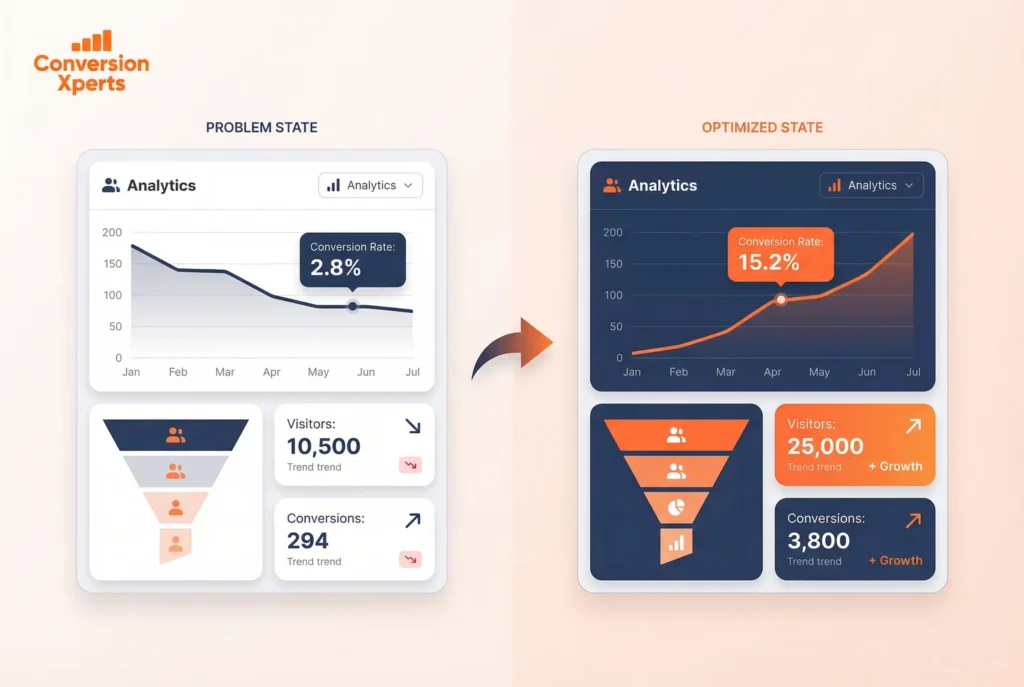
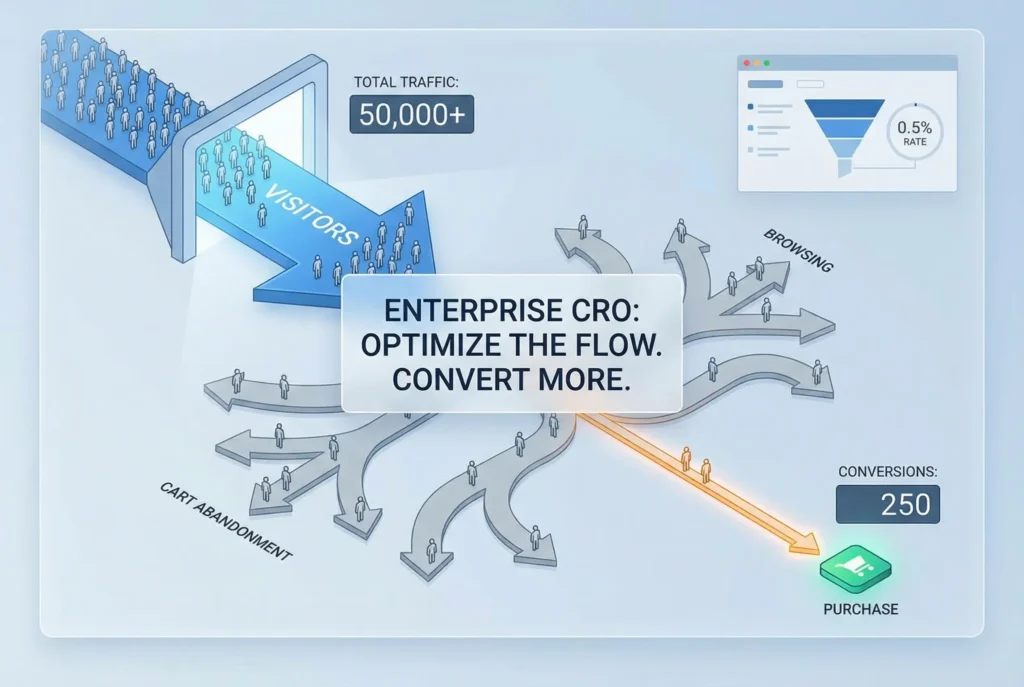
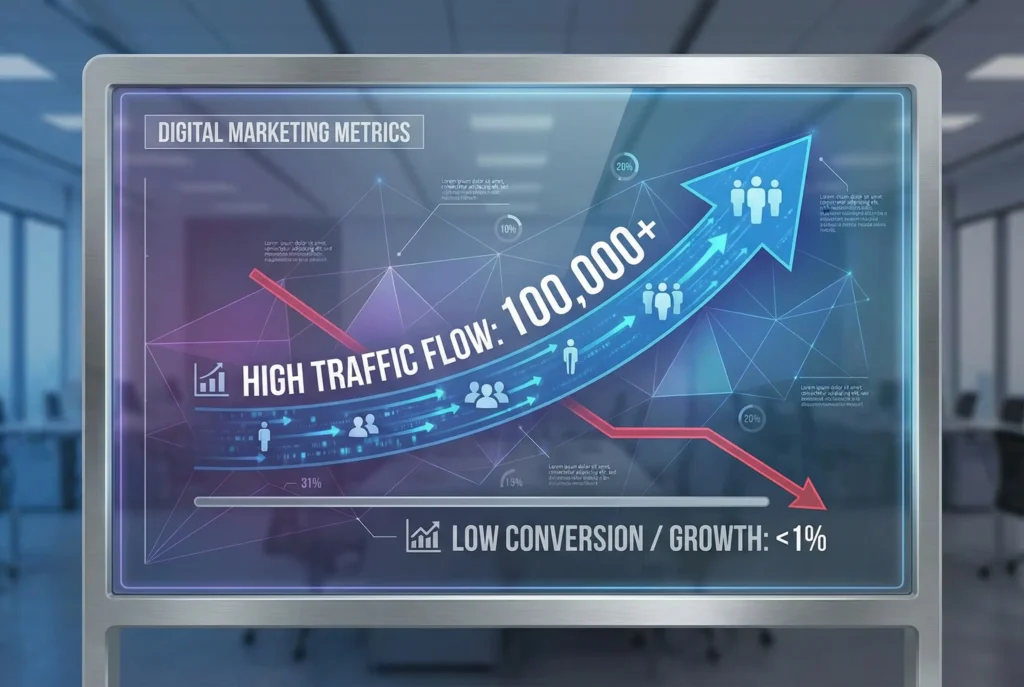
This is the most expensive blind spot in digital marketing today. The global average e-commerce conversion rate sits between 2–4%. Most stores, across every market, are running at 0.5–1% — meaning 99 out of every 100 visitors leave without converting. That is not a traffic problem. That is a conversion problem.
The reason this mistake persists is psychological. Traffic is visible. It feels like momentum. Impressions, clicks, sessions , these numbers move and they feel good. Conversion rate optimization work , rebuilding a checkout flow, rewriting a headline, improving page speed — feels slower and less exciting, even though its return on investment consistently outperforms acquisition spend by a factor of three to five.
A serious CRO expert company doesn’t guess at what’s broken. They find it — with heatmaps, session recordings, funnel analysis, and behavioural data — and fix the actual leaks before a single extra dollar goes into bringing more people through the door.
The CRO Framework That Produces Consistent Results
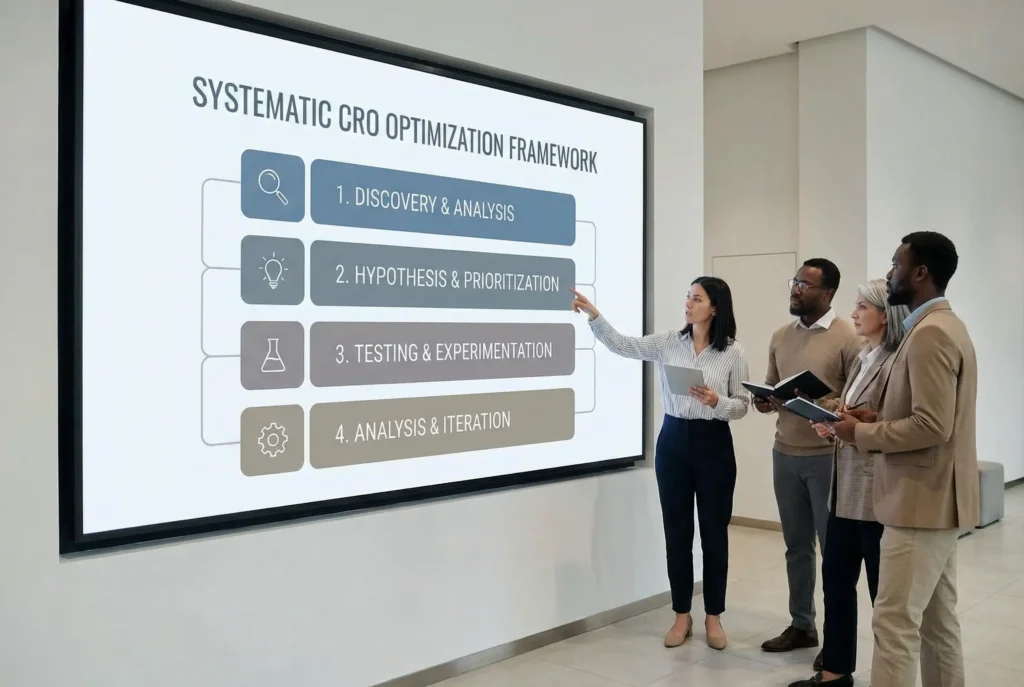
These are the exact steps that CRO experts use when working with e-commerce brands, SaaS companies, and service businesses to systematically grow revenue without growing their ad budgets.
Step 1: Diagnose Before You Prescribe
What to do: Before changing anything, map precisely where visitors are dropping off. Use tools like Hotjar, Microsoft Clarity, or Google Analytics 4 to identify the specific pages and moments where people exit without taking action.
Why it works: You cannot fix what you haven’t located. Most businesses apply generic best practices that may have no relevance to their actual problem. A fashion e-commerce site might be losing 70% of users the moment shipping costs appear. A SaaS product might be hemorrhaging sign-ups because of a confusing pricing page. These are completely different problems requiring completely different solutions. Broad fixes applied to unknown problems produce no reliable results.
In action: An online retailer discovered through session recordings that 65% of mobile users abandoned at checkout — not because of price resistance, but because their payment form had eleven required fields on a small screen. Cutting that to five fields increased mobile checkout completion by 34% in three weeks. No new campaigns. No increased budget. Just a fixed problem.
Step 2: Remove Every Point of Friction Between Visitor and Conversion
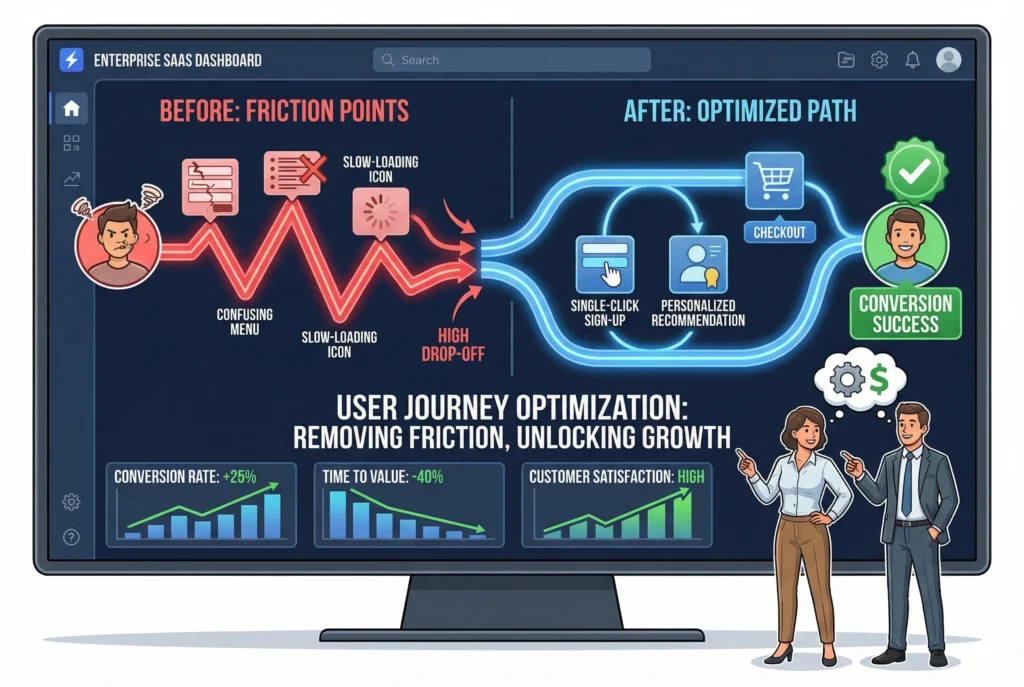
What to do: Once you know where you’re losing people, systematically eliminate the friction. This means faster load times, clearer calls to action, visible trust signals like reviews and guarantees, and a checkout or sign-up experience that requires as little effort as possible.
Why it works: Friction is invisible to business owners and painfully obvious to customers. Every extra second of load time increases abandonment. Every unnecessary form field creates doubt. Every vague CTA creates hesitation. Ecommerce conversion optimization services that focus on friction removal consistently produce the fastest and most measurable lifts, because the problems being solved are already costing money every single day.
In action: A SaaS founder offering a project management tool added three specific elements to his pricing page: a money-back guarantee, two recognisable client logos, and a live chat widget. Free trial sign-ups moved from 2.1% to 5.8% over 45 days. The product didn’t change. The price didn’t change. The page just stopped creating doubt.
Step 3: Test Everything Before Scaling Anything
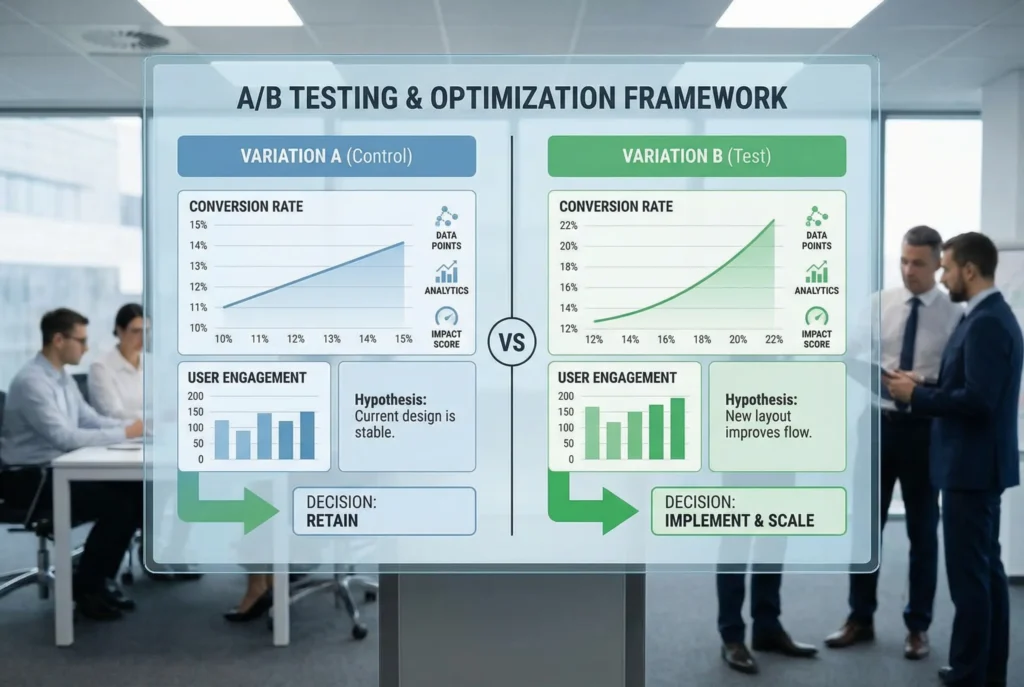
What to do: Run controlled A/B tests on your highest-traffic, highest-stakes pages — homepage, product pages, pricing pages, checkout. Test one variable at a time: headline, CTA wording, button placement, hero image, page layout. Run each test for a minimum of two to four weeks before drawing conclusions.
Why it works: Opinions are unreliable. What a founder believes will perform and what their customers actually respond to are frequently opposite. A/B testing removes preference from the process entirely. It also compounds: every test result teaches you something specific about your audience that sharpens every future decision. Businesses that test consistently build an unfair advantage over time — a deep, proprietary understanding of their own customers that no competitor can replicate.
In action: An ecommerce conversion optimization services client in the home goods space tested two product page headlines. The original: “Handmade Wooden Furniture.” The variant: “Built to Last — Free Delivery, 30-Day Returns.” The variant increased add-to-cart rate by 22%. One headline. No design changes. No additional spend.
Step 4: Align Messaging With How Your Specific Customers Actually Buy
What to do: Review every word on your key pages through the lens of your customer’s real objections, anxieties, and decision-making process. What are they afraid of? What would make them trust you faster? What question do they need answered before they’ll commit? Build your copy and page structure around those answers.
Why it works: Most websites are written from the inside out — they describe the business rather than addressing the customer. A skilled website conversion expert flips this entirely. When your messaging directly mirrors what your customer is thinking at the moment they arrive, the psychological distance between browsing and buying collapses. This is why the same product, on two differently written pages, can produce conversion rates that are three or four times apart.
In action: A software company added a single line to their homepage hero: “No credit card required. Cancel any time.” Sign-ups increased by 27% within two weeks. The product was unchanged. The objection — fear of being locked in — was simply acknowledged and removed.
3 Mistakes That Are Quietly Draining Your Revenue

Mistake #1: Sending Paid Traffic to an Unoptimised Page
When businesses invest in paid acquisition without first optimising the destination, they typically see cost-per-acquisition run two to four times higher than it should. Every campaign dollar sent to a leaking funnel is a campaign dollar underperforming.
When businesses skip this step, they typically see their paid channel become progressively more expensive over time — because lower conversion rates reduce Quality Scores, increase CPCs, and squeeze margins until the channel stops being viable.
Mistake #2: Optimising for Desktop When the Majority of Traffic Is Mobile
Global internet traffic is now predominantly mobile. If your ecommerce conversion rate optimisation services strategy doesn’t start with mobile experience — load speed, navigation simplicity, thumb-friendly design, streamlined forms — you are building a high-performance engine in the wrong vehicle.
When businesses skip this step, they typically see a persistent gap between their traffic numbers and their revenue numbers that no amount of additional ad spend closes — because the fundamental experience for most of their visitors remains broken.
Mistake #3: Making Decisions Based on Preference Instead of Data
Redesigns driven by boredom. CTA changes inspired by competitors. Homepage layouts decided by the highest-paid person in the room. Without data, you are just as likely to remove something that was working as you are to improve something that wasn’t.
When businesses skip this step, they typically see post-launch conversion rates drop despite increased investment — because the new experience, however polished visually, hasn’t been validated against real customer behaviour.
How to Know Your CRO Investment Is Working
The primary number to watch is your overall conversion rate — the percentage of visitors completing your target action. Track this weekly, segmented by device and by traffic source. A well-executed CRO programme typically delivers a 20–80% improvement within the first 60–90 days, with compounding gains as tests continue.
Beyond conversion rate, watch these secondary signals: cart abandonment rate (should fall), average order value (well-placed upsells and trust signals lift this naturally), bounce rate on key pages (should decrease as relevance improves), and revenue per visitor (the clearest single indicator of CRO working).
That last metric is the most telling. If the same volume of traffic is generating meaningfully more revenue month over month, the funnel is improving. You don’t need more visitors to prove CRO is working — you need the same visitors to convert at a higher rate. When that happens consistently, scaling paid acquisition becomes genuinely profitable rather than a gamble.
Build a simple monthly dashboard: overall conversion rate, mobile conversion rate, top exit pages, and revenue per session. Review it on a fixed schedule. The patterns it reveals over three to six months will be more valuable than any individual report.
The Honest Takeaway

If you are running an online business of any kind — e-commerce, SaaS, professional services, lead generation — you are almost certainly losing a meaningful percentage of potential revenue to problems that are entirely fixable.
You do not need more traffic to solve this. You need to understand what is stopping your existing visitors from converting, remove those barriers one by one, and verify every assumption with data before you scale.
A conversion rate optimization expert is not a luxury reserved for enterprise brands. It is increasingly the foundational investment that separates businesses growing sustainably from those stuck in an exhausting cycle of spending more to get the same results.
Start with your current conversion rate. Find your biggest drop-off point. Fix that one thing first. The revenue you’re looking for is already in your funnel — it’s just leaking out somewhere you haven’t looked yet.
At our Agency, our conversion rate optimisation experts work with e-commerce brands, SaaS companies, and business owners to diagnose exactly why visitors aren’t converting — and fix it systematically. We don’t sell you more traffic. We help you extract significantly more revenue from the traffic you already have.
Book a free CRO audit and find out precisely where your site is leaking revenue. No jargon, no generic slide decks — just a clear, specific action plan built around your funnel and your customers.