Sales Funnel Stages: The Ultimate Guide to Converting Strangers Into Loyal Customers
What Is a Sales Funnel? (And Why Most People Get It Wrong)
A sales funnel is a structured, stage-by-stage framework that maps the complete journey a prospect takes from first becoming aware of your brand to making a purchase and beyond. It is shaped like a funnel because you start with a large pool of potential leads at the top, and that pool narrows as people move closer to buying.
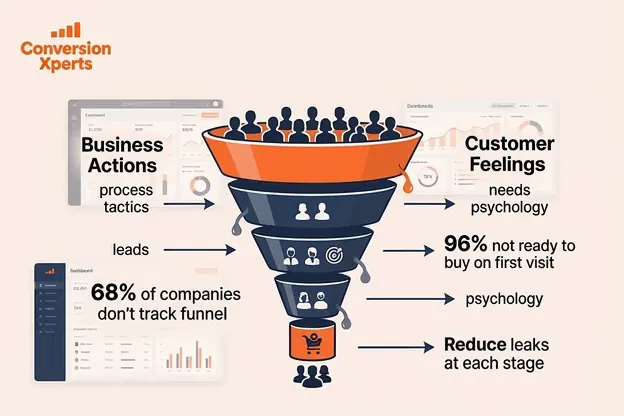
The “funnel” metaphor is useful, but it can mislead you into thinking your only job is to pour more people in at the top. The real game is reducing the leaks at every stage. 96% of website visitors are not ready to buy on their first visit. Your funnel is the system that warms them up, builds trust, and brings them back.
Why Most Businesses Ignore Their Funnel (At Their Own Peril)
A staggering 68% of companies have not identified or attempted to measure their sales funnel. They know leads are coming in, and they know some of those leads eventually buy, but they have no idea what happens in between. That is not a sales strategy. That is hope.
The businesses that win are the ones that treat their funnel like a science experiment. They measure every stage, find every leak, and systematically fix them. Businesses that provide an easy buying process are 62% more likely to close a high-quality sale. The ease does not happen by accident. It is engineered through a well-defined funnel.
The Sales Funnel vs. the Customer Journey
Many marketers use these terms interchangeably, but they represent different perspectives. The customer journey is told from the buyer’s point of view, describing how they feel and what they need at each step. The sales funnel is the business’s operational view, describing what actions, content, and tactics you deploy at each step to move the prospect forward.
The best marketing funnel strategies align both views. You design your funnel from the inside out, starting with the customer’s psychology and building your tactics around it.
The Core Sales Funnel Stages Explained
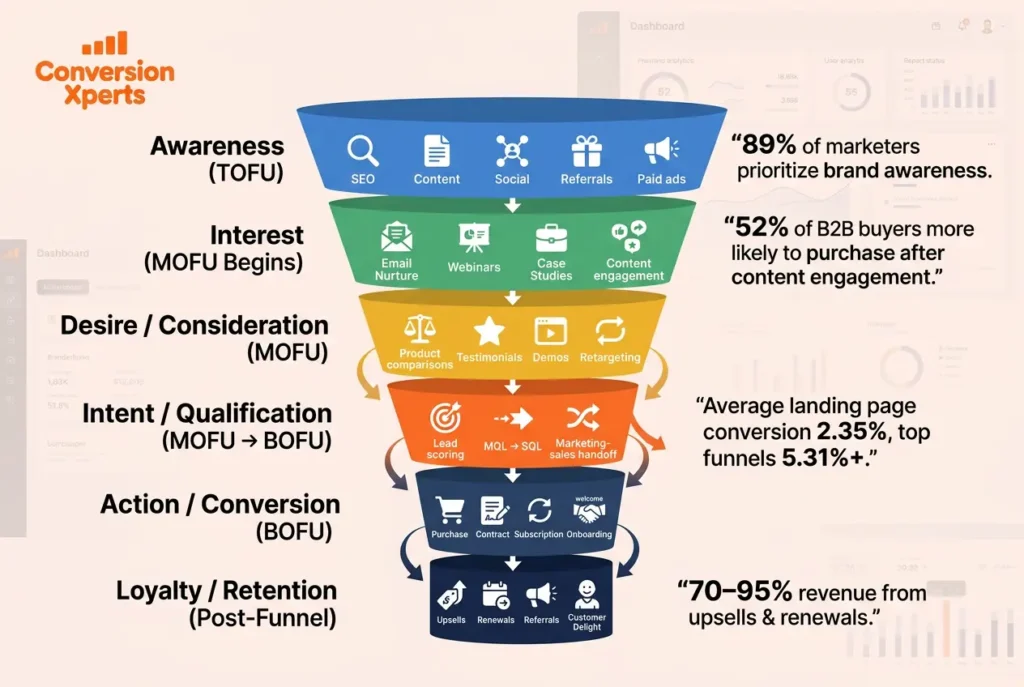
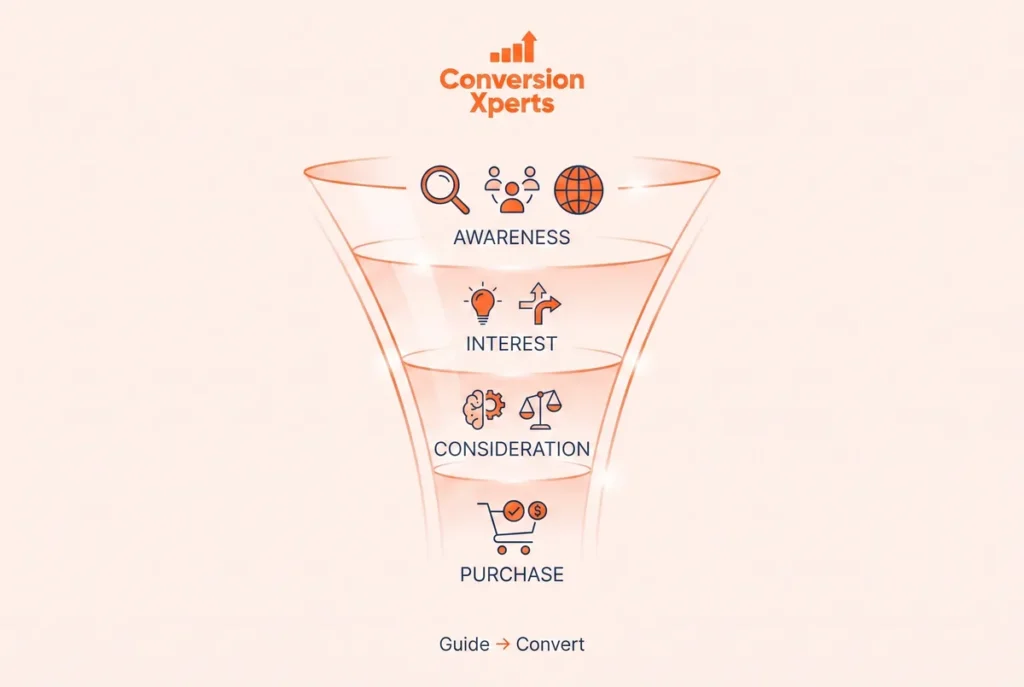
The classic sales funnel stages follow the AIDA model: Awareness, Interest, Desire, Action. Modern funnels, especially in B2B and SaaS environments, typically extend this to five or six stages to account for longer buying cycles and post-sale retention. Here is a comprehensive breakdown of each stage.
Stage 1: Awareness (Top of Funnel / TOFU)
Awareness is the moment a prospect first discovers your brand exists. This is the widest part of your funnel and the starting point for every sale you will ever make.
At this stage, your prospect is not looking for your specific product. They are experiencing a problem or feeling a desire, and your job is to appear at the exact moment they start looking for answers. 89% of marketers say brand awareness is their top priority, and consumers are 2.5 times more likely to choose a brand they already recognize over an unknown competitor.
Effective awareness-stage tactics include:
Search engine optimization and content marketing. 55% of businesses say articles and blog posts are the most productive way to bring potential customers down the sales funnel. Ranking for the right keywords means you get found by people who are already raising their hand.
Paid advertising. The maximum average sales funnel conversion rate by traffic source is paid search at 2.9%. While that number may seem modest, paid search delivers intent-driven traffic that converts better than almost any other top-of-funnel channel.
Social media and video. For 55% of brands, visuals are the first thing that catches a user’s eye, and color alone can increase brand recognition by up to 80%. If you are not investing in visual storytelling, you are invisible at the top of the funnel.
Word of mouth and referrals. Satisfied customers who talk about you are your most powerful awareness engine. Building this into your funnel from day one is a competitive advantage most businesses overlook.
Stage 2: Interest (Middle of Funnel / MOFU Begins)
Once a prospect is aware of your brand, the interest stage begins. They are actively seeking more information. They might read your blog, follow you on social media, sign up for your email list, or download a lead magnet.
This is where your content needs to shift from broad and educational to specific and authoritative. You are not just answering their questions anymore. You are positioning yourself as the definitive solution provider.
Key interest-stage tactics include email nurture sequences, in-depth guides, webinars, comparison content, and case studies. 52% of B2B buyers are more inclined to purchase from a brand after engaging with its content. That means your content is not just a traffic strategy. It is a conversion strategy.
Stage 3: Desire / Consideration (Middle of Funnel)
The consideration stage is where the real selling begins. Your prospect knows you exist and finds you credible. Now they are deciding whether you are the right choice compared to your competitors.
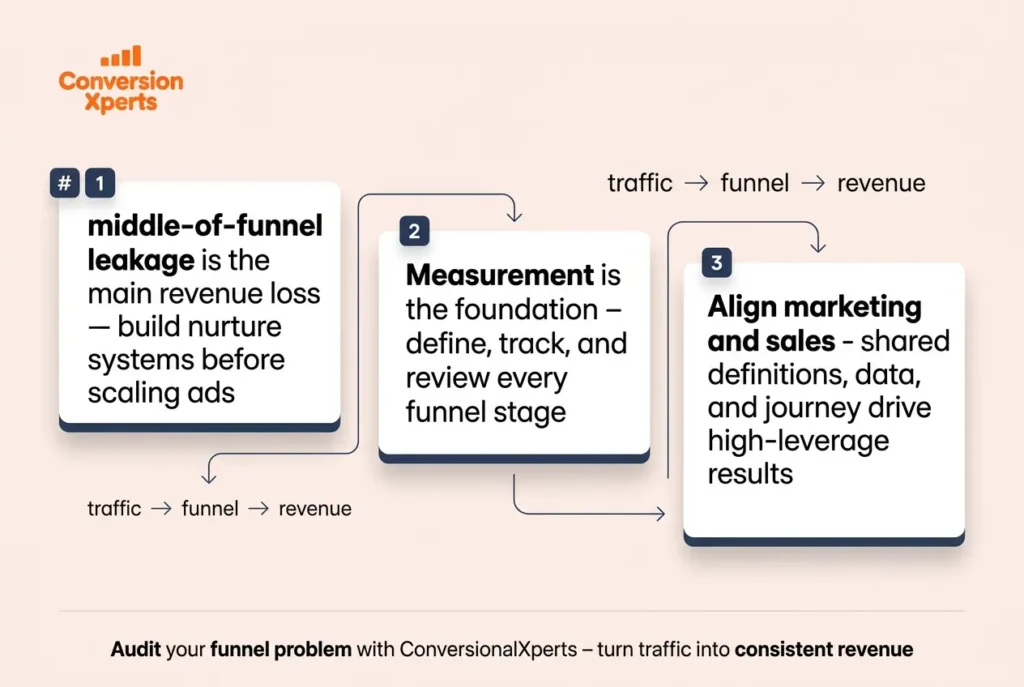
This is the stage where most funnels leak the most. A well-defined middle-of-funnel engagement and lead management strategy can increase your response rate by 4 to 10 times. Yet most businesses have almost no middle-funnel strategy at all. They run ads and wait for the sale. The gap in between is where revenue dies.
Effective consideration-stage assets include detailed product comparisons, customer testimonials and reviews, free trials or demos, retargeting campaigns, and personalized email sequences based on behavior. 43% of B2B buyers said reviews and customer testimonials helped move them further down the sales funnel.
Stage 4: Intent and Qualification (MOFU to BOFU Transition)
At this point, your prospect has moved from general interest to specific purchase intent. In B2B environments, this is where leads get scored and segmented into Marketing Qualified Leads (MQLs) and Sales Qualified Leads (SQLs).
Marketing qualified leads are contacts who have shown signs of deeper engagement, making them more likely to consider a purchase, and moving from lead to MQL typically involves lead scoring using signals like content downloads, page views, and email interactions. Sales qualified leads meet criteria agreed upon by both marketing and sales, having engaged with bottom-of-funnel content like demo requests, and are ready for direct sales outreach.
Getting this handoff right between marketing and sales is one of the highest leverage points in any funnel. When it is broken, high-quality leads fall through the cracks.
Stage 5: Action / Conversion (Bottom of Funnel / BOFU)
The action stage is the conversion event. For ecommerce, it is the purchase. For SaaS and B2B, it is the signed contract, the completed onboarding, or the subscription start. The average conversion rate for a sales funnel landing page is 2.35%, but top-performing funnels can reach 5.31% or more.
That gap between average and top-performing is not luck. It is the result of deliberate optimization: better copy, stronger offers, faster load times, fewer form fields, and clearer calls to action.
Stage 6: Loyalty and Retention (Post-Funnel)
This is the stage most traditional sales funnel guides ignore entirely, and it is where the biggest money lives. 70% to 95% of revenue comes from upsells and renewals on average for businesses that use them.
Retention is a funnel in itself. After a customer converts, your job is to deliver on your promise, create delight, generate referrals, and create opportunities for repeat and expanded purchases. In subscription and SaaS businesses, this is the entire model.
How to Build a High-Converting Sales Funnel Strategy
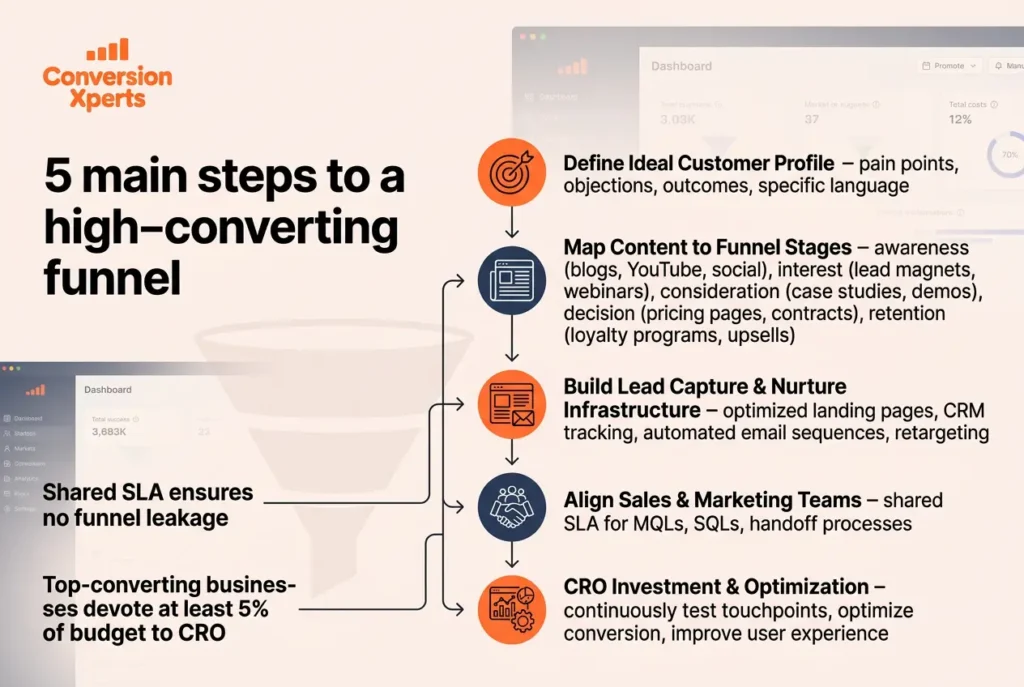
A sales funnel strategy is not a template you download and deploy. It is a custom-built system designed around your specific customer, your specific offer, and your specific competitive landscape. Here is how to build one that actually converts.
Step 1: Define Your Ideal Customer Profile with Precision
Before you build a single landing page or write a single email, you need to know exactly who you are talking to. This means going beyond basic demographics. You need to understand your prospect’s specific pain points, the words they use to describe their problems, the objections they anticipate before buying, and the outcomes they care about most.
The more precisely you define your ideal customer, the more every piece of your funnel can speak directly to them. Generic messaging produces generic results.
Step 2: Map Content to Every Stage of the Funnel
Every piece of content you create should have a job. That job is to move a prospect from one stage of the funnel to the next. This is what is meant by a content strategy that is actually strategic.
Here is a practical stage-by-stage content map:
Awareness stage content: Blog posts targeting informational keywords, YouTube videos, podcast appearances, social media educational content, and PR coverage.
Interest stage content: Lead magnets like guides and templates, email newsletters, comparison articles, and webinars.
Consideration stage content: Case studies, testimonials, detailed product pages, free trials, demos, and ROI calculators.
Decision stage content: Proposals, pricing pages, contracts, onboarding previews, and personalized outreach.
Retention stage content: Onboarding email sequences, check-in calls, loyalty programs, upsell offers, and referral programs.
Step 3: Build Your Lead Capture and Nurture Infrastructure
Your funnel is only as good as the systems behind it. You need landing pages optimized for conversion, a CRM to track every lead and their stage, an email marketing platform to run automated nurture sequences, and retargeting capabilities to bring back visitors who did not convert on their first visit.
Top-converting businesses devote at least 5% of their budget to Conversion Rate Optimization. This is not just about testing button colors. It is about systematically improving every touchpoint in your funnel.
Step 4: Align Your Sales and Marketing Teams
One of the most common causes of funnel leakage is the disconnect between marketing and sales. Marketing generates leads and considers their job done. Sales complains the leads are low quality. Neither team fixes the actual problem: no shared definition of what a qualified lead looks like, and no agreed process for the handoff.
The fix is a Service Level Agreement (SLA) between marketing and sales that defines exactly what constitutes an MQL, an SQL, and how and when each type of lead should be followed up with.
How to Optimize Your Sales Funnel at Every Stage
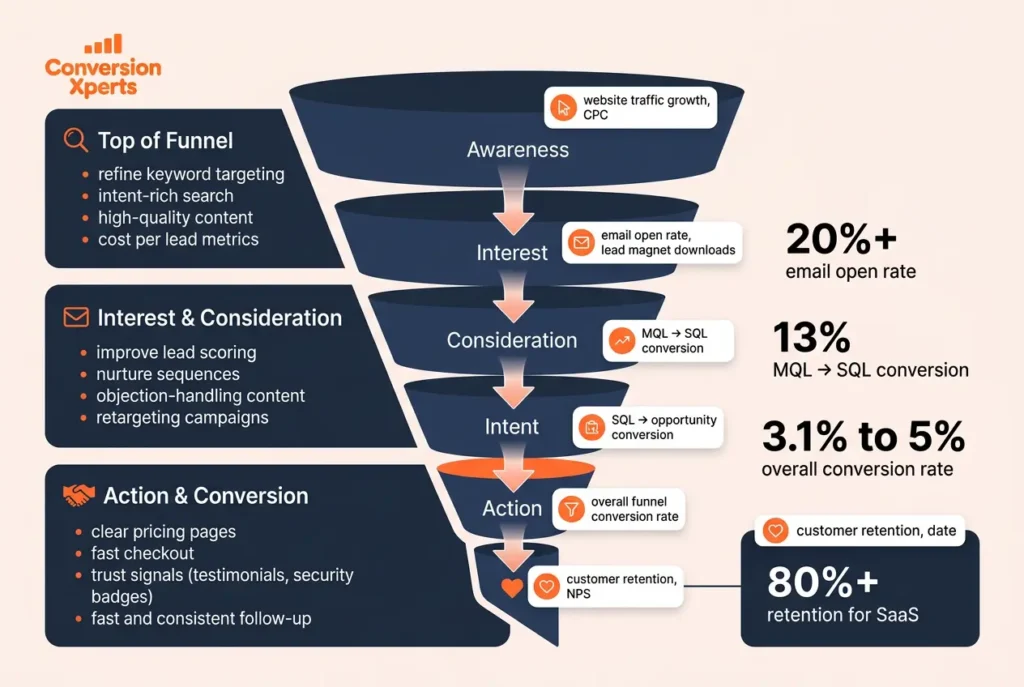
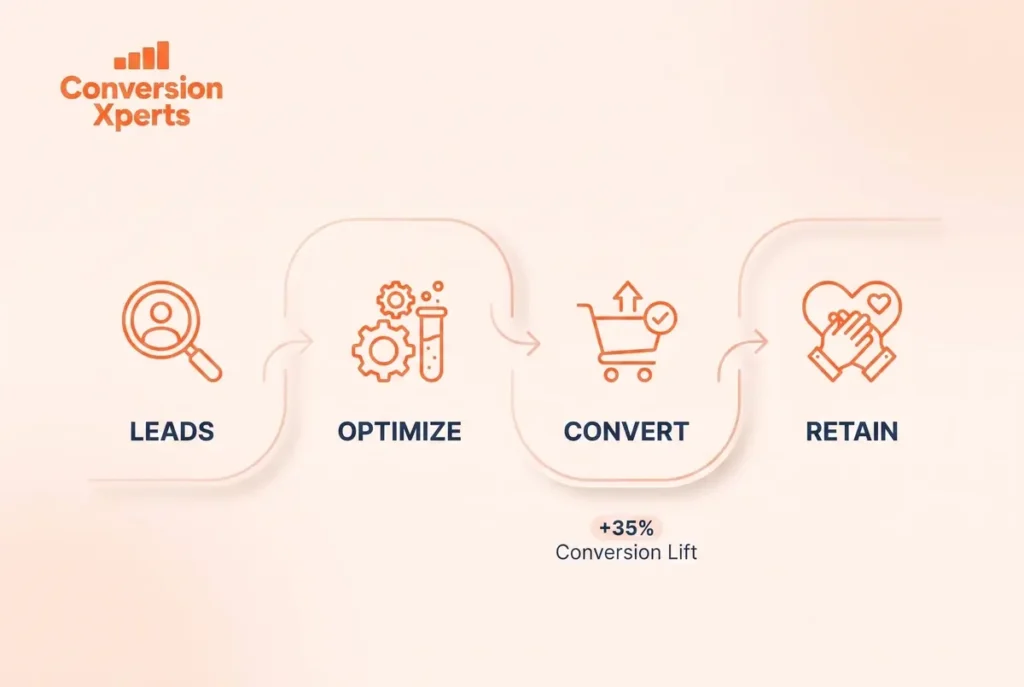
Knowing how to optimize your sales funnel is the difference between a funnel that limps along and one that compounds. Optimization is not a one-time project. It is a continuous cycle of measuring, testing, and improving.
Optimize the Top of Funnel: More of the Right Traffic
The top of funnel optimization is not about driving more traffic. It is about driving better traffic. This means refining your keyword targeting to focus on intent-rich search terms, tightening your audience targeting in paid ads to reduce wasted spend, and improving your content quality to attract prospects who are genuinely interested in what you sell.
A critical metric here is your cost per lead and the quality of those leads. A lower cost per lead that produces zero sales is worse than a higher cost per lead that closes at 30%.
Optimize the Middle of Funnel: Stop the Leaks
The middle of the funnel is where most revenue is lost and where most businesses invest the least. Middle-of-funnel optimization means improving your lead scoring model so sales only contact the most qualified prospects, tightening your email nurture sequences based on behavioral data, creating better consideration-stage content that answers objections before they are raised, and running retargeting ads specifically designed for prospects who are already in your database.
Optimize the Bottom of Funnel: Convert the Buyers Who Are Ready
Bottom-of-funnel optimization is the highest leverage work you can do because you are working with prospects who already want to buy. The friction at this stage is almost always one of these things: a confusing pricing page, a slow checkout experience, a lack of trust signals like testimonials and security badges, unclear next steps, or follow-up that is too slow.
For sales teams, more than 90% of leads require nurturing, support, and consistent communication throughout the sales funnel, and the sales cycle can take anywhere from weeks to months to close a sale. Speed and consistency of follow-up at the bottom of the funnel is not optional.
Track These Key Funnel Metrics Relentlessly
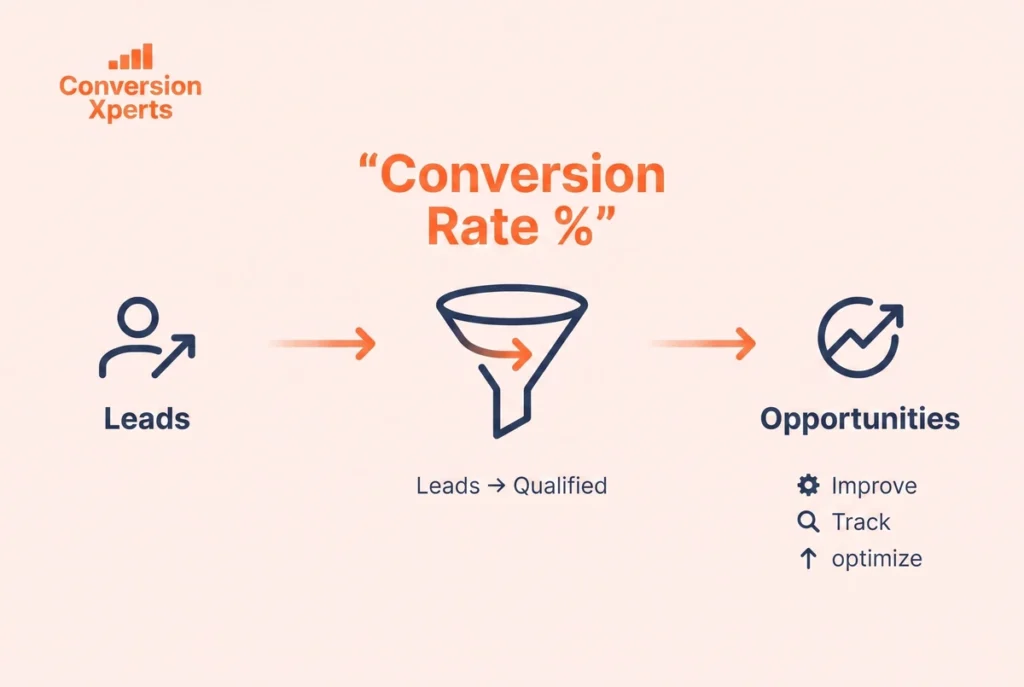
You cannot improve what you do not measure. Key stages in a sales funnel to measure include lead, MQL, SQL, opportunity, and closed deal. At each stage, you should know your conversion rate, your average time-in-stage, and your drop-off rate.
Here is a quick reference for the metrics that matter most at each stage:
| Stage | Primary Metric | Benchmark to Beat |
Awareness | Website traffic growth, cost per click | Industry-specific |
Interest | Email open rate, lead magnet download rate | 20%+ open rate |
Consideration | MQL to SQL conversion rate | 13% (HubSpot 2024 benchmark) |
Intent | SQL to opportunity conversion rate | 30-40% for well-qualified leads |
Action | Overall funnel conversion rate | 3.1% to 5% is considered good (Databox 2024) |
Retention | Customer retention rate, NPS score | 80%+ retention for SaaS |
Marketing Funnel Stages vs. Sales Funnel Stages: What Is the Difference?
This is one of the most commonly misunderstood distinctions in marketing, and getting it right will fundamentally change how your teams operate.
The Marketing Funnel’s Job
The marketing funnel covers the stages before a prospect is ready to talk to a salesperson. It is primarily concerned with awareness, interest, and consideration. The marketing team owns this portion of the journey. Their job is to attract the right people, educate them, build trust, and qualify them to the point where a sales conversation is warranted.
Marketing funnel stages are typically measured by top-of-funnel metrics like traffic, reach, and impressions, and middle-funnel metrics like leads generated, MQLs created, and engagement rates.
The Sales Funnel’s Job
The sales funnel picks up where the marketing funnel hands off. It is concerned with intent, evaluation, decision, and post-sale retention. The sales team owns this portion, and they are measured on SQLs worked, opportunities created, win rates, and deal velocity.
The handoff point between the two is often where businesses experience the most friction. A clearly defined and jointly agreed upon lead qualification criteria prevents the most common source of revenue leakage.
Why a Unified Typical Sales Funnel Wins
The businesses that consistently outperform their competitors operate from a single unified funnel that covers the entire customer journey, with marketing and sales working from shared data, shared definitions, and shared goals. This is what the best-performing B2B SaaS companies build, and it is exactly the model that ConversionalXperts designs and implements for clients. For a deeper dive into how this applies specifically to software companies, see our pillar guide on B2B SaaS Sales Funnels.
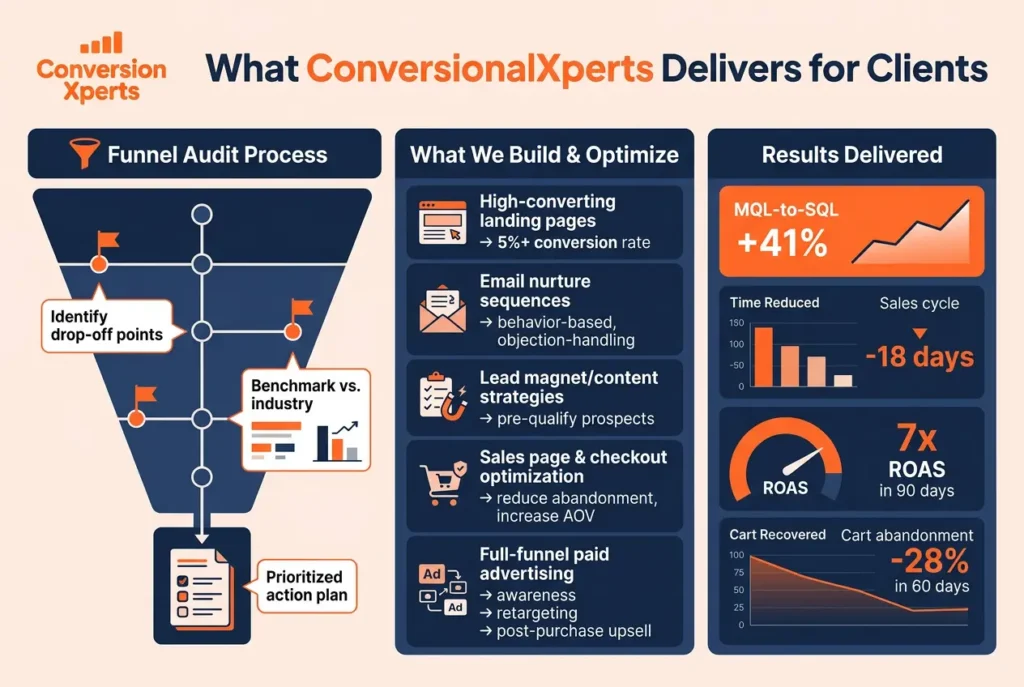
What ConversionalXperts Delivers for Clients
ConversionalXperts is a conversion-focused agency headquartered with a global delivery capability, serving clients across Pakistan, the United States, the United Kingdom, the UAE, Canada, and Australia. We are not a generic digital marketing agency. We are conversion specialists. Every service we offer exists to move prospects through your sales funnel stages faster and with less friction.
Our Funnel Audit Process
We begin every engagement with a comprehensive funnel audit. This means we map your entire existing customer journey, identify every point where leads are dropping off, benchmark your conversion rates against industry standards, and produce a prioritized action plan with specific recommendations for each stage of your funnel.
Most of our clients discover they are losing the majority of their revenue not from a lack of traffic but from fixable leaks in their middle and bottom-of-funnel experience.
What We Build and Optimize
Our team builds and optimizes:
High-converting landing pages engineered around your specific offer and target audience. We routinely move clients from below-average conversion rates to the top-performing bracket of 5% and above.
Email nurture sequences that are mapped to funnel stage and prospect behavior, not just time-based drips. Our sequences are built to address the exact objections your prospects have at each stage.
Lead magnet and content strategies that attract the right people at the top of the funnel and pre-qualify them before they ever talk to sales.
Sales page copy and checkout optimization for businesses selling directly online, reducing cart abandonment and increasing average order value.
Full-funnel paid advertising strategies that cover every stage, from awareness to retargeting to post-purchase upsell.
Results We Have Delivered
For a B2B SaaS client in Pakistan, we rebuilt their entire sales funnel strategy from the ground up, improving their MQL-to-SQL conversion rate by 41% and reducing their average sales cycle length by 18 days.
For a coaching business targeting the UK and US markets, we designed a three-stage funnel with a lead magnet, email sequence, and high-ticket sales page that generated a 7x return on ad spend within the first 90 days.
For an ecommerce brand serving the Middle East, our funnel audit identified a critical drop-off point at the cart stage. A combination of abandoned cart emails, trust badge optimization, and streamlined checkout reduced cart abandonment by 28% in 60 days.
ConversionalXperts operates where strategy meets execution. We do not hand you a report and leave. We build, test, measure, and refine until your funnel performs.